一節繪本故事與會話課相結合的英語課堂教學
——以修訂版PEP六(下)Unit 1(第三課時)為例
2016-04-16 05:07:57趙立英
小學教學設計(英語) 2016年2期
趙立英 張 鵬
最近,筆者聽了一節六年級的英語課。授課教師在會話教學中適當引入了《典范英語》2A 中 Lesson 17“On the Beach”一課的故事,巧妙地將它與本課對話銜接在一起,從而使故事與對話融為一體,有效地激發了學生的學習興趣,同時也收到了較好的教學效果,給筆者留下了深刻的印象。
一、教學過程
Step 1.Warm-up
1.一上課,教師便給學生介紹了兩位新朋友Jim和Jane,并請他們猜測Jim和Jane上周末前往海灘所做的活動(見圖1)。

圖1
T:I’m going to introduce two new friends to you.This is Jim and this is Jane.Where are they?
S1:They are at the beach.
T:Yes.Last weekend,Jim and Jane went to the beach with their family.What did they do?Can you guess?
Ss:Maybe they...
2.猜測完兩位新朋友在沙灘上做的活動后,教師和學生就上個周末所做的活動展開對話。對話內容如下:
T:They did a lot of things at the beach.How about you?What did you do last weekend?
S1:I played the piano last weekend.
T:Are you good at it?
S1:Yes,I am.
S2:I went to my friend’s home.
T:Whatdid you doat home?
S2:We drew some pictures.
S3: I bought some chocolates.
S4:Last weekend,I saw a film.
T:What do you think of the film?
S4:It was very interesting.
T:Your last weekend was just as interesting as theirs.
【設計意圖】教師介紹兩位新朋友,并借助相應問題的提出引發學生動腦思考,激活已有知識。通過與學生圍繞“What did you do last weekend?”展開對話,既讓學生了解本課的內容將圍繞“談論上周末的活動”展開,又在對話的過程中激活了學生已學的相關內容和已有的相關知識,復習了過去式的用法,為隨后課文教學做好充分的鋪墊。
Step 2.Presentation
1.Lead in
教師向學生介紹Jim和Jane到海灘各處游玩歸來之后看到的情境,為隨后導入課文的教學埋下伏筆(見圖2)。
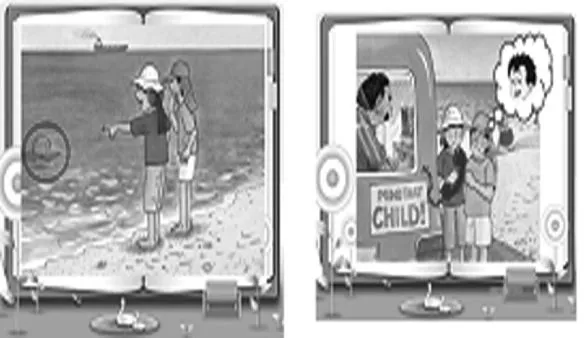
圖2
T:When Jim and Jane came back to the beach,something happened...
T:What did they see?
Ss:They saw Dad’s cap.
T:Where was Dad?Do you know?
S1:Maybe he was sleeping on the beach.
S2:Maybe he was eaten by sharks.
T:Jim and Jane didn’t know either.So...
T:What did they do?
S1:They called Gao Wei.
教師教授本課新詞called,并將其貼在黑板上。之后,教師設置給Gao Wei打電話無人接通的情境:Was Gao Wei at home?What did he do there?由此巧妙地將學生從《典范英語》的故事中帶入到教材對話的背景里。
2.Dialogue Learning
(1)The First Round:
教師提出問題,學生借助觀看視頻的方式,對教材中的對話文本完成整體感知和理解,同時提取相應的答案。
T:Was Gao Wei at home?
(Ss watch the movie of the dialogue, and find out the answer.)
Ss (After watching the movie):No.
T:Where was Gao Wei?
S1: He was at the bookshop.
T:What did he do there?
S2:He bought a storybook and a book of cartoons.
(Ss listen and check.)
(2)The Second Round:
T:How about Lisa?Was Lisa at home last weekend?
Ss:No.
T:Where was Lisa?
(Ss watch the movie of the dialogue again,and find out the answer.)
S3 (After watching the movie):She was at the cinema,and she went to see a movie.
(Ss listen and check.)
【設計意圖】通過在相應語境中的師生交流,提出針對課文對話內容的問題;隨后借助觀看視頻提取相關問題答案的方式,學生完成對本課對話內容的感知和理解。
Step 3.Practice
1.Going over the text
學習課文對話內容后,學生先聽錄音跟讀課文,再共同分角色朗讀課文,然后再兩人一小組分角色朗讀課文。
【設計意圖】通過聽錄音并跟讀、整體分角色朗讀和在小組內分角色朗讀課文的形式,進一步熟悉并掌握本課所學相關語句的用法。
2.A Chant
教師帶領學生通過問答的方式梳理出課文對話的主要內容,隨后將梳理出來的語句創編成韻文(見圖3)。
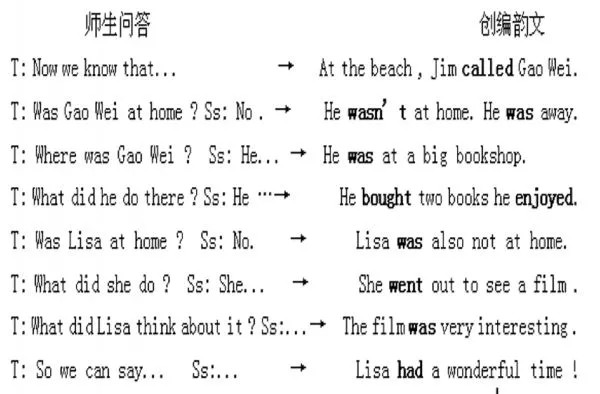
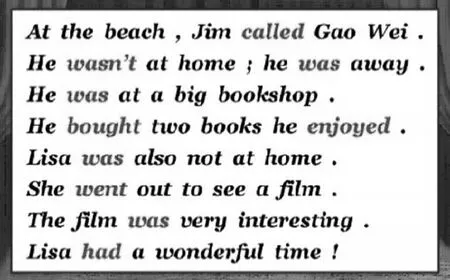
圖3
【設計意圖】將師生所創編的韻文配以有節奏的旋律,學生通過演唱韻文,在激發參與興趣的同時,夯實動詞過去式的表達法。
3.Information Gap
教師請學生相互詢問對方在上個周末的活動。
T:Both Lisa and Gao Wei were not at home last weekend.So,when Jim and Jane called them,theycouldn’tgethelp from them.If they called you,could you help them?Were you at home last weekend?
Ss:Yes./No.
T:What did you do?
Ss:I...
(Students work in pairs to ask each other.)
【設計意圖】學生相互間問答上個周末是否在家,在相應的情境中練習本課所學主要語句,從而逐漸鞏固在日常交際中的用法。
Step 4.Production
1.Revealing the Result of the Story
課程進行到此,教師適時地向學生揭示“Jim and Jane’s Trip to the Beach”的結尾(見圖4)。
T:Some of you could help them,and some of you couldn’t.It doesn’t matter.Now,let’s see where Dad really was.
T:Look!Where was Dad?
Ss:He was hiding behind!
T:Yes.Dad played a joke on Jim and Jane.So,what do you think of their trip to the beach?
Ss: It was interesting /fantastic/amazing...
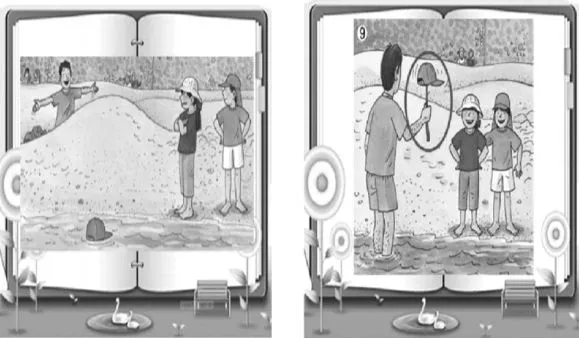
圖4
【設計意圖】揭示故事結尾,與開頭相呼應,在保持故事完整性的同時,通過學生對于這個故事的感受,自然導入對于彼此上個周末活動的談論。
2.Talking About Last Weekend in Pairs
教師請學生彼此談論各自在上個周末所做的活動,從而進一步鞏固、內化本課所學語言在實際生活中的運用(見圖5)。
T:They had a good time.How about you?Did you also have a good time last weekend?
Ss:Yes./No.
T:Really?/Why?What happened?Can you talk about yourlastweekend with your partners?
S1:Hi! Let me tell you something about my last weekend.
S2:Were you at...?/Where were you?/What did you do?/How was your...?/Did you...?
S1:I...How about you?
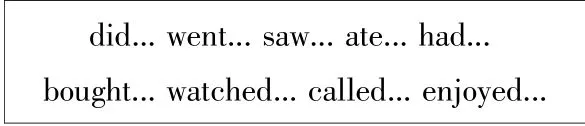
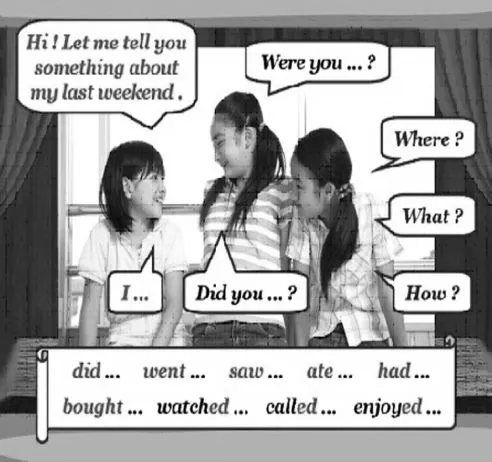
圖5
【設計意圖】學生在真實語境中,自然運用本課和之前所學的、在相應話題之下可以用到的語言進行自主交流,從而達到靈活運用所學語言,在現實情境當中展開有意義的交流的教學目標,提高學生的綜合語言運用能力。
二、回顧與反思
將繪本故事與教材文本對話融為一體是這節課的特色,也是一種教學嘗試。在最初的教學設計中,授課教師將這個故事放在了操練部分的第二個環節中,處理方式也只是帶學生讀了讀故事中的句子,然后請他們以“孩子們和爸爸見面后都會談論些什么?”為情境創編一個簡單的對話。
隨后考慮到這種活動形式與最后的語言產出部分中的活動形式是重復的,于是教師嘗試將“On the Beach”這個故事作為一個引子,一上來便呈現給學生,借助故事的內容完成對于已學和已知動詞過去式的復習及復現;然后再將本課的對話加進來,進而完成新授內容的學習;學習完畢之后,再次回到故事中以完成后續的操練和產出部分。簡而言之,便是將故事和對話結合在一起,使整節課看起來更加具有完整性,而并非是“為了加入故事而加入故事”的感覺。
最后,教師借助“在海灘上找不到爸爸之后,兩個孩子非常著急,于是給朋友Gao Wei打電話求助”這個情節的設計,將這兩部分內容聯系在了一起。從現場課的實際效果來看,當看到“兩個孩子在海灘上到處玩耍,回來突然發現爸爸不在那里了(只剩下漂浮在海面上的一頂帽子)”,一句“Where was Dad?”激發了學生繼續學習和了解故事內容的興趣;而在完成了新授對話的學習和相應的語句操練活動,又回到這個故事中揭示結尾的時候,學生看到“Dad was hiding behind”,恍然大悟一聲“哦”,傳達給教師一個明確的信息:他們始終對這個故事保持著較高的興趣。由此可見,將對話和故事融合的設計實際效果也是比較理想的。
猜你喜歡
學習方法報·小學語文一年級期末專號(2024年12期)2024-12-15 00:00:00
學習方法報·小學語文一年級期末專號(2024年12期)2024-12-15 00:00:00
學習方法報·小學語文一年級期末專號(2024年6期)2024-12-03 00:00:00
科學大眾(2022年11期)2022-06-21 09:20:52
學生天地(2020年17期)2020-08-25 09:28:54
藝術啟蒙(2018年7期)2018-08-23 09:14:18
海峽姐妹(2017年7期)2017-07-31 19:08:17
Coco薇(2017年5期)2017-06-05 08:53:16
臺聲(2016年2期)2016-09-16 01:06:53
舒適廣告(2008年9期)2008-09-22 10:02:48