The Study of Cooperative Learning Model in High School English Teaching
2015-05-30 12:20:14游玉萍
校園英語·上旬 2015年10期
游玉萍
【摘要】美國著名教育評論家埃里斯和福茨在其新署《教育改革研究》一書中曾這樣斷言:“合作學習如果不是當代最偉大的教育改革的話,那么它也至少是最大的之一”。合作學習是當前在世界范圍內被廣泛使用的課堂教學組織形式。在全面推進素質教育的今天,英語教學的改革取得令人矚目的成績,但不可否認,英語教學仍然存在很多弊端,傳統教學仍然占主導作用,合作學習作為對傳統班級授課制的一種突破和補充,目前被廣泛應用于高中英語教學中。在英語教學中組織合作學習不僅可以給學生提供語言實踐的環境,也可以提高學生的合作精神、競爭意識和集體榮譽感。本文在這種思想指導下,通過對國內外文獻資料的研究和對英語新課程標準的學習,及對高中英語教學現狀的分析,以合作學習的基本理念和現代教學設計理論為指導,通過文獻法和案例分析法,對高中英語合作教學作了初步探討。筆者就如何在高中英語教學中組織合作學習展開研究。筆者認為合作學習不僅可以在英語課堂教學中展開,也可以在課堂的前后展開,合作學習可以貫穿在整個單元,甚至整個學期的教學當中。讓學生一起參與備課,上課,評課等環節,不僅可以讓學生更好地掌握知識點,更可以讓學生互幫互助,體驗到合作的樂趣,并從中獲得成就感。筆者基于這種想法,立足于普通高中英語教學,設計了合作學習在高中英語教學中的操作模式,并通過案例分析法具體地闡述該合作學習操作模式的使用情況。筆者通過此研究,希望對英語教師有所啟發,并在一定程度上提高英語教學效率及合作學習的效率。
【關鍵詞】合作學習 高中 英語教學 組織
【Abstract】The famous American education critic,A.k.& Fouts,J.T,said:“ Cooperative learning is one of the largest educational reforms.” This quotation comes from his new book:The Research on Educational Reform.Cooperative learning,as a teaching strategy for classroom instruction and classroom management,is used in a wide variety of teaching contexts; English teaching reformation has achieved a lot during the process of competence diathesis education reform.Being introduced to the English classroom teaching,the method of cooperative learning leads to good results of English teaching.The ability of cooperation and communication has been much more developed than ever before.Cooperative learning is actualized in the classroom teaching so that the cooperative,competition and collective glory of the students make a progress.However,many problems still remain to the resolved.This thesis is guided by the teaching thoughts above.Based on the literature review at home and abroad and New National Standard for English Curriculum and the current status of high school English teaching,the author combines the concept of cooperative learning and its application on English instruction design for high school,and makes a study on high school English teaching by literature method and case study.The author believes that cooperative learning can be organized through the whole unit or even though the whole semester effectively.The author believes that making students be prepared for lessons,hold the course and evaluate the course can not only make students understand knowledge better,but also enjoy the happiness of cooperative learning and get a sense of accomplishment.Guided by these thoughts,the author design a cooperative learning model which can be used pre-teaching,while-teaching,and post-teaching.The author strives to inspire English teachers and improve the effects of English teaching and cooperative learning in some extent through this thesis.
【Key words】cooperative learning; high school; English teaching; organization
1.Introduction
1.1Origin of the study.China's new curriculum reform focuses on:cultivating students' Spirit of innovation and independent thinking,practical ability,to make students gain social necessary basic knowledge and basic skills,understanding cultural differences,developing healthy personality,cultivating the ability of and the consciousness of social morality(《全日制義務教育普通中學英語課程標準》,2005:2).New curriculum standard" advocated by the way of learning to enhance students' learning motivation and interest,form an effective cooperative learning strategy,and then to cultivate and develop the students' creative spirit.Thus,to learn how to cooperate is the challenge of the development of education,and striving to cultivate cooperative learning ability is the common trends and requirements of current national curriculum reform.UNESCO also pointed out,learning to live together is a kind of basic learning,and is also the most important intellectual support for each individual.
The world is progressing.English teaching in high schools is facing new challenges and opportunities.The crux is the enhancement of the English teaching efficiency.National Standards of English Curriculum(Experimental Edition)explicitly indicates:the focus of reform of English course is to change the situation of putting much more emphasis on grammar and lexical explanations,and of the tendency of overlooking learners language performance on actual occasions.The reform advocates experience,practice,participation,collaborative and communicative learning style and task-oriented approach based on learners comprehensive abilities.
Cooperative learning,as a theoretic and strategic system,is applied by many countries in the world.Many researches have shown that cooperative learning is a creative and effective teaching approach.There has been a growing consensus among researchers about the positive effects of cooperative learning on student achievements as well as social affective aspects.Many researches have shown that the application of this teaching approach can change the traditional ways of English teaching.Nowadays cooperative learning has been more and more popular in high school English learning.But cooperative learning cannot be used reasonable,problems are appearing constantly.For example:the insufficient preparation for cooperative learning,the unreasonable grouping of cooperative learning,the indefinite tasks of cooperative learning,the inappropriate content of cooperative learning,the unscientific evaluation of cooperative learning,problems of students and so on(王衛紅、段兆兵,2008:12).
1.2 Significances of the study.Students can build a situation of English speaking and practicing by cooperative learning,and cooperative learning can also practice students ability of cooperation.This study talks about cooperative learning in junior school English teaching.In order to get a comparatively general view of the cooperative learning in high school English learning,the author used different kinds of investigation methods,including case study and literature research methods to achieve the purpose.The author strived to access to large numbers of literature to make a more comprehensive understanding of cooperative learning and make a model of the organization of cooperative learning.The author strived to design a model of cooperative learning in high school English,which can be used not only in the classroom teaching,but also outside the classroom teaching.The paper focuses on how to organize cooperative learning in high school English learning,the author used case study to describe the way teachers organize cooperative learning.Each aspect of the organization is clear in the paper.The author wants to improve the efficiency of cooperative learning by improving its organization and make the method of organizations spread.
1.3 Current status of high school English teaching.Traditional teaching only strengthens the importance of the teacher to the students especially stress laid on the teachers authority to the students,only neglecting the influence of the students.In class the teacher would speak and speak from the beginning to the end without a stop.Nowadays educational innovation is greatly advocated,but to say is one thing and to do is another thing.Perhaps affected deeply by traditional teaching,most teachers find it hard to get rid of the shackles of traditional teaching.So they still tread the old path in new shoes.
As we know,Chinese foreign language teaching is conducted in a big country where there is no English-speaking community.The learners exposure to the language has been very limited though there have been some improvements in the wake of the “open” policy.Foreign language proficiency is achieved principally in the situation of formal teaching.After class the students almost have no chance to practice the target language.The mainly or maybe the only route of acquiring the language is from classroom teaching.But now traditional teaching seriously prevents the development of the students language competence.How to get rid of the traditional “duck-feeding”,“ full-filling” teaching? How to organize an English class? How to train the students communicative ability to use the language? In order to solve these problems,teachers must find new teaching approaches.They may try adopting cooperative learning in English teaching,because cooperative learning,if it is not the greatest educational innovation,at least it is one of them.
Cooperative learning as a breakthrough and complement to traditional classroom instruction is widely applied in the instructional design of English courses for middle schools.Thus the implementation of cooperative learning of English teaching in middle schools is the concrete incarnation of the full-scale development in the over-all education,the principal part,the development,and the cooperation.Cooperative learning is a theoretic and strategic system applied in many countries of the world in the past three decades.Many researches have shown that cooperative learning is a creative and effective teaching approach.There has been a growing consensus among researchers about the positive effects of cooperative learning on student achievements as well as social affective aspects.
2.Important Issues in Cooperative Learning Model
British linguist Jane Willis proposed the basic steps of task-based teaching model in 1996,the steps are:Pre-task,While-task,Post-task.Some scholar still increase two-step:“Evaluation and Homework” to teaching process.As the scholar said the teaching process has 5 steps:Pre-task,While-task,Post-task,Evaluation and Homework(胡愛軍,2007).
The author believes that cooperative learning can not only be organized in the teaching process,it can also be organized before teaching and after teaching.In this chapter the author will state her thoughts of the organizations of cooperative learning in junior school English Pre-teaching,While-teaching,and Post-teaching.The important issues in cooperative learning are as follows:
2.1 Grouping
2.1.1 Rational grouping.The important feature of cooperative learning is that students get together to complete the learning task in small groups.Aronson thinks that the cooperative learning group should be constituted by 3 to 6 students,and the ideal group size is 5 to 6 students(Aronson,1978).
Johnson had provided tow methods in team-building,one is that teachers divided students randomly.For example,there are 50 students in a class; teachers can divide students into 10 teams of 5 students; or teachers assign numbers from 1 to 10 to students randomly,students have the same number will be divided in the same group.The second method Johnson had provided is that students can build teams according to their interests,and teachers can make a small change of the division(張修海,2006).
From what above,the author thinks teachers can use different ways of grouping the flexibly.But no matter how to divide,teachers should grasp the principle:to help each team member actively participate in the learning process.The author also believes that group members work together with in at least one semester.The help each other master the teaching material and finish cooperative group project in one term.After grouping,teachers should number the groups with Arabic numerals,and every group has its own number.
2.1.2 Distribution of roles.Teachers should grasp the main principles of distribution of roles:team members shouldnt be too many,so that each team members can serve a role in the cooperation process and can also reduce the situation of “social wander”.In this way,each team members aware of that their performance will affect the other team members scores,the performance of other team members will have an impact on their performance,and then they will actively participate in improving the awareness of the role of promoting.
Positive interdependence is the key factor to the success of cooperative learning.For example,the leader:responsible for the global control panel discussions,the allocation of speaking opportunities,coordination of group learning process,master the time of cooperative learning,distribute each group members work in cooperative learning projects; recorder:responsible for recording the results of group discussions; reporter:responsible for cooperation and report to the class to learn the results; inspectors:members of the group responsible for checking learning.Group members can exchange roles regularly(褚軍平,2007).
The author thinks that each team member should play different roles in different cooperative learning projects and take their responsible for their own roles.For example,suppose that students learn 10 units in a term,there are 4 students in one group; at first student A is the leader of Unit 1,student B Unit 2,student C Unit 3,student D Unit 4,then after the first round,student A for Unit5.Thus the rotation moves on until all the units of the book are covered.
2.1.3 Seat placed.In traditional classroom,all desks facing the blackboard,the arrangement of desks and chairs will be easy to quiet the students easier to keep order,but it does not helpful to carry out cooperative learning through group study and discussion.Teachers should place seat according to the number of group members and the nature of the task.For example,“types of cooperative learning according to local conditions”- at the same table both as a cooperative group,(suitable for pair work);“types of co-operative of four members”- a front two rows of student collaboration group(suitable for group discussion);“types of cooperative of more than two people” - by“heterogeneity”is divided into a group of 5-6 people to sit around the circle(for completion of team work,interview,survey or tasks);“cooperative competition style”side by side,but each group member to take the class divided into several groups(for classroom competition or debate).
2.1.4 Cooperative rules and skill.It said that “no rules,no standards”,so does cooperative learning.Some scholars believe that classroom teaching should be made arrangements in advance,such as clarifying the rules of cooperative learning,to avoid the team only to become the top students performance stage.The scholars also believe that cooperative learning can be provided like this:before discussion,group members should have independent thinking first,and write down their ideas; and then each group members speak their minds in turn,other people listen at the same time,and then discuss; after discussion the recorder write down and sort out collective opinion.In this way,everyone has the opportunity and time to think.It is note worthy that in this process,the team leader must be conscious of students with learning difficulties make their first talk about the idea,put it right for members of the group and give recognition and praise,so as to establish confidence in their discussion and other members talk about their ideas at last(時寶軍,2010).
Before or in the progress of cooperative learning,teachers should give students some skills of cooperative learning.For example,the skills of attitude are:students are actively,think hard,do not rely on teachers and other students,helpful and should not interrupt other people's speech,do not make much noise,learn,concentrate on listening to others views,dare to speak and questioned,and so on.Through this cooperative learning,it make students understand how to get along with each other,how to care for others,how to think from another point of view of the problem,and then take to the community for their future,learn to cooperate with all kinds of people to prepare.
2.1.5 Regulation of learning content.In the cooperative learning process,the teacher works as a helper,a director,a facilitator and a consultant while the students are the center,the learners,the participants,the problem-solvers,and the gainers.When the students in cooperative learning,teachers should strengthen the tour guide timely for the individual groups and students for help and guidance,combine group teaching and individual teaching at the same time.On the one hand,teachers should give students enough time so that students can have a full discussion,so as to avoid a mere formality.
2.2 Task design.After building groups,the author has classified tasks into 3 types:“Pre-teaching”,“While-teaching”,and “Post-teaching”.“Task A” & “Task B” are related to pre-teaching,“Task C” is related to while-teaching,and “Task D” is related to post-teaching.Students teamwork is cycled by unit study,after one unit study,students will be classified in other types of tasks in next unit study,and then their group will have other cooperative learning task.Students in different groups have different cooperative learning tasks; these tasks should be showed before the unit study.The author designs their tasks as follows:
2.2.1 Pre-teaching.The tasks of “Pre-teaching” are done by students after school,which are not done in the classroom-teaching.
Task A:Needs collected.Before the teaching of every unit,students responsible for “Task A” should take their responsibilities to do some research among students in the class to get other students interests to this units,for example,what information or knowledge refer to this unit they want to know.Students responsible for “Task A” should collective the need of students,and then provide this information to teacher.So that teachers can do instructional design according to students needs.
Task B:Material collected.After knowing what students need,before the organization of cooperative learning cooperative learning,teachers should design the contents of teaching course and cooperative learning,so as to ensure that effective learning can be proceed.When design the contents of cooperative learning,teachers should do an analysis of teaching materials and teaching object,and design teaching course content according to the characteristics of the students.In the design of teaching content,learning objectives must be defined clearly,so as to guarantee the achievement of the ultimate goal of teaching.
At this step,students responsible for “Task B” search for the related materials to the unit study,which can be texts,audio or visual products,for example,the teacher needs some animal pictures or photos,or the teacher needs some models made by paper and so on.At this time,students are assistants of the teacher.
2.2.2 While-teaching.The task of “While-teaching” is done by students in the classroom-teaching.
Task C:Presentations.English teaching is language teaching,in the teaching process,teachers should improve students participation and practice.It is to say that students should create the situation of English learning by cooperative learning.So in the course,teachers should design some cooperative learning tasks,and make the whole students take participate in the tasks.In order to inspect students teamwork,teachers will get some groups to make presentations,and then it may be the time of students responsible for “Task C” to show their teamwork.
2.2.3 Post-teaching.The task of “Post-teaching” is done out of the classroom-teaching by students who are responsible for “Task D”.
Task D:Feedback.After every course,students responsible for “Task D” collect feedbacks from students about the course.For example,to know the knowledge they cant grasp or they cant understand well,to know what they want to know more,or students advice to improve the classroom teaching and so on.
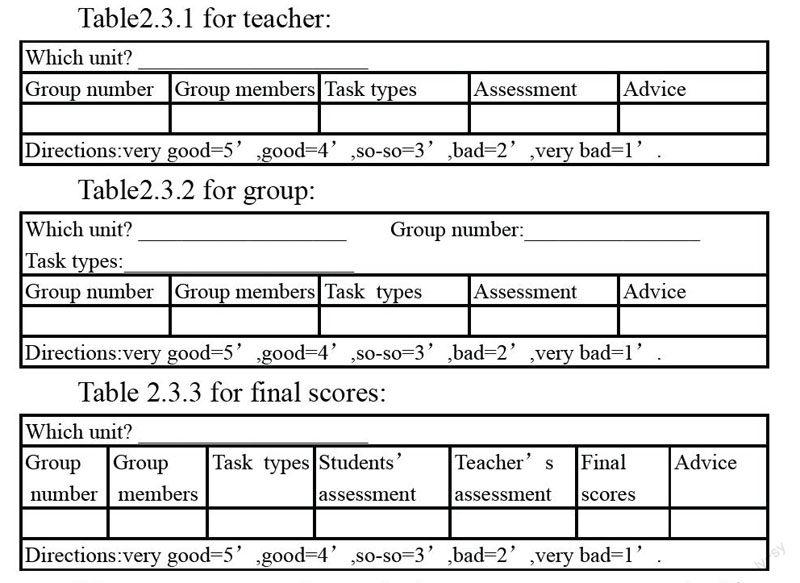
2.3 An open evaluation system.Teachers should analyze each cooperative and evaluate the results of cooperative learning appropriately in time.The author design the cooperative learning project based on the unit of unit study,so the author thinks that evaluation should be made after every unit study.In addition,the evaluation is not only made by teachers,but also by peer groups and the group itself.According to the design of cooperative learning tasks in pre-teaching,while-teaching,and post-teaching,the author has designed 3 tables for teachers and every group.So that teachers can make evaluation for each group,and every group can make evaluation for itself and other groups after every unit study.Finally,teachers will make a combination between “Table 2.3.1” and “Table 2.3.2”,and then put the results on “Table 2.3.3”; it shows the final scores of every groups cooperative learning performance.These 3 tables are as follows:
Table2.3.1 for teacher:
Which unit? _____________________
Group number Group members Task types Assessment Advice
Directions:very good=5,good=4,so-so=3,bad=2,very bad=1.
Table2.3.2 for group:
Which unit? ___________________ Group number:________________
Task types:_____________________
Group number Group members Task types Assessment Advice
Directions:very good=5,good=4,so-so=3,bad=2,very bad=1.
Table 2.3.3 for final scores:
Which unit? _____________________
Group
number Group
members Task types Students
assessment Teachers
assessment Final
scores Advice
Directions:very good=5,good=4,so-so=3,bad=2,very bad=1.
The assessment is made by scores:very good=5, good=4,so-so=3,bad=2,very bad=1.“Table 2.3.1” is for teacher and shows the teachers assessment for every group; “Table 2.3.2” is for each group and shows the each groups for itself and other groups; “Table 2.3.1” is the final scores of each group from teacher and student,it also shows the important advice for each group to make self-improvement.The final assessment is made by the teacher.After every unit study,teachers award the top three groups according to the final scores.
3.Case study
There are 45 students in the class,who are in the second semester of Grade One.Students in the class almost in the same age,but their language learning ability,English knowledge,language skills are uneven.This semester include 10 units.This case study show the detail organization of cooperative learning in the first period of the first unit:“Unit 1 Festivals around the world”.
3.1Grouping.The teacher divided the whole class into10 groups.Each team is composed of 4 or 5 students.The teacher do it like this:assign numbers from 1 to 10 to students randomly,students have the same number will be divided in the same group,and then the teacher made a small change of the division according to the student's language learning ability,gender,English language knowledge,language skills,and other characteristics.Each of the groups has its own numbers from ① to ⑩.This division is the cooperative base group.Group members work together within at least one semester.While having class,group members sit together,so that they can discuss with each other.
There are 4 roles in the team,the leader:responsible for the global control panel discussions,the allocation of speaking opportunities,coordination of group learning process,master the time of cooperative learning,distribute each group members work in cooperative learning projects; recorder:responsible for recording the results of group discussions; reporter:responsible for cooperation and report to the class to learn the results; inspectors:members of the group responsible for checking learning.Group members exchange roles every unit study.For example,there are 10 units in this term,there are 4 students in one group; at first student A is the leader of Unit 1,student B Unit 2,student C Unit 3,student D Unit 4,then after the first round,student A for Unit5.Thus the rotation moves on until all the units of the book are covered.
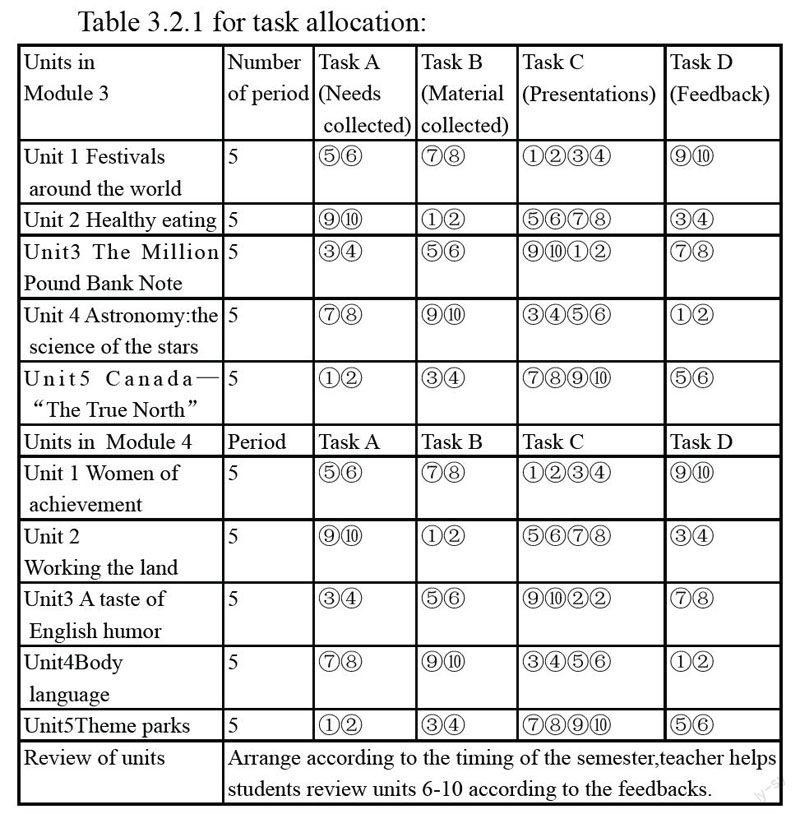
3.2 Task design.After grouping the teacher classify groups into 3 types; Task A&B are related to Pre-teaching,Task C is related to While-teaching,and Task D is related to Post-teaching.The teacher designs 5 tasks,Task A:need collected,Task B:material collected,Task C:presentations,Task D:feedback.The task of each group is showed at the beginning of the semester,which is showed as “Table 3.2.1”:
“Unit 1 Festivals around the world” is the first unit of this semester,this case study shows period 1 of unit 1.This unit conclude 5 periods,before students doing tasks the teacher has his own instruction design of period 1.Teachers assign tasks according to the instruction design,and divide the tasks into 4 parts(Task A-D).Students do tasks based on the allocation.
4.Conclusion
4.1 Implication from the research.The author makes a study on high school English teaching by literature method and case study based on the literature review at home and abroad and New National Standard for English Curriculum and the current status of junior high school English teaching.Generally,the achievement of this thesis can be used in high school English teaching.The model of cooperative learning can be operated pre-teaching,while-teaching and post-teaching.Students prepared for the course,hold the course and evaluate the course together with teachers.Through this way,students can understand the knowledge better,and enjoy the happiness of cooperative learning and get a sense of accomplishment.
4.2 Limitations of the study.The cooperative learning model is designed based on the current status of high school English teaching by literature method and case study,but hasnt been operate in real high school English teaching.In a certain extent,the achievement of this thesis maybe exist some problems in operation.So that it needs teachers to carry out in practice,and keep trying,and make it better to improve English teacher effects.
4.3 Suggestions for further study.We all know that any kind of teaching method is not perfect.There can be problems here and there in the process of implementation,teachers should reflect on their own educational process actively and make adjustments continually.It is the only way to make use of cooperative learning more and more mature,so that more and more students can be more active,and make benefits from cooperative learning.Throughout the usual teaching,cooperative learning should also be combined with other teaching methods,for example,inquiry-based learning and task-based learning.These methods can be used integrally and reasonable,so that the superiority of cooperative learning can be more fully demonstrated and English communicative function and interaction can be reflected better,students' enthusiasm for learning English can be stimulated better.When choosing teaching methods,teachers should base on the purpose of teaching.
References:
[1]Aronson.E.The Jigsaw Classroom[M].Beverly Hills,CA:Sage Publications.1978.
[2]George M.Jacobs.Michael A.Power.Loh Wan Inn[M].The Teachers Sourcebook for Cooperative Learning.CA:Sage Publications.1997:118.
[3]胡愛軍.論合作學習在初中英語教學中的運用[D].華中師范大學.2007.
[4]全日制義務教育普通中學英語課程標準[M].外研社出版. 2005:2.
[5]時寶軍.組織有效的小組合作學習[J].教育研究.2010.(06).
[6]汪衛紅.段兆兵.中學英語教學中實施合作學習的問題與對策[J].成都大學學報.2008.12(12).
[7]王坦.合作學習:原理與策略[M].北京:學苑出版社.2001.
[8]魏亞杰.初中英語課堂教學中合作學習研究[D].河北師范大學.2007.
[9]徐學峰.陳培林.課堂教學中合作學習模式設計及實驗設計[J].教育理論與實踐.2004.(08):25-28.
[10]趙明依.合作學習在高中英語課堂教學中的應用[D].山東師范大學.2007.
[11]張文周.小組合作—研究性學習的基本組織形式[J].上海教育科研.2000.(01).
[12]張修海.合作學習分組策略的教學與研究[J].遼寧師專學報(社會科學版).2006.(02).
[13]褚軍平.初中英語教學中的合作學習組織研究[D].天津師范大學.2007.
猜你喜歡
甘肅教育(2020年17期)2020-10-28 09:02:48
甘肅教育(2020年6期)2020-09-11 07:45:28
語文教學之友(2016年9期)2016-10-08 22:14:32
成才之路(2016年26期)2016-10-08 11:24:19
成才之路(2016年25期)2016-10-08 10:50:12
成才之路(2016年25期)2016-10-08 10:38:17
成才之路(2016年25期)2016-10-08 10:17:11
成才之路(2016年25期)2016-10-08 09:55:21
成才之路(2016年25期)2016-10-08 09:53:57
成才之路(2016年25期)2016-10-08 09:51:50