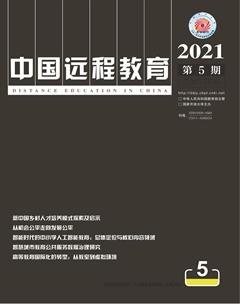
英文摘要
2021-07-29 21:02:28
中國遠(yuǎn)程教育 2021年5期
關(guān)鍵詞:英文
Cultivating talents for rural China since 1949: an analysis of the Communist Labor University model and the Radio & Television University “One College Student for One Village” model
Daichun Zha and Zhixian Zhong
Talent cultivation is key to the development of rural China. Exploration for innovative approaches has been going on ever since the founding of the Peoples Republic of China in 1949. In terms of scale and level, the Communist Labor University (CLU) “part-time work and part-time study” model and the Radio & Television University (RTU) “One College Student for One Village” model are the most influential approaches. These two models were implemented to cater for rural development needs in different historical periods. With students working and studying at the same time, they both emphasized practical teaching and were able to train rural talents more efficiently and effectively. It is argued that lessons learnt from these models have implications for cultivating talents needed to revive rural communities in the new era. Ways to promote rural talent cultivation are proposed in light of Chinas national strategy to revive its rural communities, including establishing rural talent databases, driving innovation in the agriculture-science & technology-education integration model, offering training to meet specific needs, promoting collaborative training, improving learner support, strengthening pro-agriculture education, constructing service systems for rural lifelong learning and enhancing rural education governance.
Keywords: rural community revival; rural development; talent cultivation; Communist Labor University; part-time work and part-time study; radio and television university; One College Student for One Village; open university; farmer education
From equity of opportunity to equity of development: a comparative analysis of large-scale online education between urban and rural K-12 schools in China during COVID-19
Yiling Hu, Jing Nie and Xiaoqing Gu
Faced with the outbreak of the COVID-19 pandemic, Chinese K-12 schools pivoted to online teaching to ensure continuity of learning in the first half of 2020. Due to its emergency nature, this kind of online teaching met challenges from various aspects. This study randomly distributed approximately 420,000 questionnaires to primary and secondary students, teachers and administrators across all provinces in China, with the aim of investigating online teaching during the pandemic from the perspectives of teaching organization, policy implementation and learning experience as well as comparing the ways urban and rural schools responded to COVID-19 from the perspective of balanced education development. Results show that schools across different regions in the country are equipped with essential facilities for online teaching. It is also found that schools need to enhance their capacity for contextualized decision making and innovation in teaching practice and that additional support should be given to rural schools to improve their access to resources and their online teaching experience. Significant differences between urban and rural schools are found to exist in such areas as students learning interest and effectiveness, information technology literacy and psychological well-being. Moreover, there also exists considerable discrepancy in teachers digital teaching competence between urban and rural schools. Implications from these findings are discussed and suggestions made on future directions of online teaching development.
Keywords: online education; online learning; educational equity; balanced education development; ICT in education; COVID-19; suspending classes without stopping learning; digitalization leadership
Artificial intelligence education in K-12 schools in the intelligent era: strategic positioning and core content domains
Yu Lu, Xiaoyu Tang, Jiachen Song and Shengquan Yu
With the arrival of the intelligent era, artificial intelligence (AI) has been increasingly applied in various areas, demonstrating its great application potential. The Chinese government advocates and supports the introduction of AI courses into education at different levels. Nevertheless, AI education for K-12 schools faces some critical challenges, including, inter alia, ambiguous course objectives, incoherent course content, complex and disorderly course curriculum and over-abundant resources. In light of this scenario, a review was conducted to understand the status quo of AI education in and outside China, followed by a comparison and distinction between AI education and relevant types of education to identify the strategic positioning of AI education. Given that content domains of AI education are not scientifically defined and adequately described, this article proposes six core content domains and goes on to set forth content domain-based principles for AI education course design.
Keywords: Artificial Intelligence Education; primary and secondary education; strategic positioning; core content domain; course design; agent
Transformation of internationalization in higher education: from classrooms to virtual settings
Yasar Kondakci and Elif Erberk
Internationalization in higher education (IHE) has been a policy issue for countries and a strategic orientation for individual universities. Historically, internationalization has always been a part of the university. In the traditional, face-to-face education, internationalization has specific rationales and meanings for countries, universities and individuals. However, with the developments in ICT, internationalization has gained a new meaning. The most prominent aspect of this meaning is that internationalization has gained a virtual dimension. The purpose of this article is to identify the traditional meaning and rationales of IHE as well as approaches to internationalization. Furthermore, the article defines virtual internationalization and discusses the approaches to virtual internationalization in the context of open and distance education. Finally, the article covers the opportunities and challenges that come along with virtual internationalization. It concludes that although virtual internationalization provides new opportunities, failure to tackle the challenges may end up with limited accomplishment of internationalization.
Keywords: internationalization; virtual internationalization; definition; rationale; driving force; approach; higher education; open and distance education
(英文目次、摘要譯者:肖俊洪)
猜你喜歡
國際展望(2017年2期)2017-03-21 18:34:18
鄱陽湖學(xué)刊(2016年6期)2017-01-16 13:05:41
中國遠(yuǎn)程教育(2016年6期)2016-12-07 10:07:02
財(cái)經(jīng)(2016年19期)2016-08-11 08:17:03
中國遠(yuǎn)程教育(2016年5期)2016-06-29 10:13:42
中國遠(yuǎn)程教育(2016年2期)2016-03-21 10:31:21
中國遠(yuǎn)程教育(2016年1期)2016-02-26 10:37:15
國際展望(2015年5期)2015-09-15 05:41:45
國際展望(2015年4期)2015-07-13 05:30:56
能源(2014年9期)2014-09-15 13:18:12