ABSTRACTS
2021-01-12 10:57:22
和平與發展
2021年2期
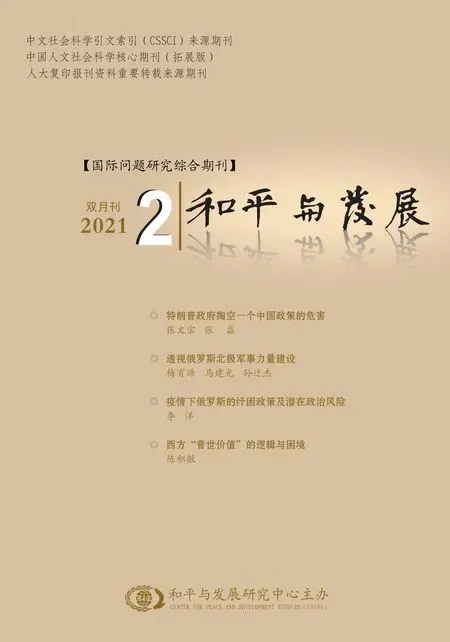
01 America’s Hollowing out of Its “One China” policy Has Made Taiwan Less Secure,by Zhang Wenzong, Assistant Director at the Institute of American Studies, CICIR; Zhang Lei, Assistant Research Professor at the Institute of American Studies, CICIR. While maintaining the relationship between China and the United States, the“One China” policy practiced by the US has been a major factor that obstructs complete unification of China. In the process of instigating a “new cold war” on China, the Trump administration once tried to abandon this policy, as seen in its efforts in raising the level of exchanges between senior officials of the US and Taiwan, changing the mode of arms sales to Taiwan, and declaring to “remove all restrictions on US-Taiwan exchanges” at the end of his administration.This hollowing out of its “One China” policy served the US strategy of containing China, and enjoyed the support of the US Congress and the cooperation of the DPP authority in Taiwan, which has forced the Chinese government to step up efforts to contain “Taiwan independence”. Although the Biden administration has claimed to continue the “One China” policy, the US relevant policies will further hollow out the content of “One China” against the backdrop of the US continuing to implement its all-out competition strategy with China. As a result, game between China and the US over Taiwan will make the situation across the Taiwan Strait more complicated and grim.
18 A Look at Russia’s Military Buildup in the Arctic,by Mei Yuyuan,Translator at the Army Research Institute; Dr. Ma Jianguang, Professor at College of Arts and Sciences, NUDT; and Sun Qianjie, Staff Member at the Army Research Institute. Against the backdrop of increasingly fierce military competition in the Arctic, Russia has accelerated the building of its Arctic military forces by upgrading its Arctic strategy,adjusting its military establishment in the Arctic, and expanding its Arctic military deployment. Compared with other Arctic countries,Russia’s Arctic military buildup is characterized by solid foundation,strategic dominance and extensive use of new technologies, but it is also faced with problems such as harsh natural environment, tense geographical environment and difficult internal environment. In future,Russia will continue to expand its military presence and maintain its leading edge in the Arctic region, which will further aggravate the military competition between the US and Russia in the Arctic, and have an impact on the geopolitical security of the surrounding region.
34 Russia’s Long-term and Short-term Rescue Policies and Their Potential Political Risks under Epidemic Situation,by Li Yang,Associate Research Fellow at the Macroeconomic Research Center of Inner Mongolia Autonomous Region. Affected by the COVID-19 pandemic, Russia’s macroeconomic indicators began to decline in all-dimensions from the second quarter of 2020, and the second wave of the epidemic at the end of the year has further intensified the uncertainty of its future economic development. The Russian government has tried to maintain macroeconomic stability through relatively loose fiscal and monetary policies, while putting in place a series of stimulus measures to provide short-term relief to businesses and households, and working out medium and long-term policies for economic recovery. However, the superposition of the epidemic and bailout has brought some new impacts and changes to the operation of Russian economy, which has also accumulated some risks.
51 The Logic and Predicament of Western “Universal Values”,by Chen Jimin, Deputy Director and Professor at the Division of World’s Trends of Thought under the Institute of Strategic Studies of the Party School of the Central Committee of C.P.C (National Academy of Governance). Western “universal values” have developed along with the development of capitalism, which is the concentrated embodiment of bourgeois values and ideology. Although they pride themselves on being universal and timeless values that transcend class and history,they are not only highly deceptive, but also obviously expansionary to the outside. In view of the current occurrence of systematic crisis of capitalism, the disastrous consequences caused by the expansion of Western “universal values” as well as people’s deep cognition and self-reflection on the falsehood and harmfulness of “universal values”,Western “universal values” is facing both internal and external dilemmas.
67 Peace Process in Afghanistan in the New Context of Competition and Cooperation among Major Powers,by Zhang Lei, Professor at the Party School of the C.P.C. Committee of Shandong Province;Rong Ying, Deputy Director and Senior Research Fellow of CIIS.This year marks the 20th anniversary of the Afghanistan war. 9/11 and the war waged by the US on Afghanistan 20 years ago have plunged Afghanistan into two decades of war and conflict, making its peace process difficult. In February 2020, the US reached a “Doha deal” with the Taliban in Afghanistan, which marked a new stage in the Afghan peace process. Nonetheless, the implementation of this agreement is not smooth, as the Afghans’ internal negotiations have repeatedly foundered. Currently, the US policy on Afghanistan under the new administration of Joe Biden is not certain, and the Afghanistan issue resonates with the new round of game among major powers. Therefore,the Afghan peace process is once again at a crossroad, facing new complex and uncertain factors. Whether Afghanistan can finally embark on path of peaceful development requires joint efforts of the international community, regional countries and various factions within Afghanistan.
83 The Shift in American Policy toward China and China’s Strategic Choice,by Wang Qiuyi, Lecturer at Institute of International Relations,China Foreign Affairs University. Since Trump came into power, there had been a serious mismatch between China and the US in their views on their relationship, thus leading to tremendous changes in China-US relations. After Biden came into office, the new US administration has made some adjustments to the China policy pursued by the Trump administration, but it will continue the tough policy tone toward China,while making it more targeted and balanced. This paper will summarize the major changes of the Trump administration’s policy toward China,and make an analysis and judgment on the future direction of China-US relations based on the cognition of Joe Biden and major members of his administration toward China, believing in the future strategic game between China and the US, China needs to maintain strategic rationality, strategic resolution and strategic bottom line, and actively leverage its influence on shaping China-US relations so as to ensure long-term stability and development of such relations.
99 The Rightward Shift in Brazil’s Foreign Policy: Reasons and Prospects,by Dr. Wang Huizhi, Assistant Research Fellow at the Department of Latin American and Caribbean Studies, CIIS. Since Jair Bolsonaro took office as president, there have been marked changes in Brazil’s diplomatic layout, moving significantly closer to the US and its far-right allies. The rightward shift in Brazil’s foreign policy is not only a reflection of President Bolsonaro’s personal political orientation,but also inseparable from the promotion of the far-right conservatives,as well as the exemplary role of the Trump administration. Brazil’s pro-American and anti-multilateralism foreign policy practices have shaky domestic foundations. With Biden winning presidential elections in the US, it will be harder for Bolsonaro to continue to advance such a foreign policy. Although Brazil’s ideological diplomacy has caused some troubles to China-Brazil relations, it can hardly change the overall situation of China-Brazil friendly cooperation.
115 Terrorism in the Age of AI: Challenges and Responses,by Dr. Xie Lei, Editor and Assistant Research Fellow at Journal of International Security Studies, University of International Relations. At present, the terrorists are exploiting the “dividends” of AI through using drones to launch attacks, gathering intelligence, carrying out cyber attacks and conducting online propaganda, which has posed a serious threat to the international community. The application of AI has increased terrorists’ability to engage in an asymmetric conflict with national governments.So, national governments need to establish an absolute advantage in AI, and strengthen international cooperation and partnership with key AI business companies and research institutions so as to prevent highlevel AI from being used by terrorists, thus effectively ruling out the possibility that terrorists could use this emerging technology to gain maximum benefits.
登錄APP查看全文