肺移植患者術后急性腎損傷影響因素分析
2020-10-20 05:25:19杜雯雯王曉星陳文倩張丹劉慧芳張相林李朋梅
中國藥房 2020年18期
關鍵詞:影響因素
杜雯雯 王曉星 陳文倩 張丹 劉慧芳 張相林 李朋梅

摘 要 目的:分析肺移植患者術后急性腎損傷(AKI)的發生情況及可能的影響因素。方法:回顧性收集2017年4月-2018年6月于我院接受肺移植術64例患者的病歷資料,按術后是否發生AKI分為AKI組(44例)和無AKI組(20例)。根據我院肺移植診療規范,所有患者均給予注射用甲潑尼龍琥珀酸鈉或注射用甲潑尼龍琥珀酸鈉聯合注射用巴利昔單抗誘導治療,并于術后行他克莫司膠囊+嗎替麥考酚酯分散片或嗎替麥考酚酯膠囊或麥考酚鈉腸溶片+甲潑尼龍片或醋酸潑尼松片三聯免疫抑制治療方案。記錄AKI組患者術后1周內AKI發生情況,并觀察兩組患者術中[手術類型、手術時間、體外膜肺氧合(ECMO)支持、免疫抑制劑使用情況、術中出血量]、術后影響因素[重癥加強護理病房(ICU)天數、機械通氣天數、ECMO支持天數、術后1周內血清肌酐(Scr)中位值,他克莫司全血濃度中位值、潛在腎毒性藥物使用種類(≥4種)、住院天數]及術后1年生存率。結果:肺移植術后1周內,64例患者有中44例(68.8%)至少發生過1次AKI,其中1期19例(29.7%)、2期17例(26.5%)、3期8例(12.5%);術后第4天AKI發生率最高(57.4%);在肺移植術后1周內3期AKI發生率總體呈上升趨勢,并在術后第5天達到最高(8.7%)。無AKI組患者的手術時間、術后1周內Scr中位值、他克莫司全血濃度中位值均顯著短于或低于AKI組(P<0.05);兩組患者手術類型、ECMO支持使用情況、免疫抑制劑使用情況、術中失血量、ICU天數、機械通氣天數、ECMO支持天數、潛在腎毒性藥物(≥4種)使用率、住院天數比較,差異均無統計學意義(P>0.05)。1期和2期AKI患者術后1年生存率與無AKI組比較,差異均無統計學意義(P>0.05);3期AKI患者術后1年生存率顯著低于無AKI組(P<0.05)。結論:肺移植術后AKI的發生率較高。手術時間、術后1周內Scr中位值、他克莫司全血濃度中位值均為術后發生AKI的可能影響因素。
關鍵詞 急性腎損傷;肺移植;術后;影響因素
中圖分類號 R563 文獻標志碼 A 文章編號 1001-0408(2020)18-2247-06
DOI 10.6039/j.issn.1001-0408.2020.18.13
ABSTRACT? ?OBJECTIVE: To analyze the occurrence of acute kidney injury (AKI) after lung transplantation and its possible influential factors. METHODS: Medical records of 64 patients who received lung transplantation in our hospital from April 2017 to June 2018 were included in this retrospective study. Patients were divided into AKI group (44 cases) and non-AKI group (20 cases), according to whether AKI occurred after operation. According to diagnostic criteria for lung transplantation in our hospital, all patients were given Methylprednisolone sodium succinate for injection or Methylprednisolone sodium succinate for injection combined with Basiliximab for injection, and triple immunosuppressive therapy of Tacrolimus capsules+Mycophenolate mofetil dispersible tablets or Mycophenolate mofetil capsules or Mycophenolate sodium enteric-coated tablets+Methylprednisolone tablets or Prednisone acetate tablets were given after operation. The occurrence of AKI in AKI group within a week after operation were recorded. Intraoperative influential factors (operation type, operation duration, ECMO support, immune inhibitor use, intraoperative blood loss), postoperative influential factors [days of ICU, mechanical ventilation and ECMO support, median value of Scr within one week after operation, median tacrolimus concentration and the use of potential nephrotoxic drugs (≥4 kinds), hospitalization days] and survival rate one year after operation were observed in 2 groups. RESULTS: Within one week after lung transplantation, 44 patients (68.8%) had experienced at least one episode of AKI, among which 19 cases (29.7%) were stage 1, 17 cases (26.5%) were stage 2 and 8 cases (12.5%) were stage 3. The incidence of AKI was the highest on post-operative day 4 (57.4%). The incidence of AKI at stage 3 exhibited growth trend within the first week after operation, and reached the highest on? median post-operative day 5 (8.7%). Operation duration, median value of Scr within one week after operation, median tacrolimus concentration in non-AKI group were significantly shorter or lower than AKI group; there was no significant difference in operation type, ECMO support, use of immunosuppressive agents, intraoperative blood loss, ICU days, mechanical ventilation days, ECMO support days, the utilization rate of potential nephrotoxic drugs (≥4 kinds) and hospitalization days between 2 groups (P>0.05). There was no statistical significance in the survival rate at stage 1 and 2 one year after operation between AKI group and non-AKI group (P>0.05). One year after operation, survival rate of AKI group at stage 3 was significantly lower than that of non-AKI group(P<0.05). CONCLUSIONS: The incidence of AKI is high after lung transplantation. Operation duration, median value of Scr within one week after operation, median tacrolimus concentration were possible factors for the occurrence of AKI after operation.
1.4.2 術中影響因素 術中影響因素包括手術類型、手術時間、ECMO支持情況、免疫抑制劑使用情況和術中失血量。
1.4.3 術后影響因素 術后影響因素包括患者重癥加強護理病房(ICU)天數、機械通氣天數、ECMO支持天數、術后1周內Scr中位值、他克莫司全血濃度中位值、潛在腎毒性藥物種類(≥4種)、住院天數。
1.4.4 臨床結局 觀察兩組患者術后1年的生存情況。
1.5 統計學方法
采用SPSS 23.0軟件對數據進行統計分析。采用Shapiro-Wilk檢驗數據是否符合正態分布,對于符合正態分布的計量資料以x±s表示,兩組間比較采用兩獨立樣本t檢驗;非正態分布的計量資料以M(P25,P75)表示,兩組間比較采用Mann-Whitney U檢驗;計數資料以例數或率表示,采用χ2檢驗或Fisher精確檢驗。P<0.05為差異有統計學意義。
2 結果
2.1 肺移植術后AKI發生情況
肺移植術后1周內,64例患者中有44例(68.8%)至少發生過1次AKI,其中1期19例(29.7%)、2期17例(26.5%)、3期8例(12.5%)。術后第4天AKI發生率最高(57.4%),肺移植術后1周內3期AKI發生率總體呈上升趨勢,并在術后第5天達到最高(8.7%),詳見表2(因術后并非每天都會檢測患者腎功能,因此Scr值不是每天都可獲得;此外,通常在術后前3 d會每天測Scr值,從第4天起醫師根據患者病情決定是否檢測腎功能,故表中“n”表示實際測定腎功能的患者例數)。
2.2 術中影響因素分析
無AKI組患者的手術時間顯著短于AKI組(P<0.05);而兩組患者手術類型、ECMO支持情況、免疫抑制劑使用例數、術中失血量比較,差異均無統計學意義(P>0.05),詳見表3。
2.3 術后影響因素分析
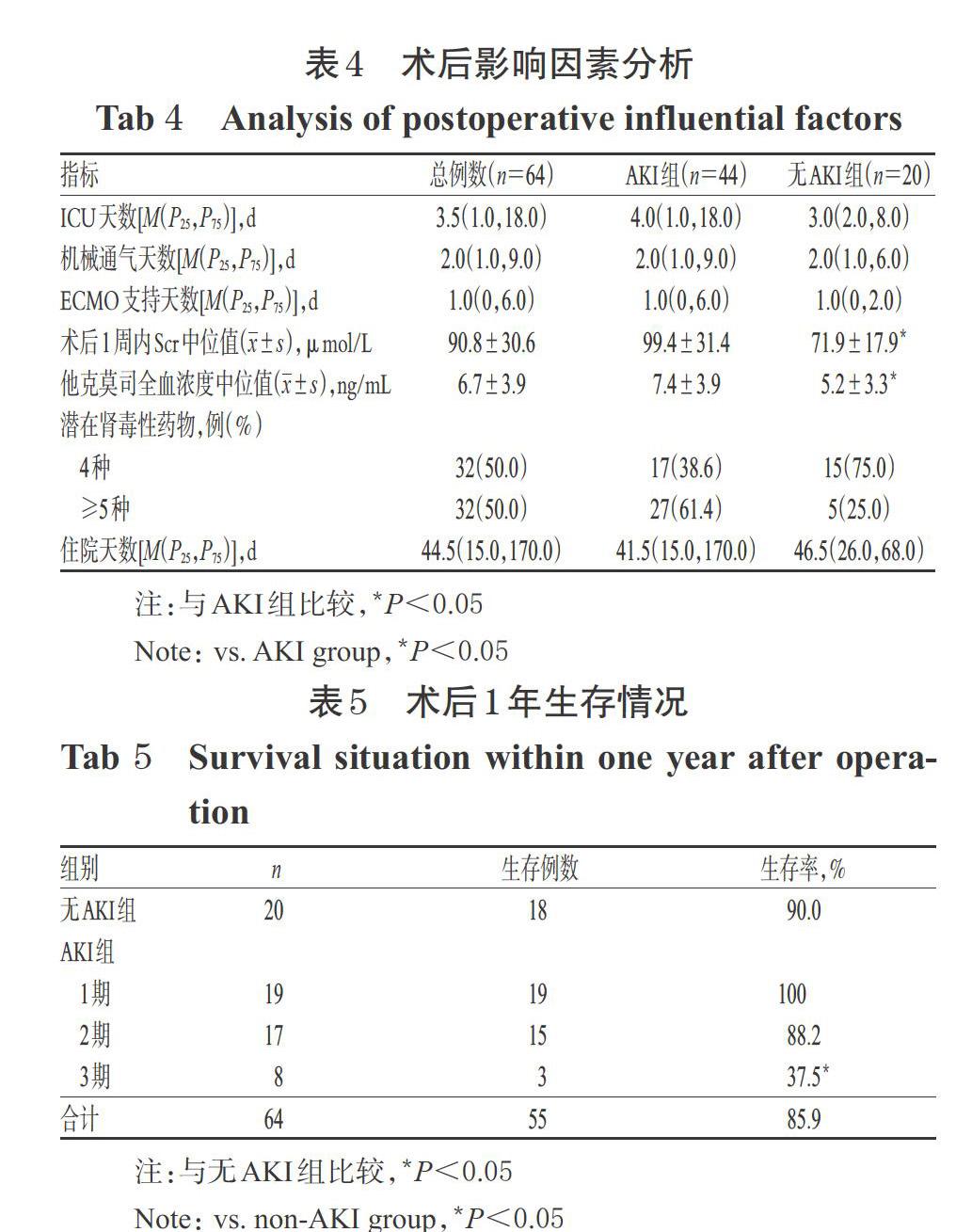
所有患者術后均在ICU實施有創呼吸機和/或ECMO輔助通氣。無AKI組患者術后1周內Scr中位值、他克莫司全血濃度中位值均顯著低于AKI組(P<0.05)。而兩組患者ICU天數、機械通氣天數、ECMO支持天數、潛在腎毒性藥物(≥4種)使用率、住院天數比較,差異均無統計學意義(P>0.05),詳見表4。
2.4 術后1年生存情況
1期和2期AKI患者術后1年生存率與無AKI組比較,差異均無統計學意義(P>0.05);而3期AKI患者術后1年生存率顯著低于無AKI組(P=0.009),詳見表5。
3 討論
隨著器官移植醫學倫理的完善和終末期肺疾病患病人數的增加,行肺移植術的患者也在逐年增多,盡管我國在外科手術和免疫抑制治療等方面取得了進展,大大提高了患者的生存率,但部分患者術后仍伴有嚴重的并發癥,尤其是AKI[2,12]。據國際心肺移植學會(ISHLT)統計數據顯示,肺移植術后1年內腎功能不全較糖尿病和閉塞性細支氣管炎等并發癥更為常見,且與患者死亡顯著相關[13-14]。
有研究認為,應用不同的AKI診斷標準可能會影響AKI發生的判斷結果[15]。近年來研究大多采用2012年KDIGO指南[4,10,16]、2005年急性腎損傷網絡(AKIN)標準[17-18]或2002年急性透析質量指導組(ADQI)提出的風險、損傷、衰竭、失功能、終末期腎病(RIFLE)分層標準[19-20]。Lertjitbanjong P等[21]進行的Meta分析結果顯示,根據KDIGO指南、AKIN標準和RIFLE分層標準,肺移植術后AKI的合并估計發病率分別為53.0%[95%置信區間(CI)(38.2%,67.3%)]、55.5%[95%CI(45.2%,65.4%)]和49%[95%CI(38.3%,59.8%)]。本研究采用KDIGO指南的AKI診斷標準得到的結果顯示,肺移植術后1周內,AKI發生率為68.8%,其中1期占29.7%、2期占26.5%、3期占12.5%,術后AKI以1期和2期為主,該結果與相關研究[4,11]結論一致。
本研究結果顯示,無AKI組患者的手術時間顯著短于AKI組,提示接受手術時間越長,患者發生AKI的風險越高,該結果目前尚未有相關文獻報道。肺部手術會通過釋放炎癥介質而致腎上皮細胞凋亡,從而引發AKI[22]。由此筆者推測,手術時間延長可能會加重上述過程,進而增加AKI發生的可能性。有研究報道,肺移植術中影響AKI的發生因素為雙肺移植和ECMO支持等[2,22-24]。而本研究發現,雖然AKI組中雙肺移植患者比例(34.1%)雖略高于無AKI組(25.0%),但差異無統計學意義,這可能與本研究中納入的雙肺移植患者較少有關[2,25]。同時,本研究還發現,單肺移植患者的手術時間短于雙肺移植手術時間,筆者推測手術類型可能會間接影響手術時間與術后AKI的相關性[22-23]。術中使用ECMO支持而導致AKI的機制可能與血液持續暴露于ECMO界面而使促炎介質激活有關[26]。雖然我院肺移植手術中ECMO支持總體率較高(73.4%),但并未發現ECMO支持是患者術后發生AKI的影響因素,該結論與相關文獻[2,25]結論一致。此外,雖然兩組患者術中失血量比較差異無統計學意義。也有研究認為,1~3期AKI患者的術中失血量雖然高于無AKI組,但組間比較差異無統計學意義(P=0.054)[15]。但由于本研究納入的樣本量較小,因此,術中出血量是否為患者術后發生AKI的可能影響因素,仍需后續研究進一步證實。
免疫抑制劑可能在AKI的發生中發揮重要作用[27]。他克莫司是肺移植術后常用的免疫抑制劑,其潛在的腎毒性已在多項研究中被提及[11,28]。他克莫司的腎毒性可能是由于其濃度偏高時,引起腎小球入球小動脈血管收縮而造成的[29]。本研究結果顯示,AKI組患者術后他克莫司全血濃度中位值顯著高于無AKI組,這與文獻報道[4,30]結果一致。但值得注意的是,AKI組患者體內他克莫司的全血濃度[(7.4±3.9)ng/mL]并未超出目標濃度范圍(8~12 ng/mL),提示常規測定的他克莫司全血濃度即使位于目標濃度范圍內,可能也會造成腎毒性[4]。Sikma MA等[4]研究認為,在腎毒性方面,他克莫司游離血漿濃度可能比全血濃度更具相關性,但由于游離血漿濃度不能通過常規分析測量,因此該相關性仍需后續研究驗證。
本研究中,所有患者的1年生存率為85.9%,該結果與文獻報道[31]一致。1期和2期AKI患者術后1年生存率與無AKI組比較,差異均無統計學意義;3期AKI患者術后1年生存率顯著低于無AKI組,這與Bennett D等[25]研究結果一致,提示術后發生嚴重AKI患者的死亡風險可能更高。
綜上所述,肺移植術后AKI的發生率較高。手術時間、術后1周內Scr中位值、他克莫司全血濃度中位值均為術后發生AKI的可能影響因素。盡管目前未有確切可行的預防術后AKI發生的相關方案,但對上述影響因素進行干預,可能會有助于減少AKI的發生、改善患者預后。由于本研究為回顧性分析,且納入的樣本量較小,故此結論可能會存在偏倚,后續仍需擴大樣本量進一步證實。
參考文獻
[ 1 ] 田普訓,敖建華,李寧,等.器官移植免疫抑制劑臨床應用技術規范:2019版[J].器官移植,2019,10(3):213-226.
[ 2 ] ATCHADE E,BAROUR S,TRAN-DINH A,et al. Acute kidney injury after lung transplantation:perioperative risk factors and outcome[J]. Transplant Proc,2020,52(3):967-976.
[ 3 ] CHAWLA LS,BELLOMO R,BIHORAC A,et al. Acute kidney disease and renal recovery:consensus report of the acute disease quality initiative(ADQI)16 workgroup[J]. Nat Rev Nephrol,2017,13(4):241-257.
[ 4 ] SIKMA MA,HUNAULT CC,VAN DE GRAAF EA,et al. High tacrolimus blood concentrations early after lung transplantation and the risk of kidney injury[J]. Eur J Clin Pharmacol,2017,73(5):573-580.
[ 5 ] ROCHA PN,ROCHA AT,PALMER SM,et al. Acute renal failure after lung transplantation:incidence,predictors and impact on perioperative morbidity and mortality[J]. Am J Transplant,2005,5(6):1469-1476.
[ 6 ] TJAHJONO R,CONNELLAN M,GRANGER E. Predictors of acute kidney injury in cardiac transplantation[J]. Transplantation Proc,2016,48(1):167-172.
[ 7 ] 陳彩妹,王涼,薛婧,等.肺移植術后急性腎損傷的危險因素及預后分析[J].中國血液凈化,2015,14(3):155-158.
[ 8 ] KHWAJA A. KDIGO clinical practice guidelines for acute kidney injury[J]. Nephron Clin Pract,2012,120(4):c179- c184.
[ 9 ] 薛婧,孫鑄興.肺移植后急性腎損傷的研究進展[J].實用醫學雜志,2012,28(18):3149-3151.
[10] STEVENS LA,CORESH J,GREENE T,et al. Assessing kidney function-measured and estimated glomerular filtration rate[J]. N Engl J Med,2006,354(23):2743-2483.
[11] MIANO TA,FLESCH JD,FENG R,et al. Early tacrolimus concentrations after lung transplant are predicted by combined clinical and genetic factors and associated with acute kidney injury[J]. Clin Pharmacol Ther,2020,107(2):462-470.
[12] CHAMBERS DC,CHERIKH WS,GOLDFARB SB,et al. The international thoracic organ transplant registry of the international society for heart and lung transplantation:thirty-fifth adult lung and heart-lung transplant report- 2018:focus theme:multiorgan transplantation[J]. J Heart Lung Transplant,2018,37(10):1169-1183.
[13] WEHBE E,DUNCAN AE,DAR G,et al. Recovery from AKI and short and long-term outcomes after lung transplantation[J]. Clin J Am Soc Nephrol,2013,8(1):19-25.
[14] CHAMBERS DC,YUSEN RD,CHERIKH WS,et al. The registry of the international society for heart and lung transplantation:thirty-fourth adult heart transplantation report:2017:focus theme:allograft ischemic time[J]. J Heart Lung Transplant,2017,36(10):1047-1059.
[15] XUE J,WANG L,CHEN CM,et al. Acute kidney injury influences mortality in lung transplantation[J]. Ren Fail,2014,36(4):541-545.
[16] SHASHATY MGS,FORKER CM,MIANO TA,et al. The association of post-lung transplant acute kidney injury with mortality is independent of primary graft dysfunction:a cohort study[J]. Clin Transplant,2019. DOI:10.1111/ctr.13678.
[17] BALCI MK,VAYVADA M,SALTURK C,et al. Incidence of early acute kidney injury in lung transplant patients:a single-center experience[J]. Transplant Proc,2017,49(3):593-598.
[18] RI HS,SON HJ,OH HB,et al. Inhaled nitric oxide therapy was not associated with postoperative acute kidney injury in patients undergoing lung transplantation:a retrospective pilot study[J]. Medicine:Baltimore,2018. DOI:10.1097/MD.0000000000010915.
[19] NGUYEN AP,GABRIEL RA,GOLTS E,et al. Severity of acute kidney injury in the post-lung transplant patient is associated with higher healthcare resources and cost[J]. J Cardiothorac Vasc Anesth,2017,31(4):1361-1369.
[20] AHMAD O,SHAFII AE,MANNINO DM,et al. Impact of donor lung pathogenic bacteria on patient outcomes in the immediate post-transplant period[J]. Transpl Infect Dis,2018. DOI:10.1111/tid.12986.
[21] LERTJITBANJONG P,THONGPRAYOON C,CHEUN- GPASITPORN W,et al. Acute kidney injury after lung transplantation:a systematic review and meta-analysis[J]. J Clin Med,2019,8(10):1713-1731.
[22] GEORGE TJ,ARNAOUTAKIS GJ,BEATY CA,et al. Acute kidney injury increases mortality after lung transplantation[J]. Ann Thorac Surg,2012,94(1):185-192.
[23] JACQUES F,EL-HAMAMSY I,FORTIER A,et al. Acute renal failure following lung transplantation:risk factors,mortality,and long-term consequences[J]. Eur J Cardiothorac Surg,2012,41(1):193-199.
[24] ISHIKAWA S,GRIESDALE DE,LOHSER J. Acute kidney injury within 72 hours after lung transplantation:incidence and perioperative risk factors[J]. J Cardiothorac Vasc Anesth,2014,28(4):931-935.
[25] BENNETT D,FOSSI A,MARCHETTI L,et al. Postoperative acute kidney injury in lung transplant recipients[J].Interact Cardiovasc Thorac Surg,2019,28(6):929-935.
[26] THONGPRAYOON C,CHEUNGPASITPORN W,LERTJITBANJONG P,et al. Incidence and impact of acute kidney injury in patients receiving extracorporeal membrane oxygenation:a meta-analysis[J]. J Clin Med,2019,8(7):981-1005.
[27] PUTTARAJAPPA CM,BERNARDO JF,KELLUM JA. Renal complications following lung transplantation and heart transplantation[J]. Critical Care Clinics,2019,35(1):61-73.
[28] CALABRESE DR,FLOREZ R,DEWEY K,et al. Genotypes associated with tacrolimus pharmacokinetics impact clinical outcomes in lung transplant recipients[J]. Clin Transplant,2018. DOI:10.1111/ctr.13332.
[29] NAESENS M,KUYPERS DR,SARWAL M. Calcineurin inhibitor nephrotoxicity[J]. Clin J Am Soc Nephrol,2009,4(2):481-508.
[30] SIKMA MA,HUNAULT CC,KIRKELS JH,et al. Association of whole blood tacrolimus concentrations with kidney injury in heart transplantation patients[J]. Eur J Drug Metab Pharmacokinet,2018,43(3):311-320.
[31] FIDALGO P,AHMED M,MEYER SR,et al. Incidence and outcomes of acute kidney injury following orthotopic lung transplantation: a population-based cohort study[J]. Nephrol Dial Transplant,2014,29(9):1702-1709.
(收稿日期:2020-05-13 修回日期:2020-08-01)
(編輯:陳 宏)
猜你喜歡
現代經濟信息(2016年19期)2016-10-20 18:46:44
現代經濟信息(2016年19期)2016-10-20 18:12:28
現代經濟信息(2016年19期)2016-10-20 16:20:30
中國科技博覽(2016年19期)2016-10-19 13:33:22
中國科技博覽(2016年18期)2016-10-19 10:49:54
中國科技博覽(2016年18期)2016-10-19 08:16:45
中國科技博覽(2016年18期)2016-10-19 06:39:44
中國市場(2016年36期)2016-10-19 03:54:01
中國市場(2016年35期)2016-10-19 02:30:10
商(2016年27期)2016-10-17 07:09:07