
不同疏果處理下香草蘭果莢脫落及其內(nèi)源激素含量變化研究
2015-04-29 02:09:55顧文亮等
熱帶作物學(xué)報(bào)
2015年3期
顧文亮等
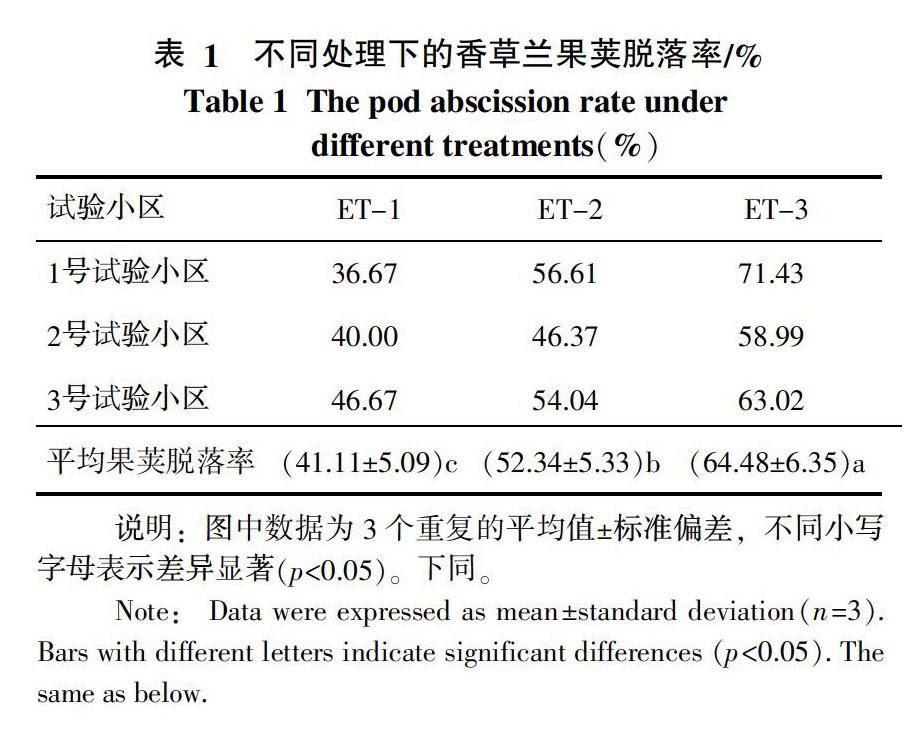
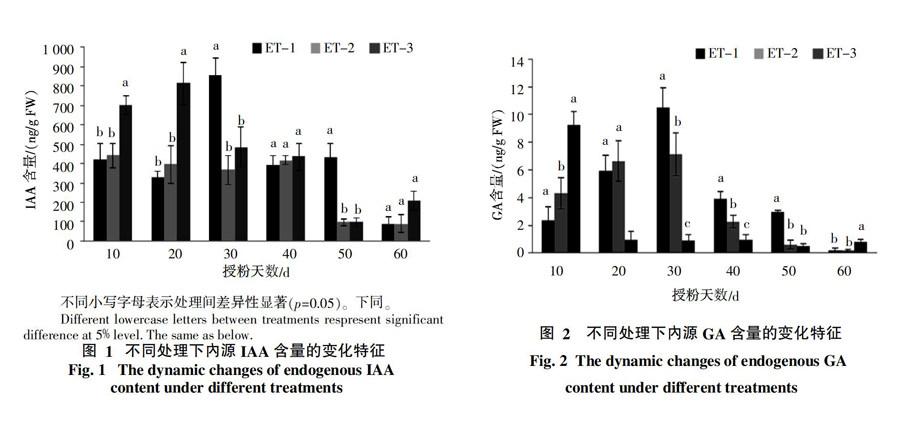
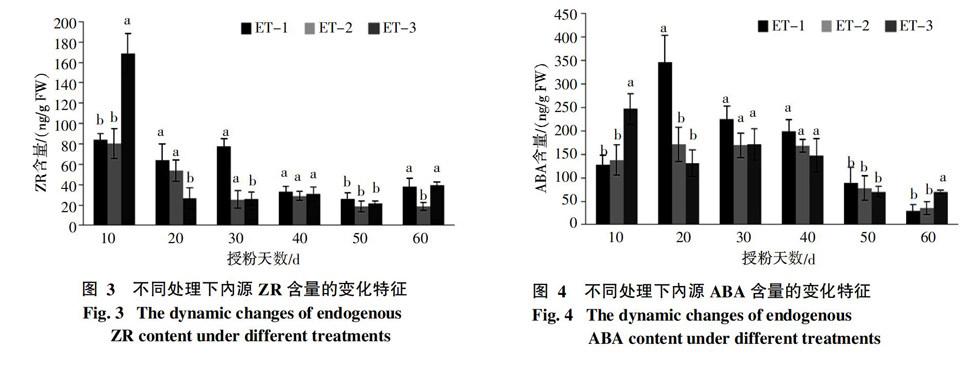
摘 要 香草蘭果莢發(fā)育中存在嚴(yán)重的果莢脫落現(xiàn)象,對(duì)香草蘭果莢脫落情況及其內(nèi)源激素含量變化進(jìn)行探討,以期解決目前生產(chǎn)上果莢脫落率高的問題。設(shè)疏果后保留1個(gè)、8~10個(gè)香草蘭果莢以及未疏果共3種處理,從果莢發(fā)育至脫落的60 d內(nèi)分期取材,采用酶聯(lián)免疫法分別測(cè)定各處理果莢中生長(zhǎng)素(IAA)、赤霉素(GA)、玉米素核苷(ZR)和脫落酸(ABA)的含量。結(jié)果表明:3種處理的果莢脫落率與保留果莢數(shù)目呈正相關(guān); IAA和ZR的含量在前期較高,ABA的含量在中、后期較高,GA的含量一直維持在較低的水平;較高的IAA/ABA 和(IAA+GA+ZR)/ABA比值有利于控制果莢脫落;疏果處理有利于坐果的激素平衡,而保留過多的果莢則不利于形成激素平衡。本研究可為解決生產(chǎn)中的香草蘭落莢問題提供理論依據(jù)和技術(shù)方法。
關(guān)鍵詞 香草蘭;果莢脫落;內(nèi)源植物激素
中圖分類號(hào) S682.31,S311 文獻(xiàn)標(biāo)識(shí)碼 A
Abstract Pod abscission in Vanilla is very serious during pod development. In order to solve this problem, the changes of endogenous plant hormones and pod abscissions under different fruit load were examined in this study. Three levels of fruit load after pollination were set by fruit thinning i.e. 1,8-10 and all vanilla pods were retained as control. The contents of IAA,GA,ZR and ABA in pods from day 0 to day 60 after pollination were measured using enzyme-linked immunoassay. The results showed that the pod abscission rates of three fruit load treatments were positively correlated with the numbers of pods that retained. The contents of IAA and ZR were higher in earlier stage. while ABA content was higher in the middle and late stage,and GA content maintained a relatively low level.The higher ratio of IAA/ABA and(IAA+GA+ZR)/ABA were related to less pod abscission. Proper adjustment of fruit load may generated a hormone balance for pod retention. This study will provide theoretical basis for solving the problem of vanilla pod abscission during its production.
Key words Vanilla planifolia Andrews;Pod obscission;Endogenous plant hormones
doi 10.3969/j.issn.1000-2561.2015.03.018
墨西哥香草蘭(Vanilla planifolia Andrews)是蘭科(Orchidaceae)香草蘭屬(Vanilla)的熱帶攀援藤本植物,具有長(zhǎng)勢(shì)快、產(chǎn)量高和果莢品質(zhì)好等特點(diǎn),其栽培面積占世界香草蘭栽培總面積的90%以上[1]。根據(jù)聯(lián)合國(guó)糧食及農(nóng)業(yè)組織(FAO)統(tǒng)計(jì)數(shù)據(jù),墨西哥香草蘭的總種植面積在8萬hm2以上,鮮豆莢的總產(chǎn)量可達(dá)9 000 t[2]。墨西哥香草蘭豆莢經(jīng)發(fā)酵生香加工后含有250多種揮發(fā)性芳香成分,可用于香煙、名酒、茶葉及香水等高端的食品和化妝行業(yè)中,僅發(fā)酵后的豆莢年產(chǎn)值就可達(dá)20億美元[3]。中國(guó)于20世紀(jì)60年代初從國(guó)外引種墨西哥香草蘭,目前在海南和云南等地有一定的種植面積,且取得了較高的經(jīng)濟(jì)效益[4]。……
登錄APP查看全文
