巨噬細胞極化在炎癥性腸病中的研究進展
2024-09-20 00:00:00張夢婷項鏡蓉朱濛昕曹凱磊石通國奚沁華
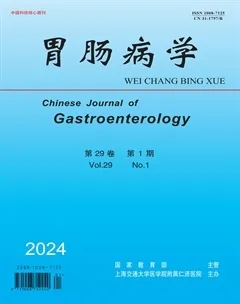
胃腸病學
2024年1期
關鍵詞:治療
摘要 炎癥性腸病(IBD)是一種慢性炎癥性胃腸道疾病,包括克羅恩病和潰瘍性結腸炎。IBD可能是由遺傳易感因素、環境因素和腸道微生物群改變之間復雜的相互作用所引起,導致先天性和適應性免疫反應失調。最近研究發現巨噬細胞在腸道炎癥反應中具有可塑性,不僅可以調節炎癥的發生,而且可以促進組織修復和愈合。IBD的發展過程中存在巨噬細胞極化異常,促炎M1巨噬細胞與抗炎M2巨噬細胞表型和功能之間的平衡受到細胞內外刺激的調節,因此這一過程有望成為新的潛在的治療靶點。本文就巨噬細胞極化在IBD中的研究進展作一綜述。
關鍵詞 炎癥性腸病; 巨噬細胞; 極化; 治療
Progress of Research on Macrophage Polarization in Inflammatory Bowel Disease ZHANG Mengting, XIANG Jingrong, ZHU Mengxin, CAO Kailei, SHI Tongguo, XI Qinhua." Department of Gastroenterology, the First Affiliated Hospital of Soochow University, Suzhou, Jiangsu Province (215006)
Correspondence to: XI Qinhua, Email: xqhxqhxqh@126.com
Abstract Inflammatory bowel disease (IBD) is a chronic inflammatory disease of the gastrointestinal tract that includes Crohn's disease and ulcerative colitis. IBD may be caused by complex interactions between genetic susceptibility, environmental factors, and alterations in the gut microbiota, resulting in dysregulated innate and adaptive immune responses. Recent studies have identified macrophages in the intestinal inflammatory response as having the plasticity to not only regulate inflammation, but also to promote tissue repair and healing. As aberrant macrophage polarization occurs during the development of IBD, the balance between the phenotype and function of pro?inflammatory M1 and anti?inflammatory M2 macrophages is regulated by extracellular and intracellular stimuli, and this process is therefore expected to be a potential target for new therapeutic approaches. This article reviewed the progress of research on macrophage polarization in IBD.
Key words Inflammatory Bowel Disease; Macrophages; Polarization; Therapy
炎癥性腸病(inflammatory bowel disease, IBD)是免疫介導的復雜的消化道慢性炎癥性疾病,包括克羅恩病(Crohn's disease, CD)和潰瘍性結腸炎(ulcerative colitis, UC),以臨床緩解期與復發期交替出現為特點,通常伴有狹窄、膿腫和瘺管等并發癥,使患者的生命質量嚴重下降[1]。最新研究發現IBD作為復雜、嚴重的慢性公共衛生問題,其發病率和流行率在世界范圍內不斷上升,已成為顯著的全球醫療負擔[2]。越來越多的研究提示IBD是由于基因、免疫系統、腸道菌群和其他環境因素之間的相互作用而引起的,但目前對IBD的確切發病機制仍知之甚少,這阻礙了IBD的臨床診治[3]。因此,研究IBD的發病機制并評估新的抗炎策略非常重要。
目前,針對IBD的治療以抗炎藥物(糖皮質激素、氨基水楊酸鹽)、免疫抑制劑(硫唑嘌呤、巰嘌呤、甲氨蝶呤)和生物制劑[抗腫瘤壞死因子(TNF)類藥物、其他抗白細胞介素(IL)類藥物]為主,但臨床療效不甚理想,仍有許多患者因治療失敗、復發或不良反應而需要替代療法[4]。……
登錄APP查看全文
猜你喜歡
今日健康(2016年12期)2016-11-17 14:39:30
今日健康(2016年12期)2016-11-17 14:38:15
今日健康(2016年12期)2016-11-17 14:35:13
今日健康(2016年12期)2016-11-17 13:34:49
今日健康(2016年12期)2016-11-17 12:57:29
今日健康(2016年12期)2016-11-17 12:11:26
今日健康(2016年12期)2016-11-17 12:03:10
今日健康(2016年12期)2016-11-17 11:52:36
今日健康(2016年12期)2016-11-17 11:42:39
中國現代醫生(2016年23期)2016-11-15 03:16:01