
Teaching TOEFL iBT in Scope of Translation Theories: “Back-Transformation” for Reading Practice
2020-12-23 04:47:37王中樞
校園英語·月末 2020年8期

【Abstract】Chinese students in preparation of TOEFL iBT would adopt translation as auxiliary approach to aid comprehension, which in detail can help establish a sound sense of language in terms of syntax. The Back-Transformation Theory by Eugene Nida aims to reveal meaning behind language form by means of surface structure and deep structure, and this theory can be used to help students comprehend complicated lengthy sentences in TOEFL iBT reading and improve their language study performance.
【Key words】TOEFL iBT Reading; Back-Transformation; Eugene Nida
【作者簡介】王中樞,天津大學外國語言與文學學院。
1. Specifics of TOEFL iBT Reading
TOEFL iBT reading section includes three to four passages that aim to examine test takers' reading comprehension. As the passages are usually excerpts from college textbooks to illustrate concepts in a certain academic discipline, this section requires test takers to possess a strong comprehension ability to deal with classifications, comparison and contrast, cause and effect, and solutions to a problem. The TOEFL Reading passages include exposition, argumentation and history. For each passage, there are possibly eight types of questions, in which the type 7, as officially called Sentence Simplification Questions, challenges most test takers for its complicated sentence structures and logical relations within clauses. It requires the reader to clarify firstry the structure and secondly the logical connection, and then compare the meaning and logic of a highlighted sentence with that in given options, which means this single one question asks the reader to process five lengthy sentences altogether. Even besides type 7 questions, there are also numerous lengthy sentences that require a sound set of grammatical skills and prepared vocabularies to process them into every detail for best comprehension. Below is a lengthy sentence example:
Fuller devised a type of dance that focused on the shifting play of lights and colors on the voluminous skirts or draperies she wore, which she kept in constant motion principally through movements of her arms, sometimes extended with wands concealed under her costumes (ETS, 2017:336).
To explicitly understand this sample sentence, readers should be able to precisely break it down to pieces till the structure of main clause, map out the syntactic hierarchy, and clarify the function of each part, each level. ?Only when syntactic structure is completely analyzed ,can a test taker finish understanding it. And translating such lengthy sentences works as an ideal choice to verify one's learning outcome.
2. Introduction of Eugene Nidas Theory
Eugene Nida is considered the most notable ? representative
of the scientific approach of translation. When still writing for
missionaries but not translators, Nida noticed that "ideas 'must
be modified' to fit with the conceptual map of experience of the different context" (Gentzler, 2004:52). This view could be seen as the foundation that Nida started to contemplate over the structure of languages for translators to handle, deriving his later theories of back-transformation, a theory resembles Noam Chomsky's trans-generative grammar. Centering at Nida's theory is a system of "kernel constructions" from which everything else is derived, as explicitly put by Edwin Gentzler:
Nida prefers to work backwards from the surface of the original text to its deep structure, transfer that deep structure to the deep structure of the new language, and then generate a surface structure in the second language. In other words, he posits a decoding and recoding process in which the original message never changes (Gentzler, 2004: 55).
This method of working the texts backwards into simple structures reflects Nida's consideration of making abstract underlying rules simple enough to be applied to translation activities. By presuming the underlying meaning of the original text is accessible, Nida paves a new route to connect source language and target language, which is of great practical value to understand complicated texts, like those in TOEFL reading passages, to help students reach to the coral level of such lengthy sentences, and to eradicate barriers to understand.
3. Back-transformation in Translation Practice of Lengthy Sentences
American translation theorist Eugene Nida introduced linguist Noam Chomsky's generative grammar to translation. Both of their theories share that "the pragmatic aspect of meaning is factored into the structure not at the surface level, but at the base" (Gentzler, 2004:53). Therefore, it is very necessary for language learners to arrive at the base structure of a given sentence and grasp the essential meaning for comprehension. As for the methodology to achieve this goal, Nida's understanding of a language's base level incorporates two aspects: syntactic structures and universal human experience. Therefore, clarifying syntactic structure of a given sentence, especially those long ones in TOEFL iBT reading passages, is of great importance and will help us better understand the meaning.
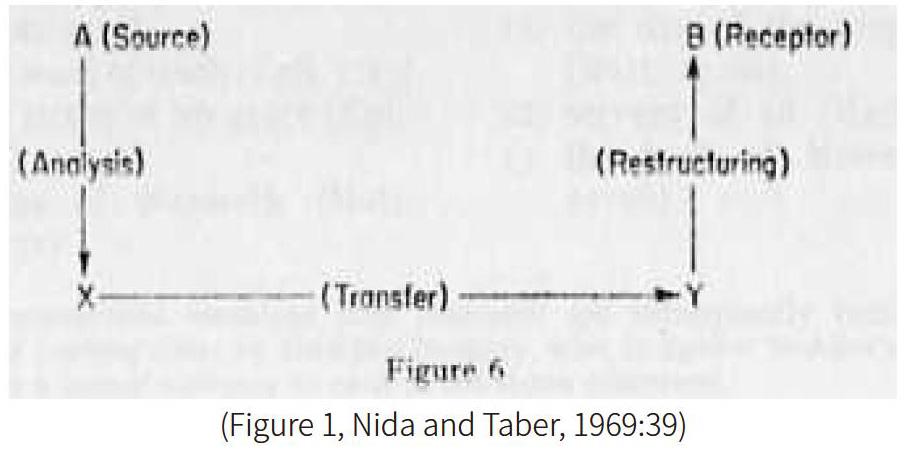
Nida and Taber suggested a scheme in which the translation process using back-transformation is demonstrated with the following flowchart:
We can notice that the translation process using back-transformation occurs at the base level below language forms. By reducing surface structures to kernel sentences, transferring meaning into the target language will be much easier. The form might be different, but the core remains identical. However, as Nida differs his kernel structure from Chomsky's deep structure by instilling it with cultural and social elements, can we say that back-transformation theory could be universally helpful in explaining lengthy sentences in TOEFL iBT reading? As TOEFL reading section is designed with explanatory and expositional articles, cultural elements of English-speaking countries are not considered as objects of examining language competence. Information positioning and message understanding are the primary tosks, so understanding syntactic structure comes as the primary strategy in translating the following sample sentence:
Fuller devised a type of dance that focused on the shifting play of lights and colors on the voluminous skirts or draperies she wore, which she kept in constant motion principally through movements of her arms, sometimes extended with wands concealed under her costumes (ETS, 2017:336).
It is easy to first tell the main clause of this sample sentence syntactically, and the attributive clause (first one) that modifies the object of the main clause. There is a very short attributive clause (second one) tagging behind "skirts or draperies" which are modified by a third one. Finally, the entire sentence ends up with a fourth one. If the syntactic hierarchy is demonstrated in brackets, then it goes like:
or it can be separately presented as,
a. Fuller devised a type of dance
b. The dance focused on play of lights and colors on skirts or draperies
c. She wore the skirts or draperies
d. She kept the skirts or draperies in motion through movement of her arms
e. Her arms were extended with wand concealed under her costume
By this process, readers could sort out the logical connection between each part. So far, we could say that the formal level has been compromised but the deep structure becomes clear. The translation of the entire sentence should be like:
洛伊-富勒發(fā)明了一種通過舞動寬大的舞裙達到光影變換效果的舞蹈。穿著這種舞裙,她通過手臂的動作來保持舞裙的運動,有時候手臂由于隱藏在衣服下面的手杖而變得更長。
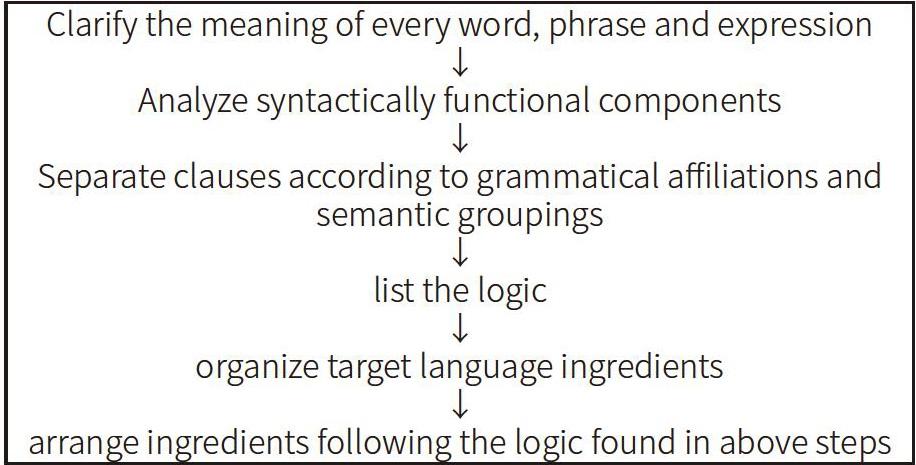
If without the help of back-transformational analysis, it will be hard to break down the sentence into the core and those attachments. Therefore, a basic paradigm could also be suggested to extend the application of such techniques to deal with more complicated syntaxes:
This paradigm indicates a rough outline to conduct back-transformation in translating a relatively lengthy sentence. Test takers could repeat using this strategy in practices upon encountering lengthy sentences. As this method can strengthen language learners' understanding of English syntactic structures, it provides opportunities to strengthen stimulus-response process that could establish faster comprehension upon different contents in complicated structure. When less time is spent dealing with a lengthy sentence, reading comprehension will become efficient and effective.
4. Reflections and Conclusion
Nidas Back-Transformation Theory is the basis upon which the "science" of translation was founded (Gentzler, 2004:46). Often seen in semantic analysis, Back-Transformation is seldom used in second language teaching and learning. Because the application of translation to guide language learners through proficiency tests like TOEFL, IELTS, SAT and ACT oftentimes hovers over practice but still lacks theoretical instructions, this paper could provide a tentative analysis approaching this issue in perspective of intralingual translation, interlingual translation and back-transformation. Though the discussion still lacks empirical verification with support from statistical investigation, ?translation has been widely used in teaching speaking and reading in TOEFL iBT. And there appears great necessity to overview this new type of translation activity in theoretical level. This paper successfully extracted the essential process of back-transformation in reading drills for better comprehension of lengthy sentences and form a paradigm. With this paradigm, it is hoped that this paper could provide some useful tips as reference for second language teaching and learning.
References:
[1]Educational Testing Service. The Official Guide to the TOEFL Test Fourth Edition[M]. New York: McGraw-Hill,2012.
[2]Educational Testing Service. 托福官方考試指南第五版[M].北京: 群言出版社,2017.
[3]Gentzler, Edwin. Contemporary Translation Theories[M]. Shanghai: Shanghai Foreign Language Education Press,2004.
[4]Nida, Eugene A., and Taber, Charles R. The Theory and Practice of Translation[M]. Leiden: Publ. for the United Bible Societies by E. J. Brill,1969.
