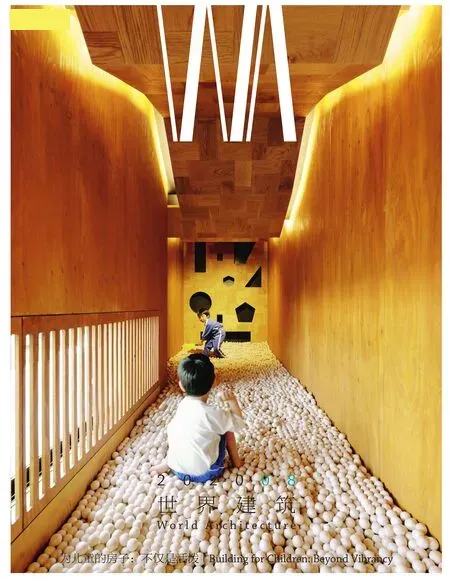
未來兒童中心,安蒂奧基亞,哥倫比亞
2020-08-24 13:33:50建筑設計綜合工坊建筑事務所
世界建筑
2020年8期
關鍵詞:兒童
建筑設計:綜合工坊建筑事務所
Architects: Taller Síntesis
未來兒童發展中心是一家公共機構,坐落在安蒂奧基亞省里奧內格羅。該中心可容納多達400名兒童,主要為周邊同名社區的居民。
這座新建的總部是單層的磚砌建筑,由一系列的拱形亭館組成,取代了早已無法滿足此類功能需求的小建筑。兒童中心的一側面朝馬爾帕索峽谷和森林,而另一側則面向該項目用地上的人工種植森林。
這些亭館均用作教室,可直接通往一系列庭院——不僅起到充分通風及照明的作用,還能在孩子與大自然之間建立起親密關系——使景觀在教育空間中常駐,將教室與大自然有效融合。
此類亭館由與之垂直的體量相連,為該項目提供了集體區域:一間可作為有頂大型庭院的食堂、行政設施、為家長與學生服務的設施、一間對外開放且供社區使用的禮堂,以及為等待孩子的家長們擋風遮雨的有頂大廳。
整個項目周全地考慮了兒童的身高尺度:壁龕、窗戶、家具均是他們可觸及的高度。這樣一來,孩子們可以構建自己專屬的空間景觀。每個房間的色彩處理均賦予了其獨特的性格,讓各個空間都易于識別及使用。 (王單單 譯)


1 拱形亭館/Vaulted pavilions
2 鳥瞰/Aerial view
(1.2 攝影/Photos: 毛里西奧·卡瓦哈爾/Mauricio Carvajal)


3 教室壁龕/Classroom niche(攝影/Photo: 毛里西奧·卡瓦哈爾/Mauricio Carvajal)
4 教室模型/Classroom model
The El Porvenir Child Development Centre is a public institution, located in the municipality of Rionegro, Antioquia. The centre can house up to a total of four hundred children, mainly inhabitants of the neighbouring neighbourhood of the same name.
The new headquarters, which replaces a small building that did not meet the needs of this type of facility, is a single-level brick building made up of a series of vaulted pavilions projecting towards the Malpaso ravine and towards a forest that has been planted as part of the intervention.
These pavilions house the classrooms that have a direct link with a series of courtyards. This allows not only adequate ventilation and lighting but also enables a direct relationship between the children and nature, giving the landscape a permanent presence in the educational spaces and enabling the effective integration of the classrooms with nature.
These pavilions are joined by a volume that is arranged perpendicular to them, and they houses the collective areas of the project: a canteen that functions as a large covered courtyard,administration facilities, services for parents and students, an auditorium that opens directly to the exterior to allow direct use for the community and a covered hall so that parents can wait for their young children without being affected by the weather.
The scale of the children appears throughout the project, niches, windows and furniture are arranged at their height, allowing them to build their own landscape, only available to them. The colour treatment of each of the rooms also gives them a particular character that allows easy identification and appropriation of each space.


5 入口/Access(攝影/Photo: 毛里西奧·卡瓦哈爾/Mauricio Carvajal)
6 平面/Plan
項目信息/Credits and Data
主持建筑師/Principal Architects: 法伊德·瑪雅,戴維·夸爾塔斯/Farhid Maya, David Cuartas
設計團隊/Design Team: 安德森·塞爾納,亞歷杭德拉·蒙托亞,毛里西奧·卡瓦哈爾/Anderson Serna, Alejandra Montoya, Mauricio Carvajal
贊助/Promoters: 麥德林兄弟……
登錄APP查看全文
猜你喜歡
少兒美術·書法版(2021年12期)2021-10-24 02:50:16
少兒美術·書法版(2021年9期)2021-10-20 06:35:28
少兒美術·書法版(2021年7期)2021-10-20 06:29:16
少兒美術·書法版(2021年11期)2021-10-20 06:23:28
少兒美術·書法版(2021年10期)2021-10-20 06:14:04
少兒美術·書法版(2021年8期)2021-10-20 06:08:10
少兒美術(2019年8期)2019-12-14 08:07:00
少兒美術(2019年3期)2019-12-14 08:02:56
雜文選刊(2016年7期)2016-08-02 08:39:56
記者觀察(2010年9期)2010-12-31 00:00:00