
經尿道前列腺電切剜除術與恥骨上前列腺切除術治療大體積前列腺增生療效對比分析
2017-06-27 08:43:20崔博葉純王健
中國實用醫藥
2017年16期
崔博+葉純+王健
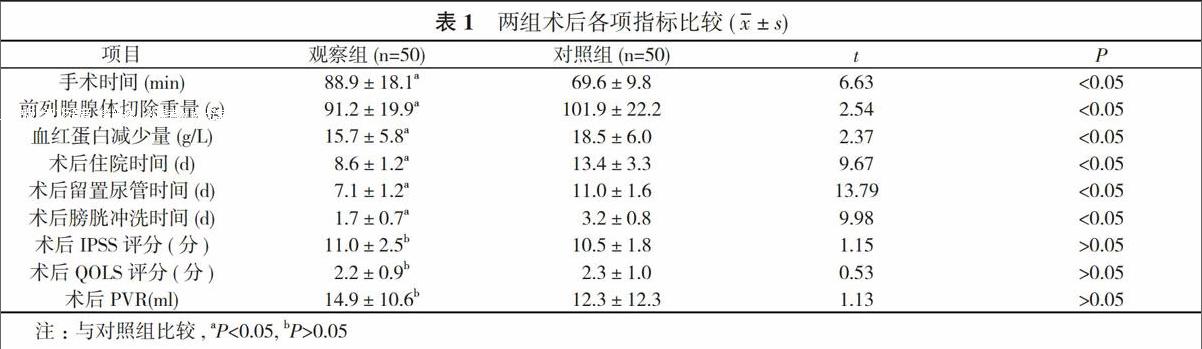
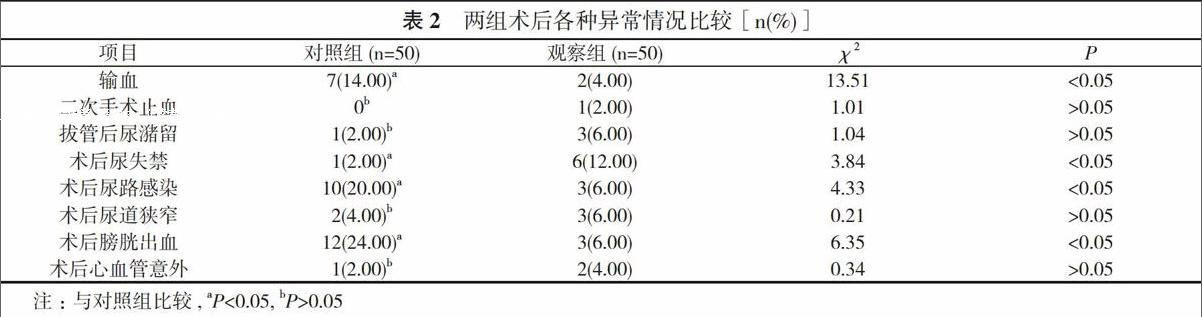
【摘要】 目的 對比分析經尿道前列腺電切剜除術(TUERP)與恥骨上前列腺切除術(SP)治療大體積前列腺增生(BPH)的臨床療效。方法 100例大體積BPH患者為研究對象, 隨機分為對照組和觀察組, 各50例。對照組接受SP, 觀察組接受TUERP。對比兩組患者的臨床療效。結果 觀察組術后國際前列腺癥狀(IPSS)評分、生命質量(QOLS)評分以及殘余尿量(PVR)與對照組比較, 差異無統計學意義(P>0.05);但其手術時間長于對照組, 術后住院時間、留置尿管時間以及膀胱沖洗時間均短于對照組, 前列腺腺體切除重量、血紅蛋白減少量少于對照組, 差異均有統計學意義(P<0.05)。對照組輸血、術后尿路感染、術后膀胱出血比例分別為14.00%、20.00%、24.00%, 均大于觀察組的4.00%、6.00%、6.00%, 術后尿失禁比例為2.00%, 小于觀察組的12.00%, 差異均有統計學意義(P<0.05)。兩組二次手術止血、拔管后尿潴留及術后尿道狹窄、心血管意外比例比較差異無統計學意義(P>0.05)。結論 TUERP與SP均可有效治療大體積BPH, 但相比之下TUERP可明顯減少術后出血量, 于預后十分有利, 值得推廣使用。
【關鍵詞】 大體積前列腺增生;經尿道前列腺電切剜除術;恥骨上前列腺切除術;出血量
DOI:10.14163/j.cnki.11-5547/r.2017.16.017
Comparative analysis of curative effect of transurethral resection of the prostate and suprapubic prostatectomy in the treatment of massive benign prostatic hyperplasia CUI Bo, YE Chun, WANG Jian. Department of Urinary Surgery, Armed Police Frontier Force General Hospital, Shenzhen 518000, China
【Abstract】 Objective To compare and analyze the clinical curative effect of transurethral enucleative resection of the prostate (TUERP) and suprapubic prostatectomy (SP) in the treatment of massive benign prostatic hyperplasia (BPH). Methods A total of 100 massive BPH patients as study subjects were randomly divided into control group and observation group, with 50 cases in each group. The control group received SP, and the observation group received TUERP. Clinical curative effect was compared in two groups. Results The observation group had no statistically significant difference in postoperative international prostatic symptom score (IPSS), quality of life score (QOLS) and postvoid residua (PVR) comparing with the control group (P>0.05), but it had longer operation time and shorter postoperative hospital stay time, inurethral catheter time and bladder irrigation time than the control group, and less prostate gland excision weight and hemoglobin reduction than the control group. Their difference had statistical significance (P<0.05). The control group had higher proportion of blood transfusion, postoperative urinary tract infection, postoperative bladder bleeding respectively as 14.00%, 20.00% and 24.00% than 4.00%, 6.00% and 6.00% in the observation group, and lower postoperative urinary incontinence as 2.00% than 12.00% in the observation group. Their difference had statistical significance (P<0.05). Both groups had no statistically significant difference in proportion of secondary surgical bleeding, urinary retention after extubation, postoperative urethral stricture and cardiovascular accident (P>0.05). Conclusion Both TUERP and SP can be effective in treating massive BPH, but TUERP can obviously reduce postoperative bleeding volume, and it is conductive to prognosis. So it is worthy of promotion and use.
【Key words】 Massive benign prostatic hyperplasia; Transurethral resection of the prostate; Suprapubic prostatectomy; Bleeding volume
BPH俗稱前列腺肥大, 常見于老年男子, 因人體雌雄激素不均衡所致。目前, 臨床上以微創治療為主, 但開放手術治療大體積BPH也具有一定臨床意義。杜明奇等[1]提出TUERP, 并對其臨床價值予以了肯定。為全面評價微創與開放手術的臨床療效, 本文特選取100例大體積BPH患者為研究對象行對照研究, 詳細研究過程報告如下。
1 資料與方法
1. 1 一般資料 選取2015年1月~2017年1月在本院接受不同手術治療的100例大體積BPH患者為研究對象, 隨機分為對照組和觀察組, 各50例。對照組患者年齡65~78歲, 平均年齡(73.8±5.2)歲;平均前列腺體積(128.7±22.8)ml;
合并膀胱結石7例;平均IPSS評分(21.4±4.7)分;平均麻醉風險(ASA)評分(2.4±0.4)分;平均QOLS評分(4.4±1.1)分;平……
登錄APP查看全文
