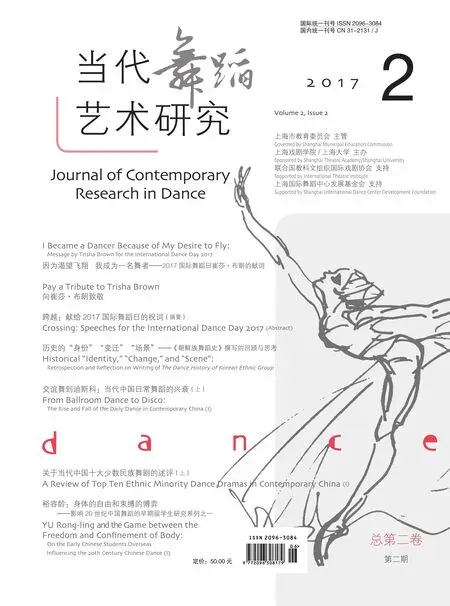
Pay a Tribute to Trisha Brown
2017-04-09 06:46:28PresidentoftheInternationalDanceCommitteeoftheInternationalTheatreInstituteITI
當代舞蹈藝術研究 2017年2期
關鍵詞:創作
President of the International Dance Committee of the International Theatre Institute ITI
[CY] Andromachi Dimitrladou Lindahl
On behalfof the International Dance Committee, I have the honor to present a tribute to the message author for the International Dance Day 2017, Mrs Trisha Brown,who unfortunately died on March 18th.
Trisha Brown belongs to the most important choreographers of our times. For over 50 years, she has been transforming the landscape of modern dance with her choreographic spirit. Her works communicate with a rare directness on the essence of movement, the constant flow of energy, the clarity of the choreographic pattern in space, the challenge to gravity, the physical awareness that surpasses materiality and become a moving meditation, a state of reflection, and a thinking body. Trisha Brown’s dance has purity, simplicity, selfsarcasm, humour, natural grace, intelligence, freedom,and familiarity.
She was born and raised in Aberdeen, Washington,a small town close to the Pacific with beautiful forests,lakes, and rivers as she recalls. Her first contact with dance was not what we call academic. It consisted from jazz, tap dancing, and acrobatics. It was later on that she graduated from the Mills College, and in the Connecticut College summer courses she studied with Jose Limon,Louis Horst, and Merce Cunningham. In 1960, she met Ann Harplin who introduced her to the dance improvisation. One year later, she moved to New York,where she immersed herselfin a community of artists,later known as the Grand Union of the legendary Judson Church Dance Theatre, who questioned the conventions of modern dance, challenged the existing perceptions of performance, and pushed the limits of choreography to an extent that changed modern dance forever.
In this context of experimentation and rebellion of the 1960s, Trisha Brown built her personal vocabulary through improvisation methods using tasks and systems.
In 1970, she formed her company and began producing works inspired by non-theatrical spaces, urban sites, and landscapes, such as “Man Walking Down the Side of a Building,” “Roof Piece,” or dances based on mathematical systems of accumulation like in “Accumulation” and in “Primary Accumulation” in 1972. It was also around this time that she began her collaboration with Robert Rauschenberg. In the 1980’s, she created many innovative productions, like the now iconic “Set and Reset,” with which a cycle of work she called Unstable Molecular Structures, closed. This cycle epitomized the fluid yet unpredictably geometric style that remains a hallmark of her work. Then, she began her relentlessly athletic Valiant Series, pushing her dancers to their physical limits and exploring gender specific movement. Next came the elegant and mysterious “Back to Zero Cycle” in which she pulled back from external virtuosity to investigate unconscious movement. In 1994, she collaborated for the final time with Rauschenberg to create “IfYou Couldn’t See Me,” in which she danced entirely with her back to the audience. Ever keen to reinvent herselfand experiment,Trisha Brown turned her attention to classical music initiating what is known as her Music Cycle. “I worked for a long time in silence,” she was saying. “My research was focused on structure, space, dynamics. Later I discovered that polyphony in classical music has a structure similar to my works.” Her choreography to J. S Bach’sThe Musical of fering—“M. O.” —in 1995 was hailed as a masterpiece by Anna Kisselgof fof theNew York Times, leading her to immerse herselfmore in operatic productions and to choreograph and direct countless high quality operas.
Her ever exploring spirit lead her to experiment with the new technologies, creating the witty and sophisticated“I Love My Robots” in 2007 in collaboration with the Japanese artist and robot designer Kenjiro Okazaki.
Brown’s last work was “I’m Going to Toss My Arms—IfYou Catch Them They’re Yours” in 2011, in collaboration with visual artist Burt Barr, whose striking set is dominated by fans. As well as a prolific choreographer, Trisha Brown was an accomplished visual artist whose drawings have been seen in exhibitions, galleries, and museums throughout the world. She has created over 100 dance works since 1961, and was the first woman choreographer to receive the McArthur Foundation Fellowship Award“Genius Award.” She has been awarded many other honours, including five fellowships from the National Endowment for the Arts. In 1988, she was named Chevallier dans L’ Ordre des Arts et Lettres by the government of France and was eventually elevated to the level of Commandeur. At the invitation of President Bill Clinton,she had served on the National Council for the Arts and Letters from 1994 to 1997. In 2003, she was honoured with the National Medal of Arts and received numerous honorary doctorates. She was an honorary member of the American Academy of Arts and Letters and in 2011 was awarded the prestigious Dorothy and Lillian Gish Price for making “an outstanding contribution to the beauty of the world and to mankind’s enjoyment and understanding of life.”
Trisha Brown died on March 18th after a lengthy illness. As one of the most acclaimed and influential choreographers and dancers of her time, Trisha’s ground breaking work forever changed the landscape of dance,and her contribution will always be remembered and honoured by the generations to come.
我榮幸地代表國際舞蹈委員會向2017國際舞蹈日獻詞人崔莎· 布朗女士致敬。
崔莎 · 布朗是我們這個時代最重要的編舞家之一。在過去的50多年里,她的編舞精神使現代舞蹈的風貌面目一新。她的作品有一種罕見的直接、與動作核心、能量的不斷流動、清晰的空間編舞模式、挑戰地心引力以及超越物質性載體的身體意識對話,成為一種移動著的冥想、一種反思的狀態、一個正在思考的身體。崔莎· 布朗的舞蹈純粹、質樸,透露著自我諷刺、幽默,有著自然的優雅、靈性、自由和熟悉感。
她出生并成長于美國華盛頓州阿伯丁市。阿伯丁市是一個靠近太平洋的小鎮,在她的記憶里,那兒有美麗的森林、湖泊和河流。她最初接觸舞蹈,是從爵士、踢踏舞和雜技表演開始的。在那之后,她就讀并畢業于米爾斯學院,然后開始系統學舞。她曾參加康涅狄格學院暑期課程,跟隨荷西· 李蒙、路易斯· 霍斯特和默斯· 坎寧漢學習舞蹈。1960年,她認識了安娜· 哈爾普林,第一次了解了舞蹈即興創作。一年以后,她移居紐約,投入藝術家團體中,即后來大名鼎鼎的賈德遜教堂舞蹈劇院的大聯盟舞團。這些藝術家們質疑現代舞蹈的傳統風格,挑戰現有的表演感知,突破編舞的極限,永遠改變了現代舞。

崔莎 · 布朗創作表演:《所在地》 (1982)
攝影:洛伊斯 · 格林菲爾德
供圖: 崔莎 · 布朗舞團
Locus, choreographed and performed by Trisha Brown, 1982 Photo ? Lois Greenfield
Photo courtesy: Trisha Brown Dance Company
在20世紀60年代實驗性創作和對傳統反叛的大背景下,崔莎· 布朗用任務編舞和系統編舞的即興創作法構建了自己的舞蹈語匯。
1970年,她成立了自己的舞團,受非戲劇空間、城市景點以及鄉村景觀的啟發,她創作了《沿墻壁行走的人》和《屋頂》等作品。借助數學累積系統,1972年,她創作了《積累》和《初步積累》等作品。也是在此期間,她開始和羅伯特· 勞森伯格合作。20世紀80年代,她推出了很多創意作品,如標志性的《設置與重置》。該作品標志著布朗的周期作品—“不穩定分子結構”的完成。這一周期的作品是她流動而又不可預知幾何風格的典范,成為她的殿堂級作品之一。隨后她開始了她運動風格的“勇敢系列”,讓她的舞者挑戰身體的極限,探索具體性別的動作。之后是優雅而神秘的“重新歸零”周期作品。布朗不再追求外在的精湛技藝,轉而研究無意識的動作。1994年,她最后一次與勞森伯格合作完成了《如果你看不見我》。在整個作品中她都是背對觀眾的。崔莎· 布朗不僅全心投入到創新和實驗中,也把注意力投向古典音樂,推出了她的“音樂周期”作品。她說道:“我創作了很長一段時間的無音樂舞蹈,我的研究專注于舞蹈結構、空間和力學。后來我發現古典音樂中的復調和我的作品有類似的結構。”1995年,她基于巴赫的《音樂的奉獻》所編排的作品—《M.O.》,被《紐約時報》的安娜 · 基賽爾霍夫贊為“大師之作”。這也使她更多地投身于歌劇的作品創作,編排、導演了眾多高質量的歌劇作品。
她一貫的探索精神讓她對一些新技術進行了嘗試,與日本藝術家、機器人設計師岡崎乾二郎于2007年合作推出了詼諧、深奧又微妙的《我愛我的機器人》。
布朗最后一部作品是2011年與視覺藝術家伯特 · 巴爾合作完成的《我扔出我的手臂—誰接住它,它就屬于誰》,舞臺布景設置了大量巴爾設計的風扇,非常引人注目。布朗不僅是一位多產的編舞家,還是一位頗有成就的視覺藝術家。她的繪畫作品屢見于世界各地的展覽、畫廊以及博物館。1961年以來,她共完成了100多部舞蹈作品,并成為首位獲得麥克阿瑟基金會“天才獎”的女性編舞家。除此之外,她還獲得很多其他榮譽,包括五次國家藝術基金獎。1988年,她被法國政府授予“藝術與人文騎士勛章”, 并最終獲得“司令勛章”。應總統比爾· 克林頓之邀,她于1994年至1997年在美國國家藝術委員會任職。2003年,布朗獲得國家藝術勛章并榮獲很多榮譽博士頭銜。她曾是美國文學藝術學會的榮譽會員。2011年,她榮獲知名的“多蘿西/麗蓮 · 吉許榮譽獎”,以表彰她對“世界之美、人類愉悅以及生命理解做出的杰出貢獻”。
崔莎· 布朗于2017年3月18日因病逝世。作為她所在時代的最具代表性和影響力的編舞家以及舞蹈家之一,崔莎· 布朗極具突破性的作品永遠地改變了舞蹈的風貌,她所做的貢獻將被永遠銘記和尊崇。

崔莎 · 布朗創作表演:《設置和重置》 (1996)
攝影:克里斯 · 卡利斯
供圖:崔莎 · 布朗舞團
Set and Reset, choreographed and performed by Trisha Brown, 1996 Photo ? Chris Callis
Photo courtesy: Trisha Brown Dance Company
猜你喜歡
小學生優秀作文(高年級)(2022年9期)2022-10-08 06:29:14
寶藏(2020年10期)2020-11-19 01:47:54
現代裝飾(2020年7期)2020-07-27 01:27:46
創作(2020年3期)2020-06-28 05:52:44
讀友·少年文學(清雅版)(2020年2期)2020-06-15 11:16:34
讀友·少年文學(清雅版)(2019年8期)2019-12-21 01:44:14
中華詩詞(2019年5期)2019-10-15 09:06:10
讀友·少年文學(清雅版)(2018年3期)2018-09-10 06:04:54
文藝論壇(2016年23期)2016-02-28 09:24:07
小說月刊(2014年1期)2014-04-23 09:00:04