
西藏多巴地區片麻巖變質演化過程及其地質意義
2016-11-09 14:16:42李鵬張聰劉曉瑜楊經綏符義穩
地球科學與環境學報 2016年5期
李鵬+張聰+劉曉瑜+楊經綏+符義穩
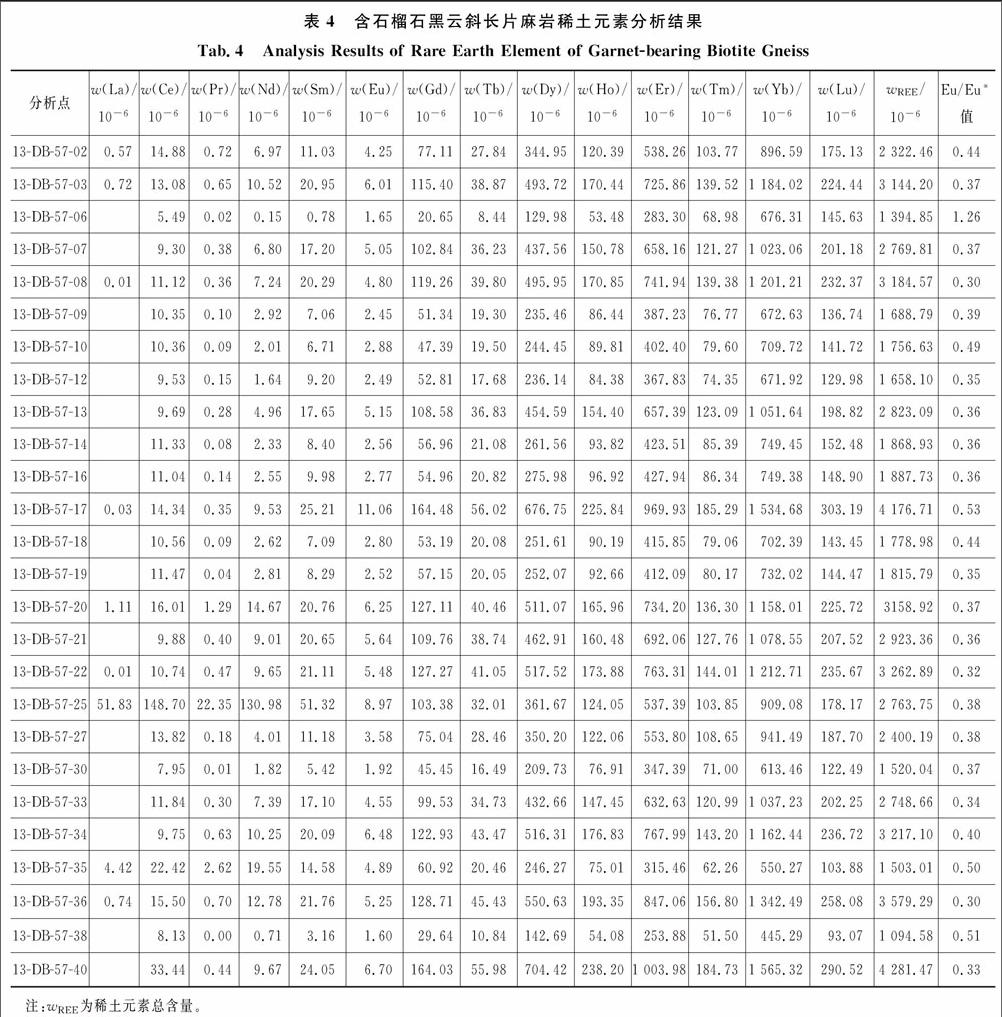


摘 要:拉薩地體普遍出露一套角閃巖相、局部達麻粒巖相的變質巖系, 以往的區域地質研究普遍認為這套變質巖為拉薩地體的前寒武紀變質基底, 稱之為念青唐古拉巖群。盡管現有的研究認為念青唐古拉巖群經歷了前寒武紀變質作用,但部分地區仍缺少令人信服的巖石學及地質年代學證據。通過對拉薩地體北部多巴地區出露的片麻巖進行巖石學及礦物學研究,認為其為一套經歷角閃巖相變質作用的中級變質巖系,主要巖石類型有云母片巖和含石榴石黑云母斜長片麻巖。礦物電子探針分析表明,組成巖石的石榴石、長石、黑云母等礦物均為變質成因礦物。石榴石無明顯核邊分帶結構,成分相對均一。利用傳統礦物對溫壓計進行了溫壓條件估算,得到640 ℃~660 ℃和0.60~0.67 GPa的角閃巖相變質溫壓條件。首次利用LA-ICP-MS方法對該區花崗質片麻巖中的鋯石進行年代學研究,得到(847.0±5.7)Ma的新元古代變質年齡,可與該區域念青唐古拉巖群的變質時代對比,為該片麻巖歸入念青唐古拉巖群提供了切實可靠的年代學證據。
關鍵詞:變質作用;花崗質片麻巖;溫壓條件;新元古代;鋯石年代學;念青唐古拉巖群;拉薩地體;西藏
中圖分類號:P588.34 文獻標志碼:A
文章編號:1672-6561(2016)05-0601-11
Abstract: A suit of metamorphic rocks, which experience amphibolite and partly granulite facies metamorphism exposes on Lhasa block, are recognized as the basement of Lhasa block and named as Nyainqentanglha Group in the former literatures. Although the rocks are thought to be part of Nyainqentanglha Group, however, it is still lack of reliable geochronological data in some area. By means of the petrological and mineralogical investigations on the gneisses exposed in Duoba area of the north part of Lhasa block, it shows that the gneiss suit is composed of mica schist and garnet-bearing plagioclase gneiss, which has experienced amphibolite facies metamorphism. The garnet in the gneiss with homogeneous composition does not have core-rim structure. The traditional mineral-pair geothermobarometer shows that the metamorphic pressure-temperature conditions are 640 ℃-660 ℃ and 0.60-0.67 GPa, which belong to amphibolite facies metamorphism. LA-ICP-MS zircon U-Pb dating technique is used for the first time to date the metamorphic age of the gneiss in Duoba area and yield the Proterozoic metamorphic age of (847.0±5.7)Ma, which can be compared with Nyainqentanglha Group in the area, exhibiting strong evidence that the gneiss in Duoba area is also part of Nyainqentanglha Group.
Key words: metamorphism; granitic gneiss; pressure-temperature conditions; Neoproterozoic; zircon geochronology; Nyainqentanglha Group; Lhasa block; Tibet
0 引 言
青藏高原自北向南由松潘—甘孜地體、羌塘地體、拉薩地體和喜馬拉雅造山帶組成[1-2]。位于歐亞大陸南邊緣的拉薩地體蘊含著豐富的大陸裂解、漂移、聚合以及碰撞造山作用相關的構造運動、巖漿活動和變質作用的地球動力學信息,吸引了國內外眾多研究者的關注[1,3-6]。拉薩地體位于歐亞板塊的南端,在新生代與印度大陸的碰撞形成了喜馬拉雅造山帶[4-5],因此,拉薩地體的演化過程是揭示青藏高原形成和演化歷史的關鍵問題之一。拉薩地體中的中、高級變質巖被前人認為是前寒武紀變質基底,并被稱為念青唐古拉巖群[7-12]。但近年來的研究表明,拉薩地體經歷了多期次不同類型的變質作用,按照變質程度的不同,自北向南可劃分為4個變質帶:北部的安多高壓變質帶,形成于早侏羅世的陸-陸碰撞造山過程中;中部的納木錯高壓變質帶,形成于晚新元古代洋殼俯沖過程中;南、北拉薩地體之間的松多高壓變質帶,形成于晚古生代的洋殼俯沖至早中生代陸-陸碰撞造山帶過程中;南部的岡底斯高溫/中壓復合變質帶,形成于中、新生代的洋殼俯沖到陸-陸碰撞造山過程中[13]。因此,部分學者將前寒武紀變質基底“念青唐古拉巖群”以不同時代、不同構造為依據劃分為“那果巖群”、“松多巖群”以及“林芝巖群”[14]。
