含π-π相互作用的Cuガ配位聚合物的合成、表征、晶體結(jié)構(gòu)及發(fā)光性能
2015-09-15 01:41:08黃廷洪曾憲光
無機化學(xué)學(xué)報 2015年12期
關(guān)鍵詞:實驗室
黃廷洪 顏 杰 楊 虎 曾憲光 陽 龑
(四川理工學(xué)院材料與化工學(xué)院,材料腐蝕與防護(hù)四川省重點實驗室,自貢 643000)
0 Introduction
The design and construction of coordination polymers with novel topologies and structural motifs have been one of the most active research subjects in the field of coordination chemistry due to their properties in catalysis[1-4],separation[5-7],molecular recognition[8-10]and photoluminescence[11-15].So far,some coordination polymer networks can be obtained by the changeof reaction-influencingfactorssuch asinorganic counter ions,organic ligands and metal-to-ligand ratio[16-18].In particular,changing organic ligands with variable bridging lengths,conformation and flexibility is a powerful and synthetically convenient way of structural modifying of coordination polymers[19-21].Use of a mono-ligand system can result in the formation of new coordination polymers[22-25],but a mixed-ligand system containing two or three types ligands provides more changeable to form much more complicated and fantastic topological types of two-,and threedimensional nets[26-31].
Currently,the research on weak interactions have grown rapidly and have directed much attention toward the construction of supramolecular structures[32-36],especially deliberate design of coordination polymers[37-42].The extent of the π…π stacking interactions of copperガcompounds containing pyridyl ligands has result in the observation of fascinating structures and luminescent properties[43-45],but predicting and designing supramolecular networks of copperガcoordination polymers formed by inter-chain weak interactions,such asπ…πstacking interactions,is relatively difficult.It appears that the design of copper ガcoordination polymers with supramolecular structures are challenging but important.Herein,we report the synthesis,structure,characterization and luminescent properties of copperガcoordination polymers{[Cu2(4-bpo)2(CH3CN)2(PPh3)2](BF4)2}n(1) and {[Cu(4-bpo)(CH3CN)(dppe)0.5]BF4}n(2)(PPh3=triphenylphosphine,dppe=1,2-bis(diphenylphosphino)ethane, 4-bpo=2,5-bis(4-pyridyl)-1,3,4-oxadiazole),indicating diverse and interesting 1D chain,2D layer and 3D extended supramolecular structures constructed by inter-chain weak interactions.In addition,solid-state emission spectra of complexes 1 and 2 are also observed.
1 Experimental
1.1 General methods and materials
All chemicals were of AR grade and were used as received without further purification.Ligand 2,5-bis(4-pyridyl)-1,3,4-oxadiazole(4-bpo)was prepared according to references[46-48].IR spectra were recorded as KBr pellets on a Nicolet 6700 spectrometer in the range 4 000 ~450 cm-1.Elemental analyses were measured with a Carlo ERBA 1106 analyzer.1H NMR,11B NMR and19F NMR spectra were recorded on a Bruck 400 spectrometer at 400.15,128.3 and 376.5 MHz,respectively.The luminescent spectra of 1 and 2 were measured at room temperature at a FL3-P-TCSPCfluorescence spectrophotometer.
1.2 Synthesis of{[Cu2(4-bpo)2(CH 3CN)2(PPh3)2](BF4)2}n(1)
A mixture of[Cu(CH3CN)4]BF4(0.031 6 g,0.1 mmol)and 4-bpo (0.022 4 g,0.1 mmol)in 5 mL CH3CN/DMF was stirred at room temperature for 0.5 h and then PPh3(0.026 2 g,0.1 mmol)was added.The reaction mixture was allowed to stir for 0.5 h at room temperature.The vapor diffusion of diethyl ether into the solution gave yellow block crystals.The complex was obtained by filtration,washed with diethyl ether and dried in vacuo.Yield:40%.Anal.Calcd.for C64H52B2Cu2F8N10O2P2(%):C,56.70;H,3.87;N,10.33.Found(%):C,56.43;H,4.05;N,10.09.IR(cm-1):3 451(br),3 059(w),2 271(w),1 613(m),1 566(m),1 540(w),1 480(s),1 436(s),1 422(m),1 054(vs),839(m),746(s),697(s),520(s).1H NMR(CD3SOCD3,25 ℃,TMS): δ2.08 (6H,-CH3),6.95~10.35 (46H,PPh3+bipy).19F NMR (CD3SOCD3,25 ℃,TMS): δ-148.3.11B NMR(CD3SOCD3,25 ℃,TMS):δ-1.32.
1.3 Synthesis of{[Cu(4-bpo)(CH 3CN)(dppe)0.5]BF4}n(2)
The synthesis of 2 was similar to that of 1 using dppe(0.019 9 g,0.050 mmol)instead of PPh3.Yield:49%.Anal.Calcd.for C27H23BCuF4N5OP(%):C,52.74;H,3.77;N,11.39.Found(%):C,52.37;H,3.81;N,11.27.IR(cm-1):3 450(br),3 031(w),2 253(w),1 616(w),1 565(w),1 538(w),1 480(m),1 457(w),1 424(s),1 060(vs),838(m),744(m),715(m),504(s).1H NMR(CD3SOCD3,25 ℃,TMS):δ2.07(3H,-CH3),2.20~2.42(2H,P-CH2-),7.07~9.98(18H,PPh2+bipy).19F NMR(CD3SOCD3,25℃,TMS):δ-148.3.11BNMR(CD3SOCD3,25 ℃,TMS):δ-1.33.
1.4 X-ray crystallography
Diffraction data for complexes 1 and 2 were collected on a Bruker APEX CCD diffractometer with graphitemonochromated Mo Kα radiation(λ=0.071 073 nm)using the φ-ω technique at room temperature.The crystal structures were solved by direct methods and refined by full-matrix least-squares on F2using SHELXTL[49].All hydrogens were generated geometrically,assigned fixed isotropic thermal parameters,and included in structure factor calculations.During the structure refinement of 1,an unidentifiable and badly disordered solvent molecule (probably H2O)was omitted by the SQUEEZE option in PLATON.The crystal of 2 was very small and had very weak high angle data,the data was of poor quality (The ratio of data completeness is 0.93,but the molecule structure can be determined).The details of the crystal data are ruled out in Table 1,and selected bond lengths and angles for complexes 1 and 2 are summarized in Table 2.
CCDC:1043971,1;1043972,2.
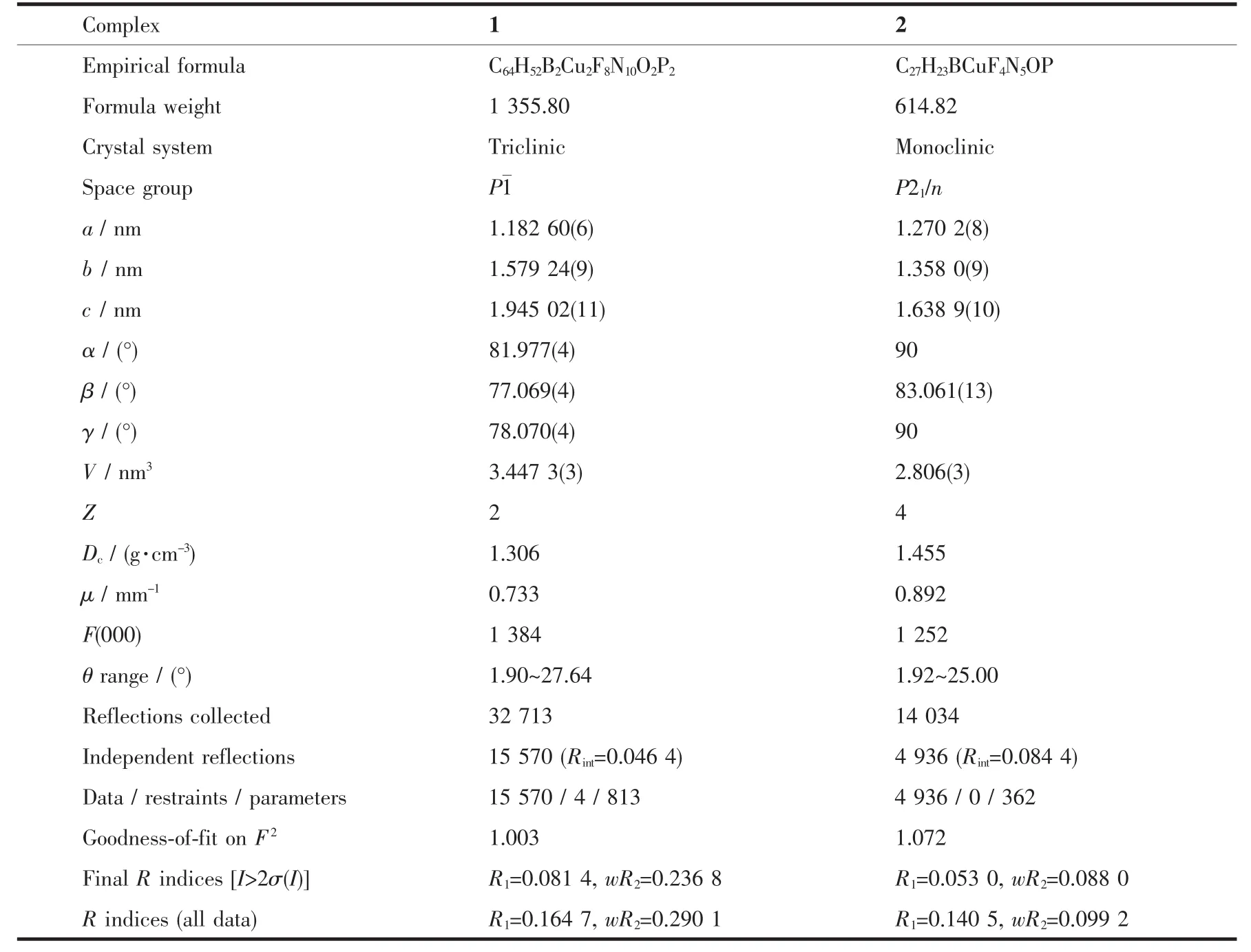
Table 1 Crystal data and structure refinement details of complexes 1 and 2

Table 2 Selected bond lengths(nm)and angles(°)for complexes 1 and 2
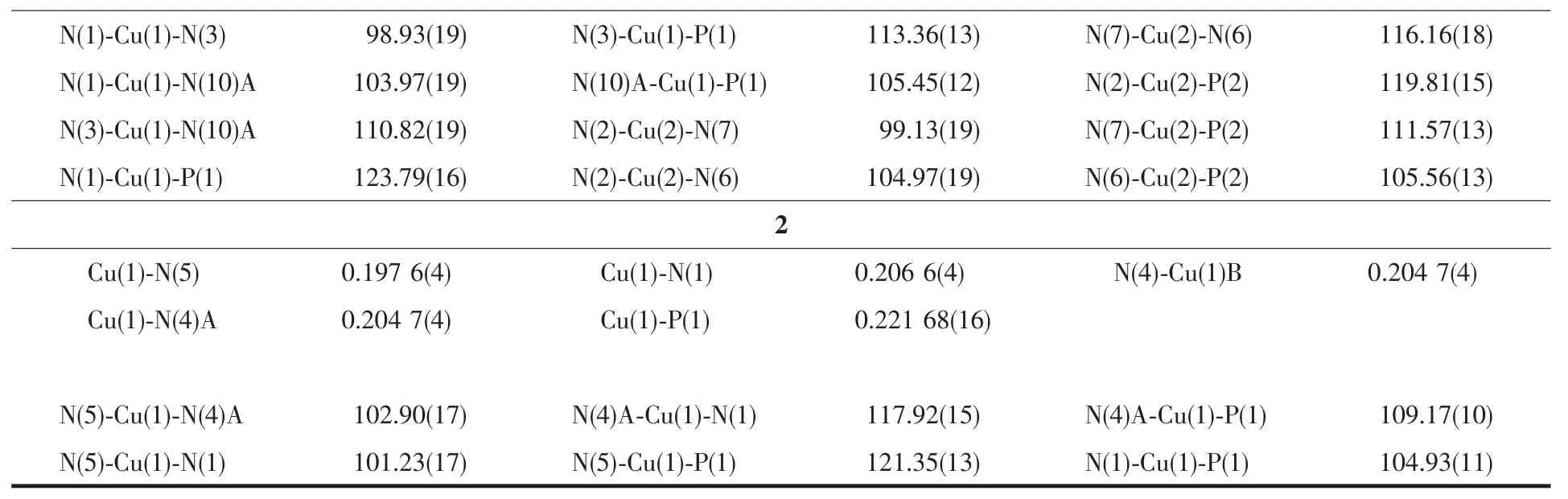
Continued Table 2
2 Results and discussion
2.1 Structural description
2.1.1 {[Cu2(4-bpo)2(CH3CN)2(PPh3)2](BF4)2}n(1)
Single-crystal analysis shows,as shown in Fig.S1,that the general structure having two different Cuガcenters present in the asymmetric unit.Both Cu1 and Cu2 are coordinated by two Npyridylatoms from 4-bpo,one Nacetonitrileatom from CH3CN and one P atom from PPh3,to yield a distorted tetrahedral geometry(Fig.1 and Fig.S1).The Cu-N bond lengths(0.199 0(5)~0.209 8(4)nm)and Cu-P bond lengths(0.221 88(15)and 0.222 22(16)nm)are within the normal ranges[50]and the metal ions are separated by the Cu1…Cu2 distances of 1.320 7 and 1.352 3 nm.Corresponding NCu-Nbond anglesrangefrom98.93(19)°to116.16(18)°,while the N-Cu-P bond angles are in the range of 105.45(12)°~123.79(16)°.
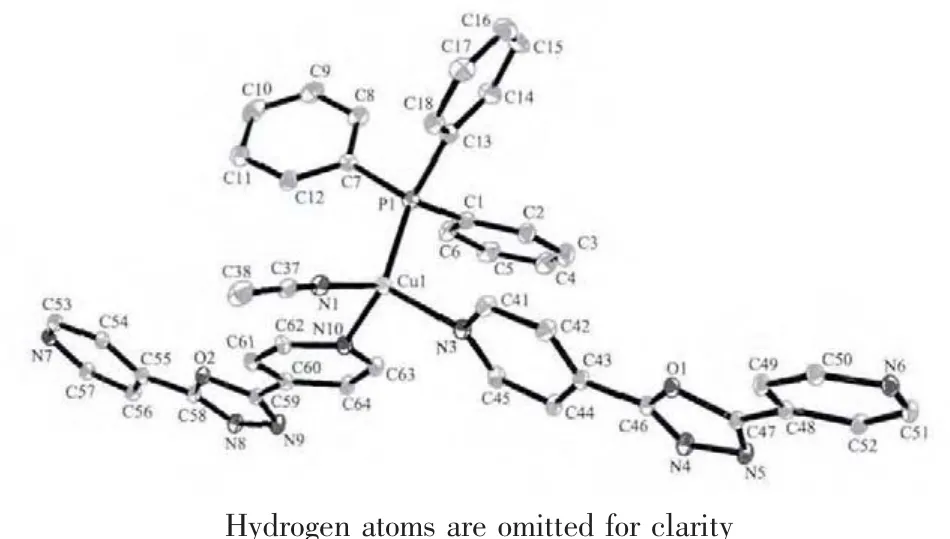
Fig.1 Coordination environments of the Cuガ atoms(Cu1)in 1 with displacement ellipsoids drawn at the 10%probability level
In the solid state,the Cu1 and Cu2 centers are linked to each other by 4-bpo through both terminal N-donors into 1D “W”-shape chain,as shown in Fig.2,which contains two different individual “l(fā)inks”.The neighboring chains are anti-parallel to each other with thenearest inter-chain Cu…Cu distanceof 0.669 9 nm.Theseone-dimensional chainsfurther stack together via intermolecularπ…π interactions to produce infinite 1D bilayer architecture(Fig.3a).In 1D bilayer architecture,two distinct types of inter-chainπ…π stacking interactions are observed: (a)the closest approach between the oxadiazole and pyridyl rings from two distinct 4-bpo is 0.334 2 nm,with the centroid … centroid distances of 0.3674 and 0.377 2 nm and dihedral angles of 2.70°and 13.90°;(b)the center-to-center distances of two parallel pyridyl rings from the two neighboring 4-bpo molecules are 0.385 4 and 0.391 9 nm.Theordered-layer-lattic BF4-islocated between these 1D bilayer chains (Fig.3b).Moreover,1D “W”-shape chain extend to generate a 2D network by intermolecular π…π stacking interactions(Fig.4).The oxadiazole ring from 4-bpo in 2D supramolecular network parallel to phenyl rings attached to phosphorus with a centroid-to-centroid distance of 0.379 8 nm and an offset dihedral angle of 15.63°,showing the existence of significantπ…π stacking interactions.The 2Dπ-stacking structure also involves intermolecular C-H…π interactions,with CH/π distances of 0.271~0.299 nm and angles of 145°~166°,respectively,and the weak interactions of C-H…N and C-H…F hydrogen bonds(Table S1).
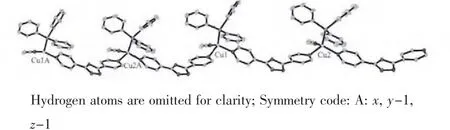
Fig.2 A view of the 1D[Cu2(PPh3)2(4-bpo)2(CH3CN)2]n chain
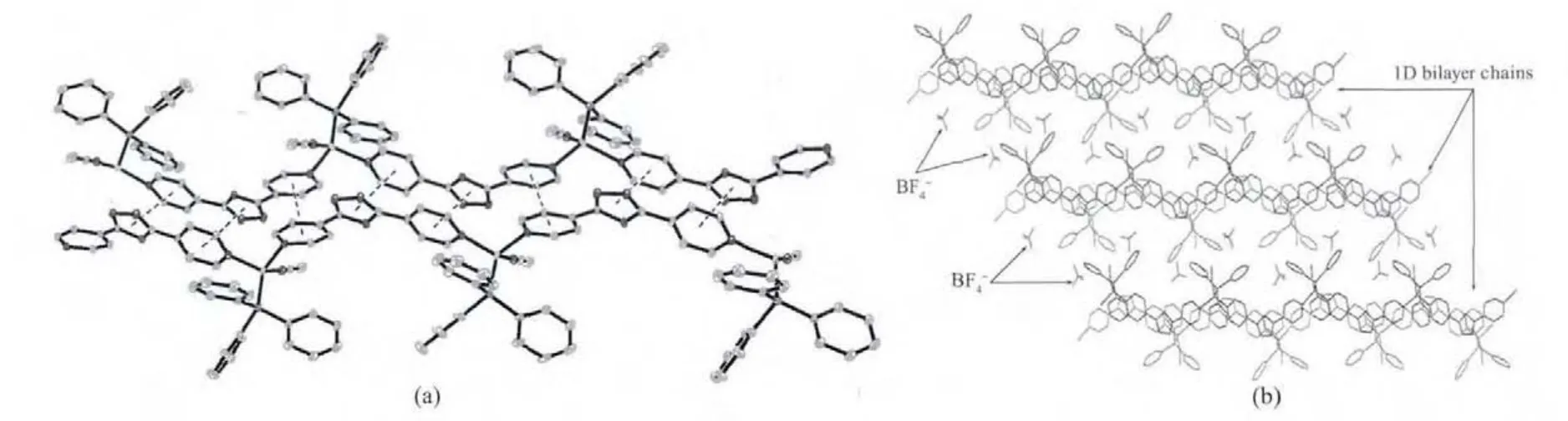
Fig.3 (a)Bilayer architecture in 1 formed by the 4-bpo-bridged Cuガ coordination polymer chain and intermolecular π…πstacking interaction;(b)Ordered-layer-latticein 1 located between 1D bilayer chains
2.1.2 {[Cu(4-bpo)(CH3CN)(dppe)0.5]BF4}n(2)
Single-crystal analysis shows,as shown in Fig.5,that the structure of 2 consists of a 1D ladder-like chain structure,based on the basis of the 4-bpobridged Cuガcoordination polymer chain and the dppe connector (T-shaped motifs).Different from 1,the fundamental buildingunit containsone independent Cuガcenter,one pair of symmetry-related 4-bpo and a dppe spacer.The Cu+ion adopts a distorted tetrahedral geometry via coordinating to two Npyridylatoms of two 4-bpo ligands,one Nacetonitrileatom of CH3CN and one Patom of one dppe ligand.The Cu-N bond lengths(0.197 6(4)~0.206 6(4)nm)and Cu-P bond lengths(0.221 68(16)nm)are within the normal ranges[51].Corresponding N-Cu-N bond angles range from 101.23(17)°to 117.92(15)°,while the N-Cu-P bond angles are in the range of 104.93(11)°to 121.35(13)°.
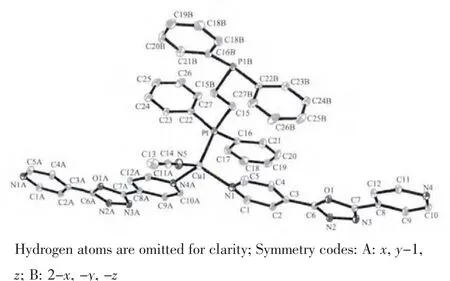
Fig.5 Coordination environments of the Cuガ atoms in 2 with displacement ellipsoids drawn at the 10%probability level
In the solid state,the 4-bpo ligand in 2 adopts a bidentate bridging mode to connect with two copperガatoms.The adjacent Cuガ centers are linked by two terminal N-donors of 4-bpo ligand to form infinite Cu-4-bpo chains(Cu…Cu 1.358 0 nm)along the b axis;the neighbouring chains are further linked by dppe ligand to generate a ladder-like chains with the Cu…Cu distance of 0.724 8 nm (Fig.6).These 1D ladderlike chains are further interlinked parallel with the ab plane to generate a 2D network through intermolecular π…π stacking interactions.In the 2D net,the planes of pyridyl and oxadiazoleare approximately parallel with a centroid-to-centroid distance of 0.377 9 nm and an offset dihedral angle of 5.25°,revealing the existence of π … π stacking interactions(Fig.7a).Similarly,the packing structure involvesπ…π interactions parallel with the ac plane,being analogous to that of 1 (Fig.7b).In 2D supramolecular network,the oxadiazole ring from 4-bpo parallel to phenyl rings attached to phosphorus with a centroid-to-centroid distance of 0.368 8 nm and an offset dihedral angle of 5.64°,which is shorter than the corresponding values in complex 1.In other words,adjacen1D ladder-like chains in the ab plane interact with each other by one kind of intermolecularπ…π stacking interactions(Fig.7a)to form two-dimensional(2D)supramolecular net,which are further linked by the other kind of intermolecularπ…πstacking interactions (Fig.7b)to form a three-dimensional(3D)supramolecular structure (Fig.8a).Moreover,the ordered-layer-lattic BF4-is located between these 3D networks(Fig.8b).In the 3D network,and C-H…F and C-H…N hydrogen bonds are also observed(H…F 0.241 nm,C…F 0.329 nm;H…N 0.238 nm,C…N 0.333 nm).
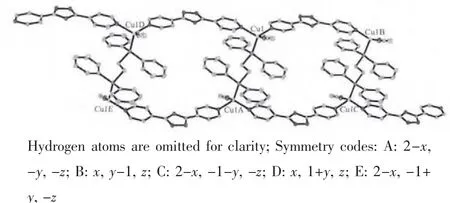
Fig.6 1D ladder-like network formed by the 4-bpobridged Cuガcoordination polymer chain and the dppe connector in 2
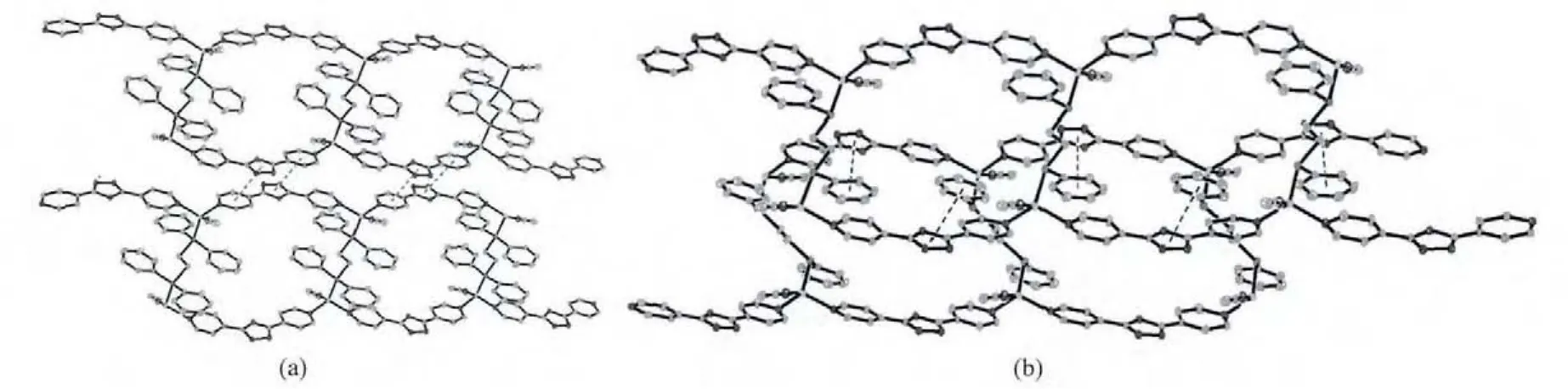
Fig.7 2D supramolecular network formed by intermolecularπ…πinteractions parallel with the ab(a)or ac(b)plane in 2
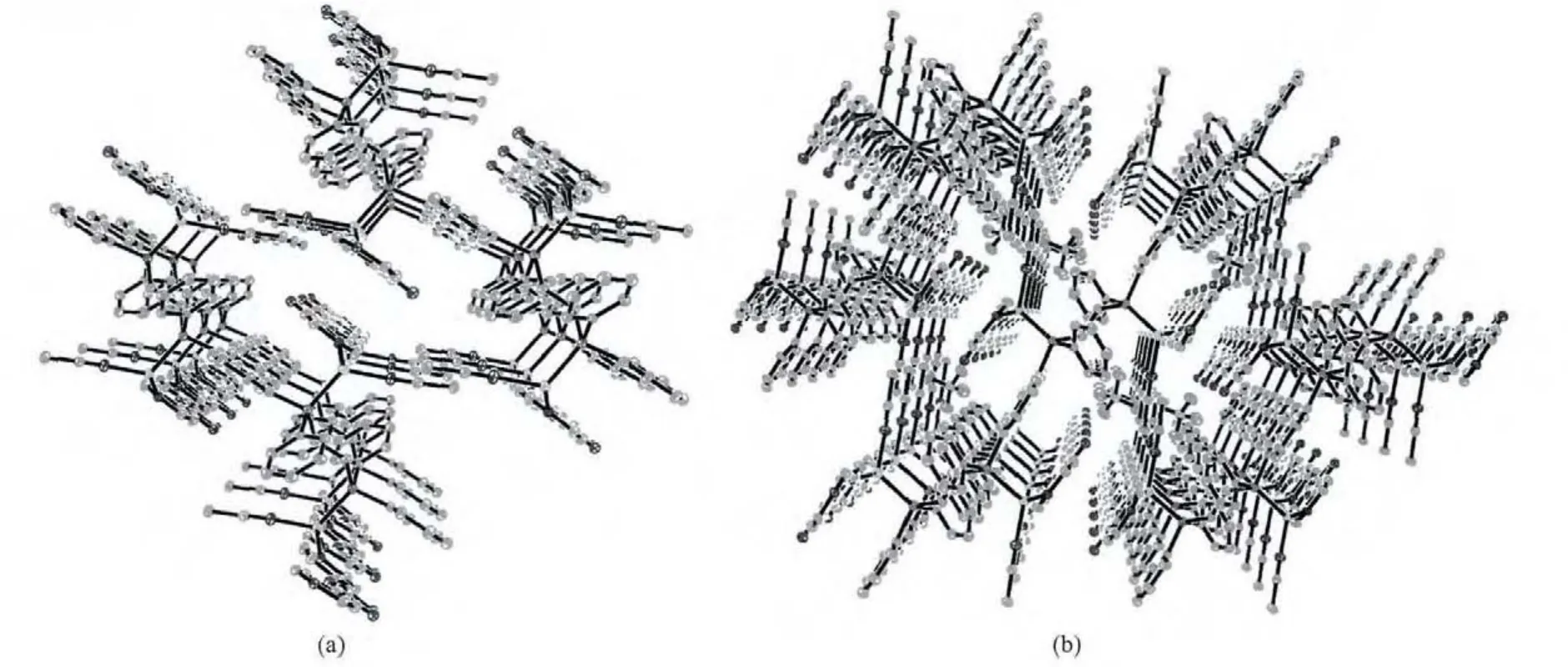
Fig.8 (a)3D framework of 2;(b)Ordered-layer-lattice BF4-in 2 located between 3D networks
2.2 Luminescent properties
Coordination compounds constructed from d10metal centers and conjugated organic ligands are promising candidates for hybrid luminescent materials with potential applications such as dye-sensitized solar cells,light-emitting or electrochemical devices and so on.As shown in Fig.9,Solid-state emission spectra of complexes 1 and 2 were recorded at room temperature,showing that excitation of the microcrystalline samples affords different fluorescent emissions,with the maximum peaks occurring at 582 nm for 1(λex=400 nm)and 440 for 2(λex=380 nm).Moreover,the maximal emission of 4-bpo ligands is observed at 417 nm (λex=370 nm)according to references[52-53].With regard to compound 1,the significant red shift of the emission band (165 nm)compared with that of 4-bpo may be assigned to metal-to-ligand charge transfer(MLCT)[54-55].For 2,the very similar profiles of their emission peaks,in comparison with that of the free 4-bpo,indicate that their photoluminescent mechanism may be properly ascribed to intraligand(IL)π→π*transition[56-57].
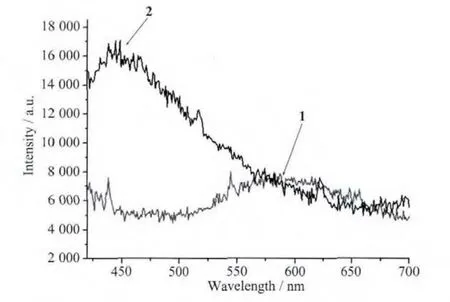
Fig.9 Emission spectra of complexes 1 and 2 in the solid state at room temperature
3 Conclusions
In this work,we have presented a new family of coordination polymers formulated as{[Cu2(4-bpo)2(CH3CN)2(PPh3)2](BF4)2}n(1)and{[Cu(4-bpo)(CH3CN)(dppe)0.5]BF4}n(2),respectively.These polymers show different supramolecular architectures:1 consists of 1D “W”-shape/bilayer chains and 2D π-stacking net;2 shows the existence of 1D ladder-like chain,2D network and 3D supramolecular structure.All these results undoubtedly reveal that the diverse structures of coordination polymers mainly depend on the Cu+ions with 4-bpo,readily interacting with different flexible/angular ligands(PPh3and dppe)to result in a variety of supramolecular (1D or 2D)networks.Moreover,the extended supramolecular networks of the lower-dimensional coordination polymers can be well modified by the secondary interactions such as intermolecularπ…πstacking interactions.Solid-state emission spectra of complexes 1 and 2 were observed at room temperature,showing that their photoluminescent mechanism may be properly attributed to ILCT or MLCT.
Supportinginformation is available at http://www.wjhxxb.cn
[1]Doherty S,Knight JG,Ellison JR,et al.Green Chem.,2014,16(3):1470-1479
[2]Dronova M S,Bilyachenko A N,Yalymov A I,et al.Dalton Trans.,2014,43(2):872-882
[3]Hou Y L,Sun R W Y,Zhou X P,et al.Chem.Commun.,2014,50(18):2295-2297
[4]Jiang L,Wang Z,Bai SQ,et al.Dalton Trans.,2013,42(26):9437-9443
[5]Falcaro P,Ricco R,Doherty C M,et al.Chem.Soc.Rev.,2014,43(16):5513-5560
[6]Mao Y,Su B,Cao W,et al.ACSAppl.Mater.Int.,2014,6(18):15676-15685
[7]Sandroni M,Maufroy A,Rebarz M,et al.J.Phys.Chem.C,2014,118(49):28388-28400
[8]Dominguez-Martin A,Choquesillo-Lazarte D,Dobado J A,et al.Dalton Trans.,2013,42(17):6119-6130
[9]Park K H,Noh TH,Shim Y B,et al.Chem.Commun.,2013,49(38):4000-4002
[10]Santos-Figueroa L E,Moragues M E,Climent E,et al.Chem.Soc.Rev.,2013,42(8):3489-3613
[11]Cheng J K,Yao Y G,Zhang J,et al.J.Am.Chem.Soc.,2004,126(25):7796-7797
[12]Huang T H,Yan J,Liu Y F,et al.Aust.J.Chem.,2015,68(7):1144-1151
[13]Huang TH,Yan J,Yang H,et al.J.Mol.Struct.,2015,1101:66-72
[14]Zhan SZ,Li M,Zhou X P,et al.Inorg.Chem.,2011,50(18):8879-8892
[15]Zhang J,Xiong R G,Chen X T,et al.Organometallics,2002,21(1):235-238
[16]Dong Y B,Cheng J Y,Huang R Q,et al.Inorg.Chem.,2003,42(18):5699-5706
[17]Jin F,Zhang Y,Wang H Z,et al.Cryst.Growth Des.,2013,13(5):1978-1987
[18]Wu JY,Chao TC,Zhong M S.Cryst.Growth Des.,2013,13(7):2953-2964
[19]Brozek C K,Dinc M.J.Am.Chem.Soc.,2013,135(34):12886-12891
[20]Tu B,Pang Q,Wu D,et al.J.Am.Chem.Soc.,2014,136(41):14465-14471
[21]Xu Z,Meng W,Li H,et al.Inorg.Chem.,2014,53(7):3260-3262
[22]Hashemi L,Morsali A.CrystEngComm,2013,15(44):8894-8897
[23]Lee L M,Elder P J W,Dube P A,et al.CrystEngComm,2013,15(37):7434-7437
[24]Niu C Y,Zheng X F,He Y,et al.CrystEngComm,2010,12(10):2847-2855
[25]Thorp-Greenwood FL,Kulak A N,Hardie M J.Cryst.Growth Des.,2014,14(11):5361-5365
[26]Du M,Li C P,Liu C S,et al.Coord.Chem.Rev.,2013,257(7/8):1282-1305
[27]Han L,Zhou Y,Zhao W N,et al.Cryst.Growth Des.,2009,9(2):660-662
[28]Martin D P,Supkowski R M,LaDuca R L.Dalton Trans.,2009:514-520
[29]Wang X L,Lin H Y,Mu B,et al.CrystEngComm,2011,13(6):1990-1997
[30]Wu Y P,Li D S,Fu F,et al.Inorg.Chem.Commun.,2010,13(9):1005-1008
[31]Yuan X,Zhang X,Zhao H,et al.Cryst.Growth Des.,2013,13(11):4859-4867
[32]Cao X,Meng L,Li Z,et al.Langmuir,2014,30(39):11753-11760
[33]Das A,Choudhury SR,Dey B,et al.J.Phys.Chem.B,2010,114(15):4998-5009
[34]González-Rodríguez D,Schenning A P H J.Chem.Mater.,2011,23(3):310-325
[35]Henze W,G?rtner T,Gschwind R M.J.Am.Chem.Soc.,2008,130(41):13718-13726
[36]Shishkin O V,Zubatyuk R I,Shishkina S V,et al.Phys.Chem.Chem.Phys.,2014,16(14):6773-6786
[37]Guan Y,Ni M,Hu X,et al.Chem.Commun.,2012,48(68):8529-8531
[38]Harada A,Takashima Y,Nakahata M.Acc.Chem.Res.,2014,47(7):2128-2140
[39]Ji X,Yao Y,Li J,et al.J.Am.Chem.Soc.,2013,135(1):74-77
[40]Ogoshi T,Kayama H,Yamafuji D,et al.Chem.Sci.,2012,3(11):3221-3226
[41]Zheng B,Wang F,Dong S,et al.Chem.Soc.Rev.,2012,41(5):1621-1636
[42]Zou GD,He Z Z,Tian CB,et al.Cryst.Growth Des.,2014,14(9):4430-4438
[43]Fang Z L,He J G,Yu R M,et al.CrystEngComm,2011,13(20):6243-6250
[44]Riesgo E C,Hu Y Z,Bouvier F,et al.Inorg.Chem.,2001,40(14):3413-3422
[45]Zhang L,Li B,Su Z.Langmuir,2009,25(4):2068-2074
[46]Bentiss F,Lagrenée M.J.Heterocycl.Chem.,1999,36(4):1029-1032
[47]Du M,Chen S T,Bu X H.Cryst.Growth Des.,2002,2(6):625-629
[48]Ma J P,Dong Y B,Huang R Q,et al.Inorg.Chem.,2005,44(18):6143-6145
[49]Sheldrick G M.Acta Cryst.,2008,A64:112-122
[50]Huang T H,Zhang M H,Yan J,et al.Inorg.Chim.Acta,2015,437:47-53
[51]Zink D M,Volz D,Baumann T,et al.Chem.Mater.,2013,25(22):4471-4486
[52]Du M,Wang Q,Li C P,et al.Cryst.Growth Des.,2010,10(7):3285-3296
[53]Li CP,Yu Q,Chen J,et al.Cryst.Growth Des.,2010,10(6):2650-2660
[54]Bergmann L,Friedrichs J,Mydlak M,et al.Chem.Commun.,2013,49(58):6501-6503
[55]Linfoot C L,Leitl M J,Richardson P,et al.Inorg.Chem.,2014,53(20):10854-10861
[56]Crestani M G,Manbeck G F,Brennessel W W,et al.Inorg.Chem.,2011,50(15):7172-7188
[57]Hsu C W,Lin C C,Chung M W,et al.J.Am.Chem.Soc.,2011,133(31):12085-12099
猜你喜歡
電子競技(2020年8期)2020-12-23 04:09:40
電子競技(2020年7期)2020-10-12 10:45:48
電子競技(2020年5期)2020-08-10 08:43:10
電子競技(2020年4期)2020-07-13 09:18:06
電子競技(2020年2期)2020-04-14 04:40:38
電子競技(2020年11期)2020-02-07 02:49:36
電子競技(2020年9期)2020-01-11 01:06:21
電子競技(2020年10期)2020-01-11 01:06:06
電子競技(2019年22期)2019-03-07 05:17:26
電子競技(2019年21期)2019-02-24 06:55:52