英文摘要
2022-11-08 11:58:53
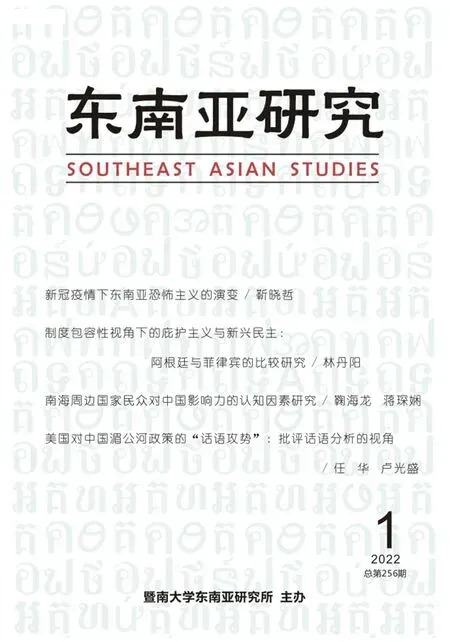
東南亞研究 2022年1期
關鍵詞:英文
-19
JIN Xiaozhe
【Abstract】The COVID-19 pandemic has changed the pace of development in the world and the terrorism. Under the impact of COVID-19 Pandemic, the overall terrorist activities in Southeast Asia have slowed down, but the individual activities have increased significantly. The IS’s influence is still far-reaching, and “Jemaah Islamiah” is also accelerating recovery. At the same time, the development of terrorism in Southeast Asia presents ne characteristics, such as network radicalization as the channel to narrate, government legitimacy as the object of censure, and “downward” management as the path to accelerate integration. In particular, under cover of the pandemic, terrorism in Southeast Asia is deeply integrating with people’s life, which may be a long-term threat to the security. In the face of the challenges, Southeast Asia countries have not relaxed their anti-terrorism work, but there are still some hidden dangers and deficiencies, such as the emergence of the “Katibah al-Mahdi fi Bilad al-Arakan”. In the future, Countries of Southeast Asia should strengthen coordination on the health crisis and terrorism threat, especially the pooling, joint construction and sharing of intelligence and resources, to safeguard regional security, stability and development.
【Keywords】COVID-19 Pandemic; Southeast Asia; Terrorism; Islamic State; Jemaah Islamiah; Regional Security
【Author】JIN Xiaozhe, Lecturer, School of Politics and International Relations/Institute for Central Asian Studies, Lanzhou University, Lanzhou, China
—
WU Yaoting
【Abstract】From 1950 to 1972, Indonesia cooperated closely with the World Health Organization on the control of smallpox. After the founding of Indonesia, the smallpox epidemics returned to Indonesia, but the smallpox vaccines, medical staff, and surveillance systems in Indonesia were insufficient to support its response to the smallpox epidemic. In response to the smallpox outbreak, Indonesia took the initiative to seek international cooperation, and the World Health Organization also responded. The World Health Organization has carried out in-depth cooperation with Indonesia on the technical update of the smallpox vaccine, the training of medical staff, the establishment of the surveillance system, and public health education, helping Indonesia to completely eradicate the smallpox infectious disease in 1972. The eradication of smallpox is a victory in the prevention and control of infectious diseases in Indonesia, and it also intuitively reflects the role and role of the World Health Organization in the prevention and control of global infectious diseases. This also means that during the Cold War, the World Health Organization not just a vassal of the great powers, but provided active assistance to the public health assumptions of developing and underdeveloped countries within a limited space.
【Keywords】Indonesia;The World Health Organization;The Controlling Smallpox; Infectious Diseases; Public Health; International Organizations
【Author】WU Yaoting, PH. D. Candidate, School of International Relations, Sun Yet-Sen University, Zhuhai, China
:
LIN Danyang
【Abstract】The effect of clientelism on new democracies is diverse and complicated. Although existing research shows the dual role of clientelism on new democracies, neither the functionalist perspective nor the political development perspective has further explored why clientelism has different effects on different countries. From the perspective of institutionalism, this article introduces a new concept “the inclusiveness of clientelism”, which can identify two types of clientelism. Furthermore, the inclusiveness of clientelism is an important factor of determining the positive or negative effects of clientelism on new democracies. In those countries like Argentina, inclusive clientelism has positive interaction with the formal institutions during the democratization period, so that the formal system can operate effectively, and the diverse and extensive social groups in society can be incorporated into the democratic system, which help the country achieve democratic transformation and democratic consolidation. On the contrary, in countries such as the Philippines, exclusive clientelism has negative interaction with the formal institutions and severely erode and destroy them, which cannot effectively aggregate public opinion or provide the necessary stability and order for the democratic system, making the political system continuously weak and making democratic consolidation more difficult.
【Keywords】Clientelism; New Democracies; Institutional Inclusiveness; Argentina; The Philippines
【Author】LIN Danyang, Associate Research Fellow, Center for Studies of Hong Kong, Macao and Pearl River Delta, Sun Yat-sen University, Guangzhou, China
’
JU Hailong & JIANG Chenxian
【Abstract】The public perception of China in the countries surrounding the South China Sea is an important indicator for the social and political effects of China’s neighborhood policies. Quantitative analysis of the micro-factors of public perception of China’s influence on relevant countries and their changes of different geopolitical conditions will be beneficial to the scientific decision-making of China’s South China Sea policies. Based on the data onto Asian Barometer, GDELT and USAID, this paper analyzes the correlation and interaction between dependent, independent, and moderating variables such as China’s influence, micro-factors affecting people’s opinion, and geopolitics. The main findings are as follows: “China’s development model” has the stable positive effect; the positive effect of “media trust” has the obvious effect; With geographical factors taken into consideration, the positive effect of “media trust” factor weakened,and the positive effect of “value similarity” disappears; “Security relationship with the United States” has a more negative moderating effect on independent variables than the “South China Sea dispute”. Therefore, as the above view suggests, enhancing economic and trade investment, balancing the US-factor, and expanding the international influence of China’s media are more beneficial to strengthening the social basis of China’s relations with the neighboring countries.
【Keywords】Countries Bordering the South China Sea; China’s Influence; Public Perception; Media Trust; Geopolitics; South China Sea Dispute
【Authors】JU Hailong, Professor, School of International Studies/The Academy of Overseas Chinese Studies, Jinan University, Guangzhou, China; JIANG Chenxian, Lecturer, Guangxi University for Nationalities, College of ASEAN Studies, Nanning, China
“”’:
REN Hua & LU Guangsheng
【Abstract】Since 2019, the United States has continuously increased public opinion input on the Mekong Issue, and gradually formed a well-structured and fully functional discourse system of Mekong policy on China. Its purpose is not only to intervene in the Mekong Issue in an appropriate capacity, but also to shape and worsen the public opinion environment against China. In terms of discourse subject structure, the discourse of American Mekong River policy on China shows the characteristics of the combination of horizontal discourse structure and vertical discourse structure; In terms of content structure, it shows strong intertextuality. The main function of American Mekong River policy on China are to beautify American behavior and morally belittle China, and alienate the cooperation between China and the Mekong countries by exaggerating China’s negative impact on the Mekong River and trying to metaphor China’s lack of responsibility for the Mekong River. Therefore, in order to reverse China’s unfavorable situation on the Mekong issue, we need to enrich the structure of discourses subject, change the “Bachelor” discourses mode and ostrich mentality on the Mekong issue.
【Keywords】USA; China; Mekong Policy; Lancang-Mekong Cooperation; Critical Discourse Analysis
【Authors】REN Hua, Assistant Research Fellow, Institute of International Relations, Yunnan University, Kunming, China; LU Guangsheng, Professor, Institute of International Relations, Yunnan University, Kunming, China
’-
SONG Qingrun & TIAN Lin
【Abstract】Since the establishment of diplomatic relations between Thailand and China in 1975 to 2021, the level of friendly cooperation between Thailand and China has ranked in the forefront among ASEAN countries. Among China’s neighboring countries and the U.S. allies, Thailand is also one of the few countries that have been friendly to China for a long time and have carried out strategic cooperation with China, which has exemplary typological significance. Thailand’s demand for more interests in China and its recognition of friendship with China coexists with a long time, forming a synergy and a strong coupling, which have become the two indispensable key drivers of Thailand’s long-term friendship and cooperation with China. On the one hand, Thailand has a long-term demand for China’s interests. It needs China’s support to safeguard its political and diplomatic autonomy, safeguard national security, promote economic and social development and improve people’s livelihood. On the other hand, influenced by Thailand’s demand for China’s interests, high cultural similarity between the two countries, and the promotion of the Thai royal family and officials, Thai officials and people generally have a positive perception of China, which is conducive to building more interests and expanding cooperation with China. Thailand and China have set a good example of friendly cooperation between countries with different social systems. The experience of friendly cooperation between the two countries could help China optimize its overall neighborhood diplomacy.
【Keywords】Thailand; China; Sino-Thai Relations; Friendly Cooperation; Coupling; Peripheral Diplomacy
【Authors】SONG Qingrun, Associate Professor, School of Asian Studies, Beijing Foreign Studies University, Beijing, China; TIAN Lin, lecturer, School of Asian Studies, Beijing Foreign Studies University, Beijing, China.
-’
LU Yang
【Abstract】Due to the civil war of China and the restrictions imposed by authorities in some Southeast Asian countries on Overseas Chinese, there were still more than 10,000 overseas Chinese waiting to be repatriations and returned to South-east Aia until the founding of PRC. Based on the official archival documents of the Chinese Ministry of Foreign Affairs, combined with other documents, the paper makes an in-depth study on the general situation of overseas Chinese waiting to return to Southeast Asian countries, the New Chinese Government’s policy on the repatriations of overseas Chinese, and the changes of International Refugee Organizations (IRO)’s institutions in China and real practices. It aims to reveals the history of the negotiations between the Chinese government and the International Refugee Organizations in China on the Repatriations of overseas Chinese in the period of the founding of the PRC. Although the Chinese government did not seek to establish official contacts with the IRO, a specialized agency of the United Nations for various reasons, it carried out pragmatic and flexible functional cooperation with the IRO’s institutions in China, and finally successfully solved this problem left over by history.The negotiation process and international cooperation is not only a great significance to the issue of the repatriations of overseas Chinese, but also an important practice in the diplomacy history of PRC at that time. It also provides experience for China to deal with other international organizations in China.
【Keywords】Overseas Chinese Repatriations; Southeast Asia; International Refugee Organization; China’s Foreign Affairs; International Cooperation
【Author】LU Yang, Associate Professor, College of International Relations, Huaqiao University, Xiamen, China
猜你喜歡
國際展望(2017年2期)2017-03-21 18:34:18
鄱陽湖學刊(2016年6期)2017-01-16 13:05:41
中國遠程教育(2016年6期)2016-12-07 10:07:02
財經(2016年19期)2016-08-11 08:17:03
中國遠程教育(2016年5期)2016-06-29 10:13:42
中國遠程教育(2016年2期)2016-03-21 10:31:21
中國遠程教育(2016年1期)2016-02-26 10:37:15
國際展望(2015年5期)2015-09-15 05:41:45
國際展望(2015年4期)2015-07-13 05:30:56
能源(2014年9期)2014-09-15 13:18:12