
比例施肥泵吸肥活塞結構優化與試驗
2022-02-15 01:10:34易中懿
農業工程學報 2022年21期
關鍵詞:優化
湯 攀,任 妮,易中懿,李 紅
比例施肥泵吸肥活塞結構優化與試驗
湯 攀1,任 妮2,易中懿2,李 紅1
(1. 江蘇大學流體機械工程技術研究中心,鎮江 212013;2. 江蘇省農業科學院信息中心,南京 210014)
為了提高比例施肥泵的注肥精度,該研究分析了吸液活塞的工作原理,采用二次回歸正交組合試驗對關鍵結構參數進行優化,以吸液活塞下端直徑、泄流槽寬度以及泄流槽深度為變量,以注入流量為響應指標,建立多元回歸模型,并通過試驗進行驗證。結果表明:在不同壓差和設定肥液注入比例下,比例施肥泵的實際肥液注入比例均低于設定肥液注入比例。壓差在0.15 MPa以下時,隨著設定肥液注入比例的升高,實際肥液注入比例與設定肥液注入比例的偏差減小,采用較高的設定肥液注入比例有利于提高注肥精度。吸液活塞下端直徑、泄流槽寬度、泄流槽深度對注入流量都有顯著影響(<0.01)。注入流量隨著吸液活塞下端直徑和泄流槽深度的增大而先升高后降低,隨泄流槽寬度的增大而增大。對注入流量的影響順序從大到小依次為泄流槽寬度、泄流槽深度、吸液活塞下端直徑。優化后的吸液活塞下端直徑為16.6 mm、泄流槽寬度為5.5 mm和泄流槽深度為3.7 mm,工作壓差為0.05、0.10和0.15 MPa時的注肥精度分別提高了3.33、1.67和7.29個百分點。研究結果可為比例施肥泵的優化設計及實際應用提供理論支持。
肥料;試驗;水肥一體化;比例施肥泵;參數優化;回歸方程
0 引 言
長期以來,肥料的大量與不合理施用對自然生態環境造成了嚴重破壞,如土壤肥力破壞、土壤污染、面源污染等,嚴重影響了農業的可持續發展[1-2]。因此,減少化肥使用量、合理施肥、提高化肥利用率已成為農業可持續發展和保障糧食安全的重要手段[3-5]。水肥一體化是精確施肥與精確灌溉相結合的產物,在灌溉技術中占有重要地位[6-8]。施肥設備是水肥一體化系統的關鍵,其性能的優劣直接影響灌溉與施肥的質量。比例施肥泵是一種先進的水肥一體化施肥裝備,其通過水壓驅動內部吸液活塞的運動來向管網中定量添加肥液,與其他施肥設備相比,比例施肥泵的施肥精度高,且肥液注入比例可在一定范圍內進行調節[9-10]。
法國Dosatron公司早在1974就開發出了比例施肥泵,此后經過不斷發展,目前已開發出了系列產品,可以滿足不同應用場合的需求。國內在施肥泵方面的研究較晚,李百軍等[11]從原理及試驗上初步研制過水動比例施肥泵,但沒有形成產品。王建東等[12]制造出施肥泵樣品并進行了試驗測試,雖然試驗結果表明該施肥泵可以基本滿足微灌施肥的需要,但與國外產品相比仍有可改進空間。針對水力性能研究,韓啟彪等[13]對一些典型產品進行了性能測試,根據試驗結果給出了典型產品的工作壓差和流量關系以及工作壓差的合理控制范圍等較重要參數。楊大森等[14-15]對3種比例施肥泵的水力性能進行了試驗,提出了比例施肥泵驅動腔和吸肥腔的容積效率計算公式。Tang等[16-17]研究了比例施肥泵注入液體的黏度對進口流量和注入流量的綜合影響,并建立了進口流量計算模型和注入流量計算模型。目前已有研究主要側重于單個運行及結構參數對某一水力性能的簡單外特性試驗研究,缺乏總體運行與結構參數對綜合水力性能及其影響機理的深入研究。隨著計算流體動力學(Computational Fluid Dynamics, CFD)的發展,數值模擬已成為目前研究流體機械內部流動規律的主要手段之一。湯攀等[18]在比例施肥泵運行機理分析的基礎上,采用流固耦合動網格技術進行數值模擬,分析其內部流動以及活塞受力。此外,王睿等[19]研究了施肥泵施肥比例與肥水比對過濾器堵塞的影響,提出了網式和疊片式過濾器的適宜肥液濃度。吳錫凱[20]指出為了提高施肥精度,在運行時不要使用較大壓差與較小施肥比例配合,當肥液注入比例設定在2%~4%時,實際所需的施肥時間與設定時間相比增加了近1/4,這表明實際注入流量要小于理論注入流量,即比例施肥泵的注肥精度仍有待提高。
目前國內比例施肥泵的研發和制造與國外相比尚有較大差距,依然缺乏自主的設計方法和優秀產品。吸肥活塞作為比例施肥泵實現肥液抽吸的關鍵水力部件,其結構參數對比例施肥泵的注肥精度具有重要影響。基于此,本文通過旋轉優化試驗設計方法對吸肥活塞的關鍵結構參數進行研究,建立各參數與性能指標的關系式,分析各因素的影響規律,以期為比例施肥泵的性能研究及關鍵水力部件優化設計提供參考。
1 吸液活塞工作原理
比例施肥泵的主要結構及工作原理已有詳細介紹[15-16],如圖1所示,吸液活塞在往復運動過程中首先需要將肥液從外部吸入到吸液活塞腔,然后將其排出到驅動活塞腔與驅動液體混合進而排出泵體。吸液活塞在吸液過程中需保持密封狀態,在排液過程中需起到將吸肥腔與驅動腔連通的作用。
如圖2所示為吸液活塞二維結構圖,活塞頭兩側開有泄流槽,由于單獨活塞頭無法完成密封與連通功能的切換,因此在吸液活塞頭中間加入滑動密封圈來控制泄流槽的連通與關閉,其主要結構參數為:吸液活塞下端直徑15.5 mm、泄流槽寬度4.5 mm及泄流槽深度3 mm。
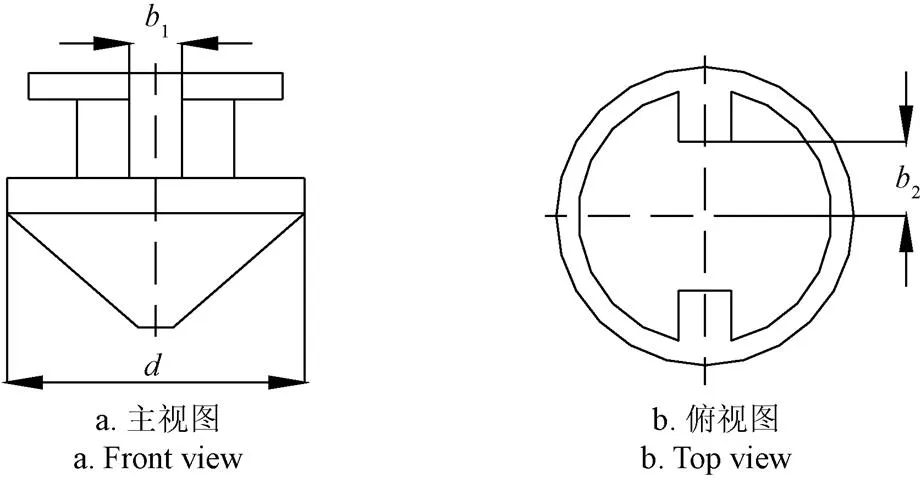
注:d為吸液活塞下端直徑,mm;b1為泄流槽寬度,mm;b2為泄流槽深度,mm。
如圖3a所示,當吸液活塞向上運動時,由于密封圈與吸液活塞腔壁面存在摩擦,使密封圈與吸液活塞頭的下端緊貼,從而阻斷泄流槽與吸液活塞腔的連通,使吸液活塞腔在活塞向上運動過程中形成負壓將外部液體吸進活塞腔。如圖3b所示,當吸液活塞向下運動時,由于密封圈與吸液活塞腔壁面存在摩擦,使密封圈與吸液活塞頭的上端緊貼,從而通過泄流槽將吸液活塞腔與驅動活塞腔進行連通。吸液活塞向下運動的同時將活塞腔里面的液體擠壓,通過泄流槽排進驅動活塞腔與工作液體混合。

注:箭頭表示液體流動方向。
2 試驗方案
為了研究比例施肥泵效率和實際注入流量與運行參數之間的關系,搭建了比例施肥泵性能測試試驗臺,如圖4所示,通過調節比例施肥泵前后的閥門來控制其工作壓差。試驗在江蘇大學流體機械工程技術研究中心的室內噴灌試驗室進行,采用意大利Dosatron公司的D25RE2比例施肥泵,其進出口直徑19 mm,最大承受壓力為0.60 MPa,設定肥液注入比例0.2%~2.0%。測試系統主要由水泵、測量裝置和控制裝置組成。系統管路為鋼管,主管路直徑50 mm,旁路管直徑25 mm。離心泵流量10 m3/h,揚程70 m。主管道流量通過電磁流量計測量,精確度為±0.3%。比例施肥泵吸液速度由精度為0.1 g的精密電子天平測量。在比例施肥泵前后以及主管上安裝3個精度為±0.4%的壓力表,試驗參照國家標準GB/T 19792-2012《農業灌溉裝備水動化肥—農藥注入泵》[21]進行。
試驗主要測試比例施肥泵在不同壓差和不同設定肥液注入比例下的注入流量和進口流量。根據比例施肥泵的最大承受壓力,試驗共設置8個水平的壓差,分別為0.05、0.10、0.15、0.20、0.25、0.30、0.35、0.40 MPa,試驗過程中將比例施肥泵的進口壓力保持在0.60 MPa,然后調節出口壓力,使比例施肥泵所設定的不同壓差下工作。設定肥液注入比例共設置13個水平,為了更加精確地測量肥液注入比例較小時的水力性能,當設定肥液注入比例在0.8%以下時,間隔為0.1%,當設定肥液注入比例大于0.8%時,間隔為0.2%。比例施肥泵的進口流量直接通過電磁流量計獲得,由于注入流量相對進口流量較小,為了提高測試精度,通過如下公式計算:

1.電機 2.水泵 3.壓力表1 4.閥門1 5.電磁流量計 6.閥門2 7.壓力表2 8.壓力表3 9.閥門3 10.比例施肥泵 11.儲液罐 12.精密電子天平 13.水池1 14.水池2

式中為注入流量,kg/h;1為儲液罐的初始質量,kg;2為測試結束時儲液罐的質量,kg;為測試時間,h。在本研究中,每次測試的時間為0.5 h。試驗過程中,改變測試工作壓差和設定肥液注入比例時,需待比例施肥泵運行穩定后開始測量,每個測試點3次重復,取均值為最終試驗結果。
3 結果與分析
表1為比例施肥泵在不同設定肥液注入比例和壓差下的注入流量。理論上,隨著壓差的增大,活塞往復運動頻率升高,吸液活塞吸液速度會增加,然而從表1可以看出,隨著壓差的增大,比例施肥泵在不同設定肥液注入比例下的注入流量都呈現先增大后趨于平穩或減小的趨勢,表明壓差的增大不能有效增加比例施肥泵的吸液速度,即活塞運動頻率過高會降低比例施肥泵的性能,其工作壓差應控制在0.20 MPa以內。表2為比例施肥泵在不同設定肥液注入比例和壓差下的進口流量,從表2可以看出,比例施肥泵的進口流量隨著壓差的增大而增大;在同一壓差下,隨著設定肥液注入比例的升高有較小幅度的降低,可認為設定肥液注入比例對進口流量的影響較小,這與吳錫凱[20]的研究相吻合。

表1 不同設定肥液注入比例和壓差下的注入流量
注:s為設定肥液注入比例,%;表中數據為均值±標準差,下同。
Note:sis the set injection ratio, %; data in the table are mean ± standard deviation, the same as below.

表2 不同設定肥液注入比例和壓差下的進口流量
實際肥液注入比例為實際注入流量與進口流量的比值,即:
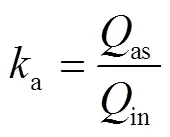
式中a為實際肥液注入比例,%;as為實際注入流量,kg/h;in為進口流量,kg/h。
通過公式(2)計算可得如圖5所示的比例施肥泵在不同壓差下的實際肥液注入比例和設定肥液注入比例的對比,從圖中可以看出,隨著壓差的增大,實際肥液注入比例與設定肥液注入比例的偏差越大;壓差在0.15 MPa以下時,隨著設定肥液注入比例的升高,實際肥液注入比例與設定肥液注入比例的偏差越小,表明采用較高的設定肥液注入比例有利于提高比例施肥泵的注入精度。Tang等[18]在研究注入液體黏度對進口流量和注入流量影響時也同樣指出比例施肥泵的最大工作壓差不應過高。在不同的壓差和設定肥液注入比例下,比例施肥泵的實際肥液注入比例都低于設定肥液注入比例,一方面,這是由于比例施肥泵存在一定的容積損失,無法按照設定的肥液注入比例進行抽吸;另一方面,吸液活塞是實現肥液抽吸的關鍵水力部件,其關鍵結構參數對比例施肥泵的注入流量具有重要的影響。
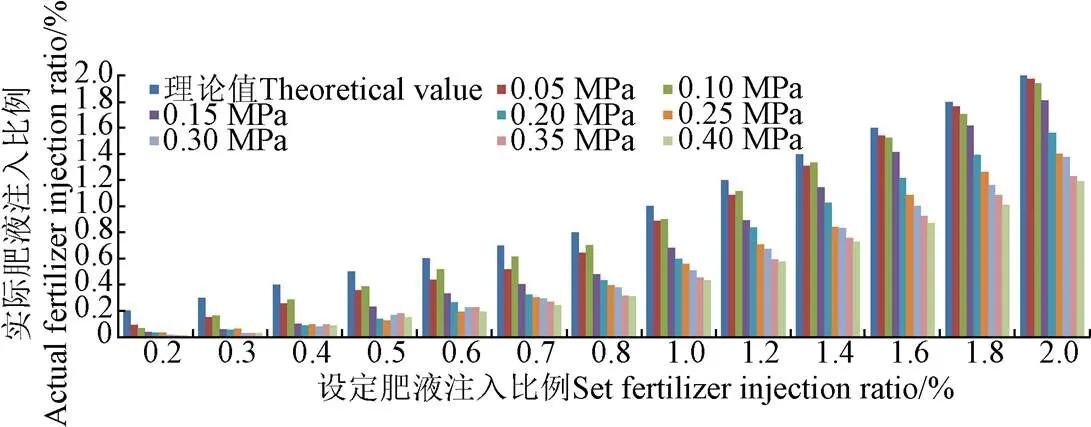
圖5 不同壓差下的實際肥液注入比例和設定肥液注入比例
4 參數優化
根據吸液活塞工作原理可知吸液活塞的結構尺寸對液體流動產生主要影響的有吸液活塞下端直徑、泄流槽寬度1以及泄流槽深度2。因此,選取這3個主要參數探索吸肥活塞流道結構尺寸對比例施肥泵施肥精度的影響規律。
比例施肥泵的注入精度是最能體現其水力性能優越的重要指標,當比例施肥泵的注入精度較低,即實際注入流量與理論注入流量差別較大時,會造成施肥時間過長或施藥濃度達不到目標設定值,進而影響施肥或施藥效果。根據圖5,比例施肥泵的實際肥液注入比例都低于設定肥液注入比例,即不同設定肥液注入比例下的實際注入流量都小于理論注入流量。比例施肥泵在同一設定肥液注入比例及壓差下工作時,注入流量越大,則注入精度越高,故選擇注入流量作為本文的試驗指標。根據表1和圖5,設定肥液注入比例越低,實際注入流量與理論注入流量的偏差越大,故試驗中將比例施肥泵的工作參數定為設定肥液注入比例0.2%,工作壓差0.05 MPa,研究吸液活塞流道結構參數對注入精度的影響規律。
4.1 二次回歸正交組合試驗
試驗采用二次回歸正交組合設計[22-24],根據前期試驗確定比例施肥泵能正常工作時各參數的取值范圍為:吸液活塞下端直徑(12~18 mm)、泄流槽寬度(4~6 mm)和泄流槽深度(2~4 mm)。由于因素數=3,則二水平試驗次數c=23=8,取零水平試驗次數0=1,根據二次回歸正交試驗設計中星號臂長度的計算公式
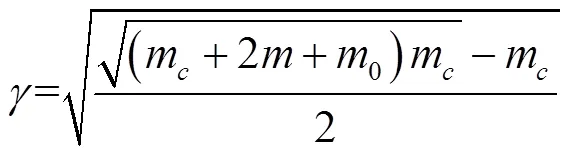
計算得到=1.215。因素的上下星號臂水平為因素的上下限,零水平為上下限的算術平均值,變化間距Δ的計算公式為
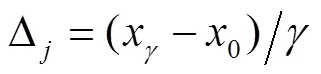
式中x為上星號臂水平,0為零水平。
因素的上下水平計算公式分別為
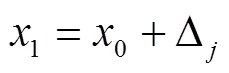
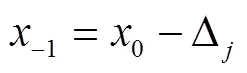
根據試驗設計得到試驗因素水平編碼表見表3。

表3 試驗因素水平編碼表
根據因素水平編碼表的參數值及表4中的不同參數組合首先在Pro/E中完成三維造型,然后采用快速成型技術(Rapid Prototyping Manufacturing, RPM)加工,材料為ABS樹脂,活塞頭試件如圖6所示。試驗測試結果見表4。
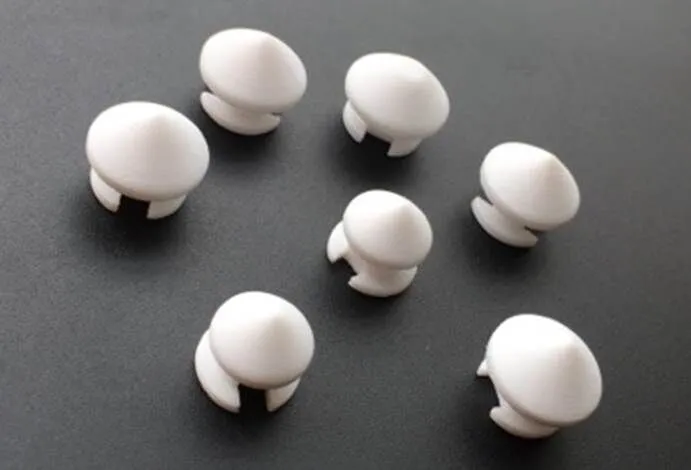
圖6 吸液活塞頭試件
將試驗方案及結果導入Design-Expert 8.0.5.0,對試驗數據處理和響應面分析,采用回歸分析法建立三元二次回歸方程
=0.084 25+0.094 167+0.263 751?0.022 752+
0.008 3331+0.013 3332+0.052 512?
0.005 8062?0.049 7512?0.069 7522(7)

表4 二次回歸組合設計試驗方案及試驗結果
注:為注入流量,kg·h-1。
Note:is injection flowrate, kg·h-1.
對試驗結果進行方差分析和顯著性檢驗,如表5所示。從表5中可以看出,注入流量模型的值小于0.01,注入流量回歸模型極顯著。模型決定系數2=0.957 4,表明模型能夠反映出95.74%的響應值變化,失擬項不顯著,說明試驗誤差小,試驗各因素對注入流量影響的大小順序依次為泄流槽寬度、泄流槽深度、吸液活塞下端直徑;3個因素的交互作用對注入流量影響的大小順序依次為,泄流槽寬度×泄流槽深度、吸液活塞下端直徑×泄流槽深度、吸液活塞下端直徑×泄流槽寬度。顯著性分析結果表明所選試驗因素都對注入流量有較為顯著的影響,且其各因素之間的相互交互作用同樣對注入流量具有顯著的影響,這表明本文所選擇的吸液活塞流道結構參數都為關鍵水力結構參數。
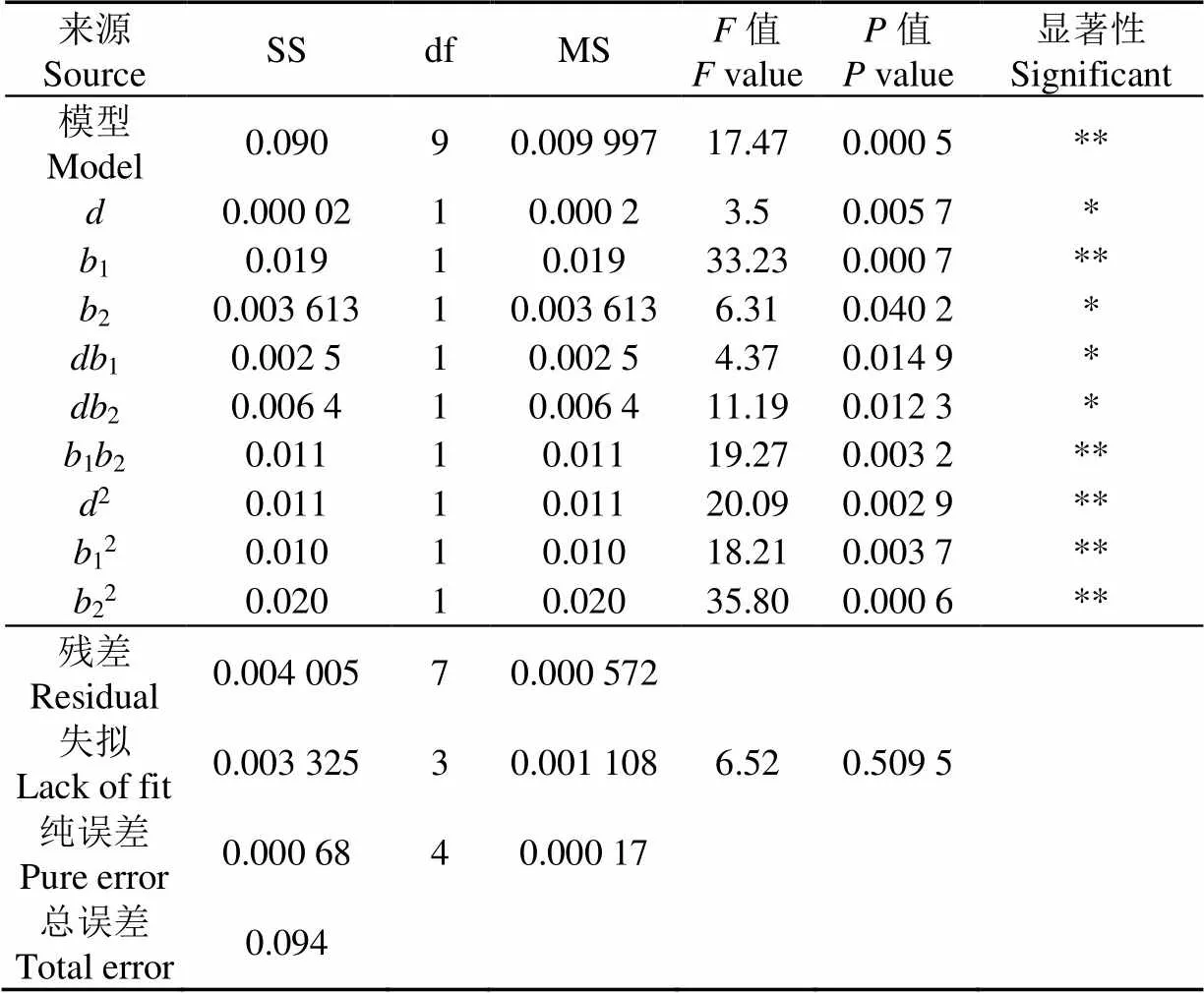
表5 試驗指標方差分析表
注:SS為離差平方和;df為自由度;MS為均方;*代表差異顯著(<0.05);**代表差異極顯著(<0.01)。
Note: SS is sum of squares; df is degree of freedom; MS is mean squares; * is significant (<0.05); ** is very significant (<0.01).
圖7為吸液活塞下端直徑與泄流槽寬度交互作用對注入流量的影響,從圖7可以看出,在同一泄流槽寬度下,注入流量隨著吸液活塞下端直徑的增大而先升高后降低,表明吸液活塞下端直徑在確定范圍內存在一個最優值。從吸液活塞結構上分析,吸液活塞下端直徑過大或過小都不利于提高比例施肥泵的注入精度,這是由于當吸液活塞下端直徑過大時會使吸液活塞與吸液活塞腔的間隙變小,增大被吸液體在排液過程中的阻力,從而使注入流量變小;相反,當吸液活塞下端直徑過小時,吸液活塞與吸液活塞腔的間隙變大,造成吸液活塞下端對滑動密封墊圈的支撐變小,導致吸液活塞在向上運動吸取液體時的密封性變差。吸液活塞下端直徑小于14 mm時,注入流量同樣隨著泄流槽寬度的增大而先升高后降低,當吸液活塞下端直徑在14~17 mm時,注入流量隨著泄流槽寬度的增大而增大。
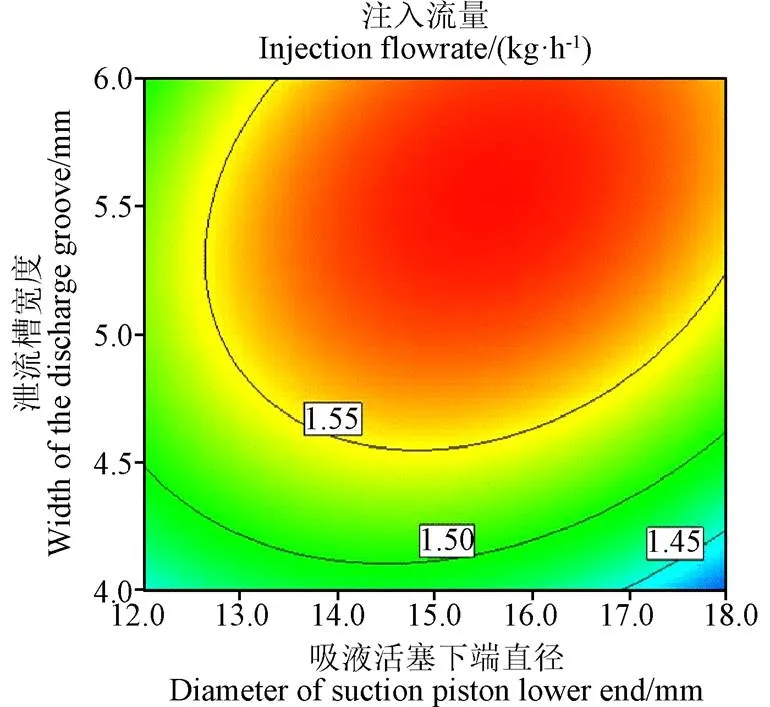
圖7 吸液活塞下端直徑與泄流槽寬度交互作用對注入流量的影響
圖8為吸液活塞下端直徑與泄流槽深度交互作用對注入流量的影響,從圖8可以看出,在設定范圍內,注入流量隨吸液活塞下端直徑與泄流槽深度的增大而先升高后降低。泄流槽深度過大或過小都會造成液體流經吸液活塞的流道過大或過小,流道尺寸較大一方面會降低流體從吸液腔到混合器的流動阻力,另一方面又會造成吸液活塞換向運動時(即由排液過程變為吸液過程)殘留在泄流槽中的液體增多,從而影響注入流量。
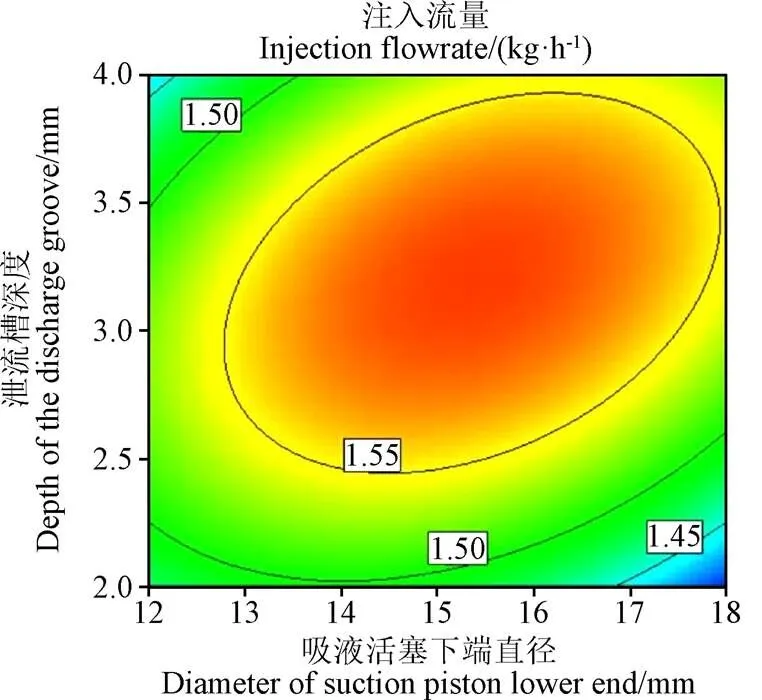
圖8 吸液活塞下端直徑與泄流槽深度交互作用對注入流量的影響
圖9所示為泄流槽寬度與泄流槽深度交互作用對注入流量的影響,從圖中可以看出,此交互作用影響與吸液活塞下端直徑與泄流槽寬度交互作用對注入流量的影響類似。當泄流槽深度小于2.5 mm時,注入流量隨泄流槽寬度的增大基本保持不變,此時泄流槽寬度對注入流量的影響較小;當泄流槽深度大于2.5 mm時,注入流量隨泄流槽寬度的增大而升高。

圖9 泄流槽寬度與泄流槽深度交互作用對注入流量的影響
4.2 優化求解及試驗驗證
模型共有3個設計變量,是一個非線性數學規劃問題[25-26]。
目標函數如下

根據式(8)目標函數與約束條件進行參數求解,得到如表6所示的吸液活塞流道結構參數優化結果及優化前后的注入流量。從表6中可以看出,吸液活塞流道結構參數優化后的注入流量得到了較大幅度的提高,從優化前的1.26 kg/h提高到了1.61 kg/h,提高幅度為27.78%。

表6 優化前后參數及性能對比
對優化結果進行圓整,取吸液活塞下端直徑為16.6 mm、泄流槽寬度為5.5 mm和泄流槽深度為3.7 mm,并進行驗證試驗,測試優化后比例施肥泵分別在壓差為0.05、0.10和0.15 MPa時不同設定肥液注入比例下的注入流量,并與原型比例施肥泵注入流量進行對比,結果如表7所示。從表7中可以發現,優化后的注入流量在不同設定肥液注入比例和工作壓差下都較原型比例施肥泵有一定提高。特別是當設定肥液注入比例較低時,優化后的實際注入流量更接近理論注入流量(進口流量與設定肥液注入比例的乘積),同時實際注入流量與理論注入流量的偏差進一步降低,在一定程度上提高了比例施肥泵的注入精度,從而有效提高了比例施肥泵的水力性能。當工作壓差為0.15 MPa時,優化后的注入流量較優化之前有一定的提高,且在較高設定肥液注入比例下的實際注入流量與理論注入流量的差距進一步縮小(壓差為0.15 MPa和肥液注入比例為2.0%時的偏差從優化之前的9.31%降低到優化之后的4.24%),從而提高了比例施肥泵的正常工作壓差范圍,有利于比例施肥泵的實際應用,因為高精度的注肥比例可以有效降低水肥一體化系統肥液濃度的變化,從而提高施肥均勻性[27-29]。
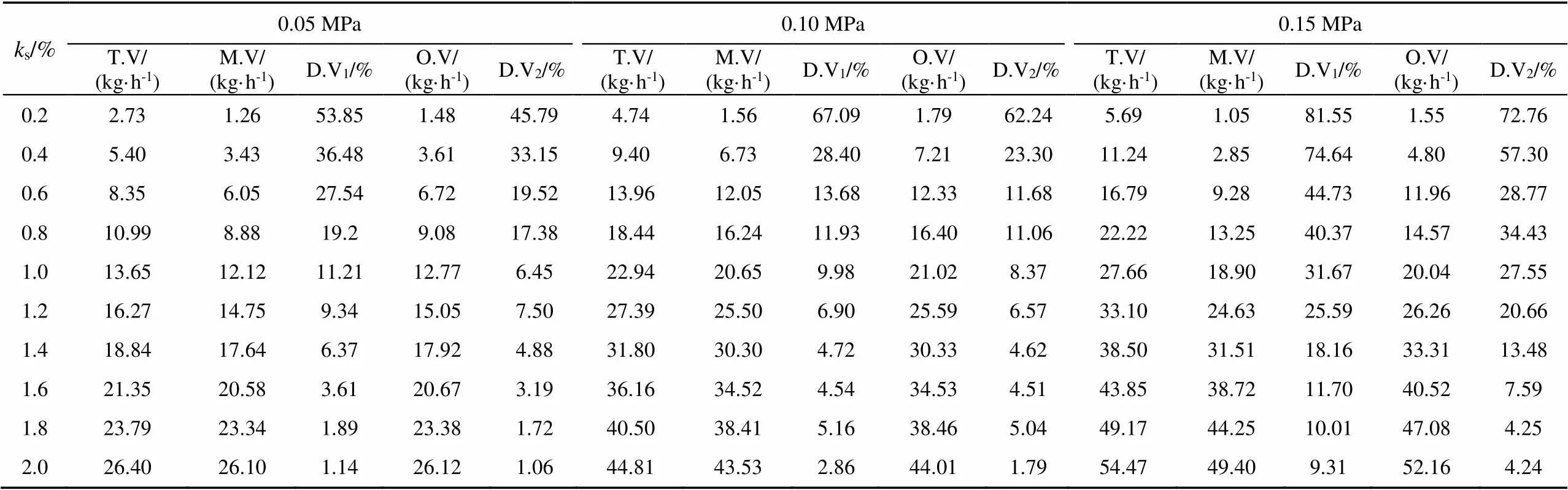
表7 不同壓差下比例施肥泵吸液活塞流道優化前后的注入流量
注:T.V為理論值;M.V為原型值;D.V1為原型值與理論值的偏差;O.V為優化值;D.V2為優化值與理論值的偏差。
Note: T.V is the theoretical value; M.V is the prototype value; D.V1is the deviation between the prototype value and the theoretical value; O.V is the optimal value; D.V2is the deviation between the optimal value and the theoretical value.
為進一步分析吸肥活塞優化前后比例施肥泵整體注肥精度的變化,將不同壓差下吸肥活塞流道結構參數優化前后比例施肥泵的實際肥液注入比例與對應的設定肥液注入比例進行對比,同時定義同一壓差下實際肥液注入比例與理論肥液注入比例比值的算術平均值為注肥精度,表示為
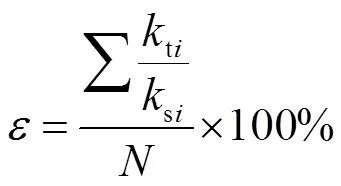
式中為注肥精度,%;ti為比例施肥泵實際肥液注入比例,%;si為對應的設定肥液注入比例,%;為同一壓差下的樣本數量;為同一壓差下的樣本編號,1≤≤。通過計算得到如表8所示的對比結果,從表8中可以發現,優化后的實際肥液注入比例與設定肥液注入比例更接近,二者的偏差比優化前的小。比例施肥泵在工作壓差為0.05、0.10和0.15 MPa時的注肥精度分別從82.74%、84.76%和65.29%提高到了86.07%、86.43%和72.58%,分別提高了3.33、1.67和7.29個百分點。
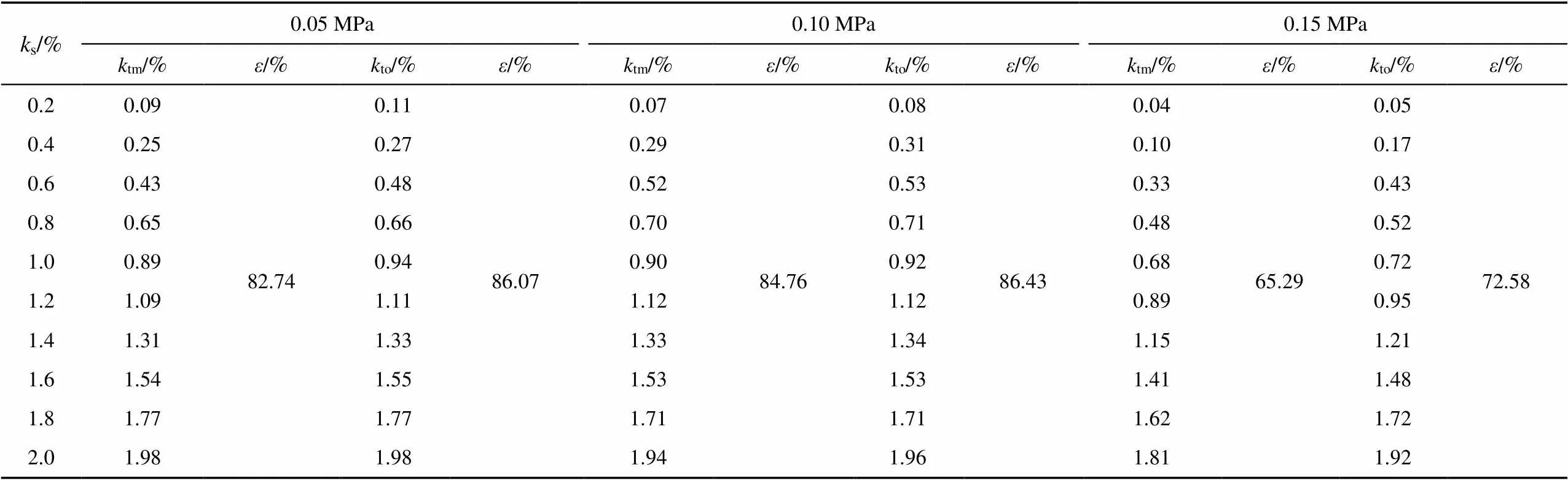
表8 不同壓差下比例施肥泵吸液活塞流道優化前后的注肥精度
注:tm為原型比例施肥泵實際肥液注入比例,%;to為吸液活塞流道結構參數優化后比例施肥泵實際肥液注入比例,%;為注肥精度,%。
Note:tmis the actual fertilizer injection rate of the prototype proportional fertilization pump, %;tois the actual fertilizer injection rate of the proportional fertilization pump after the structural parameters of the suction piston were optimized, %;is the fertilizer injection accuracy, %.
5 結 論
本研究通過二次回歸正交組合試驗設計對比例施肥泵吸液活塞關鍵結構參數進行了優化研究,得到的主要結論如下:
1)在不同壓差和設定肥液注入比例下,比例施肥泵的實際肥液注入比例都低于設定肥液注入比例。壓差在0.15 MPa以下時,隨著設定肥液注入比例的升高,實際肥液注入比例與設定肥液注入比例的偏差越小,采用較高的設定肥液注入比例有利于提高注肥精度。
2)吸液活塞下端直徑、泄流槽寬度以及泄流槽深度都對注入流量有較為顯著的影響(<0.01);各因素在選取的水平范圍內對注入流量的影響大小順序依次為泄流槽寬度、泄流槽深度、吸液活塞下端直徑。
3)在同一泄流槽寬度下,注入流量隨著吸液活塞下端直徑的增大而先升高后降低。當吸液活塞下端直徑小于14 mm時,注入流量隨著泄流槽寬度的增大而先升高后降低,當吸液活塞下端直徑在14~17 mm時,注入流量隨著泄流槽寬度的增大而增大。注入流量隨著吸液活塞下端直徑與泄流槽深度的增大而先升高后降低。當泄流槽深度小于2.5 mm時,注入流量隨泄流槽寬度的增大基本保持不變;當泄流槽深度大于2.5 mm時,注入流量隨泄流槽寬度的增大而升高。
4)優化后的吸液活塞下端直徑為16.6 mm、泄流槽寬度為5.5 mm、泄流槽深度為3.7 mm。比例施肥泵在工作壓差為0.05、0.10和0.15 MPa時的注肥精度較優化前分別提高了3.33、1.67和7.29個百分點。
[1] 劉欽普,孫景榮,濮勵杰. 中國及歐美主要國家化肥施用強度與綜合效率比較研究[J]. 農業工程學報,2020,36(14):9-16.
Liu Qinpu, Sun Jingrong, Pu Lijie. Comparative study on fertilization intensity and integrated efficiency in China and Euro-American major countries[J]. Transactions of the Chinese Society of Agricultural Engineering (Transactions of the CSAE), 2020, 36(14): 9-16. (in Chinese with English abstract)
[2] 王晶晶,卓越,張顥暉,等. 柱塞式注肥泵的設計試驗及精準施肥應用[J]. 排灌機械工程學報,2022,40(1):22-29.
Wang Jingjing, Zhuo Yue, Zhang Haohui, et al. Design and test of piston injection pump and its application in precise fertigation[J]. Journal of Drainage and Irrigation Machinery Engineering, 2022, 40(1): 22-29. (in Chinese with English abstract)
[3] Chiaregato C G, Souza C F, Faez R. The fertilizer release into water and soil as the biodegradation process in the sustainable material enhancing the fertilizer efficiency[J]. Environmental Technology & Innovation, 2021, 22: 101417.
[4] Xu M, Liu M J, Liu F, et al. A safe, high fertilizer-efficiency and economical approach based on a low-volume spraying UAV loaded with chelated-zinc fertilizer to produce zinc-biofortified rice grains[J]. Journal of Cleaner Production, 2021, 323: 129188.
[5] Zhang M, Yao Y L, Tian Y H, et al. Increasing yield and N use efficiency with organic fertilizer in Chinese intensive rice cropping systems[J]. Field Crops Research, 2018, 227: 102-109.
[6] 劉俊萍,朱興業,袁壽其,等. 中國農業節水噴微灌裝備研究進展及發展趨勢[J]. 排灌機械工程學報,2022,40(1):87-96.
Liu Junping, Zhu Xingye, Yuan Shouqi, et al. Research and development trend of agricultural water-saving sprinkler and micro-irrigation equipment in China[J]. Journal of Drainage and Irrigation Machinery Engineering, 2022, 40(1): 87-96. (in Chinese with English abstract)
[7] 朱德蘭,阮漢鋮,吳普特,等. 水肥一體機肥液電導率遠程模糊PID控制策略[J]. 農業機械學報,2022,53(1): 186-191.
Zhu Delan, Ruan Hancheng, Wu Pute, et al. Strategy on remote fuzzy PID control for fertilizer liquid conductivity of water fertilizer integrated machine[J]. Transactions of the Chinese Society for Agricultural Machinery, 2022, 53(1): 186-191. (in Chinese with English abstract)
[8] 王振華,陳瀟潔,呂德生,等. 水肥耦合對加氣滴灌加工番茄產量及品質的影響[J]. 農業工程學報,2020,36(19):66-75.
Wang Zhenhua, Chen Xiaojie, Lyu Desheng, et al. Effects of water and fertilizer coupling on the yield and quality of processing tomato under aerated drip irrigation[J]. Transactions of the Chinese Society of Agricultural Engineering (Transactions of the CSAE), 2020, 36(19): 66-75. (in Chinese with English abstract)
[9] 李紅,湯攀,陳超,等. 中國水肥一體化施肥設備研究現狀與發展趨勢[J]. 排灌機械工程學報,2021,39(2):200-209.
Li Hong, Tang Pan, Chen Chao, et al. Research status and development trend of fertilization equipment used in fertigation in China[J]. Journal of Drainage and Irrigation Machinery Engineering, 2021, 39(2): 200-209. (in Chinese with English abstract)
[10] Tang P, Li H, Issaka Z, et al. Effect of manifold layout and fertilizer solution concentration on fertilization and flushing times and uniformity of drip irrigation systems[J]. Agricultural Water Management, 2018, 200: 71-79.
[11] 李百軍,王曉寧. 水動施肥裝置的設計與試驗[J]. 江蘇大學學報(自然科學版),2002,23(2):9-12.
Li Baijun, Wang Xiaoning. Design and experiment on hydrodynamic fertilizer injection unit[J]. Journal of Jiangsu University (Natural Science Edition), 2002, 23(2): 9-12. (in Chinese with English abstract)
[12] 王建東,龔時宏,徐茂云,等. 微灌用水動活塞式施肥泵研制[J]. 農業工程學報,2006,22(6):100-103.
Wang Jiandong, Gong Shihong, Xu Maoyun, et al. Research and development of liquamatic piston fertilizer pump for micro-irrigation[J]. Transactions of the Chinese Society of Agricultural Engineering (Transactions of the CSAE), 2006, 22(6): 100-103. (in Chinese with English abstract)
[13] 韓啟彪,吳文勇,劉洪祿,等. 三種水力驅動比例式施肥泵吸肥性能試驗[J]. 農業工程學報,2010,26(2):43-47.
Han Qibiao, Wu Wenyong, Liu Honglu, et al. Experiment on fertilizer suction performance of three hydraulic driven pumps[J]. Transactions of the Chinese Society of Agricultural Engineering (Transactions of the CSAE), 2010, 26(2): 43-47. (in Chinese with English abstract)
[14] 楊大森. 水動比例施肥泵運動分析及性能優化[D]. 鎮江:江蘇大學,2016.
Yang Dasen. Water-powered Proportional Dosing Pump Movement Analysis and Performance Optimization[D]. Zhenjiang: Jiangsu University, 2016. (in Chinese with English abstract)
[15] 駱志文,水動比例注入泵性能參數研究[D]. 鎮江:江蘇大學,2017.
Luo Zhiwen. Research on Performance Parameters of Hydrodynamic Proportional Injection Pump[D]. Zhenjiang: Jiangsu University, 2017. (in Chinese with English abstract)
[16] Tang P, Li H, Issaka Z, et al. Methodology to investigate the hydraulic characteristics of a water-powered piston type proportional injector used for agricultural chemigation[J]. Applied Engineering in Agriculture, 2018, 34(3): 545-553.
[17] Tang P, Chen C, Li H. Investigation of hydraulic performance based on response surface methodology for an agricultural chemigation proportional injector[J]. Water, 2020, 12(11): 3155.
[18] 湯攀,李紅,駱志文,等. 比例施肥泵驅動活塞受力分析及內部流動模擬與試驗[J]. 農業工程學報,2017,33(23):93-100.
Tang Pan, Li Hong, Luo Zhiwen, et al. Force analysis of drive piston and simulation and experiment of internal flow for proportional fertilizer pump[J]. Transactions of the Chinese Society of Agricultural Engineering (Transactions of the CSAE), 2017, 33(23): 93-100. (in Chinese with English abstract)
[19] 王睿,王文娥,胡笑濤,等. 微灌用施肥泵施肥比例與肥水比對過濾器堵塞的影響[J]. 農業工程學報,2017,33(23):117-122.
Wang Rui, Wang Wene, Hu Xiaotao, et al. Impact of fertilizer proportion and fertilizer-water ratio on clogging of filter by fertilizer pump in microirrigation[J]. Transactions of the Chinese Society of Agricultural Engineering (Transactions of the CSAE), 2017, 33(23): 117-122. (in Chinese with English abstract)
[20] 吳錫凱. 滴灌系統水力驅動式比例施肥裝置性能影響因素研究[D]. 楊凌:西北農林科技大學,2019.
Wu Xikai. Study on Influence Factors of Performance of Hydraulic Driven Proportional Fertilizer Device in Drip Irrigation System[D]. Yangling: Northwest A&F University, 2019. (in Chinese with English abstract)
[21] 中國農業機械化科學研究院. 農業灌溉設備水動化肥-農藥注入泵:GB/T 19792-2012[S]. 北京:中國標準出版社,2012.
[22] Li H C, Gao F. Investigation on optimising agricultural cultivator openers using quadratic orthogonal rotation regression[J]. Acta Agriculturae Scandinavica, Section B-Soil & Plant Science, 2021, 71(9): 970-979.
[23] Liu J J, Zhao T, Liu K, et al. Optimization of structure parameters in a coal pyrolysis filtration system based on CFD and quadratic regression orthogonal combination and a genetic algorithm[J]. Engineering Applications of Computational Fluid Mechanics, 2021, 15(1): 815-829.
[24] 郭嘉明,吳旭東,林詩濤,等. 基于多參數耦合的蓄冷溫控箱冷板對流換熱參數優化[J]. 農業工程學報,2021,37(19):228-235.
Guo Jiaming, Wu Xudong, Lin Shitao, et al. Parameter optimization on convective heat transfer of cold plate for cold storage temperature control box based on multi-parameter coupling[J]. Transactions of the Chinese Society of Agricultural Engineering (Transactions of the CSAE), 2021, 37(19): 228-235. (in Chinese with English abstract)
[25] 張德勝,祁炳,趙睿杰,等. 海水淡化能量回收透平水力模型優化設計[J]. 排灌機械工程學報,2021,39(7):649-654.
Zhang Desheng, Qi Bing, Zhao Ruijie, et al. Optimization design of hydraulic model for seawater desalination energy recovery turbine[J]. Journal of Drainage and Irrigation Machinery Engineering, 2021, 39(7): 649-654. (in Chinese with English abstract)
[26] 諸永定,肖千豪,吳靈輝,等. 基于回歸Kriging代理模型的吸油煙機用多翼離心風機優化[J]. 排灌機械工程學報,2022,40(1):62-67.
Zhu Yongding, Xiao Qianhao, Wu Linghui, et al. Optimization of multi-blade centrifugal fan for range hood based on regression Kriging surrogate model[J]. Journal of Drainage and Irrigation Machinery Engineering, 2022, 40(1): 62-67. (in Chinese with English abstract)
[27] Fan J L, Wu L F, Zhang F C, et al. Evaluation of drip fertigation uniformity affected by injector type, pressure difference and lateral layout[J]. Irrigation and Drainage, 2017, 66(4): 520-529.
[28] 李紅,張乾坤,湯攀,等. 閥門調節式比例施肥泵性能分析與試驗[J]. 農業工程學報,2020,36(18):34-41.
Li Hong, Zhang Qiankun, Tang Pan, et al. Performance analysis and test of valve-regulated proportional fertilization pumps[J]. Transactions of the Chinese Society of Agricultural Engineering (Transactions of the CSAE), 2020, 36(18): 34-41. (in Chinese with English abstract)
[29] Li J S, Meng Y B, Li B. Field evaluation of fertigation uniformity as affected by injector type and manufacturing variability of emitters[J]. Irrigation Science, 2007, 25(2): 117-125.
Optimization and experiment of the suction piston structure for proportional fertilization pump
Tang Pan1, Ren Ni2, Yi Zhongyi2, Li Hong1
(1.212013,;2.210014)
Fertilization equipment is one of the most important equipment for the fertigation system in recent year. The performance of fertigation pump directly dominates the quality of irrigation and fertilization. Among them, the proportional fertilization pump can be expected to serve as an advanced fertilization equipment. Specifically, the water pressure can be used as the power source in the most areas without electricity. The fertilizer suction piston is one of the vital hydraulic components to promote the accuracy of fertilizer injection. Taking the suction piston as the study object, the quadratic regression orthogonal combination test was carried out to optimize the major structural parameters, according to the operating principle. The injection flow rate was utilized as the response index. A multiple regression model was established for the response index and factors. The variables included the diameter of the lower end of the suction piston, the width of the discharge groove, and the depth of the discharge groove. The results demonstrated that the actual injection ratio of the proportional fertilization pump was lower than the predicted injection ratio under various differential pressures and injection ratios. The difference between the actual and predicted injection ratio was reduced with an increase in the injection ratio, at the differential pressure of less than 0.15 MPa. It infers that a larger injection ratio was preferred to boost the fertilizer injection accuracy. The greatest factors were determined in the injection flow within the factor level range, including the width of the discharge groove, the depth of the discharge groove, and the diameter of the lower end of the suction piston(<0.01). The injection flow rate was significantly influenced by each of the three parameters individually, as well as significantly by their interactions. Once the discharge groove was the same width, the injection flow rate first rose and then fell, as the diameter of the lower end of the suction piston increased. The injection flow rate also increased initially before decreasing, as the width of the discharge groove expanded, when the lower end of the diameter in the suction piston was less than 14 mm. However, the injection flow rate rose, as the width of the discharge groove increased, when the diameter of the lower end of the suction piston was between 14 and 17 mm. The injection flow rate first increased and subsequently declined with the increase in the diameter of the lower end of the suction piston and the depth of the discharge groove. The injection flow rate essentially remained the constant, as the width of discharge groove increased, when the depth of the discharge groove was less than 2.5 mm. Only a little impact was found in the width of the discharge groove on the injection flow at this time. The injection flow rate increased with the discharge groove width, when the depth of the groove was larger than 2.5 mm. An optimal combination was achieved: The diameter of the lower end of the suction piston was 16.6 mm, the width of the discharge groove was 5.5 mm, and the depth of the discharge groove was 3.7 mm. The optimum structure parameters were also obtained for the suction piston flow channel. The structural parameters of the suction piston were optimized for the proportional fertilization pump under various injection ratios and differential pressures. The injection flow rate was higher than that of the prototype proportional fertilization pump, which further decreased the discrepancy between the actual and theoretical injection flow rate. The injection precision increased by 3.33, 1.67, and 7.29 percentage points at the differential pressure of 0.05, 0.10, and 0.15 MPa, respectively. Anyway, the injection precision of proportional fertilization pump was improved significantly to extend the typical working differential pressure range, indicating the better hydraulic performance of the device.
fertilizer; experiment; fertigation; proportional fertilization pump; parameter optimization; regress equation
10.11975/j.issn.1002-6819.2022.21.005
S277.9+4
A
1002-6819(2022)-21-0033-09
湯攀,任妮,易中懿,等. 比例施肥泵吸肥活塞結構優化與試驗[J]. 農業工程學報,2022,38(21):33-41.doi:10.11975/j.issn.1002-6819.2022.21.005 http://www.tcsae.org
Tang Pan, Ren Ni, Yi Zhongyi, et al. Optimization and experiment of the suction piston structure for proportional fertilization pump[J]. Transactions of the Chinese Society of Agricultural Engineering (Transactions of the CSAE), 2022, 38(21): 33-41. (in Chinese with English abstract) doi:10.11975/j.issn.1002-6819.2022.21.005 http://www.tcsae.org
2022-06-10
2022-10-27
江蘇省重點研發計劃項目(BE2021379);江蘇省現代農機裝備與技術示范推廣項目(NJ2021-24)
湯攀,博士,副研究員,研究方向為農業灌溉及水肥一體化設備。Email:tangpan19@163.com
猜你喜歡
房地產導刊(2022年5期)2022-06-01 06:20:14
能源工程(2022年1期)2022-03-29 01:06:28
建材發展導向(2021年12期)2021-07-22 08:06:48
建材發展導向(2021年7期)2021-07-16 07:07:52
中學生數理化(高中版.高二數學)(2021年12期)2021-04-26 07:43:48
中學生數理化(高中版.高考數學)(2021年12期)2021-03-08 01:28:50
今日農業(2020年16期)2020-12-14 15:04:59
消費導刊(2018年8期)2018-05-25 13:20:08
家庭影院技術(2018年4期)2018-05-09 07:07:41
電子制作(2017年20期)2017-04-26 06:57:45
