Gender difference for detecting global motion in adults and children
2021-08-10 12:01:44DingHanCaiYuanXieBeiDuHongBoZhangBinZhang2RuiHuaWei
國際眼科雜志 2021年8期
Ding Han, Cai-Yuan Xie, Bei Du, Hong-Bo Zhang, Bin Zhang2, Rui-Hua Wei
(作者單位:1300384中國天津市,天津醫科大學眼科醫院 眼視光學院 眼科研究所 國家眼耳鼻喉疾病臨床醫學研究中心天津市分中心 天津市視網膜功能與疾病重點實驗室;233328美國佛羅里達州勞德代爾堡,諾瓦東南大學眼視光學院)
Abstract
KEYWORDS:gender difference; global motion; adult; children
INTRODUCTION
Vision is the most important sense of a human being. More than 80% of the sensory input that the brain receives comes from the eyes. Considering that the primary visual cortex has the highest density of testosterone receptors in the total cortex, it is not surprising that sex differences have been reported in some aspects of visual function. For example, there is a higher propensity for males to have deficits in their color vision[1-2]. To perceive the same hue, males tend to need longer wavelengths and have lower sensitivities over a broad range of the light spectrum[3-4]. For high-level visual functions, males perform better regarding spatial orientation and spatial features observation[5-7]. Moreover, males perform better with cognitive tasks, such as visual navigation[8], and mental rotation[9].
Surprisingly, there have been relatively few studies conducted on the topic of the gender difference in middle-level visual functions, such as global motion. Real-life examples of global motion include a swarm of bees or a flock of birds moving in the sky, leaves on a tree blowing in the wind, and ripples on the surface of a pond. It requires the visual system to integrate the directional movement from many small locations[10], which is usually carried out by the extrastriate visual cortex, presumably the medial temporal (MT) area[11-12]. People with migraine and visual stress tend to have impaired performance to detect global motion, which is considered associated with the cortical hyperexcitability[13-14]. Sensitivity to global motion is often measured with a random dot kinematogram psychophysical test consisting of two kinds of dots. The signal dots move in the same direction, while the noise dots move randomly in different directions. The threshold to detect global motion is quantified by the coherence ratio, the minimal percentage of signal dots needed for an observer just be able to distinguish the direction[15]. One previous study reported a significantly higher threshold in females for detecting the translational motion, although the difference observed between the sexes was small[16]. Another study demonstrated lower threshold in males (16.6%) than in females (25.1%)[17].
In previous research, it has been assumed that the gender difference exists ever after birth because of its expected congenital nature. However, studies on other visual functions, such as contrast sensitivity, have suggested a sex-by-age interaction, indicating the strong influence of sex maturation. Similarly, the reported gender difference in adult males and females may not exist prior to sex maturation. Since global motion tasks require networks of cortical regions connected with MT area, gender difference on global motion performance in adults and children could be taken as an indicator of the maturity of these networks[18].
It is notoriously known that the measured thresholds heavily depend on the specific parameters used. Many spatial and temporal parameters could produce a change in coherence thresholds when varied, such as dot density[19], dot lifetime[20], and especially dot speed[19,21-22]. For example, it is reported that global motion perception is more immature for slow than fast speeds[19,21]. And a similar effect of speed on the maturation of motion perception has been found for global motion using Gabor patterns[22]. Moreover, the direction of the perceived global motion is also different in previous studies. Some studies investigated the effect of spatial and temporal parameters on global motion perception using the signal dots moving left or right[18,23], and other studies moving up or down[14]. While, the detection thresholds were reported invariant with direction of motion[24].
Discrepancies in the age at which global motion perception appears to be adult-like may depend on these stimulus parameters. Some studies indicates the motion defined form perception to be adult-like at age of seven years[25-26], other studies have shown the coherence threshold to be mature by age of 12 years[27]or 14 years[21]. Although the previous studies investigated the development of global motion detection, there is rare evidence about the effect of sex maturation on it. Therefore, the aim of the present study is to test whether there is a gender difference in global motion detection in both adults and children aged 6-15 years, with different speed of stimuli and perceived global motion direction, respectively.
SUBJECTS AND METHODS
EthicalApprovalThe study was conducted in accordance with the principles embodied in the Declaration of Helsinki. The volunteers from Tianjin Medical University Eye Hospital, China participated in the study from December 2017 to March 2018, and February to March 2021. This research was approved by the Ethics Committee of the hospital. Written consent was obtained from each adult subject, and from each child’s guardians before the any procedures.
SubjectsTo be included in the study, the subjects were required to have a LogMAR best-corrected visual acuity (BCVA) of 0.0 or better at distance for each eye. Subjects were excluded from the study if they had a prior history of any of the following ocular diseases: strabismus or ptosis, any ocular surgery, amblyopia, keratoconus, glaucoma, retinal diseases, optic disc abnormalities, phoria greater than six prism diopters at near, optic neuropathy, or other conditions that might affect BCVA. A total of 46 adults (aged 20-24 years) and 227 children (aged 6-15 years) volunteers from Tianjin Medical University participated in the study. The children were divided into five groups, including 6-7 years, 8-9 years, 10-11 years, 12-13 years, and 14-15 years. All participants were tested with their best optical correction.
StimuliBehavioral stimuli were generated in MATLAB (version 2012a, The MathWorks Inc., Natick, MA, USA) using the Psychophysics Toolbox[28]and displayed on a Mitsubishi Diamond Pro SB207022-in. CRT monitor with a resolution of 2560×1440 pixels and a 60-Hz refresh rate. Tests were completed at a distance of 60 cm at which the display size was 45×26 degrees (50×28 cm). The threshold of detecting the sensitivity to global motion was measured with random dot kinematogram test. In the task, a total of 200 white dots each with high luminance (80 cd/m2) were presented on a low luminance (0.3 cd/m2) background. The display was calibrated with a luminance meter (LS-100; Konica Minolta, Osaka, Japan)[14]. The stimulus was viewed binocularly from a head and chin rest. A central fixation mark was presented for the duration of each trial. The moving dots were presented within a 12-deg circular window and consisted of two kinds. The signal dots moved coherently towards the same direction, while noise ones moved in a random direction. A single dot size was 8 pixels, with each dot having a lifetime of 200 ms (12 movie frames), and spatial displacement of 1.0 or 5.0 arcmin, respectively. Therefore two kinds of angular speed of 1.0 and 5.0 degrees/second (deg/s) were examined in this study. The dot disappeared after 200 ms, and was then regenerated at a random location within the circular window. The duration of each trial was 500 ms (Figure 1).
ExperimentalProceduresObservers were asked to identify the direction of the perceived global motion, including upvsdown or leftvsright, in a single-interval identification paradigm[14,18,24]. Given two angular speeds of dots and two directions of perceived global motion, four conditions were examined randomly in this study. The experimental trial in every condition consisted of the following sequence: 1) a white fixation cross appeared on the screen; 2) the fixation cross disappeared and the stimulus was presented for 500 ms; 3) a text prompt appeared until the subject responded by pressing one of two keys on a keypad; 4) the text disappeared and audio feed-back was provided. The coherence of the moving dots-that is the percentage of signal dots-was adjusted according to a three-down-one-up staircase with the beginning coherence of 100%. When eight reversals appeared, the test would be discontinued automatically, and the threshold was estimated from the arithmetic mean of the coherence of last six reversals by the MATLAB program. One test was taken about 2min to finish. In each condition, the test was repeated for five times without any break, and the average coherence value was recorded. Observers could take a 2-3min break between different conditions.
StatisticsAnalysisAll statistical analyses were performed using the R software (version 3.2.2 http://www.R-project.org/ The R Project for Statistical Computing, Vienna, Austria). Kolmogorov-Smirnov test was used to test data’s normality. Unpairedt-test was used for normally distributed data, reported by mean and SD, while Mann-Whitney test was used for non-normally distributed data, reported by median and range. A two-way ANOVA was used to test the interaction between age and sex maturation in each condition. Post-hoc multi-comparisons were performed with the Marascuillo procedure. Differences withP<0.05 were defined as statistically significant.
RESULTS
Table 1 shows a summary of subjects’ baseline data. No significant differences were found between adult males and females (P>0.05), and girls and boys in every age group (P>0.05), respectively.
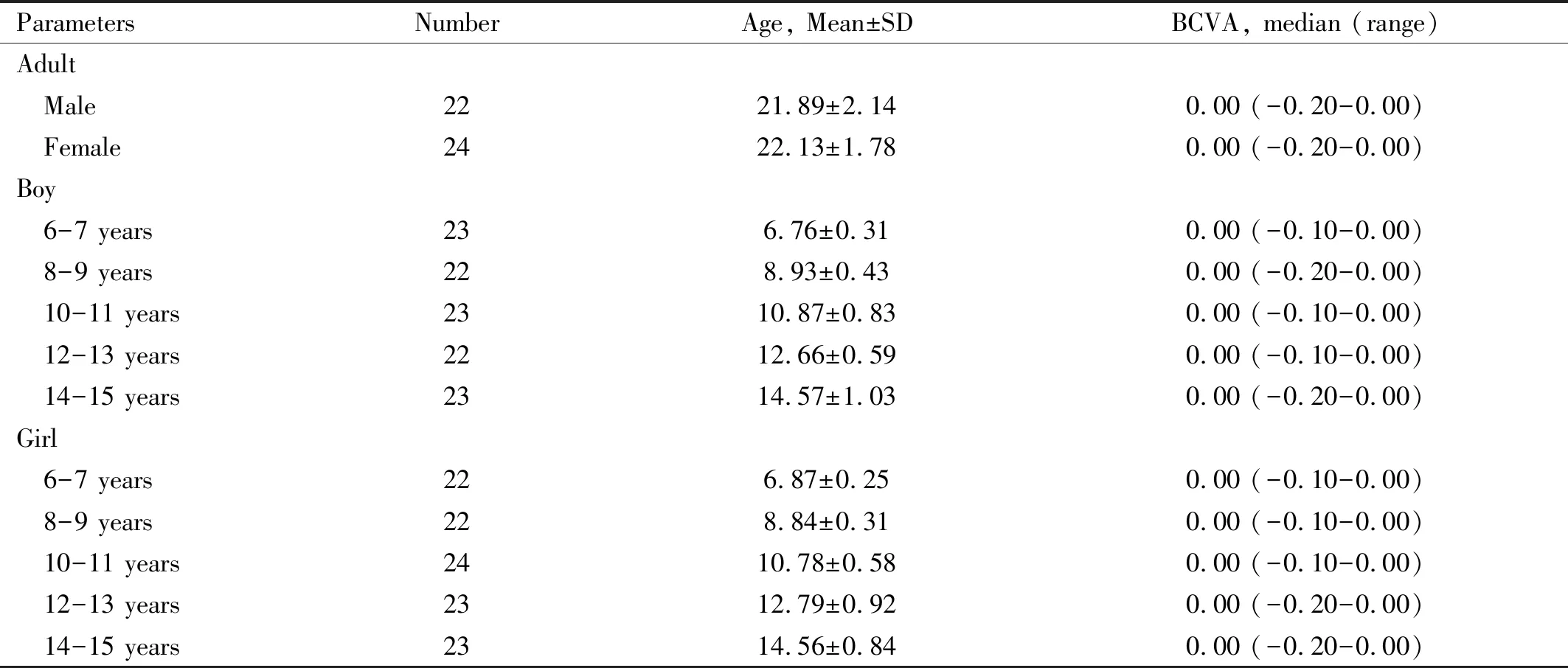
Table 1 Demographics and baseline data of the subjects
The adults’ and children’s thresholds to detect the global motion are displayed in Figure 2. For signal dots moving vertically with 1.0 deg/s (Figure 2A), the influence of gender and age on global motion detection was statistically significant (gender:F=10.533,P=0.001; age:F=8.599,P<0.001). The thresholds for adult females and 14-15 years girls were significantly higher than that in adult males (P=0.013) and 14-15 years boys (P=0.030). The girls aged 6-7 years had significantly higher threshold than adult females (P=0.031), and the boys aged 6-7, 8-9 and 10-11 years had significantly higher threshold than adult males (P=0.000, 0.007, 0.035, respectively). There was also a similar effect of gender and age for signal dots moving horizontally with 1.0 deg/s (gender:F=12.073,P=0.001; age:F=8.724,P<0.001; Figure 2B), the thresholds for adult females and 14-15 years girls were significantly higher than that in adult males (P=0.004) and 14-15 years boys (P=0.009). The girls aged 6-7 years had significantly higher threshold than adult females (P=0.033), and the boys aged 6-7, 8-9 and 10-11 years had significantly higher threshold than adult males (P=0.000, 0.003, 0.010, respectively). For signal dots moving vertically with 5.0 deg/s (Figure 2C),the influence of gender on global motion detection was statistically significant (F=6.826,P=0.010), while there was no difference between adults and children (F=1.085,P=0.369). The threshold for adult females was significantly higher than that in adult males (P=0.002). Finally, for signal dots moving horizontally with 5.0 deg/s (Figure 2D), there was a similar effect of gender and age on global motion perception as dots moving vertically with the same speed (gender:F=7.775,P=0.006; age:F=1.794,P=0.114). The thresholds for adult females and 14-15 years girls were significantly higher than that in adult males (P=0.001) and 14-15 years boys (P=0.017).
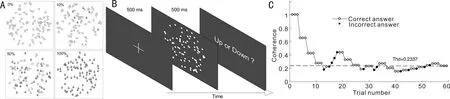
Figure 1 Stimulus and experimental procedure A: Kinematogram with different levels of coherence. Filled dots indicate dots moving at the same direction and open dots indicate dots moving at random directions; B: Experiment procedure; C: An example of results obtained from staircase with the three-down-one-up paradigm.
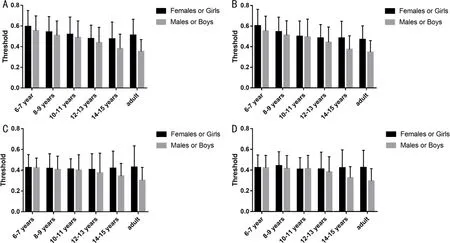
Figure 2 The threshold of global motion detection among different age groups A:Signal dots moving vertically with 1 deg/s; B: Signal dots moving horizontally with 1 deg/s; C: Signal dots moving vertically with 5 deg/s; D: Signal dots moving horizontally with 5 deg/s.
DISCUSSION
The present findings suggested that gender difference in detecting global motion only exists in adults and children older than 14 years. The threshold to detect global motion was similar for signal dots moving vertically and horizontally with the same speed. Furthermore, the global motion performance tends to be adult-like earlier for dots moving with 5.0 deg/s than 1.0 deg/s.
ComparisonwithPreviousStudiesOur results indicating that adult females have a significantly higher threshold as compared with adult males agreed with the outcomes from Snowden’s study[17]. In that study, stimuli moved at the speed of 0.5-4.0 deg/s and the mean threshold in adult females was 25.1%, which was significantly higher than that of 16.6% in adult males. However, the subjects in that study, with an age range of 54-71 years, were much older than the subjects in our study. Some studies indicated the threshold to detect global motion in adults was 0.429±0.219 after three times of practice[14], which was in accord with the present study.
The present study shows similar global motion detection with signal dots moving vertically and horizontally. The result was consistent with previous studies indicating that the detection thresholds were invariant with direction of motion, and the motion sensitivity was isotropic[24]. Furthermore, the current study also indicated that the threshold to detect global motion tends to be adult-like earlier for dots moving faster, which was consistent with the Giaschi’s study[18,23]. Motion coherence thresholds were assessed in 182 children and adults aged seven years to 30 years. The maturity of global motion detection was reached around the age of 16 years for the smallest displacement (1 arcmin) and, by the age of 12 years for the medium displacement (5 arcmin), in a test duration of 17 ms or 51 ms. While the coherence thresholds in the youngest children were adult-like with the largest displacement of 30 arcmin. The similar results indicated that global motion performance matured later in life for slower speed or smaller spatial displacement. The late maturation may reflect the improvement of global motion perception as motion processing fully matures with the pruning of connections among MT area and other associated regions in response to visual experience[29]. Previous research predicated that young children’s performance was likely limited by the ability to make full use of the information available in a motion stimulus[21]. As threshold for the faster speed or larger displacement stimuli is not different for children and adults, the noise of random dots does not appear to be a limiting factor in children’s performance.
NotExplainedbyLow-levelFunctionsThe present study demonstrated that males are more sensitive to global motion than females. However, the results couldn’t be explained by low-level functional differences. The stimuli for global motion measurement were black and white, which eliminates the possibility that the gender difference is caused by color deficits[30]. Males were found to be more sensitive at higher spatial frequencies and have better acuity at all temporal rates[3]. While in our study, there was no difference of corrected visual acuity between males and females, and the stimuli dots sizes were within the range of resolution. Therefore, the sex difference in global motion was not due to spatial vision difference between males and females. Subjects identified the location of a briefly exposed target pattern in the presence of five other patterns. Right-handed females, but not males, exhibited a significantly higher error rate in correctly localizing the target pattern when it was in the left visual field, particularly regarding the left parafoveal region[31]. We limited our test to the central 10 degrees, which is not far into the periphery, in order to eliminate the influence of peripheral visual field.
GeneralStructuralDifferencesintheBrainBetweentheTwoGendersandtheRoleofHormonesGender differences have been reported in brain structure[32-33], development[34], and functional connections[35], which, in sequence, leads to differences in behavioral performance between the two genders[36-37]. In general, males have a larger brain volume even after adjusting for the height and weight differences. Females achieve the peak volume of gray and white matter one year earlier than males. The numbers of neurons in the neocortex are different too, with an averaging of 23 million in males and 19 million in females, for a difference as large as 16%. Males have a larger amygdala (an emotion area) and females, on average, a larger planum temporale (a language area). The more testosterone there is in the amniotic fluid, the less gray matter exists in the planum temporale. Similar results come from animal experiments: a part of the amygdala called the medial posterodorsal nucleus, is larger in male rats than in females[38].
The gender difference in behaviors could be related to the distribution of the gonadal steroid hormones. In the cerebral cortex of the rhesus monkeys, including the visual cortex, a large number of androgen receptors were found. Those androgen bindings impact the cortical functions in primates greatly both prenatally and postnatally[39]. Similar findings were reported in rats, with males having more androgen receptors, particularly in the primary visual cortex[40]. It should be emphasized that, in both humans and rats, the largest concentration of androgen receptors is located in the cerebral cortex and not in the hypothalamic and limbic areas, which are associated with reproductions[41]. This distribution might be universal to the mammals. All these studies clearly indicated that the distribution of androgen-binding receptors may have a strong impact on the development of cortical structure and the maturation of visual function[3-4].
In recent years, more evidence tracing the developmental course of motion perception have been conducted[42-46]. Other studies conducted in rats have shown that, as with other cognitive functions that decline with age in a sex-dependent manner, visual cortical cells degrade faster in males than in females[47-48]. These studies showed clearly that the hormone level, which changes with age and maturation, affects the sensitivity to motion detection. The present study investigated the gender difference of global motion detection in adults and children, and showed the difference exists only in adults and children older than 14 years. The result confirms the prediction that the sex maturation has an influence on the global motion detection, and results in the gender difference late in life. We hope it could provide significant data for future studies on the sex maturation of global motion detection and studies including children with motion perception disorders.
TheLimitationsofCurrentStudySome limitations exist in the present study. First, the global motion perception in populations with visual developmental diseases, such as amblyopia, may show deficit because of the abnormal cortical networks[49]. Few studies have investigated the particular aspect. Therefore, the influence of sex maturation on global motion detection in these populations could be supplemented in future studies. Second, since the sensitivity of global motion is associated with the network of neurons in the MT areas[11-12], it is significant to supplement the neuroimaging study and explore the relationship between cortical structure and visual function in further investigations. There exists a gender difference in adults and children older than 14 years for detecting global motion, with females and girls demonstrating a high threshold.