
基于森林景觀恢復策略的莊園遺產景觀設計探尋——以荷蘭海德蘭省巴克塞比克地區為例
2021-08-03 03:04:24王顏姣斯特芬奈豪斯鮑勃烏爾森
風景園林 2021年7期
關鍵詞:景觀
王顏姣 (荷)斯特芬·奈豪斯* (荷)鮑勃·烏爾森
1 前言
莊園遺產景觀(heritage estate landscape)由歷史鄉村莊園集群構成,表現了歷史進程中人文活動規律及人與自然環境的互動(圖1)。莊園遺產景觀既給人們帶來視覺享受,也揭示了當地蘊含的文化背景,對促進區域發展的新陳代謝起到重要作用。然而,隨著工業化與急劇的城市化,遺產景觀面臨著氣候變化與文化特色喪失的威脅[1]。如今,人為干預、氣候變化、洪澇與干旱以及土壤功能喪失破壞了生態環境平衡。同時,多元化景觀也因景觀均質化、景觀元素消失和空間格局碎片化帶來的負面影響而退化為單一功能的工業化農業景觀。生態多樣性的缺失與水土保持能力的下降給景觀的修復與管理帶來嚴峻挑戰。它們不僅影響了莊園遺產景觀,也給區域景觀系統帶來壓力。為應對挑戰以及保護、恢復和進一步發展寶貴的文化歷史景觀,引入多尺度的空間規劃與設計方法,并結合研究場地的景觀特性對莊園遺產景觀進行進一步探討。

1 莊園遺址景觀的歷史情況與現狀Typical scene of a heritage estate landscape in history and now
為營建能夠積極應對未來挑戰的莊園遺產景觀,基于對景觀系統性構架的理解,生態視角下的多尺度規劃設計將是一個直接有效的方法[2]。它不僅能夠保護與發展生態價值與社會經濟價值,還能促進小尺度層面各景觀元素的積極互動[3]。利益相關者在區域構架內多個層面的溝通也將通過研究、設計、討論與想法的可視化等過程得到加強[4]。
本研究選擇荷蘭海德蘭省巴克塞比克地區的莊園遺產景觀和莊園遺產景觀區內的梅德勒和維斯2個莊園單體,從2個尺度進行研究型設計,旨在強調一種適應性的多尺度景觀設計方法。對本研究的研究對象而言,森林被理解為該莊園遺產景觀特性的主要元素,而森林砍伐被理解為導致區域空間格局變化、引發水系統問題以及生物多樣性缺失的重要因素[5]。基于此,森林景觀恢復(forest landscape restoration, FLR)作用為一種順應景觀自然發展規律的設計策略被引用到不同尺度的退化景觀中,以提升生態功能與人類福祉。本研究中,FLR為基于景觀的區域規劃設計提供了可能性,景觀設計作為解決區域問題和提升空間質量與社會價值的有效方法,為莊園遺產景觀面對來自當下與未來的挑戰提供指導。
2 森林景觀恢復作為多尺度景觀設計策略
FLR的概念由Chazdon等[6]提出并逐漸發展,是指恢復森林砍伐后或退化的景觀的生態功能并提升人類福祉的過程。FLR的提出應基于以下6點原則[7]:1)著眼于景觀發展;2)通過景觀維護提升自然生態系統;3)促進利益相關者與政府協調方的交流與互動;4)基于實際情況使用多種方法;5)以多元化價值為目的的功能多樣性恢復;6)因地制宜式的、具有可持續性韌性的管理措施。
森林景觀恢復一方面注重種樹的合理性,另一方面也旨在解決社會需求與提升人類福祉。森林景觀恢復的不同策略也已通過多個實際項目在全球范圍內得到實踐,例如泰國的都市森林項目[8]、埃因霍溫的濕地森林[9]、荷蘭高費呂韋國家公園[10]、英國新森林國家公園[11]、德國博肯納天堂自然保護區[12]、墨西哥清風造林項目[13]等。然而,森林景觀恢復目前幾乎還未被融入基于景觀的區域尺度規劃設計的框架中。通過設計進行研究是探索景觀可能性和確定應對方案的方法之一,該方法可以探索設計原則應用的可能性[14]。通過這種研究和設計機制,可以揭示區域研究的相關信息,從多個方面探索景觀的發展潛力,整合動態環境與人類活動的聯系與發展愿景。對設計的影響價值進行反思,發現“通過設計進行研究”是一種獲取關于景觀特征、空間發展可能性和解決實際挑戰的實用方法。
本研究案例中,FLR作為多尺度景觀設計策略,通過建立鄉村莊園單體之間的系統性聯系,利用本土歷史與傳統生態智慧,合理應用旨在對生態、可識別景觀、農業3個方面提升生態與文化價值的設計原則,對環境與空間格局進行積極干預。在研究與設計過程中,FLR不僅被用來指導優化樹木群落種植,同時也促使景觀向應對當下和未來挑戰的方向發展。在將長遠目標與短期干預措施相結合的過程中,FLR能為微觀尺度與區域尺度上的景觀提供優質生境與生態功能(圖2)。FLR在本研究案例中的愿景有:1)優質生態環境;2)可識別景觀;3)多樣化用地類型;4)多方合作;5)可持續發展。

2 森林景觀恢復框架——莊園遺產景觀開發與保護的多尺度景觀設計方法Forest Landscape Restoration (FLR) framework as multiscale landscape design strategy in heritage estate landscape development and protection
FLR作為系統性方法,被應用于巴克塞比克地區的莊園集群、梅德勒和維斯莊園聯合體、莊園單體等多個尺度的景觀中,促進了跨尺度景觀間的相互作用。在區域尺度上,FLR促進了莊園遺產景觀空間質量的提升。針對不同的情境,提出對應的設計原則和空間干預措施來解決特定場地的問題。例如,重新引入和演繹歷史及相應景觀要素,構筑能提高景觀質量的新景觀元素,打造智慧農場,進行恢復性造林、補充性造林以及加強土地利用。針對微觀尺度的具體情況,介紹了基于設計策略和原則的具體措施方法。為改善生態環境,修復歷史景觀,在適合的地方重建歷史溪流和溝壑林;在地勢較高且干燥的地區,提出了將傳統森林景觀類型整合到景觀中的發展策略,使森林草甸、籬笆林、分林等群落形態融于森林公園景觀;為提升水質,在小溪河岸帶建設森林和人工濕地;通過引入觀景點、棧道、重要節點的科普標識,合理梳理道路和河流交叉口的關系。莊園遺產景觀的可達性和游客的空間體驗感得到提升。
3 莊園遺產景觀——以巴克塞比克地區為例
3.1 巴克塞比克地區
巴克塞比克位于荷蘭東部的阿赫特虎克片區,隸屬于海德蘭省的沙質景觀區,是一條從東向西流淌的溪流(圖3)。這條溪流在通往艾瑟爾河的途中,會經過多種類型的景觀,如東部洪泛景觀(緩流溪流區)、莊園遺產景觀(低地溪流區)、沙脊景觀(臨時溪流區)、石南景觀(石南溪流區)、“坎彭”景觀(濕地溪流區)和臺地邊緣景觀(臺地溪流區)。各區域有著獨特的景觀要素、地理和生態條件,構成了該流域豐富的景觀類型(圖4)。遍布巴克塞比克流域的莊園中的別墅與周邊自然景觀融為一體,使該地區景觀富有濃厚的歷史人文色彩[15]。
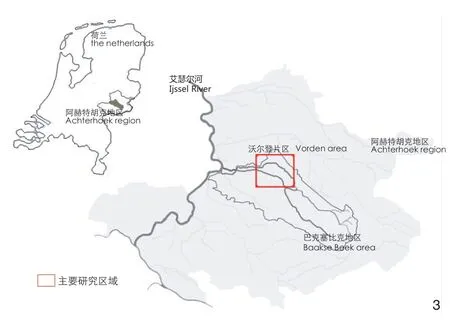
3 巴克塞比克地區區位圖The Baakse Beek Region in the Netherlands

4 巴克塞比克地區的6種景觀形態[15]Six landscape typologies in the watershed of the Baakse Beek Region[15]
然而,該區域景觀因均質化發展正面臨挑戰,其主要原因是人類活動和氣候變化給環境造成了不利影響,使土地很難為人、農作物和動物提供適宜生活與生存的條件。在莊園區的發展歷程中,除了巴克塞比克溪流和莊園本身,森林景觀從歷史到現在也對該地區產生了重要影響。森林作為莊園遺產景觀特征的重要組成部分,也是聯系生態和社會文化的紐帶。
在末次冰期(約1萬年以前),該地區的原有植被主要為沼澤與物種豐富的落葉林,15%的地區被泥炭覆蓋,是對動植物和人文活動都具有較高價值的地區。大約2 000年前,人們沿著溪流進入該地區,開墾農田、渠化河道并砍伐大量樹木獲取木材。18世紀中葉,在工業革命開始之前,隨著人類活動對自然景觀的毀壞加劇,荷蘭東部古老森林也因過度開發而消失。17—18世紀,巴克塞比克溪流中段出現了鄉村莊園,形成了該地區早期的莊園遺產景觀。同時,一系列文化運動及其引發的現象,包括啟蒙運動、人口膨脹、土地改革、世界大戰、工業革命和農業革命等,推動了城市化進程,使得對運河網絡、航運系統和木材的需求與日俱增。除此之外,更多的自然用地被開發以用于農田擴張和速生樹種植。伐木不僅降低了森林覆蓋率,而且對人們的農業活動和生活環境也有負面影響。19世紀末,在革命時代景觀與后現代新景觀的過渡時期,環境保護逐漸引起人們的重視。為抑制森林減少的趨勢,小型組織開始成立,如荷蘭自然古跡保護協會(荷蘭語:Vereniging tot Behoud van Natuurmonumenten)。政府也制定了相關條例以促進造林,既為保護生態系統,也旨在發展木材產業、促進經濟。“二戰”后,景觀逐漸進入后現代新景觀時代。如此,當前的景觀是集合了不同發展階段、顯示了人們的景觀態度的復合景觀[16]。
3.2 設計挑戰
莊園區的歷史發展體現了森林景觀的重要性。然而,近幾十年來,莊園遺產景觀的森林遭受嚴重的破壞,面臨水文環境、氣候變化和景觀特征3方面的問題。
3.2.1 莊園遺產景觀與水文環境
受森林砍伐的影響,莊園區的自然植被和作物的生長環境干旱且所處的水生態系統十分脆弱。考慮到土壤功能的退化,以及泥炭在經過歷史上的開墾活動之后幾乎消失,如今土壤的蓄水能力逐漸下降,且土壤類型多為缺乏養分的沙質土壤,人們很難有效利用土地。
3.2.2 莊園遺產景觀與氣候變化
氣溫升高是氣候變化最重要的表現形式之一,對該地區產生了重大影響。根據STOWA[17],與1990年相比,2050年荷蘭的夏季平均氣溫將上升1~2 ℃。近年來的夏季干旱帶來的缺水問題已成為自然保護主義者、農民和業主必須應對的挑戰。冬天,豐富的降水也導致該地區洪水泛濫。同時,由于莊園區位于巴克賽比克溪流的中游地段,農業產量和景觀質量也會因此下降[18]。
3.2.3 莊園遺產景觀與景觀特征
多樣化的微地形是巴克塞比克地區的重要景觀特征。這些小幅度的高差變化也帶來了多樣的景觀類型[19]。本研究對象為位于低地溪流區的莊園遺產景觀,包含了豐富的自然和文化資源。莊園遺產景觀面臨的挑戰包括可達性低、文化歷史景觀體驗缺失、利益相關者之間缺乏溝通以及地貌條件與自然類型之間的不合理聯系(圖5)。上述問題也造成了莊園遺產景觀場地精神與歷史記憶表達不足。

5 地質地貌條件與原生森林群落[20]Geomorphology condition and their natural forest[20]
目前,巴克塞比克地區的莊園遺產景觀正面臨著生態和景觀質量2方面的挑戰。與此同時,莊園區也為設計師提供了平衡生態環境、農業活動和基于景觀的空間質量的機會。
3.3 森林景觀恢復在規劃與設計中的應用
為應對上述挑戰,設計應用FLR作為保護和發展生態環境、恢復文化遺產和增進人類福祉的設計策略。基于FLR策略框架[21],整合多個關鍵干預措施,為莊園區構建了規劃愿景。例如:恢復性造林、補充性造林、營林生產、農林復合、改良休耕和一些不同形式的干預措施。這些措施將共同塑造更具韌性的生態環境,并使人們的福祉得到改善。該框架在當前土地利用類型和相應的FLR策略之間建立了聯系。例如,目前的沼澤地是林地的一部分,沒有樹木覆蓋。根據該框架,將在這些沼澤地引入恢復性造林與補充性造林(圖6)。

6 森林景觀恢復框架(6-1)及其在區域尺度上的應用(6-2)[21]FLR framework (6-1) and its application at the regional scale (6-2)[21]
3.3.1 區域性框架的建立
FLR作為設計策略,將包含11個莊園單體及其附屬農場、建成區和自然片區在內的莊園遺產景觀元素整合為全面的區域性景觀規劃框架。該框架主要包含了生態、可識別景觀與農業3個方面的措施與方針(圖7)。
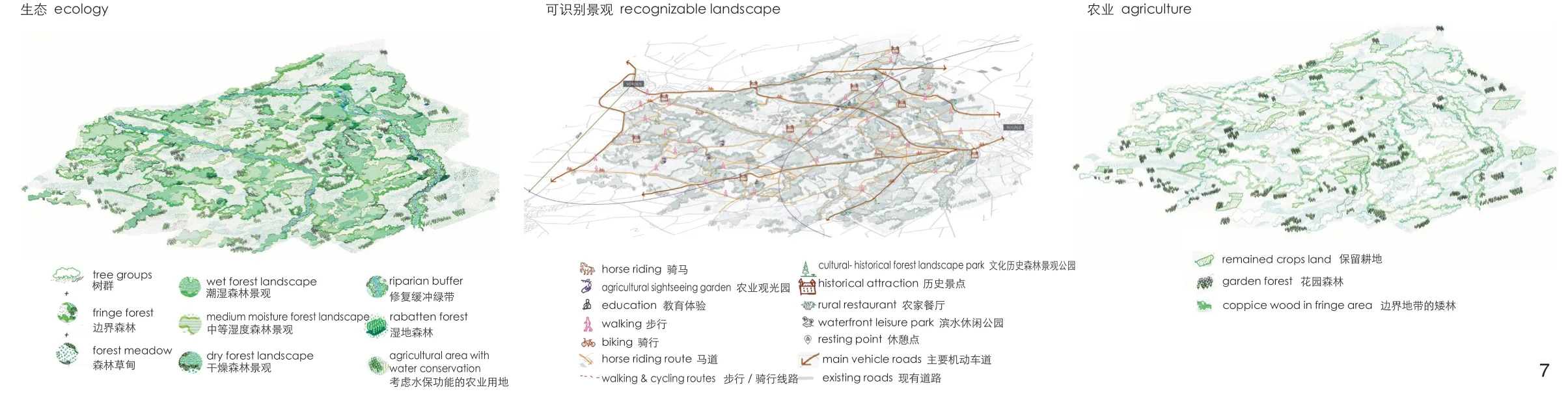
7 適應性森林景觀恢復框架的3個層面Three layers of the adaptive FLR framework
3.3.1.1 生態
基于該地區的地貌條件以及自然萌發的潛在植被作為發展基礎,提出了FLR框架下的生態層面策略。根據植被的生長習性,不同的森林群落被合理規劃到符合相應生長條件的區域。在低洼潮濕地區,規劃設計適宜在該生境下生長的、由原生樹木和其他植物多層次組合的植物群落。對于干旱和中度干旱地區,可以發展櫟–山毛櫸群落和樺–櫟群落,并利用自然演替規律保證其持續性;對于較為濕潤的地區,榿–白蠟群落和濕地榿木群落則作為主要的森林群落被引入。因地制宜地規劃設計森林群落,有助于創造各種有價值的棲息地,從而提高該地區的生態效益,促進作為“綠色基礎設施”的新景觀提高該地區的蓄水能力、水土保持能力和生物多樣性。
此外,FLR也能促進莊園遺產景觀中的水文循環。基于自然網絡中豐富的物種和群落層次,景觀與水系統的關系更加緊密。結合下層的樹木和植被在水文循環系統中的重要作用,降水量增加時,落葉喬木也可以有效阻止水分蒸發[22],土壤水分也可以在地下得到積累和保持。同時,落葉殘余和溶解性有機物的滲漏有助于增加土壤礦物質。
充分利用樹木生態價值能促進景觀質量的提升。樹木的蒸騰作用和其他生理功能驅動自然環境(特別是水文環境)中關鍵的水分循環和碳氮循環,合理的植被密度也有助于保證溪流中水質達標,從而為游客提供美麗的景色。基于農業用地的FLR,通過選擇闊葉樹種和適宜的農作物減少水分流失、積累土壤礦物質,從而促進水文循環。
因為莊園區現有的森林區域的規劃側重考慮其經濟價值,缺乏對植被適應和自然系統保護的關注,所以現存森林群落構成仍需進一步調整。從景觀發展史的第二階段(革命時代景觀)開始,原有的森林群落就已逐漸被生產林和農田所取代。物種多樣性的缺失不但影響了生態多樣性,同時也影響著水文環境;氣候變化也逐漸改變了森林群落的組成、功能、生產力和生境,并影響著生態系統的平衡[23]。而這些原始森林群落中存在的豐富物種,經歷長期繁衍、適應生境后,往往能在不同層次上通過持續的合作為生境帶來持續的積極影響。基于此,恢復物種多樣性后的莊園遺產景觀將促進景觀與生態環境形成更緊密的聯系,同時增強人們與自然的互動。通過合理規劃森林群落類型,新莊園遺產景觀可以向游客展現景觀的歷史故事,并更好地提供場地感觀體驗。在沃爾登片區的森林景觀恢復工作建設完成后,綠色基礎設施將發展成為具有更大生態調控能力的頂級森林,從而進一步促進穩定、有彈性的生態系統的發展。
3.3.1.2 可識別景觀
可識別景觀是具有明顯空間特性和景觀特征,并能讓游客感知當地歷史的景觀。基于自然景觀特征,開發新的體驗路線和科普娛樂目的地,從而加強歷史森林景觀與現代莊園遺產景觀的聯系。利用森林資源研究發展具有獨特空間特征的森林類型,使莊園遺產景觀的歷史層面更加清晰,并為人們提供多樣化和有意義的空間體驗(圖8、9)。
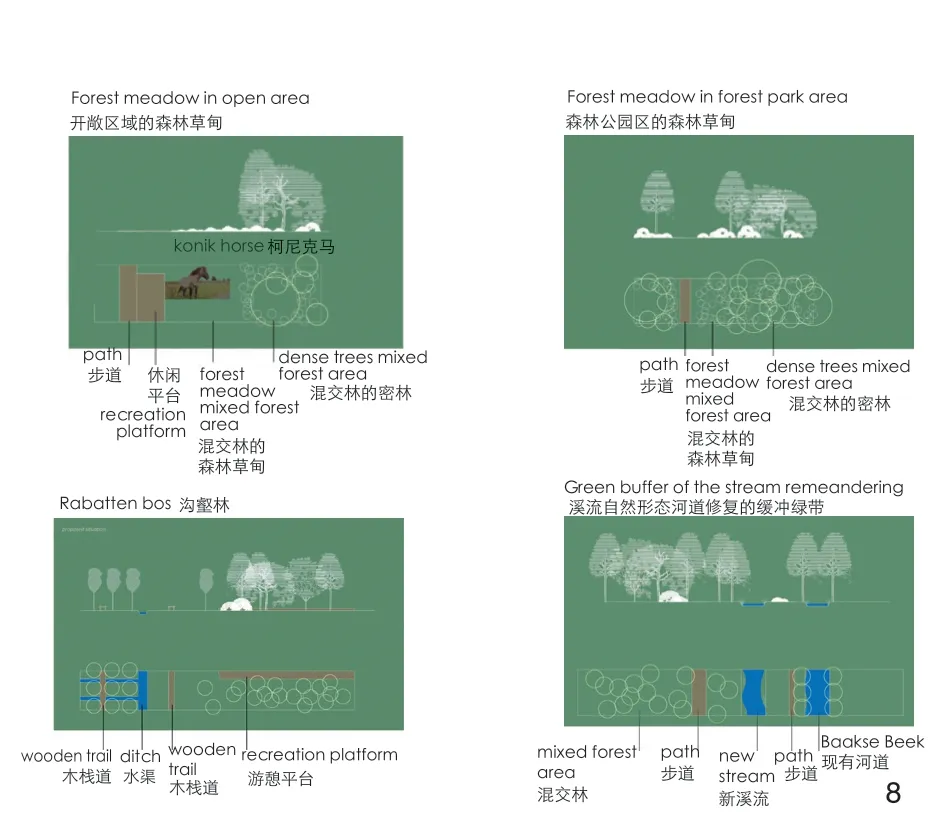
8 巴克塞比克地區的4種歷史森林形態Four historical forest types in the context of the Baakse Beek Region
9 FLR作為提升空間景觀形態的策略FLR as a means to develop spatial landscape typologies
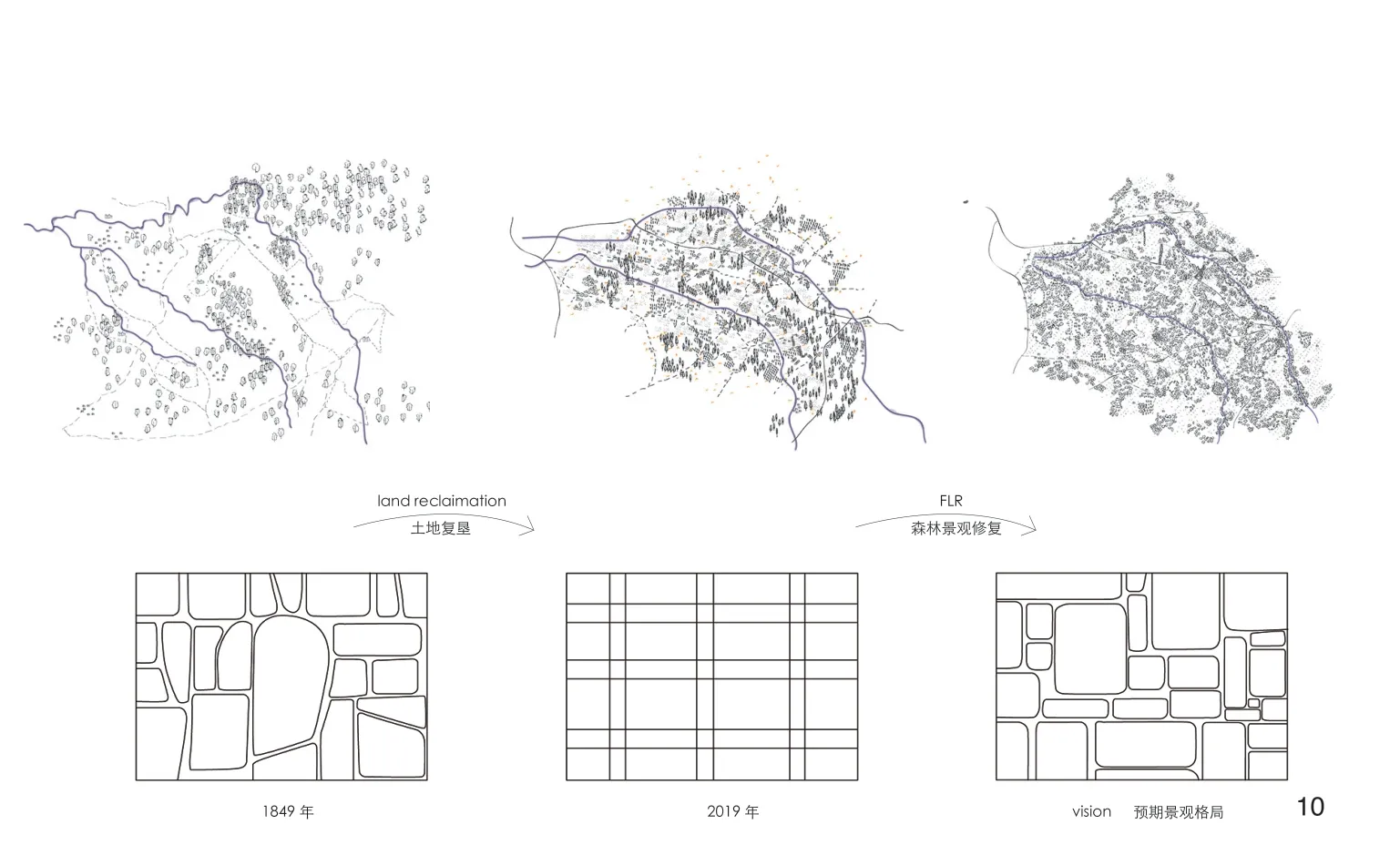
此外,歷史森林類型的修復有助于發展歷史景觀的空間格局(圖10)。受歷史上的土地復墾的影響,以及對生態環境和未來發展的考慮的缺少,人們很難從目前的網格狀空間格局和同質化景觀中了解莊園背后的故事。通過FLR的介入,歷史空間格局的有機形態得以恢復,且更具韌性與表達性。

10 區域尺度上空間格局的恢復Restoring the spatial pattern at the regional scale
通過森林景觀恢復,加強莊園周圍的景觀與內部獨具特色的花園建筑的視覺聯系,從而揭示各莊園歷代關于自然和文化的故事。另外,鄉村別墅的花園與周圍森林和農田等用地內的新景觀元素,如果樹、牛和農舍等,相互滲透、過渡并融于莊園遺產景觀中,這也體現了與中國園林建筑中相似的“借景”原則。
基于生態層面的策略,歷史森林景觀的恢復可以突出森林景觀類型與景觀體驗的聯系。通過恢復與更新森林景觀,合理規劃不同活動場景下的樹木群落,使莊園遺產景觀的特性可以以更直觀的方式被呈現。
3.3.1.3 農業
基于與新的綠色基礎設施合作的設計策略,農業方面的干預策略以農林結合為主要形式、作用于目前碎片化的農業用地,持續地豐富農業活動類型。目前農業用地是該區域的主要用地類型,這也使得農業具有巨大的發展潛力,并進一步推動農業發展、使其智能化。考慮到農業區通常排布有排水溝和灌溉溝,循環垂直的人工濕地在菜園區的應用則具有一定的潛力。這項技術不僅可以改善水質,減少衛生問題,還可以提高作物產量[24]。另外,該技術也有助于農業區發展成為游客互動與農產品生產相結合的平臺。花園還包含不同的蔬果種植模式,以便更好地利用有限的土地、土壤營養和陽光[25]。例如種植結構下層是漿果灌木和多年生草本植物,主要用于季節性生產和農家采摘活動,使區域獲得更大的經濟效益和社會效益。對于保留的耕地,智能管理和監測是必要環節。耕地內主要作物種類多為闊葉樹種,如玉米,配合小喬木或樹籬種植,以促進養分和水分循環,有利于提高產量。考慮到木材生產是該地區的主要生產活動之一,且有較大的發展機遇,FLR策略中的矮林將作為可持續生產林的新形式在這里進行引用并發揮潛力。
在農業方面,設計結合農耕活動,灰柳(Salix cinerea)、黑橡樹(Quercus velutina)、歐榛(Corylus avellana)等飼用樹種擬在森林邊緣區種植,根據種植日歷合理規劃農業活動,為游客提供更多通過農業感知景觀的新視角,以維護市場需求,同時保障農民利益。花園森林不僅可以作為游客的休閑目的地,為他們提供食品,還可以支持當地遺產保護項目:“高稈水果方舟”(Achterhoek):通過在花園森林中種植當地特定品種的蘋果樹,以保護該地區的特殊遺產。參照《高稈果樹手冊》,7種蘋果樹①將在研究區進行引種。
通過運用FLR,農業區不僅用于生產,也是人們休閑娛樂的可食景觀體驗區。設計將農產品、農場與娛樂活動相結合,縮小農民、當地食品和人們之間的距離,同時也吸引了更多的游客前來參觀。在此之前,消費者至少需要4個步驟才能購買到產品,而且由于耗時較長,食品的新鮮度會受到影響。然而,FLR策略下的農林復合經營策略和營銷模式使得農產品交易過程既省時又具有娛樂性。
3.3.2 在地尺度上的設計探索
在區域尺度上基于FLR的戰略規劃中,在地尺度的莊園遺產景觀的具體設計任務得到了進一步確定與闡述,并從生態、可識別景觀和農業3個角度應對各自的挑戰,為莊園增添價值。
維斯莊園(荷蘭語:De Wiersse)及其游園和花園是一個以傳統風格來設計并與周圍景觀緊密融合的集合體。莊園選址靠近水源,同時片區內包含多樣化的土地用途,例如牧場與農產品種植等。莊園中也富含包括森林(例如溝壑林,Rabatten)、景觀視線,房屋和雕像等在內的歷史遺留的景觀元素。但是,水質水量的不足給如今的莊園帶來巨大挑戰,同時對原始的棲息地與自然環境產生很大的影響。
在FLR框架下,干預措施以營林、農林業和補充性造林3種形式為主,旨在共同促進生態環境和空間體驗的發展。在維斯莊園的新景觀中,歷史悠久的溪流和河道可通過新的河岸緩沖區和巴克塞比克地區沿岸的植物群落來過濾和調節土壤的蓄水能力并提高水質(圖11);“溝壑林”和“森林草甸”等歷史森林景觀的恢復可以促進該莊園現有森林和營林的發展(圖12)。樹木不僅能調控二氧化碳的循環,而且可以提升該地區的“海綿”能力。此外,它還促進人們與歷史森林景觀的共鳴,加強人們對區域特性的辨識度。通過在莊園列植樹木,強調軸線,從而形成具有視覺價值的景象。功能單一和工業化的農業用地通過合理引入當地果樹品種、馬匹等轉變為多功能的森林花園。通過應用農林業結合的市場模式,促進生物多樣性以及游客與景觀的互動。因此,森林景觀恢復的森林密度與組成類型的多樣性有助于加強莊園的生態和社會價值。這也將對位于維斯莊園下游的其他莊園(如梅德勒莊園)的景觀產生積極影響。
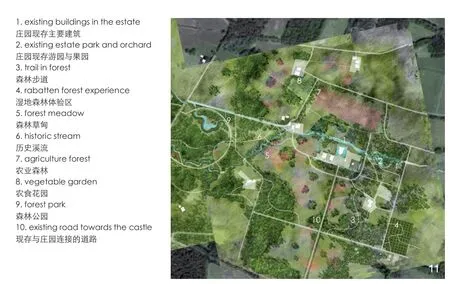
11 FLR干預下的維斯莊園FLR at De Wiersse

12 溝壑林作為造林干預維斯莊園的一種形式(12-1)以及溝壑林的后期管理(12-2)[26]“Rabatten” forest as a tool of silviculture at De Wiersse(12-1) and its management (12-2)[26]
梅德勒莊園(荷蘭語:Het Medler)的主體建筑被護城河環繞,所處地勢較高,其附屬的農場和儲藏室則位于較低的位置。基于莊園內多次的土地交換歷史,莊園區內的農舍具有深厚的文化底蘊,整個莊園與若干農舍點綴組合而成的獨特景觀也使得景觀體驗感更加豐富。但是,由于溝渠干涸、天然林工業化帶來的物種多樣性缺失、莊園和草甸的低可達性,莊園遺產景觀的復原力正面臨挑戰。此外,莊園內農業活動的增加也不斷損害著植被的多樣性,并導致莊園遺產景觀的均質化。在梅德勒莊園采用農林業結合的方式,與農民共同決策土地的多樣化合理使用,推動歷史悠久的農舍融于景觀,引導游客感知該地區的文化歷史(圖13)。此外,這些干預措施也為生態環境帶來了好處。因地制宜地對本土物種和植物群落進行規劃,依靠自然植被的生長過程逐漸解決水質水量的問題。此外,通過加強物理和視覺的聯系,使得梅德勒莊園與維斯莊園等周邊景觀的聯系進一步加深(圖14)。

13 FLR干預下的梅德勒莊園FLR at Het Medler

14 在地尺度上空間格局的發展The development of spatial patterns at the local scale
因此,FLR的設計策略也具有解決微觀尺度上莊園個體所面臨的個別問題的能力。同時,通過在各個莊園遺產景觀單體之間建立空間聯系,為整個區域提供了可以產生更多積極效應的可能性。
4 結論與討論
4.1 莊園遺產景觀設計的重要性
莊園遺產景觀是社會因素與生態環境緊密聯系的復合體。開發和保護此類景觀可以為地區帶來重要的社會和生態價值。例如,通過提升可達性和景觀質量,改善水環境質量,并配置能有效適應環境的各種森林群落等設計策略,促進旅游和娛樂、增加生物多樣性。除此之外,人類福祉也能通過宜人的自然環境得到促進。考慮到莊園內農業活動會密切影響經濟狀況,因此景觀的長遠發展應在規劃和設計中著重考慮,以確保各利益相關者的利益。特別是在面對與土地所有權和土地管理機制相關的復雜情況時,只有通過多方有效溝通才能解決問題。因此,在協作過程中應注重有效設計方法的必要性,以增加相互了解,共同制定方案,周全考慮自然和人類之間的平衡關系。
同時,莊園遺產景觀的規劃設計過程揭示了基于景觀的區域韌性發展的廣泛可能性。不僅限于打造水敏感和生態良好的環境,而且為景觀文化元素的修復提供機會,增強空間體驗、豐富空間特性。
4.2 FLR作為設計策略在莊園遺產景觀的應用
區域景觀設計方法對于多學科合作至關重要,它能有效從區域和地方尺度上將生態、休閑和社會系統的新陳代謝等方面整合到空間發展。在巴克塞比克地區,市政、設計師和其他利益相關者正在采用這種方法來實現具有氣候韌性的莊園遺產景觀。本研究將FLR理解為適用于多尺度的潛在設計策略,并對其進行多視角的討論。
在本研究案例中,FLR為莊園遺產景觀提供了韌性發展的方向。根據水系統管理和森林演替發展的不同階段,遵循區域尺度上指定的戰略框架,確定了遠期定位。這一框架不僅可以幫助制定區域韌性發展的戰略決策,也為短期的地方干預和潛在景觀開發項目奠定堅實的基礎。例如,恢復歷史河道及其生態環境將需要很長時間,但可以在短期內對局部河道實施技術解決方案,為實現長遠目標做準備。此外,應用水處理基礎設施來改善水質、增強生態價值,如植物過濾器。除了利用恢復性造林和補充性造林等策略優化生態環境與景觀體驗外,樹木生長規律與自然演替周期也被充分考慮到設計中,以使新景觀長期、動態并可持續地針對生態、可識別景觀和農業3方面發揮作用。另外,從空間、生態和歷史的視角來看,2個孤立的莊園之間也通過藍綠基礎設施建立連接(圖15)。
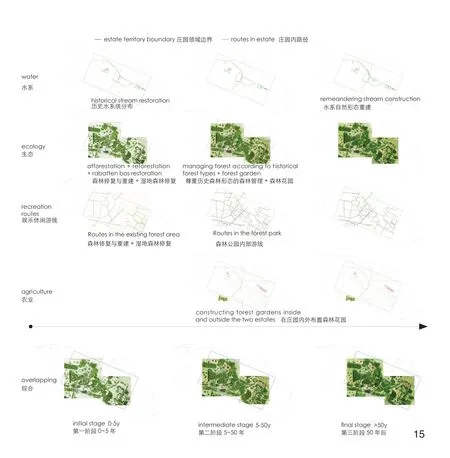
15 在地尺度上的莊園遺產景觀的不同發展階段Development phases of the estate landscape at the local scale
靈活性是空間面向未來發展的重要特征之一。FLR作為區域視角下的設計策略,結合策略框架,將不同尺度下的景觀整合為一個系統,從而使設計師在景觀的分析階段為目標地區提供多種解決方案;微觀尺度方面,遵循區域尺度策略的指導,FLR為特定地區靈活設定的潛在設計任務可以有效應對景觀缺乏文化認同與溝渠的干旱或富營養化的情境。簡而言之,將系統中每個景觀要素作為一個整體是一個重要視角。這種看待景觀的靈活視角不僅在解決當前問題方面,而且在韌性景觀規劃中都起到關鍵作用。雖然,FLR作為一種多尺度設計策略,可以調節生態環境,文化遺產以及人們的景觀體驗和景觀需求之間的平衡關系,但是FLR也存在局限性。例如,由于策略框架與土地利用類型之前的緊密關聯,該策略在區域尺度的實際應用中可能缺乏靈活性。
本研究中的設計內容通過探討不同類型的干預措施方法,為探索以莊園遺產景觀為背景的森林景觀恢復應用提供了一種直觀的方法,同時激發FLR在不同方面的可能性。
4.3 巴克塞比克案例對當代中國的啟示
莊園遺產景觀不僅是人類與自然環境互動的產物,它還承載著應對未來挑戰的使命,這對當代區域發展至關重要。在本研究中,莊園遺產景觀的韌性設計策略中闡述的多尺度景觀設計方法揭示了以增強景觀韌性和文化遺產參與度為目的,且基于景觀的包容性設計方法。
在當今的中國,為了重建文化自信,承載文化和精神價值的文化遺產在社會發展中發揮著日漸重要的作用。然而,隨著近年來城市化和工業化進程的加速,傳統景觀逐漸被現代文明所取代。為保護文化遺產,中央政府在2020年新提出了相關文件,例如新的《國家歷史文化名城名城申報管理辦法》(試行版),以加強對歷史文化資源的普查,并推動保護城市景觀環境和整體空間格局的有關工作。
巴克塞比克地區的設計方法對當代中國在應對遺產景觀保護和開發方面的類似挑戰時起到借鑒作用。此外,FLR的應用可以促進利益相關者之間的協作。基于生態環境保護的FLR策略會是中國遺產景觀規劃設計的有用工具。但是,中國目前的協調機制使得不同利益相關者的參與有所欠缺,這也為FLR提供了機遇。本研究提出的方法以從多尺度視角正確理解景觀為基礎,其關鍵在于研究與設計的緊密結合。對于中國歷史文化名城在不同尺度上的獨特性方面,特別是關于如何通過發展來保護歷史文化名城,仍有待進一步研究。鑒于中國文化景觀的保護和發展還處于早期階段,其他有經驗的國家和地區的案例研究將起到充分的借鑒作用。
致謝:
本文作者在此對本文的寫作與發表的過程中給予幫助并提出建議的審稿人員表示感謝,對就中文版本譯稿進行指點與修正的郭巍教授、雷蕓副教授和宋巖表示感謝,對指導過研究最初期工作的別克·卡圖爾表示感謝。
注釋:
① 參照《高稈果樹手冊》,7種蘋果樹分別為‘Bismarck’、‘Brabantse Bellefleur’、‘Cox’s Orange Pippin’בCox’s Pomona’、‘Keulema’、‘Koningszuur’、‘Notarisappel’和‘Zoete Bloemee’。
圖片來源:
圖1-1引自www.dewiersse.com,1-2由Hans Hendriksen拍攝;圖2、7~11、13~15由作者繪制;圖3由作者繪制,數據來源于ArcGIS;圖4由作者根據參考文獻[15]繪制;圖5由作者根據參考文獻[20]繪制;圖6由作者根據參考文獻[21]繪制;圖12由作者根據參考文獻[26]繪制。
(編輯/王亞鶯)
Forest Landscape Restoration as Design Strategy for Resilient Heritage Estate Landscapes: The Case of the Baakse Beek Region, Gelderland Province, the Netherlands
WANG Yanjiao, (NLD) Steffen Nijhuis*, (NLD) Bob Ursem
1 Introduction
Heritage estate landscapes are clusters of historic country estates and express the interaction between human activities and the natural environment throughout history (Fig. 1).These historical estates landscapes present visual enjoyment, reveal the hidden cultural layer and continuingly function as a structure contributing to regional metabolism. However, along with industrial development and the rapid urbanisation, heritage landscapes are challenged by climate change effects and vanishing cultural identity[1]. By recent human intervention, climate change, flooding, drought,and soil degradation suppress the eco-environment.Meanwhile, landscape standardisation, disappearing landscape elements and spatial fragmentation,transform the highly diverse landscapes into monotone industrial agriculture landscapes,declining biodiversity and lack of sponge capacity.This causes problematic situations for individual estates and has significant impacts on the regional landscape system. Multi-scale spatial planning and design approaches are needed to address these challenges and at the same time, protect, restore and develop these valuable landscapes.
To achieve future-proof estate heritage landscapes, employing ecological thinking in the planning and design process is one of the keys for successful solutions[2]. Ecological thinking is part of a regional landscape-based design approach in which the landscape is understood as a dynamic complex system in which natural and socialcultural processes and structures interact and exert influence on each other at multiple scale levels[3]. In this approach the multi-scale planning and design process offers a powerful method to understand and developed systemic and coherent structures, that one hand safeguard and develop ecological values socio-cultural values, and at the same time facilitate local interaction and infill. The dialogue between the different layers and stakeholders is promoted by a strong connection between research and design,and visual thinking and communication[4].
This paper addresses an adaptive and multiscale landscape design approach for the development of a more resilient heritage estate landscape, taking the Estate landscape in the Baakse Beek Region(a region in the East of the Netherlands) as a case study, in particular focusing on two estates, Het Medler and De Wiersse. Deforestation is identified as one of the critical agents of spatial change in the region, causing significant water system problems and biodiversity loss[5]. Based on a regional analysis of the estate landscape’s historical development,Forest Landscape Restoration (FLR) is employed as a contextual design strategy to regain ecological functionality and enhance human wellbeing in the degraded landscape across different scales.Here forests are identified as a central element in the identity of this estate landscape. FLR offers excellent potential in landscape-based regional design as a driving force to address the problems the region faces and add new values. In this paper,FLR is used as a strategy to revitalize the estate heritage landscape to meet current and future needs.
2 Forest Landscape Restoration as Multi-scale Landscape Design Strategy
The concept of FLR is introduced and developed by Chazdon et al.[6]. FLR is defined as a process that aims to regain ecological functionality and enhance human wellbeing in deforested or degraded landscapes. This aim is based on the following principles[7]:1) Focus on landscape development; 2) Maintain and enhance the natural ecosystem within landscapes; 3) Engage stakeholders and support participatory governance; 4) Tailor to the local context using a variety of approaches; 5) Restore multiple functions for multiple benefits; 7) Manage adaptively for long-term resilience.
FLR is thus not only about intelligently planting trees, but also addresses societal needs and human wellbeing. FLR also has been widely applied to projects all over the world, such as the Metro-Forest Project in Thailand[8], Rabattenbos Eindhoven[9]and De Hoge Veluwe nature park in the Netherlands[10], New Forest National Park in England[11], Borkener Paradies in Germany[12],Fresh Breeze Afforestation Project in Mexico[13],and so on. However, FLR is hardly applied in the framework of landscape-based regional design.
In this paper FLR is employed as a multi-scale landscape design strategy to address environmental and spatial challenges by 1) exploiting systemic relations between country estates, 2) by using local historical and traditional ecological knowledge,and 3) applying principles that leverage ecological and cultural values. In this perspective is FLR not only about planting trees but also on landscape development to meet present and future needs and connect long-term perspective and short-term interventions to provide livelihoods and Ecosystem services from a regional scale to a local scale(Fig. 2). FLR is here considered as a means to achieve: recognisable landscape; improved ecology quality; multifunctional land use; collaborative effort; sustainable development.
FLR is an approach that addresses multiple scale levels, ranging from the estate zone in BB region, the De Wiersse-Het Medler cluster to the individual estate. At the regional scale, FLR helps to develop and safeguard the spatial and ecological qualities of the estate landscape. Depending on the situation design principles and spatial interventions are proposed to deal with the site-specific problems and potentials. This entails interpreting landscape history and re-introducing lost landscape elements,illustrated by the reconstruction of the former brook and “rabatten” forest. The development of a forest park landscape in which traditional forest types like forest meadow and hedgerows fringed forest play an important role, are proposed at the higher and dryer parts of the grounds. Water purification is achieved by the construction of forests in the riparian zone of the brook together with helophyte filters, recalling the wetlands that used to grow in this situation. Of course, it also about introducing new landscape structures and functions,by reforestation, afforestation and intensified land use (e.g. smart farming) in a context specific sensitive manner. By introducing viewpoints,elevated pathways, and designing roads and stream crossings appropriately, estates’ accessibility could be enhanced and visitors’ spatial experience could be enriched.
Research through design is a constituent element of the approach to explore the possibilities and identify solutions[4]. Design experiments are employed to explore the possibilities of applying design principles derived from design research[14].By this research and design mechanism, related information of the study area could be exposed,possibilities from multiple aspects can be explored to make a holistic vision and connection between a dynamic environment and human activities. With the reflection on the design’s values, “research through design” is a practical approach to gaining knowledge about landscape characters, spatial development possibilities, and practical solutions to challenges.
3 Heritage Estate Landscape Baakse Beek as Case
3.1 The Baakse Beek Region
The Baakse Beek Region is located the province of Gelderland, in the eastern part of the Netherlands. The Baakse Beek is a brook (small water stream) flowing from the east towards the west in a sandy landscape (Fig. 3). On the way to the river IJssel, the brook passes various types of landscape,such as eastern flood landscape (slow-flowing brook area), estate landscape (lowland brook area),sand ridge landscape (temporary brook area), heath landscape (heath brook area), “Kampen”-landscape(wetland brook area) and terrace edge landscape(terrace edge brook area). Each zone has distinctive landscape elements, geographical and ecological conditions that characterise distinctive landscape types in the basin area[15](Fig. 4).
These estates in the watershed, with their identical country houses and various surrounding landscapes, make the region under the impact of history and culture. It is because of the Baakse Beek that estates in the region are where history and nature meet and communicate.
However, this variation in landscape types is now declining and the region develops into a more homogeneous landscape. The environment suffers from adverse impacts from human activities and climate change, making it challenging to provide fertile land for crops, places of suitable quality for people’s living, and habitats for animals. As for estate zone’s development across time, not only the Baakse Beek stream and estates play an essential role in this area, but also the forest landscape plays an significant role in the history as in the situation nowadays (Fig.5). Forests are part of the primary identity of this landscape and are an important condition for the ecological and sociocultural system in this region.
During the last glacial period (< 10,000 years B.P.), the landscape was characterised by swampy grassland, a species-rich deciduous forest and 15%of the region was covered with peat, which turned out to be a fertile and attractive area for vegetation’s growth, animals and people’s living. About 2,000 years ago, people moved into the region along the water stream. They began to cut down trees for more agriculture land and more wood materials.Also, more watercourses were excavated and extended. Especially before the industrial revolution started in the mid-18th century, the landscape went through accelerated deforestation, and all remaining historical forests got disappeared in Eastern Netherlands as a consequence of overexploitation. During the 17th century and 18th century, country estates emerged along the middle part of Baakse Beek stream, which shaped the estate landscape in this region in the early period.With a series of cultural revolutions, such as the Age of Enlightenment, demographic changes,land reforms, world wars, industrial processes and agriculture revolutions, etc. there was increasing demand for wood to develop canal networks,shipping systems and boost urbanisation. Apart from that, more natural land got exploited for more farmland and softwood planting. Deforestation had negative impacts not only on the forest cover,but also on people’s agricultural activities and their living environment. In the late 19th century,during the transition period between landscape of the revolutions age and post-modern new landscape, people were aware the importance of environmental preservation. To reverse the trend of forests’ decline, private societies, like Vereniging tot Behoud van Natuurmonumenten, were formed and governments also established regulations to contribute to reforestation. Some of these regulations were made for promoting ecosystem,while some reforestation projects were for wood selling to boost the economy. After world war II,post-modern new landscapes emerged. As such the current landscape is palimpsest, that showcases different stages of its development and display the people’s attitude towards the landscape[16].
3.2 Design Challenges
The historical development of the estate zone illustrates the critical role of forests. However, in recent decades the estate landscape suffered from severe deforestation and therefore faces three types of problems
3.2.1 Estate Landscape and Hydrology Environment
Negatively impacted by deforestation, natural vegetation and crops in the estate zone live in a dry habitat where the aquatic ecosystem is vulnerable.Because of the degradation of the former forest soils the sponge capacity of the soil is decreasing.This is also related to the fact that the soil in this area is mostly sandy while peat had almost disappeared after historical reclamation. Suffering from the sandy soil with little nutrients and poor functions, land here is hardly in other good use.
3.2.2 Estate Landscape and Climate Change
Temperature rise is one of the most important expressions of climate change. According to STOWA[17], the Netherlands will face an increase in average summer temperatures of between 1 and 2 degrees Celsius in 2050 compared to 1990, and will exert a great influence on the region. In the summers of previous years, drought manifested itself already and became a serious problem for nature conservationists, farmers and estate owners,which had to deal with a shortage of water. In winters, there is an abundance of water which causes flooding in several parts of the region.Meanwhile, as the middle reaches of the stream, the estate zone area will suffer from yield depression and lower quality of the landscape[18].
3.2.3 Estate Landscape and Landscape Characteristics
The Baakse Beek basin area is characterised by an undulating landscape with subtle, but important height differences. These height differences create a diversity of landscape types[19]. Here the focus is on the estate landscape located in the lowland brook area. Considering that the site contains rich materials in natural and cultural backgrounds.Challenges the estate landscape faces include lack of accessibility, cultural-historical landscape experience, negotiations among stakeholders and the relations between geomorphology condition and nature type, contribute to the lack of connection to the estate landscape from the site spirit, from the past (Fig. 5).
The estate landscape of Baakse Beek basin area now is facing challenges from both ecological and landscape quality aspects. Meanwhile, the estate zone also shows designers opportunities in achieving a balance among ecological environment, agricultural activities and landscape-based spatial quality.
3.3 Planning and Design Application of FLR
To address the challenges, FLR is used as a design strategy to conserve and develop the ecological environment, restoring the cultural heritage, and enhancing human wellbeing. Based on the FLR options framework[21], the plan proposed for the estate zone integrates several critical interventions that together result in a more resilient ecological environment and appropriates people’s wellbeing:such as reforestation, afforestation, silviculture,agroforestry, improved fallow and some riparian tools in diverse forms. The framework creates links between current land-use types and corresponding FLR strategies. For example, the current swamps are part of forest land without trees covered. Based on the framework, afforestation and reforestation would be introduced to these swamps (Fig. 6).
3.3.1 Towards a Regional Framework
The whole estate zone contains 11 different estates, farmland, built-up area and nature area. All these elements are united into a coherent regional landscape framework in which FLR is employed as a design strategy. The landscape framework addresses three layers: ecology, recognizable landscape and agriculture (Fig. 7).
3.3.1.1 Ecology
The ecology-layer of the framework is based on the geomorphological conditions of the area.The FLR takes the natural potential vegetation as the basis for its development. In lowlying wet areas you will find different communities, than in higher, dryer ones. These forest communities are the combinations of native trees and other plants at different layers.Different forest communities rely on the areas of corresponding conditions as their suitable habits.For dry and moderately dry areas, beech-oak forest and birch-oak forest can be promoted using natural succession. Alder-ash forest and swampy alder grove are the main forest communities introduced to the wet area. In this way, the forests would grow well and help to create a variety of valuable habitats and therefore increase the ecological quality of the region.The new “green infrastructure” would increase water storage capacity, water and soil conservation and enrich the biodiversity.
Water circulation in the new estate landscape would be reactivated through FLR as well. After enriching species and layers in the estate cluster’s natural network, the relationship with water flow is enhanced. Since trees and vegetation in lower layers play an essential role in the hydrological circulation system, precipitation would increase, and water evaporation can be blocked effectively by deciduous trees with board leaves[22]. Thus, soil moisture can be accumulated and maintained underground.Besides, leaf residues and dissolved organic matter percolation help to increase soil minerals.
Affected by trees’ ecological values, landscape quality gets enhanced. The transpiration and other physiological functions of trees boost the water cycle and carbon and nitrogen cycle in the nature environment, which are essential in hydrological environment conservation. Trees’ enclosure also contributes to sufficient and clean water in the stream so that visitors can enjoy the nice view.Through FLR in the agriculture area, hydrological circulation also gets stimulated. Crops and trees with wide leaves are chosen to help to decrease water runoff and increase soil minerals.
As for the current situation, forest communities in the estate zone are not in the most suitable condition, since they were planned for wood production and its economic values are the aspect considered at most, instead of vegetation adaptation and nature system preservation. Since the second period of landscape development history (landscape of revolutions age), increasing original forest communities had been being replaced by production forest and farm land.Species diversity is lost to maintain the ecological diversity and also affects the hydrological environment. Climate change also changes forests’compositions, functioning, productivity, habitats and affects the de ecosystem’s balance[23]. However,the abundant species in these original forest communities used to cooperate sustainably with each other at different layers after living together harmoniously and adapting to the habitat for long time. The estate landscape with rich species after restoration creates a better connection between the landscape and the ecology environment.Meanwhile, it can enhance people’s interaction with nature. Strategically planning forest communities in appropriate types could show suggestions of landscape history to visitors and offer better sitespecific sensory experience. After constructing the forest landscape restoration in Vorden cluster, the green infrastructure will gradually develop into a climax forest with more considerable capabilities than forests at initial development stages to contribute to a stable and resilient ecosystem.
3.3.1.2 Recognizable Landscape
To strengthen the connection between the historic forest landscape and the modern estate landscape, FLR is employed to develop forest types with particular spatial characteristics (Fig.8-9). The layer “recognizable landscape” is focused on reinforcing landscape characteristics based on the natural conditions. This means strengthening the landscape identity with landscape elements and characteristics that increases or strengthens the legibility of the landscape, helping visitors to understand the diversity of the landscape and experience the local history in a meaningful way.This layer therefore also addresses optimization of the existing accessibility network and the development of new recreational routes with new educational and recreational destinations.
Besides, the forest typologies together contribute to restoring the spatial pattern of the historical estate landscape (Fig. 10). As for the current grid-like spatial pattern, it is partly caused by the historical land reclamation without considering eco-environment and future development. The homogenised landscape makes the story behind the current estate landscape even harder to be perceived.Through interventions of FLR, the organic spatial pattern would be restored, which is similar to the historical situation, but with more resilience.
Another distinguished feature is the specific garden architecture related to the direct environs of the respective estates. The gardens contain stories on the relation on nature and culture throughout the ages. While applying the FLR approach the gardens of the country houses can be developed by strengthening visual relationships with the surrounding forests and agriculture field, with pastoral views of grazing animals and farmhouses,recalling the “borrowing scenery” principle known from Chinese garden architecture.
Based on the ecology layer, proposed historical forest communities organise these tree groups to restore the relation between forest landscape typologies and estate landscape experience. More trees of various species are proposed in different programs for multiple activities. A new forest landscape could be restored and shaped in the context of estate landscape, to contribute to a more perceivable way to understand the landscape.
3.3.1.3 Agriculture Layer
The agriculture layer is to cooperate with the new green infrastructure and sustainably enrich agriculture activities, mainly in agroforestry.
The potential of agricultural development is promising, considering currently it is the primary land use of the whole region. However, to enhance and make it smart, fragmented agriculture lands are proposed to be applied with agroforestry strategies.
Typically, the agriculture area has ditches for drainage and irrigation. In this regard, it shows good potential for the recirculating vertical flow constructed wetland’s application in the vegetable garden area. The sustainable alternative technology improves water quality, reduces sanitation problems,and increases crop yields[24]. The agricultural sightseeing garden is a combination of visitors’interaction and agriculture products producing.The garden also contains diverse layers to use better-limited land, soil nutrition, and daylight for vegetables and fruits growing[25]. Lower layers are occupied with berry fruit shrubs and perennial herbs.They are proposed mainly for seasonally producing and farm picking activities for tourists to gain more economic and societal benefits. As for the remained cropland, smart management and monitoring are of necessity. Maincrop species should be broadleaf crops, like maise, and cooperated with small trees or hedge planting. The nutrients and water circulation can be stimulated, which is useful for increasing the yield. Considering the wooden material production is one of the main producing activities in the region, this field’s development opportunity should be considered. The plan shows the potential of introducing coppice woodland as a sustainable form of production forest. Interacted with farming activities, fodder trees, like willow (Salix cinerea),black oak (Quercus velutina) and hazelnut (Corylus avellana), are proposed to be planted in the fringe area. Reasonable planting calendar in agricultural garden maintains markets’ demanding and farmers’benefits. Also, it shows more opportunities for visitors engaging with the landscape from the farming aspect. The garden forest not only can provide a rural recreational destination for tourists and food production, but it can also help to support the Leader project “Achterhoek”: Ark for high-stem fruit’. Apple trees of specific local species are planted in the garden forest to preserve the region’s particular kind of heritage. According to the Handbook of high-stem fruit, seven species of apple trees, are selected to be introduced in the study area.
By integrating agriculture products, farms with recreational activities, the gap among farmers, local food, and people get closed. Meanwhile, it attracts more tourists to have a visit. At least four steps are needed before consumers getting products, and the freshness of foods will be affected due to the time-consuming procedure. However, agroforestry strategies and marketing model make the products exchange procedure time-saving and recreational at the same time. The agricultural area is a place for producing and a recreational and edible landscape for people’s engaging.
3.3.2 Design Elaborations at the Local Scale
The design assignment at the local scale has been indicated in the strategic plan at the regional scale. Within the FLR framework, the design approach also helps individual estate combat its site-specific challenges and generated added values.
De Wiersse, together with its park and gardens,is an estate designed in a formal style and integrated into its surrounding landscape. Like farming and crops planting, various land utilities are involved within the estate’s territory, considering that the location is ideally close to water. Historical landscape compositions, such as “Rabatten”-forest (groove forest), landscape sightline, the house and statues,also survive from a long time ago. Nowadays,water shortage and low water quality are the main challenges the estate is facing. This has a great impact on the original habitats and related vegetation.
Three primary interventions promote the ecoenvironment and spatial experience in forms of silviculture, agroforestry and afforestation. The new estate landscape of the De Wiersse includes a new riparian buffer zone and helophyte filters along the Baakse Beek. The historic stream and watercourse near the estate can easily increase the water storage capacity and enhances water quality by its riparian zones (Fig. 11). Historical forest types,such as “Rabatten”-forest and “forest meadow”,are proposed to promote the development of the existing forest and silviculture at the estate(Fig. 12). More trees will enhance carbon dioxide sequestration and increase the “sponge” capacity of the area. Besides, it will remind people of the historical forest landscape, as a signifier of regional identity. Also, mono-functional and industrial agricultural land is transformed into multifunctional forest gardens. Through applying agroforestry tools, biodiversity and the visitors’ engagement with the landscape is stimulated. Thus, with restoring forest landscape consisting of different forest densities and various types, the estate’s ecological and societal values will be strengthened. It will also make a positive impact on other estates’ landscape,i.e. Het Melder, which is in the downstream of De Wiersse.
Surrounded by a moat, the main house of Het Medler is located in higher ground, while farms and storage houses are located in the lower ground.The history of exchanging land to farmers makes farmer houses within the estate area containing the rich historical value. Experienced from the roads the characteristic views with sometimes farm houses make the whole estate more attractive in a unique landscape scene. However, insufficient water in ditches, industrial forests, lacking access to the estate and meadow, are challenging the estate’s resilience.Besides, increasing agricultural activities on the estate gradually eradicated the diversity of vegetation and contributed to the homogenization of the estate landscape. For Het Medler, we provided possibilities for exchanging land with farmers by introducing agroforestry programs in such a way that the historic farmhouses become part of the scenery. This will help visitors to become more aware of the culturalhistorical clues in the area (Fig. 13). Moreover, these interventions also bring benefit to the ecological environment. According to local conditions, water quality and quantity issues are addressed by planting trees and stimulating natural growth with native species and plant communities. The relation with De Wiersse and surrounding landscape is strengthened by establishing physical and visual links (Fig. 14).
Thus, design strategy of FLR also has the capacity to address specific issues in the estate landscape at the local scale. Moreover, it presents the possibility to generate overall impacts to the region by creating spatial connections between individual estates.
4 Discussion and Conclusion
4.1 The Significance of Designing Resilient Heritage Estate Landscapes
Heritage estate landscapes are complex systems in which society and ecology are closely connected. The development and protection of these landscapes can provide important societal and ecological values. For instance, by boosting tourism and recreation through increased accessibility and stunning views, improving the aquatic environment quality, and increasing biodiversity by developing a variety of forest communities based on the natural conditions and succession. Apart from that, people’s wellbeing is promoted through an enjoyable natural environment. Since economic conditions get closely affected by agricultural activities in estates’ territories, ensuring various stakeholders’benefits through long-term landscape development are considered in the landscape planning and design. Especially the complex situation of land ownership and land management mechanism can only be addressed by involving the land owners,estate managers, etc. Therefore, a practical design approach is inevitable in a collaborative process to increase mutual understanding and develop joint solutions that carefully considers the precious balance between nature and humans.
Meanwhile, designing resilient heritage estate landscapes reveals a wide range of possibilities for context sensitive landscape development.Creating resilient heritage landscapes is not exclusively focused on creating a water sensitive and ecological sound environment, but also offers opportunities to restore cultural elements of and in the landscape, as well provides means to enhance spatial experience and identity.
4.2 The Applicability of FLR as Design Strategy for Heritage Estate Landscapes
Comprehensive spatial development that integrates ecological, recreational, and societal metabolism aspects at the regional and local scale level, a regional landscape design approach is vital to cooperate knowledge from multiple disciplines.In Baakse Beek region, municipalities, designers,and many other stakeholders are employing such an approach to achieve a climate-resilient heritage estate landscape. Here FLR is explored as potential design strategy at different scales.
In this case, FLR contributed to a long-term perspective for a resilient estate heritage landscape.Based on different stages of the development of the water management system and forest succession,a long term vision was developed in the form of a regional framework. This framework can inform strategic decisions, but also provide a solid basis for short term local interventions and projects. For instance, the restoration of the historical stream and its ecological environment will take a long time, but creating technical solutions that create conditions for that can be done tomorrow. Also, water treatment infrastructure, like helophyte filters, can be introduced to improve the water quality. To strengthen ecological value and improve visiting experience, afforestation and reforestation played a key role. Forests’ habits and succession cycle are considered in the design so that heritage estate landscape could achieve dynamic balance from ecology, recognizable landscape and agriculture aspects. In the meantime, a green and blue link between the two isolated estates from spatial,ecological and historical aspects is generated (Fig. 15).
FLR as a design strategy from a regional perspective, generates robust impacts on multiple scales, and they compose systems to complement each other. On the regional scale, FLR provides an adaptive landscape-based developing framework to different zones. Thus, with clear guidance to diagnose the landscape, problematic situations could be addressed by multiple solutions. Moreover, the flexibility for future development is considered as an essential feature. As for the local design, following the guidance from the regional scale, potential design assignments with design tools can address a lack of cultural identity and specific water issues like drought or eutrophication in the moat. In short, seeing every single landscape element together as a whole in a system is a practical cut-in point not only in tackling current problems but also in resilient landscape planning.
FLR, as a multi-scale design strategy, can be charge with the role of a connector to obtain balance among ecological environment, cultural heritage, and people’s landscape experience and needs from the landscape. Meanwhile, FLR still exists limitations.For instance, FLR might lack its flexibility in the application at the regional scale, considering that the framework closely depends on land use types.
The design presents an intuitive way to experiment with FLR’s applicability in the context of heritage estate landscape. It also helps to arouse different possibilities of FLR from various aspects by developing different types of intervention tools.
4.3 Inspiration from the Case of Baakse Beek to Contemporary China
Heritage estate landscape are an expression of interaction between humankind and the natural environment. Nowadays, it is also charged with being resilient to future challenges, which is of vital importance in contemporary regional development. In this paper, the multi-scale spatial approach elaborated in the resilient estate landscape design reveals its landscape-based inclusive way to strengthen landscape resilience and engage cultural heritage.
In today’s China, to rebuild cultural confidence,cultural heritage, which contains cultural and spiritual values, has an increasingly important role in societal development. However, with the rapid growth of urbanisation and industrialisation these years, the traditional view is gradually replaced by the modern civilisation landscape. In 2020, to preserve valuable heritage, the national government has come up with documents, like new Administrative Measures for Declaration of National Famous Historical and Cultural Cities(trial implementation version), to strengthen general survey of historical and cultural resources,and to drive the protection of urban landscape environment and overall spatial pattern.
The design approach introduced in the case of Baakse Beek can be of inspiration to similar challenges in contemporary China regarding the preservation and development of heritage landscapes. FLR could be a useful tool for heritage landscapes’ planning and design in China when the ecological environment preservation is kept in mind. In addition, FLR application process can contribute to collaboration among stakeholders.However, the mostly-seen top-down coordination mechanism in China make the involvement from different stakeholders lacking, which also shows opportunities to FLR. The proposed approach relies on the proper understanding of the landscape and a multi-scale perspective, in which research and design are strongly interconnected. Further studies on the uniqueness of Chinese historical and cultural cities at different scale are needed; especially on how to protect through development. Given that the protection and development of cultural landscape in China are still at an early stage, it is useful to study cases from other experienced countries and regions.
Acknowledgments:
We would like to thank the reviewers for their help and constructive comments. We also appreciate the help of Guo Wei, Lei Yun and Song Yan with the Chinese version of the publication. We also acknowledge Bieke Cattoor for her help and input in the initial stages of this work.
Notes:
① According to theHandbook of High-Stem Fruit, seven species of apple trees areMalus domestica‘Bismarck’,M.domestica‘Brabantse Bellefleur’,M.domestica‘Cox’s Orange Pippin’×M.domestica‘Cox’s Pomona’,M.domestica‘Keulema’,M.domestica‘Koningszuur’,M.domestica‘Notarisappel’,M.domestica‘Zoete Bloemee’.
Sources of Figures:
Fig.1-1 ? www.dewiersse.com; Fig. 1-2 ? Hans Hendriksen;Fig. 2, 7-11, 13-15 ? Wang Yanjiao; Fig. 3 ? Wang Yanjiao draw based on maps from www.ArcGIS.com; Fig.4 ?Wang Yanjiao draw based on reference [15]; Fig. 5 ? Wang Yanjiao draw based on the reference [20] ; Fig. 6 ? Wang Yanjiao draw based on the reference [21]; Fig. 12 ? Wang Yanjiao draw based on reference [26].
(Editor / WANG Yaying)
猜你喜歡
現代裝飾(2021年6期)2021-12-31 05:27:54
建材發展導向(2021年14期)2021-08-23 00:56:40
小學科學(學生版)(2020年12期)2021-01-08 09:28:10
小學科學(學生版)(2020年7期)2020-07-28 08:00:52
食品工業(2020年6期)2020-07-18 04:07:20
少年漫畫(藝術創想)(2020年12期)2020-06-09 05:50:08
創新作文(小學版)(2017年31期)2017-04-09 06:13:24
視聽(2016年2期)2016-08-21 07:50:50
照明工程學報(2016年3期)2016-06-01 12:17:56
中國攝影家(2014年6期)2014-04-29 14:54:47
