植物環肽生物活性及其作用機制研究進展
2021-01-05 14:46:00覃婷,張軍
中草藥 2021年1期
覃 婷,張 軍
植物環肽生物活性及其作用機制研究進展
覃 婷,張 軍*
廣東藥科大學生命科學與生物制藥學院,廣東省生物技術候選藥物重點實驗室,廣東 廣州 510006
環肽是植物來源的超穩定肽,是由頭至尾環化骨架和形成胱氨酸結的3個二硫鍵組成的非常穩定的化合物。與其他類似肽相比,環肽的這種獨特的拓撲化學結構使它們對化學、熱和生物降解異常穩定,超強的穩定性可使它們在醫藥學領域方面取得很多進展。植物環肽是植物研究的一個新領域,由于其具有多種生物活性,引起了很多科學研究工作者的廣泛重視與探究。多肽類藥物的低穩定性與低的傳遞效率阻礙了其發展,而植物環肽的存在為多肽類藥物存在問題的解決提供新的途徑。綜述了植物環肽的藥理活性及其作用機制,為植物環肽發展成為藥物應用于臨床提供理論基礎。
植物環肽;環半胱氨酸結結構;生物活性;作用機制;抗腫瘤;抗菌;殺蟲;溶血
植物環肽是20世紀70年代首次發現于非洲植物kalata-kalata中的一種具有生物活性的物質[1]。直到1995年才通過核磁共振技術確定其空間結構,是由3對二硫鍵組成的胱氨酸結(cyclic cysteine knot,CCK)結構(圖1)首尾相連的環肽[2]。從此,環肽結構和功能的研究取得了很大的進展,如在1999年將環肽命名為cyclotides[3];在1999年發現具有抑菌活性環肽[4];2001年首次發現大環肽kalata B1對幼蟲具有抑制活性[5];2004年首次在堇菜科植物香堇菜L.中發現大環肽cycloviolacin[6];2015年從堇菜科植物中發現含大量亮氨酸的環肽[7];2019年,通過對毛葉黃花堇菜的變種var.Torr. & A. Gray的轉錄組進行分析,從而鑒定其中環肽的差異表達基因[8];至今為止,植物環肽的研究取得了很大成果,在醫藥學領域具有廣泛的潛在應用。
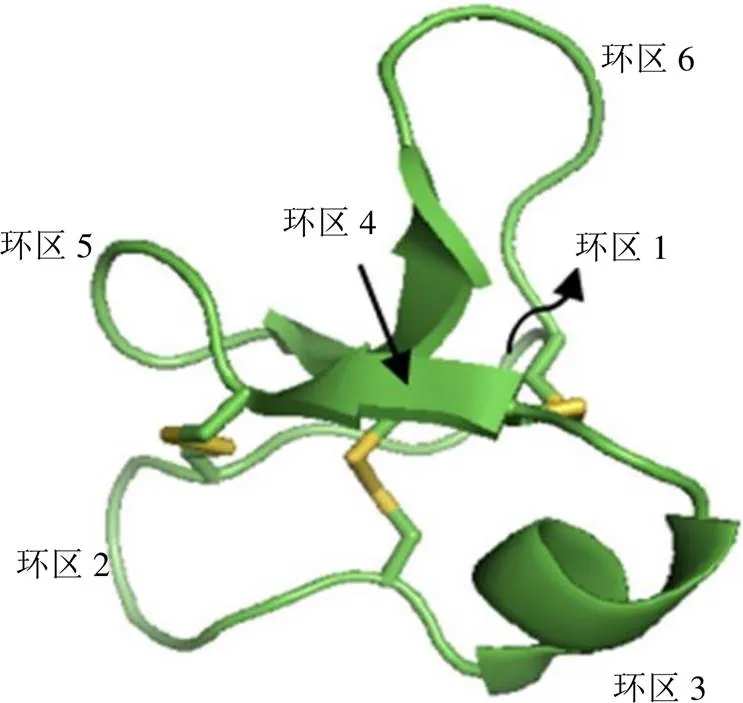
圖1 環肽的CCK結構
環肽是植物體內經基因編碼在核糖體內合成的一類序列長為28~37個氨基酸,由多肽鏈首尾相連,并與由6個固定半胱氨酸組成的三對二硫鍵形成穩定的六環結構,即CCK結構的環狀多肽化合物[9-10]。環肽的這種獨特的保守空間結構特征賦予其很強的耐酶降解能力、熱穩定性及化學穩定性[11-12];并且具有殺蟲[13-16]、抗菌[4,17]、抗人類免疫缺陷病毒(human immunodeficiency virus,HIV)[18]、抑制癌細胞[19-20]、促子宮收縮活性[21]及免疫促進活性[22]等多種生物活性[23]。據統計數據發現,目前發現的植物環肽幾乎都是從堇菜科和茜草科植物中分離出來的[24-26],植物環肽也分布于葫蘆科、茄科、豆科、禾本科植物等[9,27-30](表1),并且所有的堇菜科植物都含有環肽存在[28]。因此,大環肽資源的挖掘仍是植物研究中的重要部分,在藥學研究與農業生產上具有較大的應用前景。植物環肽具有一系列的生物活性,有很大的應用空間及開發價值,然而在研究過程中還有很多的不足亟需解決,所以還要付出更大努力使植物環肽盡早應用于臨床,造福人類。
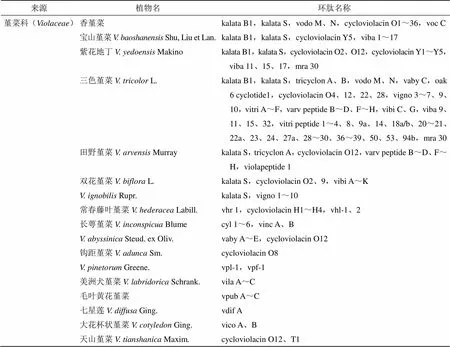
表1 環肽在植物中的分布(http://www.cybase.org.au/)
續表1
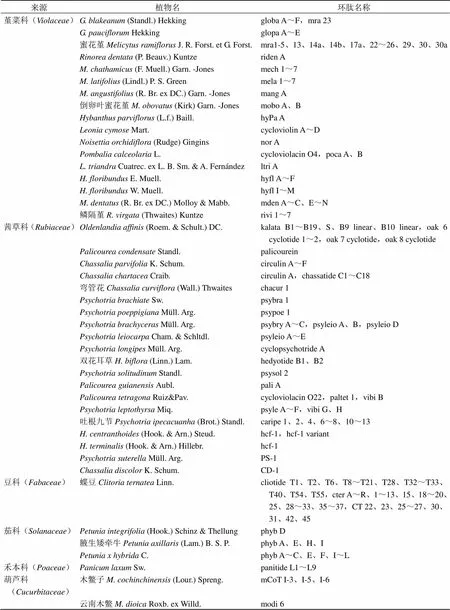
來源植物名環肽名稱 堇菜科(Violaceae)G.blakeanum (Standl.) Hekkinggloba A~F,mra 23 G.pauciflorum Hekkingglopa A~E 蜜花堇Melicytus ramiflorus J. R. Forst. et G. Forst.mra1-5、13、14a、14b、17a、22~26、29、30、30a Rinoreadentata (P. Beauv.) Kuntzeriden A M.chathamicus (F. Muell.) Garn. -Jonesmech 1~7 M.latifolius (Lindl.) P. S. Green mela 1~7 M.angustifolius (R. Br. ex DC.) Garn. -Jonesmang A 倒卵葉蜜花堇M.obovatus (Kirk) Garn. -Jonesmobo A、B Hybanthusparviflorus (L.f.) Baill.hyPa A Leoniacymose Mart.cycloviolin A~D Noisettiaorchidiflora (Rudge) Ginginsnor A Pombaliacalceolaria L.cycloviolacin O4,poca A、B L.triandra Cuatrec. ex L. B. Sm. & A. Fernándezltri A H.floribundus E. Muell.hyfl A~F H.floribundus W. Muell.hyfl I~M M.dentatus (R. Br. ex DC.) Molloy & Mabb.mden A~C、E~N 鱗隔堇R. virgata (Thwaites) Kuntzerivi 1~7 茜草科(Rubiaceae)Oldenlandiaaffinis (Roem. & Schult.) DC.kalata B1~B19、S、B9 linear、B10 linear,oak 6 cyclotide 1~2,oak 7 cyclotide,oak 8 cyclotide Palicoureacondensate Standl.palicourein Chassaliaparvifolia K. Schum.circulin A~F Chassaliachartacea Craib.circulin A,chassatide C1~C18 彎管花Chassalia curviflora (Wall.) Thwaiteschacur 1 Psychotriabrachiate Sw.psybra 1 Psychotriapoeppigiana Müll. Arg.psypoe 1 Psychotriabrachyceras Müll. Arg.psybry A~C,psyleio A、B,psyleio D Psychotrialeiocarpa Cham. & Schltdl.psyleio A~E Psychotrialongipes Müll. Arg.cyclopsychotride A 雙花耳草H. biflora (Linn.) Lam.hedyotide B1、B2 Psychotriasolitudinum Standl.psysol 2 Palicoureaguianensis Aubl.pali A Palicoureatetragona Ruiz&Pav.cycloviolacin O22,paltet 1,vibi B Psychotrialeptothyrsa Miq.psyle A~F,vibi G、H 吐根九節Psychotria ipecacuanha (Brot.) Standl.caripe 1、2、4、6~8、10~13 H.centranthoides (Hook. & Arn.) Steud.hcf-1,hcf-1 variant H.terminalis (Hook. & Arn.) Hillebr.hcf-1 Psychotriasuterella Müll. Arg.PS-1 Chassaliadiscolor K. Schum.CD-1 豆科(Fabaceae)蝶豆Clitoria ternatea Linn.cliotide T1、T2、T6、T8~T21、T28、T32~T33、T40、T54、T55,cter A~R、1~13、15、18~20、25、28~33、35~37,CT 22、23、25~27、30、31、42、45 茄科(Solanaceae)Petuniaintegrifolia (Hook.) Schinz & Thellungphyb D 腋生矮牽牛Petunia axillaris (Lam.) B. S. P.phyb A、E、H、I Petunia xhybrida C.phyb A~C、E、F、I~L 禾本科(Poaceae)Panicumlaxum Sw.panitide L1~L9 葫蘆科(Cucurbitaceae)木鱉子M. cochinchinensis (Lour.) Spreng.mCoT I-3、I-5、I-6 云南木鱉M. dioica Roxb. ex Willd.modi 6
1 作用機制
近30年來,已有很多研究報道了環肽在不同科屬植物中的分布及其變異性。環肽具有多種生物活性,研究發現,環肽與細胞膜發生相互作用是其產生生物活性的主要原因[31-33]。環狀骨架是環肽分子與膜相互作用過程中所必需的[34],同時,其表面獨特的疏水性區域能調節其與膜相互作用,但它們的具體作用模式或機制并不太清楚[35-36]。雖然尚不能對環肽具體作用機制進行完全闡明,但大多數研究表明,植物環肽的生物活性取決于環肽的結構與細胞膜組成[15,37-38];環肽具有活性是因其結構、凈電荷和疏水性與膜相互作用導致膜通透性改變的結果,強烈依賴于環肽獨特的結構特征[36,39-41]。研究表明,膜結合是功能性的,因為環肽能夠誘導磷脂囊泡的內容物泄漏,并在脂質雙層中形成大孔[41],膜結合調節細胞毒性。
CCK結構的存在,賦予環肽較直鏈肽超強的耐熱、耐化學降解及耐酶解的能力[42]。有研究表明,當kalata B1的CCK結構發生變化時,修飾后的衍生物不具有相應的抗HIV活性[43]。Ireland等[44]對植物環肽抗HIV的構效關系分析表明除了植物環肽的環狀骨架對活性有影響外,植物環肽上某些loop區域的疏水性也與抗HIV的活性有關,而生物測定試驗表明,環肽類和非環肽類具有相當的活性,表明環肽骨架可能不是活性的必要要求[45],但對維持環肽結構完整性具有重要性。由于潛在的藥用價值,更多的大環肽被挖掘出抗HIV活性,研究發現環狀骨架是抗HIV所必須的,大環肽的疏水性與抗HIV活性呈相關性,而且環肽抑制HIV病毒逆轉錄酶活性的能力似乎表明抗病毒活性發生在病毒進入宿主細胞之前,但是作用機制仍不清楚[18,43-44,46]。研究還發現將胰蛋白酶抑制劑亞家族環肽MCOTI-II的環3、5或6替換到M?bius亞家族環肽kalata B1的相應環中,降低了其溶血和細胞毒性活性,且大大降低了其細胞穿透性。另一方面,用kalata B1的相應環取代MCOTI-II的環,嵌合體環肽并不會產生細胞毒性[47]。說明獨特的環序列對相應環肽的結構有重要影響,從而對環肽生物活性產生影響。
環肽已被分為3個亞家族,稱為M?bius、bracelet和胰蛋白酶抑制劑(squash trypsin inhibitor,squash TI)環肽亞家族[48](圖2)。相鄰半胱氨酸(C)之間的環區被標注為1~6。一般而言,M?bius和bracelet亞家族大環肽的環區1包括1個保守的谷氨酸(E);M?bius亞家族大環肽序列長度多為28~29個氨基酸,其環區5包含1個標志性的脯氨酸(P);bracelet亞家族序列長度多為30~32個氨基酸;squash TI亞家族大環肽分布于葫蘆科植物,序列長度多為33~34個氨基酸,且環區序列與其他亞家族差異較大,諸如環區1和6。盡管不同亞家族都具有CCK結構,但它們組成環的氨基酸殘基不一樣,因此活性也截然不同。如M?bius亞家族中的kalata B1,谷氨酸是調節其生物活性的重要氨基酸殘基,一旦發生酯化反應其生物活性就會降低[49];而bracelet亞家族環5含有成簇的帶電氨基酸,能產生微摩爾單位抑菌效果,強于M?bius亞家族[38]。有研究表明,化學修飾的環肽衍生物,其中單個殘基相繼被丙氨酸取代,證實在環肽表面有一片殘基聚集,對生物活性很重要[15]。有研究表明蛋氨酸殘基的氧化導致生物活性的喪失,增強了疏水區域對膜相互作用的重要性[45]。研究表明細胞毒性活性和它們的疏水性之間并沒有很強的相關性。相反,似乎更像是帶電和疏水氨基酸殘基的分布決定了最終的效力。此外,研究還發現,雖然谷氨酸殘基在維持bracelet亞家族環肽cycloviolacin O2的活性非常重要,但在M?bius環肽中卻不太重要;而且在bracelet亞家族中,含有幾個陽離子殘基的環肽的活性略高于中性凈電荷的活性[38]。

圖A中粗線表示二硫鍵,圖B中二硫鍵和首尾環化均用直線表示
對帶電氨基酸殘基谷氨酸、精氨酸、賴氨酸、色氨酸進行化學修飾,研究發現,色氨酸殘基對M?bius亞家族環肽varv A和bracelet亞家族環肽cycloviolacin O2的生物活性具有同等重要意義[38];對M?bius亞家族中varv A的谷氨酸進行修飾,其活性降低300%;而在bracelet亞家族中cycloviolacin O2,對谷氨酸進行酯化會使活性大幅度降低[49]。對谷氨酸修飾后的大環肽進行核磁結構鑒定,顯示甲基化或乙酰化修飾影響cycloviolacin O2環3處α-螺旋的氫鍵形成。氫鍵的缺失明顯影響了α-螺旋的柔韌性,使其生物學活性大大降低[50]。修飾kalata B1的谷氨酸或用谷氨酸代替kalata B12中的天冬氨酸,會降低氧化折疊效率,對谷氨酸進行化學修飾,環肽的生物活性會喪失;因此,谷氨酸的存在提高了環肽的穩定性,并且對于環肽的細胞膜破壞活性至關重要[51]。cycloviolacin O2中帶電的谷氨酸和賴氨酸殘基的化學掩蔽導致對沙門氏菌的活性幾乎完全喪失,而掩蔽精氨酸,活性則降低不太明顯[52]。
環肽具有跨膜屏障和進入細胞的能力;特別是Mobius和bracelet亞家族的環肽已被發現具有脂質結合結構域,這允許特異性識別生物膜中的磷脂酰乙醇胺(phosphatidylethanolamine,PE),這種脂質選擇性與環肽高度保守的三維結構密切相關,對其報道的生物學活性和細胞穿透能力具有重要意義[53];如kalata B1可以通過細胞內吞途徑或直接膜易位進入細胞,就是通過將PE磷脂靶向細胞表面并誘導膜變形來啟動通路的[54]。kalata B1的抗HIV活性也是因為它具有靶向和破壞HIV毒顆粒膜的能力,這些顆粒膜是富含PE磷脂的膜[55]。而胰蛋白酶抑制劑家族中缺少這種與細胞膜結合的結構,使得其具有不同于其他類型大環肽的理化性質與生物活性,但仍能透過細胞膜。Shenkarev等[56]采用dodecyl- phosphocholine micelles作為細胞膜模型,通過特異性識別細胞膜上的PE,測定kalataB1與細胞膜結合的方位。但這種具體作用機制尚不明確。
2 植物環肽的生物活性
2.1 抗HIV活性
由于環肽潛在的藥理應用,其抗HIV活性得到了廣泛研究。近年來,來自bracelet和M?bius亞家族的環肽被證明有抗HIV活性,見表2。
研究表明,cycloviolacin O2可能是靶向單核細胞中HIV-1的理想候選物,它們被納入輔助治療方法可能會提高HIV-1蛋白酶抑制劑的療效,并最終促進病毒的消除[61]。最新研究表明,cycloviolacin O2的膜活性可能有助于抑制病毒載量并提高抗逆轉錄病毒藥物的療效[63]。

表2 具有抗HIV活性的環肽分布
2.2 細胞毒活性及抗腫瘤活性
相對于其他抗菌肽,環肽抗腫瘤活性最突出的特點表現在選擇性對腫瘤細胞發揮細胞毒性[19,60,64]。從香堇菜中分離出了環肽cycloviolacin O2,該環肽能夠分解人淋巴瘤細胞系U-937 GTB細胞的細胞膜,對鈣黃綠素負載的HeLa細胞和脂質體的功能研究顯示,它們各自的內容物以濃度相關性快速釋放[65]。目前的結果表明,環肽具有特定的細胞膜破壞活性。從紫花地丁中提取出了viphi A、F、G均對腫瘤MM96L、HeLa、BGC-823細胞系和非腫瘤HFF-1細胞系顯示出了細胞毒活性[20]。Yeshak等[66]在中發現了vaby A、D 2種環肽,它們均對淋巴瘤細胞系U-937 GTB細胞表現出劑量相關性細胞毒性。研究發現vaby A、D在其序列中都含有帶電荷的殘基,但vaby A的凈電荷是中性的,而vaby D是帶負電荷的肽。據報道,環肽的細胞毒性活性與其凈電荷含量和帶電殘基含量相關[67]。Gerlach等[68]在雙花堇菜中發現了環肽psyle A、C、E并且研究發現它們對淋巴瘤細胞系U-937 GTB細胞顯示出了濃度相關性細胞毒性。Claeson等[69]對田野堇菜進行了初步篩選的分級。使用葡聚糖凝膠LH-20吸附色譜法,活性化合物被濃縮成2個級分,用反相色譜法從這2個級分中分離出varv A、F;而Lindholm等[19]檢測了Varv A、F對10種人類腫瘤細胞系的細胞系,表現出了對不同細胞系有不同的影響,半數抑制濃度(IC50)值為2.7~7.5 μmol/L。就目前而言,環肽分子的體外實驗比較廣泛,體內實驗較少,而急性毒性實驗目前尚無研究。因此,環肽的細胞毒活性作用要想在臨床上得到廣泛的應用,就必須加強對體內和急性毒性實驗的研究。具有細胞毒活性的植物環肽見表3。
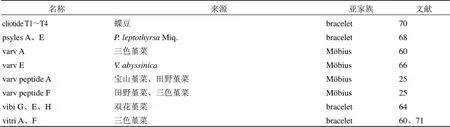
表3 具有細胞毒活性的植物環肽
2.3 抗菌活性
目前研究主要報道了Mobius和bracelet 2類大環肽都存在抗菌活性[52,72],其抗菌機制可能是由于它們分子表面不同區域兼有疏水區和親水區而具備兩性分子的特性。Pr?nting等[52]在香堇菜中用反相高效液相色譜法分離出典型的環肽,包括Mobius亞族kalata B1和bracelet亞族cycloviolacin O2。用放射擴散法和最低抑菌濃度實驗及時間-殺菌動力學的方法研究環肽對大腸桿菌、抗沙門氏菌血清型鼠傷寒沙門氏菌LT2和金黃色葡萄球菌3種細菌的抗菌活性。結果表明cycloviolacin O2對沙門氏菌血清型鼠傷寒沙門氏菌LT2和大腸桿菌的抑制活性較強;cycloviolacin O2能夠有效殺死革蘭陰性菌,包括耐藥菌株肺炎克雷伯菌和銅綠假單胞菌,Pr?nting等[52]認為這與帶電的谷氨酸和賴氨酸殘基的化學掩蔽有關。
2.4 殺蟲活性
G?ransson等[73]研究了從香堇菜中分離得到的cycloviolacin O2對海洋污損生物藤壺的作用,結果表明cycloviolacin O2對藤壺具有抑制作用,且呈量效關系。藤壺是最具代表性的海洋污損生物,隸屬于節肢動物門()、甲殼綱()、圍胸目(),它的幼蟲在海水中漂浮15~20 d,逐漸成熟附著在潮間帶的礁石以及船只等設施的表面,分泌出有強吸附作用的藤壺膠,滲入到附著物的表面縫隙及微孔結構里,形成十分強大的吸附力,破壞這些表面[74-75]。藤壺又稱海洋附著生物,當它大量繁衍且未能及時清理就會造成很大的危害,如給水產養殖和航運帶來了嚴重的技術和經濟問題。而且cycloviolacin O2對藤壺的作用在生物測定中是可逆和無毒的。因此,cycloviolacin O2在凈化海洋環境中有很好的應用前景。還有研究表明cycloviolacin O2吞噬指數增加,證明其在體內的抗葡萄球菌活性可能與吞噬活性有關,此外還與直接的抗致病活性有關[76]。具有殺蟲活性和抗菌活性的植物環肽見表4。
2.5 溶血活性
據報道,許多環肽具有溶血活性,并且它們在體內與膜相互作用[5]。Wang等[18]從光瓣堇菜中發現環肽cycloviolacins Y4、Y5具有溶血活性。將這2種環肽用于人類紅細胞的體外溶血活性實驗研究,并以蜂毒素作為陽性對照,結果表明這兩種環肽的半數溶血(HD50)值均低于蜂毒素的HD50值,且二者溶血活性都比原型環肽kalata B1更強。Tang等[71]探究了三色堇菜的9種環肽提取物以蜂毒素為陽性對照對人類血紅細胞的溶血活性試驗,結果表明,環肽具有不同程度的溶血活性,HD50值范圍為4.29~225.90 μmol/L。Vitri B溶血作用最小,vitri D溶血作用最強。具有溶血活性的植物環肽見表5。
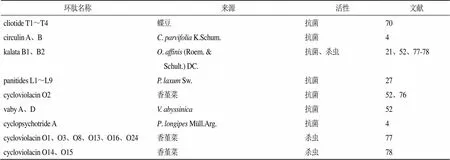
表4 具有殺蟲活性和抗菌活性的植物環肽分布

表5 具有溶血活性的植物環肽分布
2.6 其他
環肽還具有蛋白酶抑制活性,目前從堇菜屬植物中發現了4種環肽cycloviolacin O13、14、16、24具有蛋白酶抑制活性。Ireland等[11]以kalata B1為陽性對照,考察了這4種環肽對胃蛋白酶、胰蛋白酶、嗜熱菌蛋白酶的抑制作用,結果顯示kalata B1在5 min內即完全降解,環肽在6 h時還均未降解。充分證明環肽可以抑制蛋白酶的降解。環肽還能促進子宮收縮,如Gran[1,79]對kalata-kalata植物的沸水提取物進行分離發現了具有子宮收縮活性的kalata B1,并作用于大鼠、兔子和人,它們的子宮收縮肌呈OT狀。研究確定了天然kalata B1和2種嫁接環肽(緩激肽拮抗劑CKB-KAL和CKB-KIN)在大鼠中通過口服和靜脈注射的藥動學參數,并為天然和接枝環肽提供了可參考的藥動學參數。本研究表明,天然和嫁接環肽的體內生物半衰期與臨床使用的肽類藥物相當,所測試的環肽具有與市場上的肽類藥物相當的高的藥物效率,暗示了低可能性的非靶點效應和毒性,因此是一種可行的藥物設計支架,具有可調節的藥動學性質[80]。
3 總結與展望
近10年,植物環肽在醫藥學領域不斷發展,在藥物中得到了應用。Thongyoo等[81]和Sommerhoff等[82]用減少環肽環6中的殘基數量,或設計1種嵌合環肽,其中部分序列被結構相似的蛋白酶抑制劑片段所取代的方法研究開發了β-類胰蛋白酶抑制劑環肽,可作為治療過敏性哮喘和炎癥性疾病的治療靶點。通過針對合成肽庫篩選蛋白酶、分子建模或使用相關抑制劑的已知特異性數據來鑒定環肽序列替換,用序列替換的方法開發出了人凝血因子XIIa和基質蛋白酶抑制劑,用這種方法主要是替換環肽環1的序列,因為環1是squash TI亞家族環肽的主要結合環[83-84]。SET蛋白能夠抑制癌基因蛋白磷酸酶2A(PP2A)發揮作用,COG肽是SET蛋白的有效拮抗劑;但由于COG肽水解穩定性差及生物利用低,導致COG肽的應用受到了限制。D’Souza等[85]將COG肽嫁接到超穩定的環肽支架MCoTI-II上,變成嫁接環肽MCOG,研究表明MCOG對癌細胞具有細胞毒性,在人血清中具有較高的穩定性,證明了環肽MCoTI-II在開發用于治療癌癥的肽藥物中的應用。2015年,從熱帶雨林植物堇菜科植物(P. Beauv.) Kuntze發現環肽riden A,具有微弱的促進子宮收縮作用,在尼日利亞西南部發現有部分牧民利用該植物來幫助動物分娩,但在民族醫學中,還需要在更大的范圍內進行進一步的研究[86]。細胞穿透肽是細胞內傳遞親水分子的理想載體,但它們作為藥物的應用因其在血清中的低穩定性而受到損害,Huang等[87]對藥物設計中研究最廣泛的環肽支架之一MCoTI-II進行了修飾,修飾后的MCoTI-II與標準細胞穿透肽一樣有效,并且細胞內化效率更高,還保持了所有所需的特征作為模板來移植所需的生物活性。環肽[T20K] kalata B1經口服給藥可顯著延緩和減輕小鼠自身免疫性腦髓炎的癥狀,抑制淋巴細胞增殖和減少促炎細胞因子,特別是白細胞介素-2,環肽嚴重阻礙了疾病的進展,沒有表現出不良反應。因此,環肽是作為治療T細胞介導的疾病的肽藥物[88]。
植物環肽獨特的結構骨架、廣泛的生物活性、潛在的生物可獲得性以及目前研究所顯示出的分子多樣性使得植物環肽成為一類在醫藥和植物保護上極有應用前景的物質。植物環肽一方面由于其內在的活性可能被直接用作藥物或作為新藥研究和設計的優良先導結構;另一方面由于其精確的三維結構、高穩定性和其中一些環區中氨基酸殘基的可變性,可連接其他新穎活性物質而成為在多肽藥物設計上非常有用的支架。環肽已被證明能夠滲透人類細胞膜,并能夠有效地靶向蛋白質-蛋白質在體外的相互作用,但更重要的是在動物模型中。雖然還沒有環肽達到人類臨床試驗,但從動物模型中獲得幾種生物活性環肽的結果表明,這在不久的將來可能會發生。植物環肽對腫瘤細胞具有很強的細胞毒活性,不會影響正常細胞的正常生長,有望成為一類高效低毒的抗腫瘤藥物。在非洲傳統醫藥中,環肽促進子宮收縮活性已經得到廣泛的應用,但還有待于現代醫藥學研究技術將其開發為高效低毒藥物應用于臨床。植物環肽還具有強殺蟲活性,推測它可以用基因工程方法構建抗飛蛾及相關昆蟲的轉基因植物,以實現潛在的植物農藥應用價值。但目前植物環肽藥理研究還存在許多不足,各種藥理活性的作用機制還有待進一步明確。綜上所述,植物環肽在醫藥學領域具有很大的應用空間及開發價值,需要不斷克服在研究過程中出現的不足與困難,將植物環肽早日應用于臨床。
利益沖突 所有作者均聲明不存在利益沖突
[1] Gran L. On the effect of a polypeptide isolated from “kalata-kalata” (DC) on the oestrogen dominated uterus [J]., 2009, 33(5/6): 400-408.
[2] Saether O, Craik D J, Campbell I D,. Elucidation of the primary and three-dimensional structure of the uterotonic polypeptide kalata B1 [J]., 1995, 34(13): 4147-4158.
[3] Craik D J, Daly N L, Bond T,. Plant cyclotides: A unique family of cyclic and knotted proteins that defines the cyclic cystine knot structural motif [J]., 1999, 294(5): 1327-1336.
[4] Tam J P, Lu Y A, Yang J L,. An unusual structural motif of antimicrobial peptides containing end-to-end macrocycle and cystine-knot disulfides [J]., 1999, 96(16): 8913-8918.
[5] Jennings C, West J, Waine C,. Biosynthesis and insecticidal properties of plant cyclotides: The cyclic knotted proteins from[J]., 2001, 98(19): 10614-10619.
[6] Dutton J L, Renda R F, Waine C,. Conserved structural and sequence elements implicated in the processing of gene-encoded circular proteins [J]., 2004, 279(45): 46858-46867.
[7] Ravipati A S, Henriques S T, Poth A G,. Lysine-rich cyclotides: A new subclass of circular knotted proteins from Violaceae [J]., 2015, 10(11): 2491- 2500.
[8] Sternberger A L, Bowman M J, Kruse C P S,. Transcriptomics identifies modules of differentially expressed genes and novel cyclotides in[J]., 2019, 10: 156.
[9] Poth A G, Chan L Y, Craik D J. Cyclotides as grafting frameworks for protein engineering and drug design applications [J]., 2013, 100(5): 480-491.
[10] White A M, Craik D J. Discovery and optimization of peptide macrocycles [J]., 2016, 11(12): 1151-1163.
[11] Ireland D C, Colgrave M L, Craik D J. A novel suite of cyclotides from: Sequence variation and the implications for structure, function and stability [J]., 2006, 400(1): 1-12.
[12] Shafee T, Harris K, Anderson M. Biosynthesis of cyclotides [J]., 2015, 76: 227-269.
[13] Simonsen S M, Sando L, Ireland D C,. A continent of plant defense peptide diversity: Cyclotides in Australian(Violaceae) [J]., 2005, 17(11): 3176-3189.
[14] Barbeta B L, Marshall A T, Gillon A D,. Plant cyclotides disrupt epithelial cells in the midgut of lepidopteran larvae [J]., 2008, 105(4): 1221-1225.
[15] Simonsen S M, Sando L, Rosengren K J,. Alanine scanning mutagenesis of the prototypic cyclotide reveals a cluster of residues essential for bioactivity [J]., 2008, 283(15): 9805-9813.
[16] Pinto M F, Fensterseifer I C, Migliolo L,. Identification and structural characterization of novel cyclotide with activity against an insect pest of sugar cane [J]., 2012, 287(1): 134-147.
[17] Ovesen R G, Brandt K K, G?ransson U,. Biomedicine in the environment: Cyclotides constitute potent natural toxins in plants and soil bacteria [J]., 2011, 30(5): 1190-1196.
[18] Wang C K, Colgrave M L, Gustafson K R,. Anti-HIV cyclotides from the Chinese medicinal herb[J]., 2008, 71(1): 47-52.
[19] Lindholm P, G?ransson U, Johansson S,. Cyclotides: A novel type of cytotoxic agents [J]., 2002, 1(6): 365-369.
[20] He W, Chan L Y, Zeng G,. Isolation and characterization of cytotoxic cyclotides from[J]., 2011, 32(8): 1719-1723.
[21] Gran L, Sletten K, Skjeldal L. Cyclic peptides fromDC. molecular and biological properties [J]., 2008, 5(10): 2014-2022.
[22] Nguyen K N, Nguyen G K, Nguyen P Q,. Immunostimulating and gram-negative-specific antibacterial cyclotides from the butterfly pea () [J]., 2016, 283(11): 2067-2090.
[23] Oguis G K, Gilding E K, Jackson M A,. Butterfly pea (), a cyclotide-bearing plant with applications in agriculture and medicine [J]., 2019, 10: 645.
[24] Witherup K M, Bogusky M J, Anderson P S,. Cyclopsychotride A, a biologically active, 31-residue cyclic peptide isolated fromlongipes [J]., 1994, 57(12): 1619-1625.
[25] G?ransson U, Luijendijk T, Johansson S,. Seven novel macrocyclic polypeptides from[J]., 1999, 62(2): 283-286.
[26] Gustafson K R, Walton L K, Sowder R C Jr,. New circulin macrocyclic polypeptides from[J]., 2000, 63(2): 176-178.
[27] Nguyen G K, Lian Y L, Pang E W,. Discovery of linear cyclotides in monocot plantof Poaceae family provides new insights into evolution and distribution of cyclotides in plants [J]., 2013, 288(5): 3370-3380.
[28] Burman R, Yeshak M Y, Larsson S,. Distribution of circular proteins in plants: Large-scale mapping of cyclotides in the Violaceae [J]., 2015, 6: 855.
[29] Niyomploy P, Chan L Y, Poth A G,. Discovery, isolation, and structural characterization of cyclotides fromMiq. [J]., 2016, 106(6): 796-805.
[30] Niyomploy P, Chan L Y, Harvey P J,. Discovery and characterization of cyclotides fromspecies [J]., 2018, 81(11): 2512-2520.
[31] Wang C K, Wacklin H P, Craik D J. Cyclotides insert into lipid bilayers to form membrane pores and destabilize the membrane through hydrophobic and phosphoethanolamine- specific interactions [J]., 2012, 287(52): 43884-43898.
[32] Craik D J. Host-defense activities of cyclotides [J].(Basel), 2012, 4(2): 139-156.
[33] Park S, Str?mstedt A A, G?ransson U. Cyclotide structure-activity relationships: Qualitative and quantitative approaches linking cytotoxic and anthelmintic activity to the clustering of physicochemical forces [J]., 2014, 9(3): e91430.
[34] Daly N L, Love S, Alewood P F,. Chemical synthesis and folding pathways of large cyclic polypeptides: Studies of the cystine knot polypeptide kalata B1 [J]., 1999, 38(32): 10606-10614.
[35] Shenkarev Z O, Nadezhdin K D, Lyukmanova E N,. Divalent cation coordination and mode of membrane interaction in cyclotides: NMR spatial structure of ternary complex Kalata B7/Mn2+/DPC micelle [J]., 2008, 102(5/6): 1246-1256.
[36] Henriques S T, Huang Y H, Castanho M A,. Phosphatidylethanolamine binding is a conserved feature of cyclotide-membrane interactions [J]., 2012, 287(40): 33629-33643.
[37] Huang Y H, Colgrave M L, Clark R J,. Lysine- scanning mutagenesis reveals an amendable face of the cyclotide kalata B1 for the optimization of nematocidal activity [J]., 2010, 285(14): 10797-10805.
[38] Burman R, Herrmann A, Tran R,. Cytotoxic potency of small macrocyclic knot proteins: Structure-activity and mechanistic studies of native and chemically modified cyclotides [J]., 2011, 9(11): 4306- 4314.
[39] Kamimori H, Hall K, Craik D J,. Studies on the membrane interactions of the cyclotides kalata B1 and kalata B6 on model membrane systems by surface plasmon resonance [J]., 2005, 337(1): 149- 153.
[40] Wang C K, Hu S H, Martin J L,. Combined X-ray and NMR analysis of the stability of the cyclotide cystine knot fold that underpins its insecticidal activity and potential use as a drug scaffold [J]., 2009, 284(16): 10672-10683.
[41] Huang Y H, Colgrave M L, Daly N L,. The biological activity of the prototypic cyclotide kalata b1 is modulated by the formation of multimeric pores [J]., 2009, 284(31): 20699-20707.
[42] Colgrave M L, Craik D J. Thermal, chemical, and enzymatic stability of the cyclotide kalata B1: The importance of the cyclic cystine knot [J]., 2004, 43(20): 5965-5975.
[43] Daly N L, Gustafson K R, Craik D J. The role of the cyclic peptide backbone in the anti-HIV activity of the cyclotide kalata B1 [J]., 2004, 574(1/2/3): 69-72.
[44] Ireland D C, Wang C K, Wilson J A,. Cyclotides as natural anti-HIV agents [J]., 2008, 90(1): 51-60.
[45] Nguyen G K, Lim W H, Nguyen P Q,. Novel cyclotides and uncyclotides with highly shortened precursors fromand effects of methionine oxidation on bioactivities [J]., 2012, 287(21): 17598-17607.
[46] Chen B, Colgrave M L, Daly N L,. Isolation and characterization of novel cyclotides fromHederaceae: Solution structure and anti-HIV activity of vhl-1, a leaf-specific expressed cyclotide [J]., 2005, 280(23): 22395-22405.
[47] Abdul Ghani H, Henriques S T, Huang Y H,. Structural and functional characterization of chimeric cyclotides from the M?bius and trypsin inhibitor subfamilies [J]., 2017, 108(1): e22927.
[48] Weidmann J, Craik D J. Discovery, structure, function, and applications of cyclotides: Circular proteins from plants [J]., 2016, 67(16): 4801-4812.
[49] Herrmann A, Svang?rd E, Claeson P,. Key role of glutamic acid for the cytotoxic activity of the cyclotide cycloviolacin O2 [J]., 2006, 63(2): 235-245.
[50] G?ransson U, Herrmann A, Burman R,. The conserved glu in the cyclotide cycloviolacin O2 has a key structural role [J]., 2009, 10(14): 2354- 2360.
[51] Wang C K L, Clark R J, Harvey P J,. The role of conserved glu residue on cyclotide stability and activity: A structural and functional study of kalata B12, a naturally occurring glu to asp mutant [J]., 2011, 50(19): 4077-4086.
[52] Pr?nting M, L??v C, Burman R,. The cyclotide cycloviolacin O2 fromhas potent bactericidal activity against gram-negative bacteria [J]., 2010, 65(9): 1964-1971.
[53] Troeira Henriques S, Craik D J. Cyclotide structure and function: The role of membrane binding and permeation [J]., 2017, 56(5): 669-682.
[54] Henriques S T, Huang Y H, Chaousis S,. The prototypic cyclotide kalata B1 has a unique mechanism of entering cells [J]., 2015, 22(8): 1087-1097.
[55] Henriques S T, Huang Y H, Rosengren K J,. Decoding the membrane activity of the cyclotide kalata B1: The importance of phosphatidylethanolamine phospholipids and lipid organization on hemolytic and anti-HIV activities [J]., 2011, 286(27): 24231-24241.
[56] Shenkarev Z O, Balandin S V, Trunov K I,. Molecular mechanism of action of β-hairpin antimicrobial peptide arenicin: Oligomeric structure in dodecylphosphocholine micelles and pore formation in planar lipid bilayers [J]., 2011, 50(28): 6255-6265.
[57] Gustafson K R, Sowder R C, Henderson L E,. Circulins A and B. Novel human immunodeficiency virus (HIV)-inhibitory macrocyclic peptides from the tropical tree[J]., 1994, 116(20): 9337-9338.
[58] Hallock Y F, Sowder R C, Pannell L K,. Cycloviolins A-D, anti-HIV macrocyclic peptides from[J]., 2000, 65(1): 124-128.
[59] Daly N L, Clark R J, Plan M R,. Kalata B8, a novel antiviral circular protein, exhibits conformational flexibility in the cystine knot motif [J]., 2006, 393(Pt 3): 619-626.
[60] Svang?rd E, G?ransson U, Hocaoglu Z,. Cytotoxic cyclotides from[J]., 2004, 67(2): 144-147.
[61] Gerlach S L, Yeshak M, G?ransson U,. Cycloviolacin O2 (CyO2) suppresses productive infection and augments the antiviral efficacy of nelfinavir in HIV-1 infected monocytic cells [J]., 2013, 100(5): 471-479.
[62] Bokesch H R, Pannell L K, Cochran P K,. A novel anti-HIV macrocyclic peptide fromcondensata [J]., 2001, 64(2): 249-250.
[63] Gerlach S L, Chandra P K, Roy U,. The membrane- active phytopeptide cycloviolacin O2 simultaneously targets HIV-1-infected cells and infectious viral particles to potentiate the efficacy of antiretroviral drugs [J].(Basel), 2019, 6(1): E33.
[64] Herrmann A, Burman R, Mylne J S,. The alpine violet,, is a rich source of cyclotides with potent cytotoxicity [J]., 2008, 69(4): 939- 952.
[65] Svang?rd E, Burman R, Gunasekera S,. Mechanism of action of cytotoxic cyclotides: Cycloviolacin O2 disrupts lipid membranes [J]., 2007, 70(4): 643-647.
[66] Yeshak M Y, Burman R, Asres K,. Cyclotides from an extreme habitat: Characterization of cyclic peptides fromof the Ethiopian Highlands [J]., 2011, 74(4): 727-731.
[67] Wang C K, Gruber C W, Cemazar M,. Molecular grafting onto a stable framework yields novel cyclic peptides for the treatment of multiple sclerosis [J]., 2014, 9(1): 156-163.
[68] Gerlach S L, Burman R, Bohlin L,. Isolation, characterization, and bioactivity of cyclotides from the Micronesian plant[J]., 2010, 73(7): 1207-1213.
[69] Claeson P, G?ransson U, Johansson S,. Fractionation protocol for the isolation of polypeptides from plant biomass [J]., 1998, 61(1): 77-81.
[70] Nguyen G K, Zhang S, Nguyen N T,. Discovery and characterization of novel cyclotides originated from chimeric precursors consisting of albumin-1 chain a and cyclotide domains in the Fabaceae family [J]., 2011, 286(27): 24275-24287.
[71] Tang J, Wang C K, Pan X L,. Isolation and characterization of cytotoxic cyclotides from[J]., 2010, 31(8): 1434-1440.
[72] Wong C T, Taichi M, Nishio H,. Optimal oxidative folding of the novel antimicrobial cyclotide fromrequires high alcohol concentrations [J]., 2011, 50(33): 7275-7283.
[73] G?ransson U, Sj?gren M, Svang?rd E,. Reversible antifouling effect of the cyclotide cycloviolacin O2 against barnacles [J]., 2004, 67(8): 1287-1290.
[74] Subramanian G, Palanichamy S, Veeramani P. An eco-friendly process for prevention of biofouling [J]., 2016, 99:474-479.
[75] Yee M S L, Khiew P S, Lim S S,. Enhanced marine antifouling performance of silver-titania nanotube composites from hydrothermal processing [J]., 2017, 520: 701-711.
[76] Fensterseifer I C, Silva O N, Malik U,. Effects of cyclotides against cutaneous infections caused by[J]., 2015, 63: 38-42.
[77] Colgrave M L, Kotze A C, Ireland D C,. The anthelmintic activity of the cyclotides: Natural variants with enhanced activity [J]., 2008, 9(12): 1939-1945.
[78] Colgrave M L, Kotze A C, Kopp S,. Anthelmintic activity of cyclotides:studies with canine and human hookworms [J]., 2009, 109(2): 163-166.
[79] Gran L. Oxytocic principles of[J]., 1973, 36(2): 174-178.
[80] Poth A G, Huang Y H, Le T T,. Pharmacokinetic characterization of kalata B1 and related therapeutics built on the cyclotide scaffold [J]., 2019, 565: 437-446.
[81] Thongyoo P, Bonomelli C, Leatherbarrow R J,. Potent inhibitors of beta-tryptase and human leukocyte elastase based on the MCoTI-II scaffold [J]., 2009, 52(20): 6197-6200.
[82] Sommerhoff C P, Avrutina O, Schmoldt H U,. Engineered cystine knot miniproteins as potent inhibitors of human mast cell tryptase beta [J]., 2010, 395(1): 167-175.
[83] Quimbar P, Malik U, Sommerhoff C P,. High-affinity cyclic peptide matriptase inhibitors [J]., 2013, 288(19): 13885-13896.
[84] Swedberg J E, Mahatmanto T, Abdul Ghani H,. Substrate-guided design of selective FXIIa inhibitors based on the plant-derivedtrypsin inhibitor-II (MCoTI-II) scaffold [J]., 2016, 59(15): 7287-7292.
[85] D’Souza C, Henriques S T, Wang C K,. Using the MCoTI-II cyclotide scaffold to design a stable cyclic peptide antagonist of SET, a protein overexpressed in human cancer [J]., 2016, 55(2): 396-405.
[86] Attah A F, Hellinger R, Sonibare M A,. Ethnobotanical survey of(Violaceae) used in South- Western Nigerian ethnomedicine and detection of cyclotides [J]., 2016, 179: 83-91.
[87] Huang Y H, Chaousis S, Cheneval O,. Optimization of the cyclotide framework to improve cell penetration properties [J]., 2015, 6: 17.
[88] Thell K, Hellinger R, Sahin E,. Oral activity of a nature-derived cyclic peptide for the treatment of multiple sclerosis [J]., 2016, 113(15): 3960-3965.
Research progress on biological activities and action mechanisms of cyclotides in plants
QIN Ting, ZHANG Jun
Guangdong Provincial Key Laboratory of Biotechnology Candidate Drugs, School of Life Science and Biopharmaceutics, Guangdong Pharmaceutical University, Guangzhou 510006, China
Cyclotide is a plant-derived remarkable-stable peptide, which consists of a head-to-tail cyclization skeleton and a cyclic cysteine knot formed by three disulfide bonds. Compared with other similar peptides, the unique topological chemical structure of cyclotides makes them extremely stable to chemical, thermal and biological degradation, and their super-strong stability make them become attractive subject in the field of medicine and pharmacy. Cyclotides in plants are a new field of plant research. Because of their various biological activities, they have attracted extensive attention and exploration from many scientific researchers. The low stability and low delivery efficiency of polypeptide drugs hinder their development, while the existence of cyclotides in plants provides a new way to solve the existing problems of polypeptide drugs. The pharmacological activities and mechanisms of cyclotides in plants are summarized in this paper, which provides theoretical basis for the development of cyclotides in plants into drugs for clinical application.
cyclotides in plants; cyclic cysteine knot; biological activities; mechanism of action; anti-tumor; antibacterial; insecticidal; hemolysis
R284.194
A
0253 - 2670(2021)01 - 0255 - 12
10.7501/j.issn.0253-2670.2021.01.031
2020-04-25
國家自然科學基金資助項目(31570506);廣東藥科大學創新強校項目(2017KCXTD020)
覃 婷(1995—),女(壯族),碩士研究生,研究方向為植物環肽功能研究。E-mail: Qting016@163.com
張 軍(1980—),男,碩士生導師,副教授,研究方向為從事植物藥用功能基因研究。E-mail: lsszhangj@gdpu.edu.cn
[責任編輯 崔艷麗]
猜你喜歡
天天愛科學(2022年9期)2022-09-15 01:12:54
體育科技文獻通報(2022年3期)2022-05-23 13:46:54
天天愛科學(2022年4期)2022-05-23 12:41:48
當代水產(2022年3期)2022-04-26 14:26:56
遼金歷史與考古(2021年0期)2021-07-29 01:06:54
航空世界(2020年10期)2020-01-19 14:36:20
科技傳播(2019年22期)2020-01-14 03:06:54
民用飛機設計與研究(2019年4期)2019-05-21 07:21:24
紅領巾·萌芽(2017年5期)2017-06-23 10:35:59
爆笑show(2016年7期)2017-02-09 09:36:13