
Two Approaches of Literature Teaching:A Classroom-Based Study
2020-04-10 06:46:55林瑞韜陸尚瑜
世界家苑 2020年1期
關鍵詞:課程
林瑞韜 陸尚瑜
Abstract:This study aims to compare the influence of two approaches, that is prodcut-based teaching and language-based teaching in teaching EFL literature on the progress of English literature students in university.
Key Words:literature teaching; product-based teaching; language-based teaching
Introduction
This study aims to compare the influence of two approaches in teaching EFL literature on the progress of English literature students in university. Two approaches will be investigated:the “product-based teaching” and the “language-based teaching” approach. The study looks at pretest/posttest gain scores for the sample as a whole and for each group, and compares the performances of the groups. In order to improve literature teaching, this research is conducted to investigate whether there is any evidence to justify which approach is better than the other, insofar as this could be measured in terms of student progress.
Generally speaking, there are mainly two approaches:the “product-based” teaching and the “language-based teaching” approach. The “product-based” teaching approach are product- and teacher- centered, employing methods of “teaching literature which take the text as a body of knowledge”. (Carter, 1996:xxi) This is a relatively traditional method, and nowadays runs counter to current language-teaching theory and practice. In contrast, the typical language-teaching practice is “language-based” teaching approach which is student-centered, activity-based and process-oriented, including:“prediction exercises; cloze exercises; ranking tasks; active comprehension techniques; producing and acting out the text and so on.” (Carter, 1996:3)
Research design
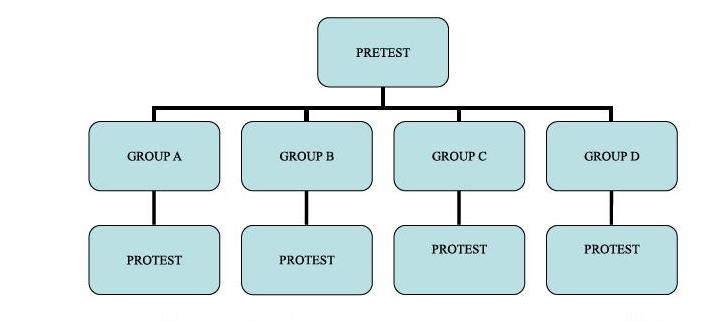
This study will take place within the normal constraints of a teaching program lasting for 20 weeks. Within those constraints a fair amount of flexibility is possible, as is the advance construction of a research design which offered a reasonable degree of control. A pretest/posttest design should be employed with matched groups, as shown in Fig. 1.
Fig. 1:
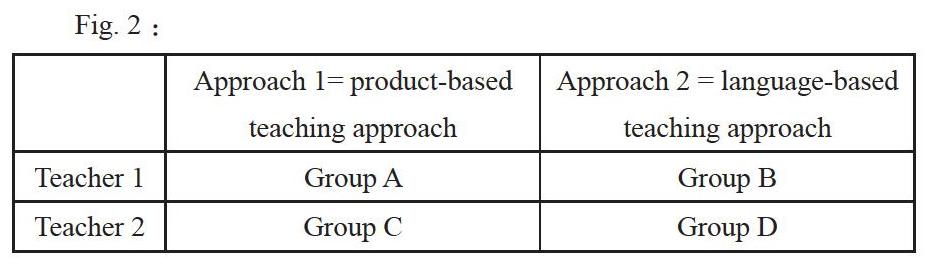
The same teacher (T1) will teach two groups using a different approach for each (Approach 1= product-based teaching approach; Approach 2 = language-based teaching approach), while a second teacher (T2) will teach the other two groups by different approach for each (Approach 1= product-based teaching approach; Approach 2 = language-based teaching approach), thus providing a control for the Approach (Fig. 2)
Fig. 2:
Approach 1= product-based teaching approach Approach 2 = language-based teaching approach
Teacher 1 Group A Group B
Teacher 2 Group C Group D
SAMPLE:The subjects in this research are 40 undergraduate students who major in English. After three years systematic language learning, they are presumed to have possessed language competence and the ability to appreciate literary works.
THE PRETEST:The 40 subjects should be administered a cloze pretest before group assignments are made.
FORMING THE GROUPS:Because of the small size of the sample it seemed advisable to match the groups as far as possible. This is done on the basis of the pretest scores. The 40 students are formed into four groups. Their average scores should be similar between groups. Therefore the differences between any two groups could be ignored. It is assumed that these four groups have no difference of language competence.
THE ‘APPROACH VARIABLE:The first approach is product-based teaching approach. Teacher emphasizes on literature as a resource in the classroom for language growth and development and on language as a point of entry to greater literary understanding and appreciation.
The second approach is language-based teaching approach. Such approaches require pedagogies which are more process-based and which involve greater language awareness on the part of teachers and learners.
In the following, we will take drama teaching for example to provide two sample lesson plans according to the two approaches.
Sample Lesson Plan for Approach 1 (product-based teaching approach):
Play:The Merchant of Venice by William Shakespeare
Preparation:eliminate vocabulary difficulty in the play
Lesson plan:
◆ Detail explaining the grammar of a complicated sentence,
◆ Analyzing character, plot, scene, symbol etc. in the play
◆ Introducing on cultural implications in the texts,
◆ Asking comprehension questions (literal – inferential - critical)
◆ quiz:using vocabulary in context
Sample Lesson Plan for Approach 2 (product-based teaching approach):
Play:The Merchant of Venice by William Shakespeare
Preparation:fully reading of the play
Trying the best to appreciating the character by student themselves
Lesson plan:
◆ Take any question from students
◆ Introduction on the society, religion, culture, and people way of living and thinking in 16th century in Venice
◆ Inductive appreciation of the characters in play
◆ Role play (trying to express understanding of characters relating his status to the history and the society)
◆ Homework:outline and summary of the whole play
POSTTEST:The posttest will be given after all instruction had been completed. It is identical to the pretest. A comparison should be made between the pretest and the posttest.
ADDITIONAL INSTRUMENTS:Except the pretest/posttest design, additional instruments will be employed to provide subsistent data. The scores will reflect students progress, but not enough. The process and their response can not be reflected through scores. Therefore observation and diaries are invited to this study.
ANALYSIS AND DISCUSSION
All the data above should be analyzed and a deep discussion must be given in the last part of the study, from which the betterapproach could be sorted out and the improvement could be made.
Works cited:
[1] Almond, Mark k. ‘Language through Drama:an investigation into the effect of drama in the English language classroom. [D] Canterbury:Canterbury Christ Church College, 1996.
[2] Carter, Ronald, John McRae. (ed.) Introduction.[A] Language literature and the learner:creative classroom practice[C] New York:Longman,1996.
[3] Carter, Ronald. Look both ways before crossing:developments in the language and literature classroom. [A] Carter, Ronald, john McRae.(ed.) Language literature and the learner:creative classroom practice[C] New York:Longman,1996.
基金項目:本論文系成都中醫藥大學教務處JGYB201945和線上線下混合式課程《英語泛讀》的階段性研究成果。
(作者單位:成都中醫藥大學)
猜你喜歡
云南化工(2021年6期)2021-12-21 07:31:42
內蒙古教育(2021年20期)2021-03-08 01:09:14
作文成功之路·小學版(2020年9期)2020-10-28 08:07:02
計算機教育(2020年5期)2020-07-24 08:53:38
計算機教育(2020年5期)2020-07-24 08:53:20
家庭影院技術(2019年11期)2019-12-09 09:14:30
商周刊(2017年23期)2017-11-24 03:24:01
理科考試研究·初中(2017年4期)2017-11-04 22:12:36
紡織科技進展(2016年3期)2016-11-29 01:27:04
幼兒100(2016年30期)2016-02-28 21:26:29
