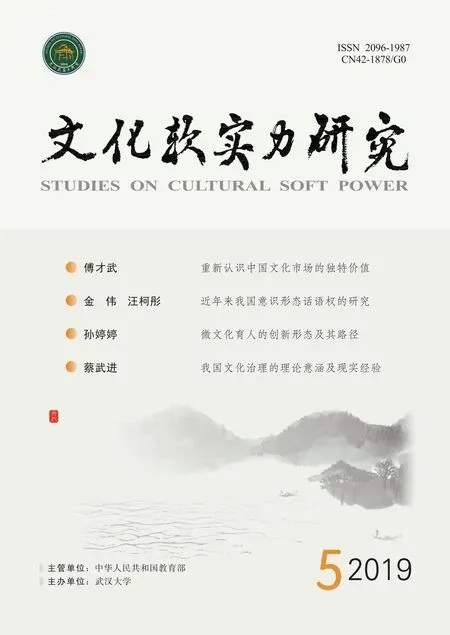
中華思想文化術語(連載二十)
2019-12-27 08:31:02
文化軟實力研究 2019年5期
1.氣韻/qìyùn
Artistic Appeal
指繪畫、書法、文學中所流露出的氣勢、韻致和生機,是文學藝術作品整體給人的審美感覺。最初僅用于繪畫,指用墨、用筆恰當,作品就能表現出自然山水的意態,畫幅上就會有流動的生機,令人體味到筆墨之外的精神、韻味。后來逐漸由繪畫擴大到詩文、書法等領域。在實際應用中,與“風韻”“神韻”等術語近似,是需要借助經驗、感悟來獲得的審美感覺。氣韻雖然通過作品呈現,卻與藝術家本人的格調、心胸直接相關,屬于自然天成,不能刻意獲得。
This refers to the momentum,charm,and vitality in paintings as well as in calligraphic and literary works which together create artistic appeals. The term was first used to refer only to painting,meaning that the proper use of ink and the painting brush could vividly present natural landscape,make the painting flow with vitality,and enable viewers to appreciate its underlying allure. Later,the term was extended to cover poetry,essay,calligraphy and other literary creations. Artistic appeal,which is similar in meaning to such terms as artistic charm and literary charm,is an aesthetic appreciation gained through experiences and feelings. Expressed in a work of art,artistic appeal reflects an author’s unique approach to art and inspiration,something that he is born with rather than acquired.
引例 Citations:
◎六法者何?一曰氣韻生動是也,二曰骨法用筆是也,三曰應物象形是也,四曰隨類賦彩是也,五曰經營位置是也,六曰傳移模寫是也。(謝赫《古畫品錄》)
(繪畫的六個法則是什么呢?其一是作品要充滿生氣,富有神韻;其二是運筆能自如呈現各種線條變化;其三是造型要順應對象外形特征;其四是要根據對象特征進行著色;其五是構圖要合理搭配,呈現整體效果;其六是要臨摹佳作以傳承前人畫技。)
There are six rules for painting. A painting should be full of vitality and artistic appeal;the painting brush should be used in such a way as to make changes in lines natural;image painted should suit the appearance of the painted object;coloring should suit the features of the object portrayed;the painting should be well structured to present an overall visual effect;and masterpieces of past painters should be copied to draw inspiration from them. (Xie He:AnAppraisalofAncientPaintings)
◎氣韻有筆墨間兩種。墨中氣韻,人多會得;筆端氣韻,世每鮮知。(方薰《山靜居畫論》)
(氣韻有兩種,分別在筆之間、墨之間。用墨當中的氣韻,人們多能領悟;筆端的氣韻,世上很少有人知道。)
There are two types of artistic appeal in the use of ink and of the painting brush respectively. The artistic appeal created through the use of ink is readily appreciated;however,such appeal created through the use of the painting brush is not easy to appreciate. (Fang Xun:OnPaintingintheQuietMountainStudio)
2.千里之行,始于足下/qiān lǐ zhī xínɡ,shǐ yú zú xià
A Journey of a Thousand Li Begins with the First Step.
千里遠的行程,要從邁第一步開始。比喻遠大目標的實現,要從小的、基礎的事情做起。足下:腳所站立的地方。語出《老子》。《 老子》以大樹、高臺、千里之行一方面說明在問題或禍亂發生之前一定要提前防范或處置妥當,以免量變引起質變;另一方面說明任何事情都需要從頭做起,一個好的開始往往是事情成敗的關鍵,遠大的理想和抱負需要腳踏實地地推進,才能在一個個具體目標的實現中完成看似不可能完成的任務。
Any major undertaking must start small from the basics. The expression comes fromLaozi.Zuxia(足下) means the place where one is standing. Laozi used the metaphors of a giant tree,a high platform,a long journey to represent two different ideas. 1) Proper preventive measures must be taken before problems or troubles occur lest things become worse;2) All undertakings must start from the very beginning,because success or failure often depends on a good start;an extension of this is that reaching distant ideals and aspirations depends on many practical steps along the way to attain the seemingly impossible goal.
引例 Citation:
◎合抱之木,生于毫末;九層之臺,起于壘土;千里之行,始于足下。(《老子·六十四章》)
(合抱的大樹,是從細小的萌芽生長起來的;九層的高臺,是一筐筐土筑起來的;千里遠的行程,是從邁第一步開始的。)
The giant tree that needs several people to encircle grew from a tiny sapling;the platform nine stories high was built from piling many baskets of earth;and the journey of a thousand li begins with the first step. (Laozi)
3.遷想妙得/qiān xiǎnɡ miào dé
Inspirational Creation Based on Association in Thinking
指畫家在藝術構思與創作過程中善于聯想,將各種形象、素材通過畫家的情感活動重新組織、構圖,使畫面形神兼備,如同妙手偶得。“遷想”重在想象、選擇與構思,所創作的題材、素材來源于現實,卻不是現實的完全復制。“遷想”是將畫家的思想情感融進、移入作品的形象。“妙得”意思是精妙之得,是“遷想”的最終結果,重在作品的審美效果。它不僅要“得”物之形,還要“得”物之神,如此才稱得上“妙”,因此,“妙得”也有妙得靈感的意思。“遷想”“妙得”是一個連貫的藝術創作過程,不可分割。這一術語是對藝術構思與審美活動特點的最早概括,后成為中國繪畫理論中的一個重要原則。
This concept means a painter should be good at association in thinking in artistic conception and creation. He should give full rein to his imagination and connect and reconstruct a variety of source images and materials so as to create a great painting in both image and spirit.“Association in thinking” stresses imagination,selection,connection and conception. While the subject matter and source materials come from reality,the painting is by no means a replica of it. “Association in thinking” makes it possible for a painter to reconstruct his thoughts and emotions in the image of his work. “Inspirational creation” stresses the aesthetic effects of a good painting that derives from “association in thinking.” A good painting should not only create a good image,but also enable the viewer to appreciate the underlying message. Such a painting is one of inspirational creation.“Association in thinking” and “inspirational creation” together constitute an inseparable process of artistic creation. This concept is the earliest definition of artistic conception and aesthetic appreciation in China;it later became an important principle underlying the theory on Chinese painting.
引例 Citations:
◎凡畫,人最難,次山水,次狗馬,臺榭一定器耳,難成而易好,不待遷想妙得也。(顧愷之《論畫》)
(凡是畫畫,畫人最難,其次是畫山水,再次是畫狗馬之類的動物,亭臺樓榭是固定的器物,難畫卻容易畫好,不需要遷想妙得。)
Painting human figures is most difficult;less difficult is painting the landscape,and then animals such as dogs and horses. Pavilions,which are fixed objects,are also difficult to paint,but it is easy to create accurate image of them because no inspirational creation based on association in thinking is required. (Gu Kaizhi:OnPainting)
◎顧公運思精微,襟靈莫測,雖寄跡翰墨,其神氣飄然在煙霄之上,不可以圖畫間求。(張懷瓘《畫斷》)
(顧愷之運用心思精深微妙,他的襟懷與想法難以預料,雖然依托筆墨來表現,但他的神采氣韻卻高高飄于云霄之上,不能只在畫面中尋求。)
Gu Kaizhi thought deeply before creating a painting,with his vision and thinking hard. His paintings were created through the use of ink and painting brushes,but his artistic appeal and charm have transcended his paintings,reaching high clouds. (Zhang Huaiguan:AnAppraisalofPaintings)
4.清明/qīnɡmínɡ
The Qingming Festival
中華民族四大傳統節日(春節、清明節、端午節、中秋節)之一,是中國傳統歲時體系中唯一與節氣合一的節日,通常在4 月4 或5 或6 日。唐以前,清明主要作為二十四節氣之一,反映自然時節的變化,與農事息息相關。唐宋以后,清明節取代寒食節而成為節日,寒食節原有的祭祖掃墓、吃冷食等成為清明節俗的內容。此時萬物生氣旺盛,人們順應季節的變化,又有郊游踏青、插柳、放風箏、蕩秋千等活動。時至今日,清明仍是中國人生活中具有特殊意義的節日。2006 年5 月20 日,經國務院批準,清明節被列入中國第一批國家級非物質文化遺產名錄。
It is one of the four major traditional festivals,namely,the Spring Festival,the Qingming Festival,the Dragon Boat Festival and the Mid-Autumn Festival,that are celebrated by the Chinese. It is the only Chinese festival which occurs on one of the solar terms of the traditional calendar,usually on April 4,5 or 6. Prior to the Tang Dynasty,Qingming functioned primarily as one of the 24 solar terms that reflected natural changes of seasons and were closely associated with timing of agricultural activities. After the Tang and Song dynasties,Qingming took the place of the Hanshi (“Cold Food”) Festival,and the practices of sweeping ancestral graves and eating cold food became prominent features of the Qingming Festival. At this time of year,with the coming of spring,all living things are bursting with vitality,and people go on country outings,plant willows,fly kites and play on swings. Today,Qingming has remained a festival of special significance to the Chinese. On May 20,2006,it was put on the first list of national-level intangible cultural heritages by the Chinese government.
引例 Citations:
◎清明時節雨紛紛,路上行人欲斷魂。
借問酒家何處有?牧童遙指杏花村。(杜牧《清明》)
(清明時節下著紛紛小雨,路上的行人十分惆悵。向別人詢問什么地方有酒家?牧童遙遙地指向杏花村。)
In the drizzling rain of Qingming,/ A traveler walks with a heavy heart. / He asks,“Where can I find an inn?” / In response,a cowherd points to a village where apricot trees are in bloom. (Du Mu:Qingming)
◎燕子來時新社,梨花落后清明。(晏殊《破陣子》)
(燕子飛來的時候是春社,梨花飄落后就到了清明節。)
When the swallows return,it is the Spring Observance;/ And after the pear blossoms fall,it is Qingming. (Yan Shu:Pozhenzi)
5.求同存異/qiútónɡ-cúnyì
Seek Common Ground While Setting Aside Differences
尋求共同點,保留不同點。戰國時期的學者惠施(前370 ?—前310 ?)、莊子(前369 ?—前286)等人認為,一切事物的差別﹑對立都是相對的,差異性中包含著同一性。從辯證的觀點看,一切事物的差異都是相對的,都存在相互轉化的可能。以孔子(前551—前479)為代表的儒家文化則強調在處理人與人、國與國之間關系時,在承認彼此有差異的前提下,通過協調而達到一種“和而不同”的狀態。承認差異的存在或者暫時擱置差異,承認文化和價值觀的多元,不追求絕對的一致、茍同,盡量站在對方的立場去看問題,努力尋求彼此的共同點,最終達成各方最大的共識。這一思想后來成為中國處理對外關系的重要理念。
The term means to seek points of agreement while maintaining difference of opinion. Scholars of the Warring States Period such as Hui Shi (370?-310? BC) and Zhuangzi (369?-286BC) believed that differences and antitheses between all things are relative,and that commonalities exist within differences. From a dialectical perspective,differences between all things are relative and there is always the possibility of one thing transforming into its opposite. The Confucian culture represented by Confucius (551-479BC) stressed that in relations between people and between states,“harmony without uniformity” should be achieved through accommodation,provided that differences between the parties are recognized. The greatest possible consensus between all sides is ultimately reached by acknowledging the existence of differences or setting them aside. To achieve such consensus,people should recognize the diversity of cultures and values and not seek absolute unanimity or forced agreement;and they should look at problems as much as possible from the perspective of others. This approach subsequently became an important principle underlying China’s handling of foreign relations.
引例 Citations:
◎大同而與小同異,此之謂“小同異”;萬物畢同畢異,此之謂“大同異”。(《莊子·天下》)
(大同小異與小同大異是有區別的,這種區別稱為“小同異”;萬物完全相同、完全不同,這稱為“大同異”。)
When there are major commonalities and minor differences,or minor commonalities and major differences,it is called“minor commonality and differentiation.” When things are totally identical or totally different,it is called “major commonality and differentiation.” (Zhuangzi)
◎君子和而不同,小人同而不和。(《論語·子路》)
(君子追求和諧友善,但對具體問題的看法卻不會附和別人;小人習慣于附和別人,但并不和諧友善。)
A virtuous man seeks harmony but not unanimity;a petty man seeks unanimity but not harmony. (TheAnalects)
6.三省吾身/sānxǐnɡ-wúshēn
Reflect on Oneself Several Times a Day
多次反省自身。“三省吾身”是儒家所主張的一種道德修養方法。儒家認為,德行的確立取決于自身的追求與努力。因此應時時反省自己的言行與內心,并以此作為修養道德的基本方法。曾子特別提出,每日應從盡己為人、誠信待人、溫習課業等方面多次反省自身是否存在不足,有則改之,無則加勉。
Reflecting often on what one does—this is a way of self-cultivation of virtue advocated by Confucianism. This school of thought holds that as moral integrity is established with one’s efforts of self-cultivation,one needs to constantly examine his words and deeds as well as what he has in mind as a fundamental way of improving himself. Zengzi,in particular,stresses that one should everyday reflect many times on whether he has performed duties for others,treated others with good faith and whether he has reviewed what he learned to see if there is any room for improvement.
引例 Citation:
◎曾子曰:“吾日三省吾身:為人謀而不忠乎?與朋友交而不信乎?傳不習乎?”(《論語·學而》)
(曾子說:“我每天多次反省自己:為他人謀劃是否未盡心竭力?與朋友交往是否不守信諾?傳授的學問是否沒有溫習?”)
Zengzi said:“Each day I reflect on myself several times:Have I tried all my best to help someone when offering advice to him? Have I kept my word to my friends? Have I reviewed what I learned?”(TheAnalects)
7.上兵伐謀/shànɡ bīnɡ fá móu
The Best Strategy in Warfare is to Foil the Enemy’s Strategy.
用兵的上策是挫敗敵方的計謀。“ 上兵伐謀”是孫子(前545?—前470 ?)提出的一條軍事原則。在孫子看來,軍事斗爭是在不同層面展開的。不同層面的斗爭都可以對戰爭勝敗產生重要的影響。其中,武力攻伐對于雙方都會造成極大的傷害,因此是不得已的選擇。善于用兵之人應在武力斗爭發動之前,運用謀略破除敵人的進攻威脅,或為己方的武力攻伐掃清障礙,以最小的代價實現戰略目標。
Foiling the enemy’s strategy is an important principle proposed by Sunzi (545?-470?BC). In his view,war is waged at different levels,all of which have a significant impact on the outcome. Armed attacks will do great damage to both sides,so they should be avoided if at all possible. Those who are good at leading armies should be able to use stratagems to eliminate the threat of enemy attack in advance or clear the obstacles to their own armed forces to achieve their strategic goals at minimal cost.
引例 Citation:
◎故上兵伐謀,其次伐交,其次伐兵,其下攻城。攻城之法,為不得已。(《孫子·謀攻》)
(所以用兵的上策是挫敗敵方的計謀,其次為破壞敵方的外交,再次是攻打敵方的軍隊,最下策進攻敵方的城邑。攻城是不得已采取的辦法。)
The best strategy in warfare is to foil the enemy’s strategy,the next to break up their alliances,still the next to strike at their troops,and the worst to attack their walled cities. Attacking walled cities must be avoided if at all possible. (TheArtofWar)
選自“中華思想文化術語”系列圖書(外語教學與研究出版社出版)