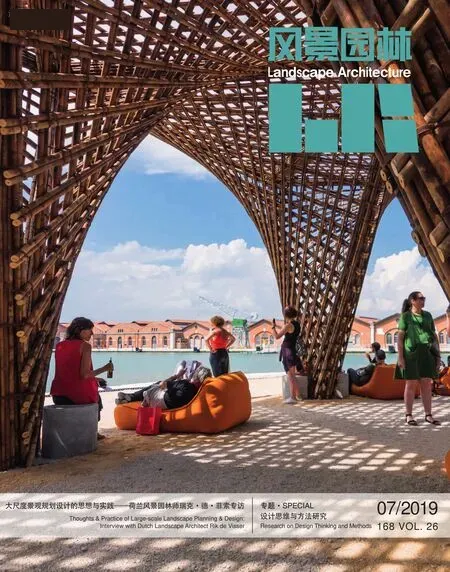
大尺度景觀規(guī)劃設(shè)計(jì)的思想與實(shí)踐—荷蘭風(fēng)景園林師瑞克·德·菲索專(zhuān)訪
2019-11-30 08:44:46采訪張博雅校對(duì)宋巖
風(fēng)景園林 2019年7期
采訪:張博雅 校對(duì):宋巖
瑞克·德·菲索是荷蘭Vista景觀與城市規(guī)劃所創(chuàng)始人兼首席設(shè)計(jì)師,曾任瓦格寧根大學(xué)、代爾夫特理工大學(xué)、阿姆斯特丹建筑學(xué)院、萬(wàn)豪勞倫斯坦應(yīng)用科學(xué)大學(xué)等多所高校的客座講師。他有著超過(guò)30年的景觀項(xiàng)目實(shí)踐經(jīng)驗(yàn),尤其擅長(zhǎng)鄉(xiāng)村及都市群環(huán)境中的大尺度景觀規(guī)劃與設(shè)計(jì)項(xiàng)目。在他的職業(yè)生涯中,曾主持了多個(gè)著名項(xiàng)目,包括荷蘭馬肯湖—瓦登海項(xiàng)目,公園21項(xiàng)目以及弗和米爾圩田項(xiàng)目。他曾受邀參與在北京林業(yè)大學(xué)舉行的2018世界風(fēng)景園林師高峰講壇。《風(fēng)景園林》雜志社有幸對(duì)瑞克·德·菲索先生進(jìn)行了專(zhuān)訪,以下是采訪全文。
LAJ:《風(fēng)景園林》雜志
Rik:瑞克·德·菲索
LAJ:您在大尺度景觀規(guī)劃設(shè)計(jì)項(xiàng)目上有著豐富的經(jīng)驗(yàn)。您早年是如何開(kāi)始介入這一領(lǐng)域的呢?
Rik:這和我的教育背景有關(guān)。當(dāng)我在瓦格寧根學(xué)習(xí)的時(shí)候,農(nóng)業(yè)景觀改造和整理是荷蘭的熱門(mén)議題,都是關(guān)于大尺度的項(xiàng)目。那時(shí)候,在舊須德海范圍內(nèi)的圩田建造工程也還在進(jìn)行中,該工程也是我的導(dǎo)師尼可·德·永的主要關(guān)注點(diǎn)之一。我發(fā)現(xiàn)大尺度項(xiàng)目的工作非常有趣。我們同負(fù)責(zé)建設(shè)的政府部門(mén)在圩田區(qū)進(jìn)行了大量的實(shí)地考察,那時(shí)是圩田建設(shè)的高峰時(shí)期,所以他們不得不讓工程快速進(jìn)行。了解他們的規(guī)劃,聆聽(tīng)他們的方案匯報(bào)讓我深受啟發(fā)。這些經(jīng)歷讓我開(kāi)始對(duì)大尺度項(xiàng)目產(chǎn)生了強(qiáng)烈興趣,我覺(jué)得處理如此大面積的區(qū)域是很吸引人的事情。

1 澤蘭省瓦赫倫地區(qū)1850年的歷史地圖。稠密的水系、綠色網(wǎng)絡(luò)以及劃分較細(xì)的小塊土地構(gòu)成了這里的景觀特征The historical map of Walcheren in Zeeland in 1850.The landscape is characterized by dense water and tree networks and small plots of land. Image: Staatsbosbeheer

2 “二戰(zhàn)”期間,為阻止德軍前進(jìn),盟軍于1944年破壞了部分堤壩,使部分地區(qū)被淹沒(méi)。戰(zhàn)后,堤壩被修復(fù),重建工作陸續(xù)進(jìn)行。重建工作的目標(biāo)是為農(nóng)業(yè)提供更現(xiàn)代化的景觀布局,以及保護(hù)原有的特質(zhì)The underwater setting of Walcheren in 1944 was carried out by the Allies to weaken the German position(World War II). After the war and the restoration of the dikes, reconstruction was carried out. The aim was to modernize the layout of the landscape for agriculture while maintaining the quality of the landscape. Image:Staatsbosbehee

3 瓦赫倫地區(qū)1946年的重建規(guī)劃。該計(jì)劃的宗旨是通過(guò)基礎(chǔ)設(shè)施以及綠色網(wǎng)絡(luò)重新組織景觀結(jié)構(gòu)The reconstruction plan of Walcheren in 1946. The idea is to reorganize the landscape with green networks and infrastructures

4 為進(jìn)行土地整理而調(diào)整的瓦赫倫地區(qū)重建規(guī)劃方案Landscape plan Walcheren: elaboration of the reconstruction plan for the land re-allotment project
尼可·德·永教授還曾帶我去澤蘭省參觀。“二戰(zhàn)”時(shí)期,由于水壩被轟炸,澤蘭省遭受了洪災(zāi)。那里的人們需要在既尊重歷史景觀,又滿足未來(lái)需求的情況下,恢復(fù)受災(zāi)的土地。澤蘭省在歷史上的主要景觀是密集的小尺度景觀,這對(duì)于游客和動(dòng)植物來(lái)說(shuō)都很有吸引力,但對(duì)于農(nóng)業(yè)活動(dòng)來(lái)說(shuō)很不方便。于是人們進(jìn)行了土地整理①項(xiàng)目。他們?cè)囍屝碌耐恋匾?guī)劃既保留一定的歷史特征,又保證農(nóng)業(yè)上的實(shí)用性。農(nóng)業(yè)用地、綠地系統(tǒng)以及對(duì)氣候變化的適應(yīng)均被充分考慮了。這是戰(zhàn)后的一個(gè)著名案例。在20世紀(jì)60—70年代,河流區(qū)域也經(jīng)歷了很多轉(zhuǎn)變。由于頻繁的水災(zāi)以及這里的圩田曾經(jīng)大部分都是沼澤,該區(qū)域的可達(dá)性和實(shí)用性都很差。人們改進(jìn)了這里的水利系統(tǒng),并建設(shè)了新的農(nóng)場(chǎng)(圖1~6)[1]。
重建圩田景觀在我所受的教育中是很重要的一課。當(dāng)然,我在學(xué)校里也接觸了公園和公共空間設(shè)計(jì),但那對(duì)我來(lái)說(shuō)不夠有趣。我對(duì)三角洲工程、舊須德海工程那樣的大尺度的景觀項(xiàng)目更為著迷。
LAJ:對(duì)于那個(gè)時(shí)代的荷蘭風(fēng)景園林師來(lái)說(shuō),相比于公園和廣場(chǎng)之類(lèi)的項(xiàng)目,大尺度的項(xiàng)目是否更為流行?

5 瓦赫倫地區(qū)的開(kāi)敞景觀由低洼的黏土地和較高的溪流、土堤組成,其中的土堤通過(guò)林帶進(jìn)行強(qiáng)調(diào),而低地則保持開(kāi)放Open landscape in Walcheren. The landscape of Walcheren consists of higher-lying creek ridges and lower-lying clay soils. The creek ridges are accented with tree planting. The lower parts are kept open

6改造后路旁樹(shù)木密植,以抵御強(qiáng)風(fēng)The roads near the coast are densely planted to protect against the wind
Rik:并非如此,風(fēng)景園林是一個(gè)非常寬泛的學(xué)科。像是皮特·奧道夫,他完全專(zhuān)注于宿根植物的研究,并成為這一領(lǐng)域的專(zhuān)家。有些人可能更關(guān)注公共空間設(shè)計(jì),那可能對(duì)美學(xué)表達(dá)有更高要求。我只是在大尺度景觀上更為專(zhuān)業(yè)而已,為此,我需要了解自然過(guò)程、生態(tài)學(xué)、農(nóng)業(yè)和城市發(fā)展以及與景觀融合的基礎(chǔ)設(shè)施。
我畢業(yè)以后曾以風(fēng)景園林師的身份在荷蘭農(nóng)業(yè)、自然資源與漁業(yè)部工作。我的工作包括土地整理、改善農(nóng)業(yè)用地、建立新的度假區(qū)和自然地。我們還建設(shè)新的道路,新的水利系統(tǒng)等。我們想要讓景觀更加符合這個(gè)時(shí)代的需求。
LAJ:您還曾撰寫(xiě)了關(guān)于土地整理的專(zhuān)著②。
Rik:的確。我的書(shū)回顧了土地整理的全部歷史。起初,人們只關(guān)注如何讓土地為農(nóng)業(yè)服務(wù),并且在建設(shè)的過(guò)程中破壞了土地原有的歷史文化和生態(tài)價(jià)值。漸漸地,人們認(rèn)識(shí)到可以在保全文化和生態(tài)價(jià)值的前提下提升景觀功能性。
LAJ:您可以向我們簡(jiǎn)單介紹您的工作方法嗎?您認(rèn)為在大尺度項(xiàng)目中,哪些因素更為重要呢?
Rik:我們的工作方法包含很多維度。首先,我們會(huì)用疊圖法進(jìn)行分析。借助GIS工具,我們可以將所有項(xiàng)目相關(guān)數(shù)據(jù)與地圖進(jìn)行關(guān)聯(lián)。我們首先把信息按照下面的標(biāo)準(zhǔn)分類(lèi):
土地的物理信息:土壤、地質(zhì)、地形、水文等;基礎(chǔ)設(shè)施:公路、鐵路、能源管線等;用地功能:農(nóng)業(yè)、水利、工業(yè)、居住、休閑等。
選擇哪些數(shù)據(jù)、做到何種精度取決于項(xiàng)目的要求。充分理解設(shè)計(jì)任務(wù)是最重要的事情:客戶(hù)到底想要實(shí)現(xiàn)什么?設(shè)計(jì)研究是用于檢驗(yàn)我們是否在正確的軌道上前進(jìn)。我們通常會(huì)為同一項(xiàng)目提供不同策劃方案,并比較它們是否符合任務(wù)要求。這是一個(gè)充滿創(chuàng)造、交流且循環(huán)往復(fù)的過(guò)程。客戶(hù)在這一過(guò)程中也扮演了重要的角色。雙方對(duì)于任務(wù)的理解越充分,最后的結(jié)果就會(huì)越出彩。
收集各方信息后,風(fēng)景園林師會(huì)對(duì)信息進(jìn)行整合,并轉(zhuǎn)化成空間設(shè)計(jì)方案。好的設(shè)計(jì)要讓項(xiàng)目中不同部分緊密聯(lián)系,同時(shí)又讓整體具有超越個(gè)體之和的價(jià)值。我們會(huì)從以下3個(gè)維度衡量項(xiàng)目的好壞:設(shè)計(jì)滿足功能需要,經(jīng)濟(jì)合理;設(shè)計(jì)具有生態(tài)價(jià)值,是可持續(xù)的;設(shè)計(jì)符合美學(xué),并且擁有獨(dú)特個(gè)性。
LAJ:在大型復(fù)雜項(xiàng)目中,您必須和很多人同時(shí)協(xié)作。在這個(gè)過(guò)程中,您如何在眾多不同學(xué)科背景的專(zhuān)家中實(shí)現(xiàn)主導(dǎo)呢?
Rik:對(duì)我們來(lái)說(shuō)和不同背景的人合作是家常便飯。有時(shí)候,我會(huì)和他們說(shuō)我其實(shí)什么都不懂,我唯一懂的就是怎樣整合。比如,我不是水利專(zhuān)家,我對(duì)如何疏浚并不了解。不過(guò),作為風(fēng)景園林師,腦海中需要有一個(gè)目標(biāo):想要完成這個(gè)項(xiàng)目。因此我需要來(lái)自不同學(xué)科的信息,需要和不同的專(zhuān)家明確哪些事情更為重要。我的經(jīng)驗(yàn)是,如果你對(duì)其他人掌握的知識(shí)有濃厚的興趣,并恰當(dāng)?shù)叵蛩麄兲釂?wèn),你可以得到你需要的有用信息。我覺(jué)得這至關(guān)重要。
當(dāng)開(kāi)始馬肯湖—瓦登海項(xiàng)目時(shí),工程師對(duì)我說(shuō),“你是風(fēng)景園林師,你來(lái)設(shè)計(jì),我們只需要把你設(shè)計(jì)的方案做出來(lái)”。我回答說(shuō):“我必須先向你們學(xué)習(xí)。比如,我需要了解你們的疏浚技術(shù):你們使用什么設(shè)備,速度是多少,什么是可行的,什么是工程上無(wú)法實(shí)現(xiàn)的,是否有不同的工作方案……”于是他們向我展示了不同的技術(shù)和材料,不同樣式的工程船和疏浚設(shè)備。這樣我就和工程師建立了聯(lián)系。事實(shí)上,工程師們喜歡解釋自己的工作,每個(gè)人都喜歡談?wù)撍麄冏约核龅墓ぷ鳌H绻覀儽憩F(xiàn)出足夠的興趣,就可以建立良好的合作基礎(chǔ)。因?yàn)樗麄冎雷约旱囊庖?jiàn)會(huì)被認(rèn)真對(duì)待,而且清楚為了實(shí)現(xiàn)最終的目標(biāo),我們需要彼此,這是很好的合作關(guān)系。和生態(tài)學(xué)家的協(xié)作也是如此。他們腦海中有大量的知識(shí)儲(chǔ)備,比如什么植物可以生長(zhǎng)在這個(gè)地區(qū),什么動(dòng)物可以在這里生存,生態(tài)系統(tǒng)如何運(yùn)作,怎樣才能讓生態(tài)系統(tǒng)良性運(yùn)轉(zhuǎn)……我可以和他們討論創(chuàng)造怎樣的生境,以及如何創(chuàng)造。

7 馬肯湖—瓦登海項(xiàng)目由一系列在馬肯湖中的人工島嶼和堤壩組成The plan of Marker Wadden-a series of artificial dikes and islands in Markermeer

8 人工島嶼的建造原理The building principle of the island

9 發(fā)生在馬肯湖—瓦登海項(xiàng)目的自然過(guò)程The natural process around Marker Wadden

10 作為地標(biāo)的觀鳥(niǎo)屋The bird watching tower as a landmark
馬肯湖—瓦登海項(xiàng)目的最終方案是基于不同學(xué)科的綜合知識(shí)提出的(圖7)。馬肯湖是一處70 000 hm2的巨大水域。從項(xiàng)目地到阿姆斯特丹大約40 km。盛行西南風(fēng),且風(fēng)力大。由于盛行風(fēng)的作用,湖中水位會(huì)抬高1 m以上,相應(yīng)地,在另一邊,水位會(huì)下降。這個(gè)效應(yīng)使得馬肯湖—瓦登海產(chǎn)生的洪水大量涌入沼澤,當(dāng)風(fēng)停止后,這些水又會(huì)流出。我們?cè)噲D利用這個(gè)效應(yīng)重現(xiàn)自然的沉積過(guò)程。當(dāng)水從沼澤地流走時(shí),會(huì)自然地產(chǎn)生小溪。所以我們不需要特意設(shè)計(jì)小溪,只要我們?cè)谠O(shè)計(jì)中留了出水口,小溪就會(huì)因這一自然過(guò)程而產(chǎn)生。一位生物學(xué)家向我講述了這里原有沼澤地的故事。由于沼澤地會(huì)時(shí)不時(shí)地被淹,所以魚(yú)群會(huì)階段性地在這里聚集。這種相對(duì)封閉的環(huán)境是幼魚(yú)成長(zhǎng)的絕佳場(chǎng)所。一方面,鳥(niǎo)類(lèi)也知曉這一現(xiàn)象,由于魚(yú)群非常集中,所以它們?cè)谶@里很容易捕到魚(yú)。當(dāng)洪水再次來(lái)臨,水位上漲,魚(yú)類(lèi)就可以離開(kāi)這里去往另一個(gè)系統(tǒng)。了解了這一現(xiàn)象后,我們?cè)陧?xiàng)目中特意設(shè)計(jì)了這樣的區(qū)域。挖泥船就像3D打印機(jī)一樣,我們用淤泥來(lái)“打印”一個(gè)島。密度大的材料入水后會(huì)很快下沉,而輕質(zhì)的材料會(huì)漂到稍遠(yuǎn)的地方。然后我們?cè)谔囟ǖ牡胤椒忾]或留出缺口,因而形成了封閉及開(kāi)敞的區(qū)域。這種多樣性對(duì)于生態(tài)系統(tǒng)來(lái)說(shuō)非常重要。我們吸取了生態(tài)學(xué)家的智慧,并將其轉(zhuǎn)化成了設(shè)計(jì)方案(圖8~10)。然后我們和疏浚公司通力協(xié)作,讓方案在技術(shù)上充分可行。只要對(duì)其他人掌握的知識(shí)保持好奇、愿意交流,那么風(fēng)景園林師就可以基于他們提供的信息得出空間設(shè)計(jì)方案。
LAJ:您很早就將自然過(guò)程與設(shè)計(jì)項(xiàng)目相結(jié)合,弗和米爾圩田項(xiàng)目是一個(gè)很好的案例。在化工廢棄物上建設(shè)圩田的想法非常獨(dú)特。您能向我們簡(jiǎn)單介紹這一案例嗎?
Rik:在我們介入該項(xiàng)目前,我們就研究了“綠心”③區(qū)域的泥炭地。從我們的研究數(shù)據(jù)來(lái)看,盡管很多地方的泥炭地在退化,但在另一些地方,泥炭也隨時(shí)間逐漸積累。所以我們擁有創(chuàng)造泥炭的自然基礎(chǔ),當(dāng)然,這需要時(shí)間。我當(dāng)時(shí)的工作合伙人是一位生態(tài)學(xué)家,他家有一個(gè)池塘。為了消遣,他嘗試在池塘里養(yǎng)泥炭苔蘚。令人驚訝的是,苔蘚長(zhǎng)勢(shì)非常好。這些苔蘚是泥炭沼澤形成的基礎(chǔ),既受雨水的影響,也受圩田中水的影響。它們?cè)谏L(zhǎng)的過(guò)程中會(huì)逐漸形成像海綿一樣的結(jié)構(gòu),并吸收大量的水、有機(jī)物以及二氧化碳。所以,當(dāng)我們接手弗和米爾項(xiàng)目時(shí),對(duì)于如何安全地覆蓋化工垃圾的難題,我們已經(jīng)有了答案。從美學(xué)的角度講,泥炭沼澤是一個(gè)很好的方案,因?yàn)檫@一區(qū)域周邊都是泥炭地,所以新的泥炭沼澤會(huì)與周邊很好地融合。這個(gè)區(qū)域原先有一片高于海平面5 m的泥炭沼澤,后來(lái)化工垃圾在此堆積。除了泥炭沼澤外,另一個(gè)方案是用黏土覆蓋化工廢棄物,并在上面種草。但這需要高頻的養(yǎng)護(hù)管理,否則可能會(huì)長(zhǎng)出樹(shù)苗,樹(shù)根會(huì)刺破隔離層,進(jìn)入廢棄物層,再次造成污染。受之前的研究啟發(fā),我們想為什么不直接在這里建立自然的泥炭地呢?我們的想法是把圩田按照原來(lái)的地形,像稻田一樣劃分成不同的小塊(圖11~14)。

11 弗和米爾圩田平面圖Volgermeer plan

12 弗和米爾圩田鳥(niǎo)瞰渲染圖Bird’s-eye view visualization

13 新景觀建設(shè)過(guò)程N(yùn)ew landscape in construction

14 圖案般的景觀Graphical landsape
這一提案引發(fā)了很多爭(zhēng)論。工程公司擔(dān)心造價(jià)會(huì)非常昂貴,且難以實(shí)現(xiàn)。后來(lái),他們發(fā)現(xiàn)在泥炭中的化學(xué)廢棄物沒(méi)有任何向外擴(kuò)散或滲漏的跡象,非常安全。這讓他們確信泥炭對(duì)于化學(xué)廢棄物來(lái)說(shuō)的確是安全的基礎(chǔ)。之后,我們提議在廢棄物的表層也覆蓋一層泥炭,稱(chēng)之為“自然帽子”(圖15、16)。相較而言,這一方案非常經(jīng)濟(jì),因?yàn)閮H需很少的土方工程量和其他材料。方案具有很好的雨洪調(diào)蓄功能,為鳥(niǎo)類(lèi)提供生境,讓人們可以在水上泛舟、在水邊騎行,并且完美地融入周邊的景觀(圖17~21),遠(yuǎn)優(yōu)于單純覆蓋廢棄物的方案。在荷蘭也有將化學(xué)廢棄物填埋場(chǎng)轉(zhuǎn)化為其他用途的案例,比如艾爾伯格附近的迪莫海堤。該區(qū)域完全被新的土壤覆蓋,變成風(fēng)景優(yōu)美的公園。但是,無(wú)法使人了解區(qū)域的變遷。
我認(rèn)為弗和米爾圩田是一個(gè)很特別的項(xiàng)目。我們真正把不同因素整合,并把它們放在合適的位置。我十分欣喜地看到高校中有針對(duì)該區(qū)域的泥炭圩田發(fā)展的持續(xù)跟蹤研究。
LAJ:您處理自然過(guò)程的手段很獨(dú)特。通常人們的關(guān)注點(diǎn)可能在于自然保護(hù),而您選擇了一種更為主動(dòng)的,創(chuàng)造自然過(guò)程的策略。您如何看待您的選擇?
Rik:我們當(dāng)然熱愛(ài)自然保護(hù),而且我們也在這樣做,但那更多的是關(guān)于維護(hù),而且可能是非政府組織的責(zé)任。我們并沒(méi)有真正“創(chuàng)造”過(guò)程,我們只是創(chuàng)造條件,然后自然過(guò)程便會(huì)自然發(fā)生。
東瓦德湖曾被規(guī)劃為工業(yè)區(qū),但當(dāng)湖水被抽干后,它并沒(méi)有被投入使用。兩年以后,植物瘋狂生長(zhǎng),徹底覆蓋了這一區(qū)域。所以有些人會(huì)說(shuō),我們可以“建造”新的自然。但自然其實(shí)是一種無(wú)處不在的力量,在一刻不停地改變著景觀。我常說(shuō),在荷蘭,森林可以在任何地方天然形成,擺脫森林才需要刻意地努力。農(nóng)夫通過(guò)不斷地耕田、收糧食、養(yǎng)奶牛來(lái)維持田地不被其他植物占據(jù)。如果對(duì)田地放任不管,幾年以后,樹(shù)木會(huì)遍地生長(zhǎng),形成屬于該地區(qū)的天然森林。

15 覆蓋化學(xué)廢棄物的概念圖解The concept of covering chemical waste

16 植被發(fā)展的4個(gè)階段Four stages in vegetation development
當(dāng)我在農(nóng)業(yè)部工作時(shí),曾有一個(gè)為游憩設(shè)計(jì)新森林的項(xiàng)目。林業(yè)部門(mén)想要把所有植物都種好,但將永遠(yuǎn)無(wú)法通過(guò)種植獲得自然的生態(tài)系統(tǒng)。比如,如果只種植櫸樹(shù),雖然櫸樹(shù)有很好的遮陰效果,但樹(shù)林失去了多樣性。而如果讓自然自行發(fā)展,會(huì)形成充滿多樣性的森林。
我成立自己的公司后負(fù)責(zé)的第一個(gè)項(xiàng)目也是關(guān)于森林的。我們嘗試不種樹(shù),而只是提供不同的基礎(chǔ)條件,然后讓森林自然形成,并留出一些開(kāi)敞的草地,或許會(huì)形成沼澤。這個(gè)過(guò)程是自發(fā)的。當(dāng)經(jīng)人工種植而天然生長(zhǎng)的森林形成后就可以規(guī)劃路徑和開(kāi)放空間。這比種樹(shù)更有趣,而且可能會(huì)更美。因?yàn)槟M自然是非常困難的,自然比我們更會(huì)做設(shè)計(jì)。當(dāng)我在學(xué)校教書(shū)時(shí),我也讓學(xué)生設(shè)計(jì)森林。他們感到很困惑:如何設(shè)計(jì)森林呢?該從哪里開(kāi)始?我對(duì)他們說(shuō):“只管想象森林已經(jīng)在那里就好了,然后你會(huì)做什么呢?”
LAJ:我認(rèn)為生態(tài)設(shè)計(jì)中比較棘手的一點(diǎn)是,我們?cè)跒閯?dòng)植物創(chuàng)造更好的環(huán)境,但不同物種之間總存在競(jìng)爭(zhēng)。選擇“幫助”一些物種勢(shì)必意味著影響其他物種。那么,面對(duì)自然競(jìng)爭(zhēng),您的立場(chǎng)是什么呢?
Rik:自然界中,發(fā)生在不同物種之間的競(jìng)爭(zhēng)無(wú)法避免,而且始終存在。比如海鷗會(huì)吃小鴨子。對(duì)此,其實(shí)你沒(méi)辦法影響。
不過(guò)我想,可以從人的角度去考慮。在馬肯湖—瓦登海項(xiàng)目中,我們嘗試設(shè)計(jì)很多路徑來(lái)豐富體驗(yàn)。比如我們有沙灘體驗(yàn):你可以在這里游泳,俯瞰湖面。由于沙丘在身后,你會(huì)有被庇護(hù)的感覺(jué)。在沙丘的另一邊,可以體驗(yàn)沼澤景觀,觀察鳥(niǎo)巢和魚(yú)類(lèi)。為了讓人們有身臨其境的感覺(jué),我們?cè)O(shè)計(jì)了一條1 km的棧道(圖22)。同時(shí)還設(shè)計(jì)了觀景塔。由于這里整體上十分平坦,所以視覺(jué)地標(biāo)就尤為重要(圖23)。向上走時(shí),首先會(huì)看到美麗的湖面。在塔頂,可以俯瞰整個(gè)沼澤,如同看地圖般清晰(圖24)。在低矮的觀鳥(niǎo)屋,人們可以觀察到鳥(niǎo)掠過(guò)湖面的情形。我們盡可能向游客提供豐富的體驗(yàn),讓他們領(lǐng)略到這一區(qū)域的不同特質(zhì)。
對(duì)于生活在沼澤中的鳥(niǎo)類(lèi),不需要人工干預(yù)。不過(guò)對(duì)于大型動(dòng)物而言就沒(méi)這么簡(jiǎn)單了。在東瓦德湖,動(dòng)物的種群數(shù)量不斷上升。由于食物有限,有些動(dòng)物在冬天不得不挨餓。在自然條件下,這些動(dòng)物可以遷徙到食物更為充足的區(qū)域。但是,這些動(dòng)物受到限制,無(wú)處可去。有些人無(wú)法接受這種狀況,并進(jìn)行了抗議。管理這一區(qū)域的林業(yè)部門(mén),只好決定削減種群數(shù)量。這也算是一種自然管理。這是一種對(duì)自然的人工干預(yù),但迫于公眾輿論,他們不得不這樣做。
LAJ:您在包括中國(guó)在內(nèi)的很多國(guó)家和地區(qū)都有實(shí)踐經(jīng)歷。在您看來(lái),在不同地方的實(shí)踐有何異同?
Rik:在不同地區(qū)做項(xiàng)目當(dāng)然有很多差異,包括文化和審美偏好。在荷蘭,設(shè)計(jì)可能更注重簡(jiǎn)潔性及功能性;而在中國(guó),人們可能更關(guān)注項(xiàng)目背后的文化含義。但事實(shí)上我們有很多共同的關(guān)注點(diǎn),比如設(shè)計(jì)可持續(xù)的景觀。我們有大量的共同愿景和目標(biāo),所以并不需要說(shuō)服彼此,而是可以相互學(xué)習(xí)和借鑒。
有時(shí),真正的難點(diǎn)在于如何說(shuō)服當(dāng)?shù)卣邮苣愕南敕ā_@在荷蘭也是一樣的。官員并不一定愿意建立新的自然地,或者是投資很綜合的項(xiàng)目。他們可能會(huì)更關(guān)心房屋和基礎(chǔ)設(shè)施建設(shè),而且這些都需要被快速完成。因?yàn)樗麄儠?huì)決定財(cái)政預(yù)算的流向,所以我們真正要做的是讓他們理解和信任。有時(shí)候大尺度景觀項(xiàng)目是很復(fù)雜的,而決策者可能沒(méi)有太多的時(shí)間去理解,所以他們只能用喜歡或者不喜歡去回應(yīng)。他們甚至沒(méi)機(jī)會(huì)真正了解問(wèn)題到底出在哪里。所以,除了把方案做好,更具挑戰(zhàn)的是如何更有效地傳遞信息。
注釋?zhuān)?/p>
① 在荷蘭,土地整理指為適應(yīng)現(xiàn)代化對(duì)郊野景觀進(jìn)行的改造。具體工作內(nèi)容包括改善水管理網(wǎng)絡(luò)、土壤成分、用地性質(zhì)及權(quán)屬的再分配,以及將農(nóng)場(chǎng)搬遷至更適宜的位置。景觀規(guī)劃為整合道路綠化、森林、自然保護(hù)區(qū)以及休閑度假區(qū)域而作。土地整理的高峰時(shí)期為二戰(zhàn)結(jié)束后的1945—1980年。
② 該專(zhuān)著為《Een Halve Eeuw Landschapsbouw — Het landschap van de landinrichting》。
③ 綠心區(qū)域:荷蘭蘭斯塔德地區(qū)由環(huán)繞綠心的一系列城市組成,包括阿姆斯特丹、海牙、鹿特丹、烏特勒支以及一系列小城市。800余萬(wàn)人口居住在這一區(qū)域。綠心區(qū)域位于蘭斯塔德城市環(huán)內(nèi),人口密度較低,主要為泥炭景觀。這一區(qū)域被指定為國(guó)土景觀。
圖片來(lái)源:
圖1、2來(lái)源于荷蘭國(guó)家林業(yè)署;圖3、4、10~13來(lái)源于參考文獻(xiàn)[1];圖5、6由阿利·斯托克攝;圖7~9,14~16,22~24來(lái)源于荷蘭Vista景觀與城市規(guī)劃所;圖17~21由Hans Peter F?llmi攝。
(編輯/王亞鶯)

17 用于研究的池塘中的植被和泥炭積累Research plot vegetation and peat development

18 蘆葦田間的水道The waterways between reed fields

19 蘆葦田景觀The reed fields
Rik de Visser is the owner and director of Vista Landscape architecture and urban planning in the Netherlands. During his career he taught as a guest lecturer at Wageningen University,TU Delft, Van Hall Larenstein and Academy of Architecture Amsterdam University of the Arts. He has over 30 years of experience in the landscape architecture. He specializes in integral large-scale landscape projects, both in rural and metropolitan areas. During his professional career, he has taken the lead in many noted projects, including Marker Wadden, Park 21 and Volgermeerpolder.And he was invited as a keynote speaker in the International Landscape Architecture Symposium in Beijing Forestry University in 2018. Landscape Architecture Journal had the honor to interview Mr. Rik de Visser. Following is the full text of this exclusive interview.
LAJ:Landscape ArchitectureJournal
Rik: Rik de Visser
LAJ: You’ve had rich experience in large-scale landscape planning & design projects. How did you start to work in this field in the early years?
Rik: It first comes from my education. I was educated in Wageningen. By the time I was studying, reorganizing the agricultural landscape was a hot issue, and that was all about large scale projects. People were also finishing the polder landscape, in the former Zuiderzee, which was a major interest of my professor Nico de Jonge. I found it to be very interesting to work on big scale.We did a lot of field trips in the polders, together with the government service who was responsible for building the polders. They had to really build very fast, because it was the high time of building polders. It was very inspiring to be there to see their plans, watch their presentations about the plans. That’s how I got interested in the big scale landscape architecture. I was fascinated that I could work with such large areas.
Nico de Jonge also took me to the province of Zeeland. Zeeland was flooded in The Second World War, because several dikes were bombed. People there had to recover the complete landscape, and they had to respect the historical landscape as well as future needs at the same time. It used to be very small scale landscapes, which was interesting for tourists and nature. But it was difficult for the farmers to work with that. There came the land re-allotment projects①. They try to build the landscape with the character before but also very functional for the farmers. Green structures, agricultural areas, climate adaptation, etc., were all well considered. It was a famous example in postwar years. In the 60s and 70s,the river district also went through many transitions.That district used to be very unaccessible, because it flooded frequently and the polders there were just marshlands. People developed it, improved water system and built new farms (Fig. 1~6).
Rebuilding the polders was very important in my education. Of course we also had park and public space designs in college, but that was less interesting for me. I was just more fascinated with the bigger landscapes, like Delta Works and former Zuiderzee.
LAJ: Back to that time, for Dutch landscape architects, is that maybe more popular to work on bigger landscapes instead of parks and public spaces?
Rik: No. Landscape architecture is a big discipline. Like Piet Oudolf, he is completely focusing on perennials, and he became an expert on it. Some people focus more on public spaces, which might be more about the aesthetics. I just more specialized in this more large-scale landscape architecture, where I’ve been getting to know landscape process, ecology,agriculture, urban development and infrastructure that fits in the landscape.
After I graduated, I worked for the ministry of agriculture, nature conservation and fisheries as a landscape architect. I worked on new recreational areas, new natural areas and land re-allotment plans.Land re-allotment is to improve the structure of the agricultural landscapes. We built new roads, new water systems, and we created nature, new green structures to provide possibilities for recreation. We wanted to bring the landscape into modern time.
LAJ: You wrote a book②about the land re-allotment.
Rik: Exactly. I have written a book about the whole history of land re-allotment. In the beginning,people focused on improving the land only for agriculture. And they demolished a lot of historic cultural values and ecological values in the landscape.Gradually, people started to understand it’s possible to make a very functional landscape without decreasing those historical and ecological values.
LAJ: Can you brief us about your method of work? What aspects are important for you in large projects?
Rik: Our method of working has different dimensions. We do landscape analyzes using the layer approach. With GIS we map all relevant data for the assignment. We first of all distinguish among: physical-geographic data: soil, geology,relief, hydrology, etc. Infrastructure: roads, rail lines, power lines, etc. Land use: agriculture, nature management, industry, living, recreation, etc.
The design assignment determines the selection of the data and the level of detail. Understanding the design assignment is the most important. What does the client want to achieve? We use design research to determine whether we are on the right track. We often create multiple scenarios that we then test against the assignment. This is a cyclic, creative and interactive process. The client has an important role in this. The better the assignment, the better the final result.
With all the input from different sectors,the landscape architect assembles the knowledge and ideas of specialists and translates this into spatial design. The strength of a good design lies in the coherence of the component parts and the added value of the whole. Ultimately, we test each plan against three important and coherent core values: the design is economic and functional;the design is ecologically valuable and sustainable;the design is aesthetic and has a strong identity.
LAJ: In large complex projects, you must cooperate with a big group of people. How do you take the lead among specialists from different backgrounds?

20 從“自然帽子”望向周邊環(huán)境。新的圩田已經(jīng)完全融入了周邊環(huán)境The view from the ‘natural cap’ to the surrounding landscape. The new polders are completely immersed to the surroundings

21 最終會(huì)形成泥炭的植被The vegetation which eventually will form the peat
Rik: We often work with different people from different disciplines. Sometimes I tell them that I don’t know anything, the only thing I know is how to bring things together. For instance, I am not a specialist in water systems, I don’t know how to dredge. But, as a landscape architect, you have the goal in your mind. You want to realize the plan. Therefore you need to know from all the disciplines, all specialists about what’s important.And my experience is that if you have a deep interest in other people’s knowledge and put right questions to them, you can get all the useful information for your plan. I think that’s significant.
When we started to work on Marker Wadden,the engineers told me that you’re the landscape architect, so you can make your plan and then we will build it. And I said no, I have to learn from you first. For instance, I wanted to know the dredging techniques: what equipment do you use; how fast do you go; what you can build and what you can’t do; what different options do you have… So they showed me the different techniques and materials they could use, different boats and dredging machines they have. Thereafter we got good contact.Actually they also like to explain. Everybody likes to talk about their own works. If you put a lot of interest in those people, you will create a firm base to cooperate. Because they know that you take their opinions seriously. And you also build a good relationship that they know you need each other to reach the final goal. The same goes for ecologists.They have a great deal of knowledge: what plants grow in the area; what animals live there; how the ecosystem functions; what do you have to do to make the ecosystem healthy… You can discuss with them what kind of habitats we can create and how can we achieve that.
The final plan of Marker Wadden was designed according to the combined knowledge(Fig. 7). Markermeer is a big stretch of water covering 70 000 hm2. The distance from Marker Wadden to Amsterdam is about 40 km. The prevailing wind comes from the southwest, and it’s strong. The water level can rise more than one meter with the wind. On the other side, the water level goes down. This effect makes Marker Wadden flood, so water can come in into the marshland. When wind goes away, the water goes out again. In this way we want to create natural process of sedimentation again. When the water leaves the marshland, creeks come as a result.So we don’t have to design creeks. As far as we have openings in our plan, we will get creeks naturally by this effect. A biologist told me a story about the disappeared old marshlands. Because it flooded once in a while, there was a lot of fish captured in the marshland for a period of time.That was ideal situation to nurture the young fish.And the birds also knew it. They knew that they could fish there quite easily, because there was so much fish concentrate. When the marshland floods again, because of high river tables, fish can escape to another system. In Marker Wadden we also created isolated parts because of this effect.The dredging machine was like a 3D printer, and we ‘print’ the island with silt. The strong materials going down quickly, close to the spot you put;the soft materials go to the side. At some point we open the islands and at other parts we closed.So we have isolated parts and open parts. This diversity is very important for the ecosystem. We took the input from the ecologist and turned it into a plan(Fig. 8~10). Together with dredging company, we made it technically feasible. Just be interested in the knowledge of other people and exchange ideas. Then, as a landscape architect,you make the spatial plan based on their inputs.

22 位置較低的觀鳥(niǎo)屋The lower bird watch

23 在觀鳥(niǎo)屋頂端遠(yuǎn)眺沙灘的情形The view of the beath from the top of the tower

24 新的泥灘吸引了反嘴鷸The new mudflat attracts avocets
LAJ: You mentioned natural process.And you began to work with it very early.Volgermeerpolder is probably a great example.The idea of creating the peat landscape on chemical waste was ingenious. Can you introduce us about that?
Rik: Before we had that project, we did a research about the peat area in the Green Heart③.According to our studies, though peat was degrading in many places, it also developed on certain spots over time. So we had the natural conditions to create peat. It takes time of course. My partner in the office back to that time was an ecologist. He had a pond at his home, where he tried to grow peat moss for fun. Surprisingly, it grew very well. That was the start of the peat bogs. It was under influences of rain water as well as polder water. While they grew,the structure they formed was like big sponges.It absorbs a lot of water, organic materials, and CO2. So, when we got Volgermeerpolder project,we’d almost have an answer to the question that how to cover the chemical waste in a safe way. It was also a good answer aesthetically. Because the surrounding landscape is peat landscape. The new peat bogs would fit. We used to have large peat bogs in that area, which was about 5 meters above sea level. And the chemical waste was also elevated in the landscape. Another option could be cover it with clay and grow grass there. But it had to be maintained often. Otherwise trees can appear, and their roots can penetrate the polluted part again. So we were wondering why don’t we just develop peat?It was inspired by our studies. The idea was to make polders like rice paddies, following the topography of this place (Fig. 11~14).
And then there was a lot of discussions on that plan. The engineering company worried that this proposal might be very expensive and difficult to achieve. Afterwards, they discovered that the chemical waste was actually safely located in the peat landscape. The toxic waste was not transported anywhere else. This convinced them that the peat was good natural condition to make the chemical waste safe. After a while, we proposed to cover the waste with peat on top as well, and we call that ‘a(chǎn) natural cap’ (Fig. 15, 16). It was cheaper than any other options. Because we need less transportation of soil or other materials. It could be a water buffer as well. It can also create habitat for birds. People can bike along the polders, canoe in the canals.And it’s completely integrated into surrounding landscapes (Fig. 17~21). It’s a better solution than simply cover it. In the Netherlands we also have other chemical waste land fills transformed to other uses, like Diemerzeedijk near IJburg. That was completely covered by dirt. It became a nice park landscape, but you can’t understand what happened there before.
I think Volgermeerpolder is a very special project. Different aspects of this project come together and fall into the right place in a way. There are still researches going on in universities about the peat development in this project. I’m very happy with that.
LAJ: I think the way deal with nature process is very unique: you took an active approach to create the process, while others may focus on the conservation of nature. What do you think?
Rik: We also like to preserve nature and we do, but that’s more about maintenance, which could to be NGO’s responsibilities. We don’t really‘create’ the process, we just create the conditions for nature, and nature will do its own work.
Oostvaardersplassen used to be planned as industrial areas. But it was not put in use after the water was pumped out. After two years,it was completely overgrown. Hence a lot of people said that sometimes we can also ‘build’new nature. But nature is a force that presents everywhere, and it’s ever changing the landscape.I always say, in Holland, you will get forest wherever you want, by nature. We have to make an effort not to have forest. The farmers do that through ploughing their land and harvest the crops and raising cows in the fields. If you leave the field alone, after a few years, the trees would start to grow everywhere. Then you get a natural forest that belongs to there.
When I was working for the Ministry of Agriculture, we had a program of designing new forests for recreation. And the State Forestry Service wanted to plant everything. But you will never get a natural ecosystem if you plant. For instance, if you plant beech trees, which give a lot of shades, it will be beech forest forever, with no diversity. If you let the nature develops itself, you get very interesting forest with great diversity.
The first assignment I had in my own office was also about forest. I said, well, let’s try to experiment not to plant the trees, but to create different conditions. And nature will create forest,leave open space and maybe some marshland, all on its own. After you have a natural forest, you can focus on paths and open space in it. That’s more interesting, and probably more beautiful than what we can plant. Because it’s very difficult to immediate nature. Nature does better designs than us. When I was teaching, I also had the assignment for students to make forest. They found it very difficult: how do we design forest? Where do we start? I told the students that just imagine the forest is already there. Then, what would you do?
LAJ: What I found tricky about ecological design is that you could say you are making better space for animals and plants, but there are always conflicts among species. When you choose to ‘help’ one, you may ‘hurt’another. Then how do you take the stand in front of the natural competitions?
Rik: Well. There is always natural competition between species, like seagulls eat small ducks. There is always a natural competition. And you can’t do anything about it.
In my perspective, what you can do is do it for people. In Marker Wadden, we tried to make a lot of paths with different experiences. We have the beach experience, where you can overlook the lake and swim there. You get sheltered, because the dune is behind you. If you go to the other side,you can explore the marshland, watching the birds’nests and fishes. To create the feeling of being in the marshland, we create this 1 km long broad walk (Fig. 22). And we designed the viewing tower.When everything is flat, it would be important to have a landmark (Fig. 23). When you are walking upwards, you’ll get a view on the lake first. On top,you take an overview of the marshland as if you are looking at the map (Fig. 24). We also made a bird watching place which was really low, where you see the birds flying just above the water. We try to provide different experiences for visitors, showing different identities of the area.
You don’t have to interfere for the birds in marshlands. But with big animals, you might have problems. In Oostvaardersplassen, the population of animals kept rising. Some animals starve in winter time, because there’s not enough food. In natural circumstances, the animals can migrate to somewhere else, where they can get enough food. But these animals couldn’t travel. There was protesting, because some people thought it was not acceptable. The State Forestry Service, who was responsible for that area, decided to cut down the population. That’s kind of natural management.It is of course interfering nature, but they had no choice because of public opinions.
LAJ: You have practice many places in the world, including China. For you, what are the commons when you work at different countries? And what is the difference?
Rik: Of course there are many differences,including cultural differences and aesthetic values.In Holland the designs might be more focused on simplicity and functionality, while in China there might be more attention on symbols and icons. But I also noticed that we have many common ideas,like making more sustainable landscapes. We share so many of the same dreams that we don’t have to convince each other. We can also get inspired by each other, learn from each other.
Sometimes, the difficult part is to convince local governments with your ideas. This also happens in Holland. The politicians are not always in favour of making new nature, or making very integrated projects. They are mostly concerned about building houses and infrastructure, and they want to get it done fast. We need to convince them, because they are responsible for the budgets.Sometimes the landscape can be very complicated,and decision makers don’t have much time to understand that. So they can only react on likes and dislikes. They even don’t have the chance to get into the real problems. Besides working on better landscapes, I think we also have to pass our words in a more efficient way. That’s very challenging.
Notes:
①Land re-allotment: In Dutch context, it refers to changing the landscape to adapt the modernization of the rural landscape. The work includes improving water management,soil, distribution of land use and ownership, including moving farms to better locations. Landscape plans were made to integrate road planting, forests, nature reserves and recreational use. The heyday of land re-allotment is the postwar period between 1945 and 1980.
②Een Halve Eeuw Landschapsbouw — Het landschap van de landinrichting
③Green Heart: The Dutch Randstad consists of a ring of cities around a Green Heart. The Randstad includes the cities of Amsterdam, The Hague, Rotterdam, Utrecht and many smaller cities. Just over 8 million people live in the Randstad.The Green Heart is a relatively sparsely populated peat meadow area within the Dutch Randstad. The area has been designated as a National Landscape.
Sources of Figures:
Fig. 1, 2?State Forestry service; Fig. 3, 4, 10~13? reference[1];Fig. 5, 6?Arie Stolk; Fig. 7~9, 14~16, 22~24?Vista Landscape Architecture and Urban Planning; Fig. 17~21?Hans Peter F?llmi.
猜你喜歡
現(xiàn)代裝飾(2021年6期)2021-12-31 05:27:54
小學(xué)科學(xué)(學(xué)生版)(2020年12期)2021-01-08 09:28:10
少年漫畫(huà)(藝術(shù)創(chuàng)想)(2020年12期)2020-06-09 05:50:08
藝術(shù)啟蒙(2018年7期)2018-08-23 09:14:18
海峽姐妹(2017年7期)2017-07-31 19:08:17
Coco薇(2017年5期)2017-06-05 08:53:16
中國(guó)科技博覽(2016年2期)2016-04-25 20:32:39
小學(xué)生導(dǎo)刊(2016年34期)2016-04-11 00:49:44
電測(cè)與儀表(2015年5期)2015-04-09 11:30:52
中國(guó)攝影家(2014年6期)2014-04-29 14:54:47