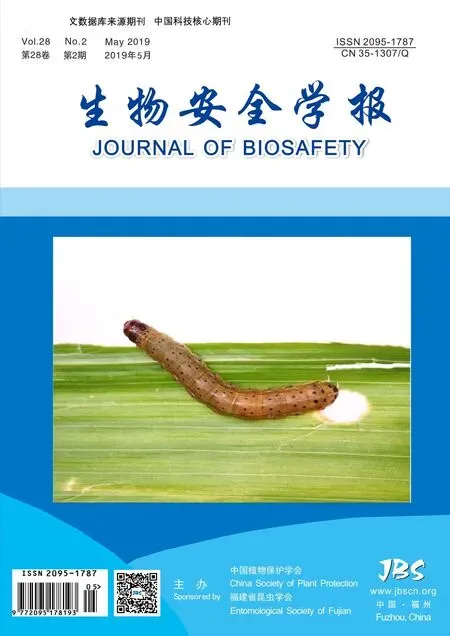
Attack on the East — the status and management of biological invasions in China
2019-02-15 12:15:30GborPozsgai
生物安全學報 2019年2期
Gbor Pozsgai
State Key Laboratory of Ecological Pest Control for Fujian and Taiwan Crops, Fujian Agriculture and Forestry University, Fuzhou, Fujian 350002, China
Decades after ecologist realized the negative effects of species alien to local floras and faunas, and started investigating the effects of them, particularly those that cause invasions, governments started accepting the importance of this issue and biological invasions became a well-known environmental problem. In spite of this, not many countries have so far made a detailed assessment of their alien invasive species. The United Kingdom, USA, and other developed countries are in the lead but their economically less developed counterparts are lagging behind. Thus, it is surprising that whilst a freshly published report on the invasive alien species of South Africa was highlighted on the pages of Nature (Wild,2018), the extensive two-volume book on the invasive species of China, published by Springer in 2017, gained less attention.
This book gives an overview on the pressing problems of invasive organisms in China, by discussing the ways and causes of their invasion, potential precautions, and applied control measures.
In the first part, the readers can get an overview of the history, reasons, current issues of the invasions, and realized or potential management practices against them in the five most important biomes in the country. China′s scientific and political approach to biological invasions can also be found in this major part.
The second part lists the most invasive insect species, whilst the third part deals with "everything else" (other animals, microorganisms and invasive plants). Somewhat surprisingly, whilst the first — habitat-focused — part mostly brings up examples of invasive plants, the dominance of animals is apparent in the chapters providing species-specific, detailed information. Overall, these chapters discuss ten insect species, six other animal species, eight plants, and two microscopic fungi. Most of the chapters have similarly-structured information on the different species: a short description on the origin, invasion history, and the reasons behind the invasiveness of that particular species, followed by the potential means of monitoring, prevention, and control.
As the editors point out, some invasive alien species may have remained undetected in remote areas, and the continuous pressure of new introductions makes it impossible to tackle with all invasive species in China at once. They also emphasize that some species′ invasive status, especially that of marine organisms, is not yet satisfactorily determined. Nevertheless, invasive species in natural ecosystems are particularly underrepresented in the book; most focus is given to economically important invasives, such as pests or weeds. The fact that no invasive mammals or birds are discussed further highlights this discrepancy.
The fourth part rounds off the two volumes by giving perspectives for the future and point to important areas of research in relation to invasion ecology.
Readers can learn about a number of issues that a large country like China has to tackle when trying to prevent biological invasions. The long coastal area, the busy ports, and the flourishing economy made this country particularly vulnerable to the import of non-native species. Moreover, whilst for most countries it is sufficient to focus on an effective quarantine system at entry ports to prevent the arrival of potentially invasive species, because of China′s large territory, the spread of these species within the boundaries of the country poses an additional serious problem both to agriculture and natural ecosystems. In addition to increased commerce, the economic boom in China also increased the within-country movements of humans, and with it the traficking of plants and animals as well as their products. Clearly, the increasing, and sometimes illegal, pet and horticulture trade makes controlling the processes even more difficult.
We often attribute biological invasions to the lack of native natural enemies, as the result of species arriving without them to a new non-native region. This book brings up several other factors, just as influential, that substantially facilitate the spread of an organism, such as adaptability to extreme environmental conditions, high reproduction rate, and competitiveness. Some of the invasive species are particularly worrisome; microevolutionary processes were found inBemisiatabacito adapt local conditions, the pinewood nematode made a new mutualistic link by which it can more effectively infest trees, and several invasive plant species alter the microbial flora of the soil and reorganize mycorrhizal connections to favour their own growth at the expense of natives. In many cases, however, even all of these adaptations would not be enough; several chapters point out the role of human contribution to the spread and successful invasion.
This work not only shows the complexity of the issue of invasive organisms and the challenges they pose on the scale of a continent but also summarises the development of the Chinese monitoring systems and lists potential controlling methods. Although the country is already using cutting-edge molecular technologies for detecting some new invaders, or intends to implement these technologies in the near future for screening others, literature on monitoring systems operating in China remain largely missing from the Western scientific forums. This is particularly unfortunate because effective actions against biological invasions greatly rely on international collaboration.
In spite of having an increasingly effective monitoring system, China had 610 recorded invasive species by the end of 2016; invasion rates increasing especially after the late 1970s. Although controlling these still greatly relies on chemical and mechanical methods, several chapters emphasize that China is now seeking more advanced, non-chemical solutions of control. This desire is understandable. The effective vegetative reproduction of some plants makes the manual removal inefficient and the increasing price of labour raises the costs. In addition, increasing environmental concerns and the higher price for organic products also exert pressure to find alternative ways of protection.
Whereas the most commonly discussed of these alternatives in the book is biological control by natural enemies or pathogens, relatively little can be found on landscape design, promoting native flora and fauna, or increasing diversity. Although the natural enemy approach is widely used in many countries, and rules for introducing natural enemies for non-native pests are strict, the potential dangers of using an introduced non-native organism to control other aliens are poorly discussed; the use ofActinoteanteasbutterfly for controlling the invasive weedsMikantiamicranthaandChromolaenaodoratabeing one of the best explained.
Replacements of invasive plants with competitive native ones can be a feasible idea but it underestimates the additional side-effects of facilitating the superdominance of one, or few, species in a community. Admittedly, however, native invaders can be tackled with more easily than non-natives. Therefore, the mere idea using exotics against exotic invaders, as mentioned as an option in the book, should be discarded. However, using parasitic plants, such as dodders (Cuscutaspp.) against invasive plants seems to be a promising way for control. Similarly, to utilise invasive plants or animals, and thus decrease their abundance, as discussed in the case of the tilapia and the goldenrod, is an interesting approach. However, this approach may backfire if people will plant/spread the otherwise invasive organisms for their economic value.
Modern sterile male techniques, genetically modified resistant crops, and next-generation pheromone traps are also the elements of the contemporary Chinese arsenal against invasive species.
The importance of knowledge transfer underlining the merits of education, including courses for farmers, or generally raising awareness on invasive species, whilst rarely emphasized in similar works, is an added value of this book. Several chapters point out the need for strengthening and enforcing the legislations related to trafficking in organisms.
Whilst the value of this work is inevitable, a few issues diminish the reader′s experience. The volumes could have benefited from a more thorough language editing; poor English in some chapters jeopardizes the understanding, or decreases the readability of the text. Moreover, it is not clear how the invasive species are ordered (they are neither in taxonomic nor alphabetical order). In my opinion, the separation of insects from other species is difficult to justify. Since most readers are likely to use these books as lexicons, chapters rigorously following a predefined structure, providing the same pieces of information in a standard order of subheadings (e.g. native distribution, invasive status in the world, invasive status in China, reasons for invasiveness, damage, monitoring, and control) would increase usability. Even though most species discussed are internationally known invasives, references to, often obscure, Chinese publications dominate, while sources from other countries published in international journals, especially of those from earlier years, are almost completely missing.
In summary, I believe, this book will help non-Chinese scientists to delve into the problems this continent-sized country faces. Since none of the countries can solve alone the issues of alien invasive species that often threaten ecosystems globally, I hope that this work will open new doors for international collaborations and joint projects to prevent, monitor, and limit biological invasions. Rapid action is definitely needed, potential invaders of natural ecosystems are on the wind and the number of newcomers is increasing every year in China (Bozorovetal., 2018).