顯微鏡下全切或次全切除術治療腦膠質瘤的綜合療效及預后
2019-01-06 03:43:51程品文
中國現代醫生 2019年32期
關鍵詞:認知功能
程品文
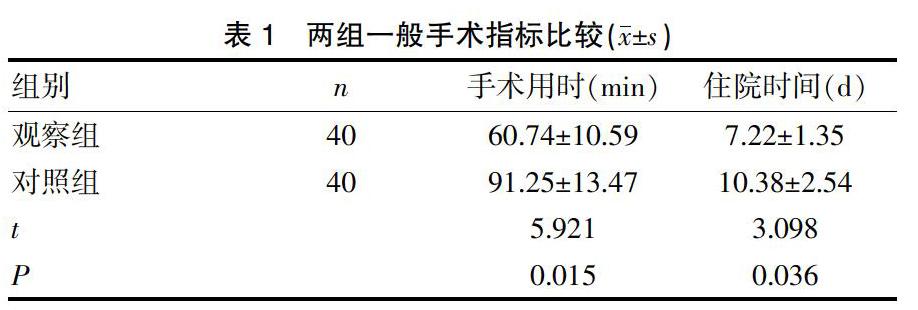

[摘要] 目的 探討顯微鏡下全切或次全切除術治療腦膠質瘤的綜合療效及預后。 方法 選取2016年6月~2017年6月于我院就診的80例腦膠質瘤患者作為研究對象。采用隨機數字表法將其分為觀察組與對照組,對照組40例接受傳統開顱膠質瘤切除術,觀察組40例在顯微鏡下行全切或次全切除術,比較兩組患者手術治療的綜合效果及預后結局。 結果 觀察組手術用時[(60.74±10.59)min]、平均住院時間[(7.22±1.35)d]明顯低于對照組手術用時[(91.25±13.47)min]、平均住院時間[(10.38±2.54)d],差異有統計學意義(P<0.05);兩組術前定向力、記憶力、注意力、計算力、回憶能力、語言能力評分比較,差異無統計學意義(P>0.05);術后兩組各項評分均高于術前,且觀察組明顯高于對照組(P<0.05)。術前兩組腦脊液神經肽水平比較,無顯著差異(P>0.05),術后觀察組腦脊液神經肽水平與對照組比較,存在顯著差異(P<0.05);兩組術后并發癥發生率比較,無顯著差異(P>0.05);術后1年隨訪顯示觀察組復發率與死亡率均為2.5%,對照組復發率與死亡率均為2.5%,兩組復發率與病死率比較,無顯著差異(P>0.05)。 結論 采用顯微鏡下全切或次全切除術治療腦膠質瘤療效可靠且安全性高,能夠有效降低患者認知功能的損害,促進患者腦脊液神經肽水平的恢復,有利于改善患者近遠期預后,具有臨床應用及推廣價值。
[關鍵詞] 顯微鏡下全切或次全切;腦膠質瘤;綜合療效;認知功能;預后結局
[中圖分類號] R739.41 ? ? ? ? ?[文獻標識碼] B ? ? ? ? ?[文章編號] 1673-9701(2019)32-0037-04
Comprehensive curative effect and prognosis of microscopic total or subtotal resection for glioma
CHENG Pinwen
Department of Neurosurgery, Gucheng County People's Hospital in Hubei Province, Gucheng ? 441700, China
[Abstract] Objective To investigate the comprehensive curative effect and prognosis of microscopic total or subtotal resection for glioma. Methods Eighty patients with glioma treated in our hospital from June 2016 to June 2017 were selected as the subjects and divided into the observation group and the control group by the random number table method. The control group, consisting of 40 patients, were treated with traditional craniotomy for glioma resection, and the observation group, consisting of 40 patients, were treated with microscopic total or subtotal resection. The comprehensive effects and prognosis outcomes of surgical treatment were compared between the two groups. Results The surgical time [(60.74±10.59) minutes] and the average hospitalization time [(7.22±1.35) days] in the observation group were significantly lower than those [(91.25±13.47) minutes, (10.38±2.54) days] in the control group (P<0.05). The orientation, memory, attention, calculation, recall and language ability scores were not significantly different between the two groups before surgery(P>0.05), of which all improved evidently after surgery, but the scores in the observation group were all significantly higher than those in the control group after surgery (P<0.05). The two groups were not significantly different in the cerebrospinal fluid neuropeptide level before surgery(P>0.05), but the two groups were significantly different in the cerebrospinal fluid neuropeptide level after surgery(P<0.05). The two groups were not significantly different in the incidence of postoperative complication (P>0.05). The recurrence rate and the mortality rate were both 2.5% in the observation group and the recurrence rate and the mortality rate were also both 2.5% in the control group in the postoperative 1-year follow-up, with no significant differences between the two groups(P>0.05). Conclusion Microscopic total or subtotal resection for glioma is reliable and safe. It can effectively reduce the cognitive function damage and promote the recovery of cerebrospinal fluid neuropeptide levels in patients, which is conducive to improving the patients' short and long term prognosis and is of clinical application and promotion value.
猜你喜歡
山東體育學院學報(2016年5期)2017-01-18 20:58:33
中國醫藥導報(2016年29期)2016-12-27 11:10:00
中國實用醫藥(2016年29期)2016-12-26 09:42:28
中國當代醫藥(2016年28期)2016-12-20 17:42:35
中外醫學研究(2016年26期)2016-11-30 03:02:44
藝術科技(2016年9期)2016-11-18 16:23:08
中國現代醫生(2016年23期)2016-11-15 03:24:49
中國實用醫藥(2016年26期)2016-11-07 13:39:15
中國實用醫藥(2016年26期)2016-11-07 13:39:07
中國實用醫藥(2016年21期)2016-08-19 13:46:24