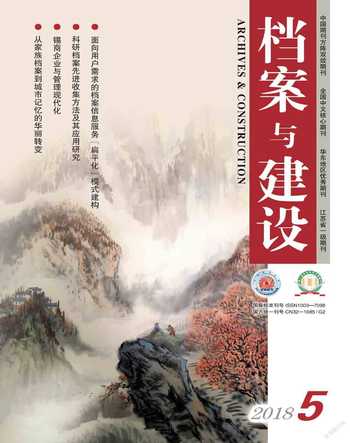
編纂新記憶:論社會(huì)記憶與檔案文獻(xiàn)編纂之間的關(guān)系
2018-09-10 04:20:43單旭東
檔案與建設(shè)
2018年5期
單旭東
[摘要]在檔案記憶觀理論中,檔案在社會(huì)記憶建構(gòu)過程中發(fā)揮著獨(dú)特的作用。由于社會(huì)記憶的形成和傳承必須依賴于系統(tǒng)的社會(huì)框架,所以分散、無(wú)序的檔案材料不具備系統(tǒng)記憶的功能,只有經(jīng)過系統(tǒng)編纂整理的檔案才能作為具備記憶特征的資源參與到社會(huì)記憶的建構(gòu)中去。論文從檔案文獻(xiàn)編纂工作的思想性出發(fā),通過闡釋檔案文獻(xiàn)編纂與社會(huì)記憶之間的關(guān)系,介紹了檔案作為建構(gòu)社會(huì)記憶的重要資源的合理性,并就在社會(huì)記憶的視角下如何改進(jìn)檔案文獻(xiàn)編纂工作提出一些自己的看法。
[關(guān)鍵詞]社會(huì)記憶檔案記憶檔案文獻(xiàn)編纂
[分類號(hào)]G270
On the Relationship Between Social Memory and Archival Literature Compilation
Shan Xudong
(The School of History andArchives of Yunnan University,Kunming, Yunnan,650091)
Abstract: In the theory of archival memory, archives play a unique role in the construction of social memory. The disordered archival material does not possess the memory attribute, only through systematic arrangement of archives can be regarded as a resource with memory characteristics to participate in the construction of social memory. By explaining the relationship between archival document compilation and social memory, this paper explains the rationality of archival document as an important resource to construct social memory, and discusses how to improve archival document compilation from the perspective of social memory. Some of their own views and work.
Keywords: Social Memory; Archival Memory; Archival Documentation Compilation
1作為一種思想的檔案文獻(xiàn)編纂工作
科林伍德提出“一切歷史都是思想史”的觀念,意指我們?cè)趯?duì)歷史事件的介紹中更多體現(xiàn)出的是對(duì)思想過程的描述。之所以將檔案文獻(xiàn)編纂工作也看做是一種思想,首先是由檔案文獻(xiàn)自身的歷史性決定的。檔案的歷史性不僅是其文本所具備的屬性,更是檔案思想性的重要體現(xiàn)。檔案被看做是對(duì)歷史實(shí)踐活動(dòng)的原始性記錄,它首先是線性的并包含一定的時(shí)間跨度,所以檔案是對(duì)社會(huì)實(shí)踐活動(dòng)過程的記錄,是歷史思想外化的重要表現(xiàn)形式。其次,檔案文獻(xiàn)編纂的過程是編纂思想的重要體現(xiàn)。對(duì)于同一份檔案材料,如何編纂體現(xiàn)的是檔案工作者個(gè)人的價(jià)值選擇和判斷,而對(duì)于不同的檔案文獻(xiàn)材料,編研成品則體現(xiàn)出時(shí)代對(duì)于歷史進(jìn)程的認(rèn)識(shí)。……
登錄APP查看全文
猜你喜歡
民間文化論壇(2023年6期)2024-01-17 07:28:56
阿來研究(2021年1期)2021-07-31 07:38:26
課程教育研究(2021年15期)2021-04-13 23:21:23
新世紀(jì)智能(高一語(yǔ)文)(2020年9期)2021-01-04 00:42:46
學(xué)苑創(chuàng)造·A版(2020年10期)2020-11-06 05:21:26
作文周刊·小學(xué)一年級(jí)版(2016年27期)2017-06-03 23:21:17
絲綢之路(2016年9期)2016-05-14 14:36:33
新湘評(píng)論·下半月(2016年4期)2016-05-05 22:12:41
新湘評(píng)論·下半月(2016年4期)2016-05-05 22:12:41
海外文摘(2016年4期)2016-04-15 22:28:55