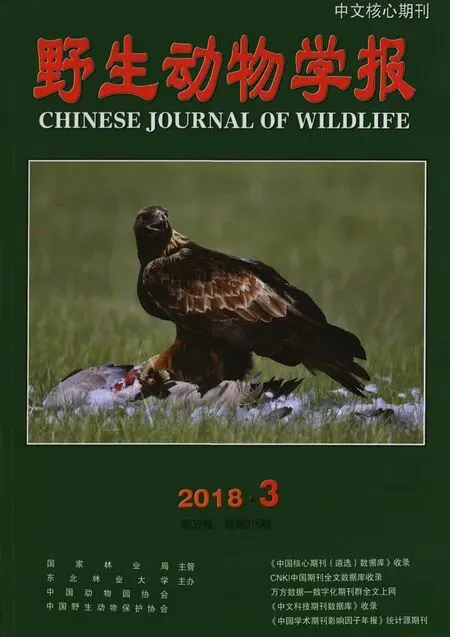
西藏林芝黑頸鶴越冬地潛在威脅的模型分析
2018-08-21 02:37:10韓雪松郭玉民
野生動物學報 2018年3期
韓雪松 郭玉民
(1 北京林業大學自然保護區學院,北京,100083)
黑頸鶴(Grusnigricollis)是中國國家Ⅰ級重點保護野生動物,被IUCN評為易危物種,列入CITES附錄Ⅰ(http:∥www.iucnredlist.org/details/22692162/0)。同時,黑頸鶴也是全球15種鶴類當中唯一繁殖和越冬都在高海拔地區的物種,是青藏高原的特有鶴類[1]。因其在濕地生態系統中的指示作用及其保護行動中的旗艦作用[2-3],現在黑頸鶴的繁殖地及越冬地已開展了大量的科學研究及保護工作。其中,由于黑頸鶴在越冬期集群覓食夜棲的習性,相較于繁殖棲息地,現已基本查明其在青藏高原及周邊濕地的越冬地,并已開展相應的監測及科研活動[3]。
西藏自治區作為黑頸鶴目前已知最大的越冬棲息地,為黑頸鶴種群提供了不可或缺的棲息地及生存資源[4]。據楊樂等(2016)在西藏“一江兩河”流域的調查,約6000只黑頸鶴在西藏越冬于雅魯藏布江中上游河谷以及拉薩河—彭波河谷地區[5]。2016~2017年,在對西藏東部雅魯藏布江下游濕地進行調查時,發現在尼洋河與雅魯藏布江匯合處的 “T” 型河谷地帶有大量黑頸鶴越冬。在連續兩年的觀察記錄基礎上,本研究對該黑頸鶴越冬棲息地使用最大熵模型(MAXENT)進行分析,以明確其越冬棲息地選擇偏好及潛在威脅來源。
1 研究方法
1.1 研究區域概況
研究區域位于西藏自治區林芝地區的尼洋河與雅魯藏布江匯合處的 “T” 型河谷地帶,N 29°7′44.4″~29°37′48″,E 93°59′9.6″~94°46′33.6″。野外觀察中注意到黑頸鶴在研究區域內主要集中分布于4個地區,即(A)米林縣城—米林機場,(B)米林機場—雅尼匯口,(C)林芝市—雅尼匯口,以及(D)雅尼匯口—米瑞鄉(圖1),江面水位在2920~2960 m之間。

圖1 研究區域以及黑頸鶴實際分布位點Fig.1 Study area and empirical distribution sites of the black-necked crane
1.2 物種分布及環境數據的收集
野外工作開展于2016年2~3月以及2017年2~3月間。在對黑頸鶴進行觀察時,在每一個樣點使用20倍單筒望遠鏡進行直接觀察及計數[6],與此同時對6只個體開展衛星跟蹤工作。本研究所用跟蹤器型號為HQBP3221(湖南環球信士公司),可以提供包括經緯度、海拔、速度、航向以及數據精度等信息。在完成跟蹤數據的回收后,使用黑頸鶴的實際跟蹤數據來建立物種分布模型,以此對其越冬棲息地選擇偏好進行分析[7]。在對黑頸鶴的棲息地進行分析時,本研究僅使用速度為0且位點誤差<10 m的點[8]。
本研究通過公共數據平臺共獲得29個環境變量,其中包括19個生物氣候變量[9](下載于Bioclim 1.4 數據庫,www.wordclim.org),6個地理地形變量(http:∥www.naturalearthdata.com/),3個人類活動相關變量以及土地利用類型(http:∥www.esa-landcover-cci.org)。使用R軟件對所有環境變量進行Spearman Test測試并去除相關性較高的變量(|r|>0.9)[10]。最終保留的環境變量包括12個生物氣候變量(Bio1-Bio6,Bio8,Bio9,Bio12,Bio14,Bio15,Bio17),5個地理地形變量(海拔,坡度,坡向以及距離河流,湖泊距離),2個人類活動相關變量(距離道路,鐵路距離)以及土地利用類型。
1.3 物種分布模型及潛在威脅分析
本研究使用MAXENT模型來對黑頸鶴在研究區域內的越冬棲息地進行分析。首先,在ArcGIS 10.1軟件中對物種分布數據以及環境數據進行處理。某一區域過于密集的物種分布數據可能會影響到模型對于訓練數據的分析[7]。因此,本研究首先使用ArcGIS對收集到的衛星跟蹤數據進行降密度操作以避免跟蹤數據間存在的空間自相關(每平方千米內僅保留1點)[11-12],并最終從來自于6只跟蹤個體共計5038個誤差小于10 m的實際分布位點(圖1)中保留89個位點,作為模型建立的訓練數據。對環境數據進行處理,最終獲得20個范圍相同,分辨率為1000 m的環境變量圖層。
使用WGS 1984投影,在Maxent 3.3.3k(http:∥www.cs.princeton.edu/~schapire/maxent/)中對研究區域中黑頸鶴的越冬棲息地進行分析。在模型設置上,設定最大交互作用數為500[13],使用軟件對于正則化值的自選擇[14],并使用5次重復以及交叉驗證來獲得最接近于真實情況的結果[15]。此外,使用Jack-knife獲得變量的重要性排序以及相應的響應曲線[16]。在對模型表現進行評價時,使用Receiver Operating Characteristic(ROC)Curve對模型在訓練數據上的表現進行評價(以曲線下面積—Area under the Curve,AUC—作為評判的參數)[17]。此外,使用未用來訓練模型的跟蹤位點作為驗證數據集,以此評價模型對物種真實分布數據的模擬能力[18]。
依據MAXENT模型生成的變量重要性排序獲得影響研究區域內黑頸鶴棲息地選擇的最關鍵環境因子(海拔),并通過相應變量響應曲線明確其對變量的選擇偏好。黑頸鶴多于不沒過跗間關節的淺水處棲息[19],因此在本研究中,黑頸鶴對于某一高度海拔的偏好(2920 m)實際上是反映了其對研究區域內當前水位的選擇。基于此,本研究以5 m作為水位變化梯度,分析研究區域內關鍵環境因子變化時黑頸鶴越冬棲息地的受脅情況。
2 結果與分析
2.1 野外觀察結果
兩年的野外調查中分別記錄到460只及527只黑頸鶴個體,全部位于在雅魯藏布江及尼洋河河道沙洲以及兩岸沿江狹窄分布的農田中(圖2)。衛星跟蹤數據表明黑頸鶴在研究區域中分布于(A)米林縣城—米林機場,(B)米林機場—雅尼匯口,(C)林芝市—雅尼匯口以及(D)雅尼匯口—米瑞鄉4個地區,此外并無其他越冬棲息地(圖1)。在黑頸鶴的越冬群體中,同時夾雜有少數越冬的灰鶴(Grusgrus)個體(圖2)。在幼鳥的數量上,2016及2017年分別為40只和35只,幼體新增率(Recruitment rate)分別只有8.64%和6.64%。研究區域黑頸鶴種群數量統計見表1。
表1 研究區域野外觀察黑頸鶴數量統計

Tab.1 Population counts of the black-necked crane recorded in the field work
2.2 MAXENT模型表現及預測結果
使用跟蹤數據建立的MAXENT模型AUC值為0.978,證明該模型對訓練數據集具有很好的判別能力(discrimination ability)[20-21]。同時,驗證數據集的相對出現概率中位數為0.794,證明該模型可以準確預測黑頸鶴在研究區域內的分布[18]。
MAXENT模型預測結果如圖3。同野外觀察及衛星跟蹤結果相一致,黑頸鶴在研究區域中主要分布于河道沙洲及兩岸農田中,并無其他潛在棲息地。適宜棲息地總面積131.98 km2,越冬黑頸鶴種群密度為3.99只/km2。環境變量重要性的分析表明,海拔為影響研究區域內黑頸鶴越冬棲息地選擇的最關鍵環境因素(重要性為49.7;圖3)。海拔的變量響應曲線表明在研究區域內,黑頸鶴主要越冬于海拔在2920 m左右的地區(所有環境變量響應曲線請見附件1)。

圖2 研究區域農田中覓食的大群黑頸鶴及灰鶴Fig.2 Black-necked and common cranes foraging in the croplands within the study area

圖3 MAXENT模型預測結果及重要變量(海拔)響應曲線Fig.3 MAXENT prediction map and the response curve for the most important variable(Altitude)
2.3 關鍵環境因子改變對研究區域內黑頸鶴越冬地的影響
將不同高度水位以下地區同黑頸鶴預測存在棲息地相疊加,結果如圖4所示。結果表明,當研究區域內水位由當前高度(2920 m)升高至2925 m,黑頸鶴的預測越冬棲息地面積將由當前的131.98 km2減少至71.83 km2,僅為原先的54.42%;隨后,當水位以5 m為單位上升,棲息地面積將僅剩余56.38 km2(42.72%),41.86 km2(31.71%),29.47 km2(22.33%),19.61 km2(14.86%);當水位上升至2950 m時,研究區域內黑頸鶴棲息地面積將減少120.06 km2,僅為當前棲息地面積的9.03%(圖4)。

圖4 水位變化對黑頸鶴越冬棲息地的影響Fig.4 Impact from water stage variations on the wintering habitats of the black-necked crane
3 討論
3.1 林芝黑頸鶴種群的特殊性和重要性
目前,黑頸鶴主要越冬于貴州西北部,云南西北部及東北部,西藏自治區的南部,以及不丹[19]。在西藏自治區,以往研究認為黑頸鶴主要越冬于“一江兩河”地區,即雅魯藏布江中游河谷以及其支流拉薩河,年楚河流域[22-23],而位于西藏東部林芝地區的尼洋河流域僅“有少量的越冬鶴”[23]。本研究野外調查當中,在該地區記錄到不少于527只黑頸鶴越冬個體,約占其全球種群的5%,適宜分布區內越冬種群密度為3.99只/km2,證實該地區為黑頸鶴一重要越冬棲息地。同時,根據《國際重要濕地鑒定標準》中“基于水禽的特定指示標準”——“正常情況下維持某一水禽物種或亞種之1%個體數量的濕地”,黑頸鶴在研究區域內龐大的越冬種群實際上已使得該濕地滿足國際重要濕地標準。 此外,在該越冬種群的年齡結構上,兩年來種群總體數量增多但幼鳥數量反而減少,幼體新增率分別為8.64%及6.64 %。據Johnsgard(1983),10%~15%之間的幼體新增率可作為某一鶴類越冬種群健康程度的衡量標準[24]。根據調查結果,研究區域內越冬黑頸鶴種群幼體新增率尚不足該標準下限且仍在降低,這抑或預示著在其相對應的繁殖棲息地,遷徙停歇地以及越冬棲息地,黑頸鶴可能面臨著較為嚴重的威脅。
吳志康等(1993)根據當時已有的少數幾筆環志紀錄推測黑頸鶴在青藏高原可能存在3條遷徙路線[25],而這一推斷也得到了之后工作的證實[26-29]。 截至目前,尚未見有關于不同地理種群黑頸鶴個體交流的報道。因此,至少目前看來,每一遷徙路線上的黑頸鶴地理種群都具有其獨特性,某一特定地理種群的喪失所造成的生態位空缺并難以通過其他種群的匯入而得到補充,都將對黑頸鶴這一物種的遺傳多樣性造成破壞。本研究所報道的黑頸鶴越冬種群在地理上介于西部和中部種群之間,其抑或為一獨立的種群,基礎研究資料匱乏,關于其遷徙路線以及相應繁殖棲息地的研究亟待開展。
3.2 潛在威脅及保護
物種分布模型結果表明,海拔為研究區域內影響黑頸鶴越冬棲息地選擇的最重要因素。根據野外調查,黑頸鶴在研究區域內主要覓食于尼洋河及雅魯藏布河道的沙洲及岸邊的農田內,并將水流平緩的岸邊作為夜棲地(圖2)。因此,由于氣候變化或人類活動所引起不同程度的水位上升將會威脅該黑頸鶴越冬種群的生存。此處需要注意的是,水位的升高對于研究區域內黑頸鶴越冬棲息地的影響并不僅限于棲息地在景觀上的直接縮減。在野外調查中注意到,在該地區黑頸鶴主要以河谷中耕地內收割后的剩余農作物作為主要的食物來源(青稞,玉米等)。 水位的上升會使得部分或全部耕地被水淹沒,使得研究區域內的黑頸鶴越冬種群適合度降低,并最終可能因食物的匱乏而減少直至消失。另外,黑頸鶴主要在平緩河流或湖泊邊不沒過跗間關節的淺水處夜棲[19]。因水位上升而拓寬的江面將使得原本狹窄的沙洲及河岸向后退縮,最終因距離山體或居民點距離過近造成適宜夜棲地的喪失。由模型預測結果可見(圖3),米林機場(圖1中A,B段之間)的修建已侵占了黑頸鶴適宜越冬棲息地,將其排擠至周邊的沙洲及岸邊覓食及夜棲。未來,相比于由氣候變化所引起的水位上升,人工提高水位——特別是永久性地提高水位——將會迅速地對黑頸鶴的越冬棲息地造成不可逆轉的破壞,使其永久性地喪失適宜的覓食地及夜棲地。
綜上,在林芝地區的尼洋河與雅魯藏布江匯合處的 “T” 型河谷地帶存在大量黑頸鶴越冬(約占其全球種群數量的5%),主要分布于該地區海拔在2920 m左右的沙洲及江岸農田。鑒于該越冬棲息地生境狹窄的特殊性,因氣候變化或人類活動而引起的水位上升將直接對黑頸鶴該越冬種群的生存產生嚴重的影響。
致謝:感謝國家林業局的資金和政策支持,林芝林業局的后勤保障,以及米林林業局和工布江達林業局在野外調查中給予的現場協助。
附件1環境變量重要性排序及響應曲線
Appendix 1 Variable importance and response curves for all the predictors
變量重要性排序
Variable importance rankings

變量響應曲線
Response curves
1.Altitude

2.Aspect

3.Bio_1

4.Bio_2

5.Bio_3

6.Bio_4

7.Bio_5

8.Bio_6

9.Bio_8

10.Bio_9

11.Bio_12

12.Bio_14

13.Bio_15

14.Bio_17

15.Dislake

16.Disrard

17.Disriver

18.Disroad

19.Landcv

20.Slope

The black-necked crane(Grusnigricollis)is the National First Class Protected Animal in China,and it is also evaluated as Vulnerable by IUCN and is listed in CITES Appendix I(http://www.iucnredlist.org/details/22692162/0).Meanwhile,endemic to the Tibetan Plateau,the black-necked crane is also the only crane species that breeds and winters in alpine landscape[1].Because of its environment-indicating and flagship effects in plateau wetland ecosystem and associated conservation actions[2-3],many research and conservation efforts have been made in both its breeding and wintering grounds[3].
Serving as the largest known wintering grounds,the Tibetan Autonomous Region provides the black-necked crane with irreplaceable habitats and living resources[4].According to the investigations conducted in the drainage area of Yarlung Zangbo and its two branches,approximately 6000 black-necked cranes winter in the valley of the upper reach of the Yarlung Zangbo and Lhasa-Pengbo river valley[5].2016-2017,when investigating the lower reach drainage of the Yarlung Zangbo,we recorded a large number of the black-necked crane wintering in the T-shaped region at the estuary of the Yarlung Zangbo and Nyang River.Based on our two-year field observation,we employed the MAXENT model to analyze the wintering habitat of this regional population of the black-necked crane,and further identified its habitat selection preference and potential threats.
1 Methods
1.1 Study Area
The study area is located at the T-shaped region at the estuary of the Yarlung Zangbo and the Nyang River(abbreviated as YN Estuary),N 29°7′44.4″-29°37′48″,E 93°59′9.6″-94°46′33.6″.In our fieldwork,we noticed that within the study area,the black-necked crane mainly winters in four regions with water stages between 2920-2960 m,namely(A)Milin County-Milin Airport,(B)Milin Airport-YN Estuary,(C)Nyingchi City-YN Estuary,and(D)YN Estuary-Mirui Town(Fig.1).
1.2 Species and Environmental Data Collection
Fieldwork was conducted during February to March of 2016,2017.Monocular(x20)was used to observe and to count the black-necked cranes[6].During our fieldwork,six individuals were also captured and tagged with GPS-GSM transmitters(HQBP3221 from Hunan Global Messenger Technology Co.,Ltd),which could provide information including latitude,longitude,speed,direction,precision,etc.Distribution data collected from the transmitters was used in the Species Distribution Model(SDM)construction to analyze the wintering habitat selection preference of the black-necked crane[7].In this study,only still distribution points with a precision within 10 meter were employed in model construction[8].
When building the SDM,twenty-nine environmental variables were downloaded from public Open Access sources,including 19 Bioclimate variables(Bioclim 1.4 Database,www.wordclim.org)[9],six geographic variables(http://www.naturalearthdata.com/),three anthropogenic variables and land cover status(http://www.esa-landcover-cci.org)[8].After removing variables that are highly correlated(|r|>0.9)[10],twenty variables were retained as predictors,including 12 Bioclimate predictors(Bio1-Bio6,Bio8,Bio9,Bio12,Bio14,Bio15,Bio17),five geographic predictors(Altitude,Slope,Aspect and Distances to rivers and lakes),two anthropogenic predictors(Distances to roads and railroads),and Land Cover Status.
1.3 Species Distribution Model Construction and Potential Threat Analysis
In this study,we used the MAXENT model and 1000-meter resolution to analyze the wintering habitat of the black-necked crane in the study area.To avoid the influence from the spatial autocorrelation existing in the tracking data,we chose 89 points from 5038 collected distribution points as training dataset by maintaining one point every one squire kilometer[7,11-12].
Using WGS 1984 projection,we built the MAXENT model in the Maxent 3.3.3k(http://www.cs.princeton.edu/~schapire/maxent/).In model settings,we set the maximum number of interactions to 500[13],and we also used software’s automatic selection for regularization values[14]and cross-validation with five replicates[15].Moreover,Jack-knife was used to obtain the variable importance and associated responding curves[16].For model assessment,we used Receiver Operating Characteristic(ROC)Curve to evaluate model’s performance on the training data,which is usually indicated by the Area under the Curve(AUC)[17].Moreover,we used those remaining distribution points as testing data to evaluate model’s accuracy in predicting the potential wintering habitats of the black-necked crane[18].
Based on the variable importance rankings created by the MAXENT,we identified the most influential factor in the wintering habitat selection of the black-necked crane in Nyingchi(which is Altitude),and further determined its influence mechanism via the associated response curve.The black-necked crane is known to roost in the shallow and calm water beneath tarsus[19],therefore in this case,the preference for particular altitude(2920 m)of the cranes is actually its selection to the current water stage in the study area.Based on these facts,by selecting a proper gradient(5 m),we analyzed the wintering habitats of the black-necked crane under the changing critical environmental variable.
2 Results
2.1 Field Observation and Population Counting
In 2016 and 2017,respectively 460 and 527 black-necked cranes were recorded in the sandbanks and croplands in/along the Yarlung Zangbo and Nyang River(Fig.2).GPS-GSM tracking data showed that in the study area,the black-necked crane are mainly distributed in(A)Milin County-Milin Airport,(B)Milin Airport-YN Estuary,(C)Nyingchi City-YN Estuary and(D)YN Estuary-Mirui Town,which is accordant with our field observations(Fig.1).Among the wintering flocks of the black-necked crane,some Common Crane(Grusgrus)were also recorded to forage and roost(Fig.2).With respect to the breeding status,40 and 35 chicks were recorded in 2016 and 2017,with the recruitment rate only at 8.64% and 6.64% respectively(Table 1).
2.2 Model Performance and Prediction
The AUC of the MAXENT was 0.978,which showed an excellent discrimination ability of the model[20-21].Meanwhile,the medium of our test dataset is 0.794,further proving that the model could accurately predict the crane’s distribution within the study area[18].
Model prediction is presented in Fig.3.In accordance with our field observations and GPS-GSM tracking results,the black-necked crane is predicted to distribute in the sandbanks within the river and croplands along the river.The suitable wintering habitats of the black-necked crane is predicted to be 131.98 km2,with a population density at 3.99 individuals every squire kilometer.The variable rankings indicated that Altitude is the most critical factor in the wintering habitat selection of the black-necked crane(variable importance at 49.7),and its response curve indicated that within the study area,the black-necked crane mainly winter in the lands with an elevation at 2920 m(Fig.3;response curves for all the predictors were presented in Appendix 1).
2.3 Impact from the Changing Environment on the Wintering Habitats
At first,we created layers of remaining land under various water stages,and then we overlaid them with the predicted suitable wintering habitats of the black-necked crane(Fig.4).The results showed that when water level rises from current stage(2920 m)to 2925 m,the wintering habitats of the black-necked crane would decrease from current 131.98 km2to 71.38 km2,only accounting for 54.42% of the original habitat area.If water stage continues to rise by five meters,the wintering habitats of the black-necked crane will only remain as 56.38 km2(42.72%),41.86 km2(31.71%),29.47 km2(22.33%),19.61 km2(14.86%);and when the water stage reaches 2950 m,the available and suitable wintering habitats will decrease by 120.06 km2(9.03%;Fig.4).
3 Discussion
3.1 Significance of the Regional Population of the black-necked crane in Nyingchi
At present,the black-necked crane mainly winters in NW Guizhou,NW and NE Yunnan,S Tibet and Bhutan[19].In Tibet,the black-necked crane previously was believed to winter in the drainage area of Yarlung Zangbo and its two branches,Lhasa and Nyanchu rivers[22-23].Whereas in the drainage of the Nyang River,the number of the crane is only reported to be “a few”[23].In our fieldwork,overall 527 wintering individuals of the black-necked crane got recorded(accounting for approximately 5% of its global population),which has sufficiently proved that this region is actually serving as a significant and irreplaceable wintering grounds for this species.Meanwhile,according to the “Specific criteria based on waterbirds” in the The Ramsar Sites Criteria-“A wetland should be considered internationally important if it regularly supports 1% of the individuals in a population of one species or subspecies of waterbird”,the abundance of this regional population of the black-necked crane has actually proven the qualification of this wetland to be a RAMSAR site.Moreover,with respect to the age structure,the number of chicks of this regional crane population is decreasing,whereas the overall population size is enlarging-recruitment rate of 2016 and 2017 is only 8.64% and 6.64% respectively.Johnsgard(1983)indicated that a recruitment rate between 10%-15% could be used as a criterion to judge the health of crane population[24],we may thus infer that the relatively low and still decreasing recruitment rate is perhaps resulted from its threatened breeding habitats or migration routes.
Wu et al(1993)determined three separate regional population and associated migration routes for the black-necked crane[25],which have been confirmed by following research[26-29].The population reported in this research is discovered between the western and middle population of the black-necked crane geographically,which is highly likely to be another separate population,and the loss of it will jeopardize the genetic diversity of the whole species.More attentions and efforts should be paid to its poorly studied wintering,migration and breeding ecology.
3.3 Potential Threats and Conservation Suggestions
Our SDM showed that Altitude is the most critical factor in determining the wintering habitats of the black-necked crane in the study area(Variable Importance at 49.7).For this regional population that forages and roosts at the sandbanks and croplands in/along the rivers(Fig.2),rising water stages resulted from changing climate or anthropogenic pressures would pose a severe impact on the survival of the black-necked crane that winters in Nyingchi.It is noticeable that the impact from rising water surface is not merely limited to the landscape loss of their habitats.In our fieldwork,we noticed that in this region the crane mainly feeds on the remaining seed after harvest(e.g.highland barley,popcorn).Rising water would encroach existing croplands,thereby reducing the population fitness of the black-necked crane via the decrease of available food sources.Moreover,the black-necked crane mainly roosts at the shallow and calm water beneath tarsus[19],and the expansion of water surface would also consume the suitable roosting sites of the crane.From our prediction(Fig.3),it is clear that the construction of the Milin Airport(between A & B in Fig.1)has already occupied the crane’s suitable wintering habitats,forcing them to forage and roost in surrounding habitats.In the future,compared with global warming,artificially raising water surface would severely encroach the wintering habitats of the black-necked crane in Nyingchi,Tibet,finally resulting in permanent habitat losses of this unstudied regional crane lineage.
In summary,approximately 5% of the global population of the black-necked crane winter in the T-shaped region at the estuary of the Yarlung Zangbo and the Nyang River,mainly distributed in the sandbanks and croplands with an elevation at 2920 m.Considering the long and narrow shape of the valley that the cranes inhabit,rising water stages resulted from either climate change or anthropogenic pressures would severely impact this unique wintering population of the black-necked crane.
猜你喜歡
童話王國·奇妙邏輯推理(2024年5期)2024-06-19 16:03:38
英語世界(2023年10期)2023-11-17 09:18:18
中學生數理化·七年級數學人教版(2020年10期)2020-11-26 08:24:50
數學物理學報(2020年2期)2020-06-02 11:29:24
科學大眾(中學)(2019年3期)2019-05-17 10:04:30
汽車觀察(2018年10期)2018-11-06 07:05:26
光學精密工程(2016年6期)2016-11-07 09:07:19
中國科技博覽(2016年2期)2016-04-25 20:32:39
小學生導刊(2016年34期)2016-04-11 00:49:44
少兒科學周刊·少年版(2015年1期)2015-07-07 17:15:12