快速康復(fù)在腹腔鏡治療老年直腸癌患者圍手術(shù)期護(hù)理體會(huì)
2016-12-29 13:29:42孫薇
特別健康·下半月
2016年11期
孫薇
【中圖分類號(hào)】R486.41 【文獻(xiàn)標(biāo)識(shí)碼】B 【文章編號(hào)】2095-6851(2016)11-0-01
【 abstract 】 objective to study the concept of rapid rehabilitation surgery in laparoscopic treatment in elderly patients with colorectal cancer perioperative nursing. Methods select 102 cases of elderly patients with colorectal cancer patients, divided into two groups by applying the method of random number table, quick rehabilitation nursing solution (group A, FTS group, 52 cases) as experimental group and the traditional care solutions group (group B, the traditional nursing group, 50 cases) as control group and observation group 2 preoperative, intraoperative and postoperative after rapid rehabilitation nursing and traditional treatment scheme, compared two groups of elderly patients with rectal cancer patients after the anus exhaust the five indicators. Results two groups of patients with no statistically significant difference were observed in the preoperative clinical data comparison, postoperative anal exhaust5 indicators compared with significant difference (P < 0.05). Conclusion rapid rehabilitation surgery concept can accelerate in elderly patients with colorectal cancer postoperative rehabilitation, obtain satisfactory curative effect.
【 key words 】Elderly patients with colorectal laparoscopic ,Rapid recovery
直腸癌是消化道最常見的惡性腫瘤之一。隨著社會(huì)老齡化,老年直腸癌病人日益增多。腹腔鏡下直腸癌根治術(shù)具有創(chuàng)傷小、并發(fā)癥少、出血少、腸功能恢復(fù)快等優(yōu)點(diǎn)[1-2]。2013年6月~2016年6月,我院普外科為102例老年直腸癌患者施行腹腔鏡下直腸癌骶前切除術(shù),圍手術(shù)期快速康復(fù),效果滿意。
臨床資料和方法
1.一般資料本組患者共102例,其中,男54例,女48例,年齡均大于60歲(68.21±9.3 歲 )。
2.圍手術(shù)期處理:全部患者術(shù)前腸鏡檢查病理診斷為直腸癌,均在全麻下行腹腔鏡直腸癌骶前切除術(shù)(Dixon術(shù))。結(jié)果102例手術(shù)均獲成功。快速康復(fù)模式由一個(gè)團(tuán)隊(duì)組成,其團(tuán)隊(duì)人員:手術(shù)醫(yī)師、麻醉師、管床責(zé)任護(hù)士。團(tuán)隊(duì)密切配合共同完成快速康復(fù)治療護(hù)理模式。其快速康復(fù)治療護(hù)理方案內(nèi)容:術(shù)前健康教育心里輔導(dǎo),告訴快速康復(fù)方案,全麻后置入胃管 ;術(shù)中全麻(短效麻醉藥),術(shù)中保溫 ,術(shù)中輸液控制<1500ml,術(shù)后鎮(zhèn)痛(PCA+硬膜外鎮(zhèn)痛),阿片類 鎮(zhèn)痛,術(shù)后腸內(nèi)早期營(yíng)養(yǎng),術(shù)后早期拔出導(dǎo)尿管(術(shù)后24h),術(shù)后早期拔出腹腔引流管(術(shù)后24h),術(shù)后早期下床活動(dòng)(術(shù)后1d)。
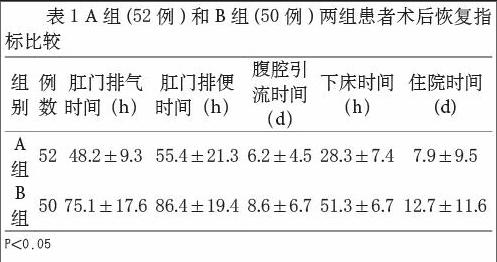
3.評(píng)價(jià)指標(biāo):觀察2組患者術(shù)后肛門排氣 、 肛門排便 、腹腔引流時(shí)間、下床時(shí)間、住院時(shí)間等術(shù)后恢復(fù)5項(xiàng)指標(biāo)差異。
4.4 統(tǒng)計(jì)學(xué)方法采用SPSS21.0統(tǒng)計(jì)軟件進(jìn)行處理,定量數(shù)據(jù)采用x±s表示,檢驗(yàn)方法采用t檢驗(yàn)。P<0.05為比較差異有統(tǒng)計(jì)學(xué)意義。
4.結(jié)果:2組患者術(shù)恢復(fù)情況比較,F(xiàn)TS組術(shù)后肛門排氣 、 肛門排便 、腹腔引流時(shí)間、下床時(shí)間、住院時(shí)間等術(shù)后恢復(fù)5項(xiàng)指標(biāo)均明顯低于對(duì)照組,P<0.05,見表1。……
登錄APP查看全文
猜你喜歡
腹腔鏡外科雜志(2022年7期)2022-08-16 04:31:06
河北畫報(bào)(2020年10期)2020-11-26 07:20:50
特別健康(2018年2期)2018-06-29 06:13:44
中國(guó)內(nèi)鏡雜志(2017年2期)2017-03-20 16:18:12
腹腔鏡外科雜志(2016年11期)2016-06-01 12:10:09
腹腔鏡外科雜志(2016年9期)2016-06-01 12:10:07
中國(guó)衛(wèi)生標(biāo)準(zhǔn)管理(2015年3期)2016-01-14 03:41:47
中國(guó)衛(wèi)生(2014年6期)2014-11-10 02:30:50
中國(guó)中醫(yī)藥現(xiàn)代遠(yuǎn)程教育(2014年22期)2014-03-01 04:33:14
中國(guó)中醫(yī)藥現(xiàn)代遠(yuǎn)程教育(2014年13期)2014-03-01 04:26:36