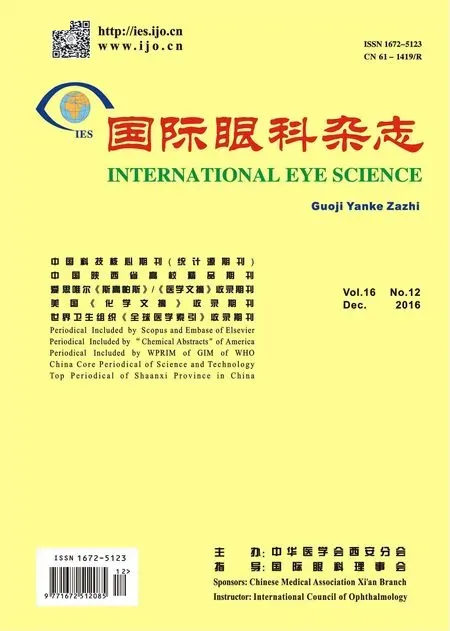
不同手術(shù)方法治療鼻淚管阻塞繼發(fā)淚囊炎的臨床研究
2016-12-05 08:59:09周麗娟龔建華許衛(wèi)平
國(guó)際眼科雜志
2016年12期
關(guān)鍵詞:差異
周麗娟,龔建華,許衛(wèi)平, 陳 春
?
·臨床報(bào)告·
不同手術(shù)方法治療鼻淚管阻塞繼發(fā)淚囊炎的臨床研究
周麗娟,龔建華,許衛(wèi)平, 陳 春
?METHODS: A total of 348 cases with nasolacrimal duct obstruction secondary dacryocystitis patients (397 eyes) were selected in Jan.2010 to Jan.2016 of our hospital as the research object. According to the treatment of surgery, the research subjects were divided into three groups respectively. The lacrimal duct laser group (130 patients, 152 eyes), the nasolacrimal duct group (113 patients, 127 eyes) and the nasal endoscopy group (105 patients, 118 eyes) of lacrimal duct laser group patients accepted the treatment of lacrimal duct laser lines. Nasolacrimal duct group patients received artificial nose tube stents implantation treatment, patients with nasal endoscopy group underwent anastomosis of lacrimal sac nasal endoscope. The therapeutic effect in three groups of patients and the incidence of adverse reactions were analyzed.
?RESULTS: After 1mo, 3 groups of eye treatment effect were statistically significant difference (P<0.05). Lacrimal duct effect of laser treatment group significantly was better than that of the nasolacrimal duct and nasal endoscopy group (P<0.05). The nasolacrimal duct group compared with the effect of nasal endoscopic treatment group was no statistically significant difference (P>0.05). Postoperative 4mo, 3 groups of eye treatment effect comparison results were completely accorded with postoperative 1mo. But the three groups of 4mo after treatment were significantly difference with postoperative 1mo (P<0.05). The incidence of adverse reactions difference in 3 groups was statistically significant (P<0.05). The incidence of adverse reactions of lacrimal duct laser group was significantly lower than the nasolacrimal duct and nasal endoscopy group (P<0.05). The nasolacrimal duct incidence of adverse reactions compared differences between groups with and nasal endoscopy had no statistically significant (P>0.05). Three groups of eye recurrence rate comparison difference had no statistically significant (P>0.05).
?CONCLUSION: For the treatment of lacrimal duct laser lines nasolacrimal duct obstruction secondary efficacy and safety of dacryocystitis were good.
目的:對(duì)比分析三種術(shù)式治療鼻淚管阻塞繼發(fā)淚囊炎的療效以及安全性,探索臨床治療鼻淚管阻塞繼發(fā)淚囊炎的最佳術(shù)式。
方法:選取2010-01/2016-01我院收治的鼻淚管阻塞繼發(fā)淚囊炎患者348例397眼作為研究對(duì)象,根據(jù)手術(shù)治療方案不同分為3組:淚道激光組接受淚道激光成行術(shù)治療130例152眼、鼻淚管組接受人工鼻內(nèi)管支架植入術(shù)治療113例127眼、鼻內(nèi)鏡組接受鼻內(nèi)鏡淚囊鼻腔吻合術(shù)治療105例118眼,對(duì)比分析3組患者的治療效果及不良反應(yīng)發(fā)生率。
結(jié)果:術(shù)后1mo,3組患眼治療效果差異有統(tǒng)計(jì)學(xué)意義(P<0.05),淚道激光組治療效果顯著優(yōu)于鼻淚管組、鼻內(nèi)鏡組(P<0.05),鼻淚管組與鼻內(nèi)鏡組治療效果相比差異無(wú)統(tǒng)計(jì)學(xué)意義(P>0.05)。術(shù)后4mo,3組患眼治療效果比較結(jié)果與術(shù)后1mo完全一致,但是3組患者術(shù)后4mo的治療效果均顯著變差,差異有統(tǒng)計(jì)學(xué)意義(P<0.05)。3組患者不良反應(yīng)發(fā)生率差異有統(tǒng)計(jì)學(xué)意義(P<0.05),淚道激光組不良反應(yīng)發(fā)生率顯著低于鼻淚管組、鼻內(nèi)鏡組,差異有統(tǒng)計(jì)學(xué)意義(P<0.05),鼻淚管組與鼻內(nèi)鏡組不良反應(yīng)發(fā)生率相比差異無(wú)統(tǒng)計(jì)學(xué)意義(P>0.05)。3組患眼復(fù)發(fā)率比較差異無(wú)統(tǒng)計(jì)學(xué)意義(P>0.05)。
結(jié)論:淚道激光成行術(shù)治療鼻淚管阻塞繼發(fā)淚囊炎的療效與安全性均良好。
淚道激光成行術(shù);人工鼻內(nèi)管支架植入術(shù);鼻內(nèi)鏡淚囊鼻腔吻合術(shù);鼻淚管阻塞;淚囊炎
引用:周麗娟,龔建華,許衛(wèi)平,等.不同手術(shù)方法治療鼻淚管阻塞繼發(fā)淚囊炎的臨床研究.國(guó)際眼科雜志2016;16(12):2335-2337
0引言
鼻淚管阻塞繼發(fā)淚囊炎是眼科最常見(jiàn)的疾病之一,其主要臨床表現(xiàn)包括患眼溢淚、溢膿等癥狀體征,從而給患眼區(qū)域健康、患者生存質(zhì)量帶來(lái)嚴(yán)重影響[1-2]。目前臨床多采用手術(shù)對(duì)鼻淚管阻塞繼發(fā)淚囊炎進(jìn)行治療,但是該病的術(shù)式較多,為探索治療臨床最佳術(shù)式,本研究對(duì)比分析了淚道激光成行術(shù)、人工鼻內(nèi)管支架植入術(shù)、鼻內(nèi)鏡淚囊鼻腔吻合術(shù)等三種術(shù)式治療鼻淚管阻塞繼發(fā)淚囊炎的療效以及安全性,現(xiàn)報(bào)告如下。
登錄APP查看全文
猜你喜歡
英語(yǔ)世界(2023年10期)2023-11-17 09:19:16
汽車實(shí)用技術(shù)(2022年10期)2022-06-09 11:16:58
音樂(lè)探索(2022年2期)2022-05-30 21:01:37
收藏界(2019年3期)2019-10-10 03:16:40
小天使·一年級(jí)語(yǔ)數(shù)英綜合(2019年8期)2019-08-27 02:23:00
中國(guó)特種設(shè)備安全(2018年11期)2019-01-08 02:08:32
小學(xué)科學(xué)(學(xué)生版)(2018年7期)2018-08-13 09:33:04
中國(guó)非營(yíng)利評(píng)論(2017年1期)2017-11-09 03:09:10
海外華文教育(2017年8期)2017-11-07 04:42:02
現(xiàn)代語(yǔ)文(2016年21期)2016-05-25 13:13:50