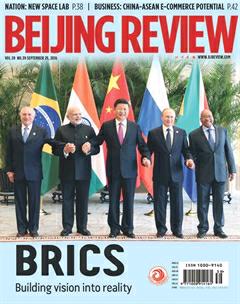
CHALLENGED BUT OPTIMISTIC
2016-10-22 02:35:41HanLiqun
Beijing Review 2016年39期
?
BRICS INSIGHT
CHALLENGED BUT OPTIMISTIC
The BRICS remain economically resilient By Han Liqun

The author is a research fellow with the China Institutes of Contemporary International Relations
Along with the recent economic contraction in some of the BRICS countries, the argument that this association of large emerging economies is faltering is pervasive again.
In the current climate of global economic fragility, the BRICS have encountered many development challenges. However,the argument put forward that the BRICS are in decline has overlooked favorable factors for long-term growth in these countries and played down their role in global affairs on the mere basis of economic slowdown.
Economic growth is not the only foundation for cooperation among the BRICS countries. In an ever-evolving world, the rise of emerging economies is a historical trend. Developed nations also need the vast markets of emerging economies, though they may wish to prevent the establishment of a rival political group from the latter.
Potential remains
Currently, the BRICS countries have many challenges to meet with regard to development. However, these problems can be addressed and some of the resolutions may,in turn, enhance cooperation within the group.
Undeniably, the BRICS are losing some comparative advantages in terms of economic growth. At present, many emerging economies, including the BRICS,are encountering difficulties, such as rising costs of labor, land, resources and capital, while returns on investment are declining remarkably.
For instance, labor costs in China were merely 33 percent of Mexico’s in 1996, but the ratio had soared to 115 percent by 2015. From 2012 to 2015, Morgan Stanley Capital International’s BRIC index, which measured the combined equity market performance in Brazil, Russia, India and China, was negative. In the meantime, annual returns on investment in the BRICS also declined sharply. There are a variety of causes underpinning the slump in investment demand. On the one hand, this indicates a return to normal levels after investors reevaluated the previously exaggerated investment potential of the BRICS. On the other hand, problems including financing difficulties and excess production capacity, which worsened following the 2008 financial crisis, further curbed investor enthusiasm.
External competition has also grown increasingly fierce for the BRICS. Developed countries are attempting to regain dominance of the world economy through reindustrialization, which may reshape the globalization process. Taking the United States as an example, the contracted growth in average real wages and widespread automation have boosted productivity and reduced production costs,pushing the return of manufacturing jobs. Additionally, large U.S. multinational corporations are constantly innovating and entering emerging industries to maintain global leadership. Furthermore, other emerging economies have grown rapidly in recent years. Mexico, for instance, is becoming a new factory of the world, taking advantage of its large working-age population, favorable proximity to the huge U.S. market and membership of the North American Free Trade Agreement.
To cope with the global financial crisis, the BRICS countries adopted powerful stimulus measures, helping them to stay afloat during testing times. However, these measures, to some extent, stifled enterprises,harming long-term economic development. For example, Brazil lowered its benchmark lending rate for 16 consecutive months,dealing a heavy blow to Petrobras, a semipublic petroleum company that accounts for 10 percent of the country’s economy.
Before the global financial crisis, national security spending of the BRICS countries was comparably low owing to the relatively stable situation in their vicinities. However,the post-crisis global security environment has worsened remarkably due to intertwined traditional and non-traditional threats as well as the combined influence of state- and non-state actors (such as Al Qaeda and the Islamic State extremist groups) on global affairs. The escalation of strategic competition between major powers has not only complicated some issues, but also threatened global stability. If this remains unchanged,achieving global economic recovery will become more difficult. For example, Russia has been involved in conflict in Ukraine and Syria since the end of 2013, with its military expenditure ballooning to $66.4 billion in 2015,its highest in the past decade.
Despite all that, growth potential in the BRICS is still strong. There have been efforts to adjust the economic structure in order to create new drivers of growth. They are all seeking to forge new competitive advantages in high-value-added fields through increasing research and development.
More than half of the enterprises in China have reportedly made innovation their top priority, compared to less than 30 percent of U.S. companies. Chinese telecommunications equipment makers have already gained ground on their Western counterparts, while India-made generic medicines have cornereda large share of the global market. Brazil has become a dominant world player in protein products, and Russian overseas investment is constantly rising. These new competitive advantages as well as the improved caliber of their labor forces will help the BRICS countries rebound from the crisis.
Also, many international organizations and research institutions are optimistic about the growth prospects of the BRICS. While the IMF lowered its outlook for global economic growth by 0.1 percentage point in the April edition of its World Economic Outlook report,it raised its China growth forecast by 0.1 percentage point, underlining its confidence in China’s recent pro-growth policies. The IMF also said that Russia and Brazil may return to growth in the next few years and that the Indian economy can maintain relatively rapid long-term expansion.

On the eve of the First Meeting of BRICS Ministers of Science, Technology and Innovation in Cape Town, South Africa, on February 10, 2014
Balancing power
The international order has undergone a profound evolution since the outbreak of the global financial crisis. The economic status and strength of emerging economies, including the BRICS, have risen rapidly. Emerging economies have become an important force in improving international governance and promoting the building of a fairer and more reasonable world order. Even if the BRICS are unable to maintain high-speed growth, their participation in international governance will not shrink.
Since the establishment of the BRICS mechanism, the five countries have set up a comprehensive system for cooperation on the basis of equal consultation. Their cooperation encompasses both political and economic arenas. Together, they have set up the New Development Bank(NDB) and the BRICS Contingent Reserve Arrangement. They have also coordinated positions and actions on major international affairs. The NDB has already begun to fund projects in the BRICS countries, underlining that cooperation within the group has become institutionalized. The comprehensive cooperation among the BRICS has helped consolidate mutual understanding and support among the peoples of the five countries and has promoted integration.
The challenges currently facing the BRICS are really the two sides of the same coin. The obstacles to economic development may turn out to be driving forces for political cooperation. For instance, as the international security environment worsens and hinders global economic recovery,emerging economies, including the BRICS,share a common interest in reversing the unfavorable trend.
The BRICS countries vary in terms of development levels. The global economic downturn further amplifies these differences and simultaneously provides new cooperation potential.
There have always been naysayers critical of the BRICS and China, even before the global financial crisis. However, the influence of the BRICS is continually growing. In the past several years, the five countries have contributed more than 50 percent of global growth. Currently, they account for more than 20 percent of global GDP, and the proportion is expected to rise to about 25 percent by 2020. The BRICS Summit to be held in India in October is likely to deliver more fruitful benefits to the future development of this important cooperation mechanism. ■
Copyedited by Dominic James Madar
Comments to liuyunyun@bjreview