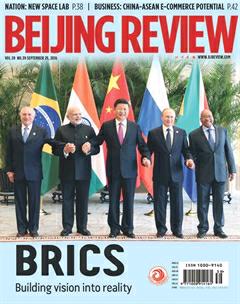
BRICK BY BRICK
2016-10-22 02:41:26MeiXinyu
Beijing Review 2016年39期
?
BRICS INSIGHT
BRICK BY BRICK
BRICS collaboration needed more than ever in the face of a bearish primary commodity market By Mei Xinyu
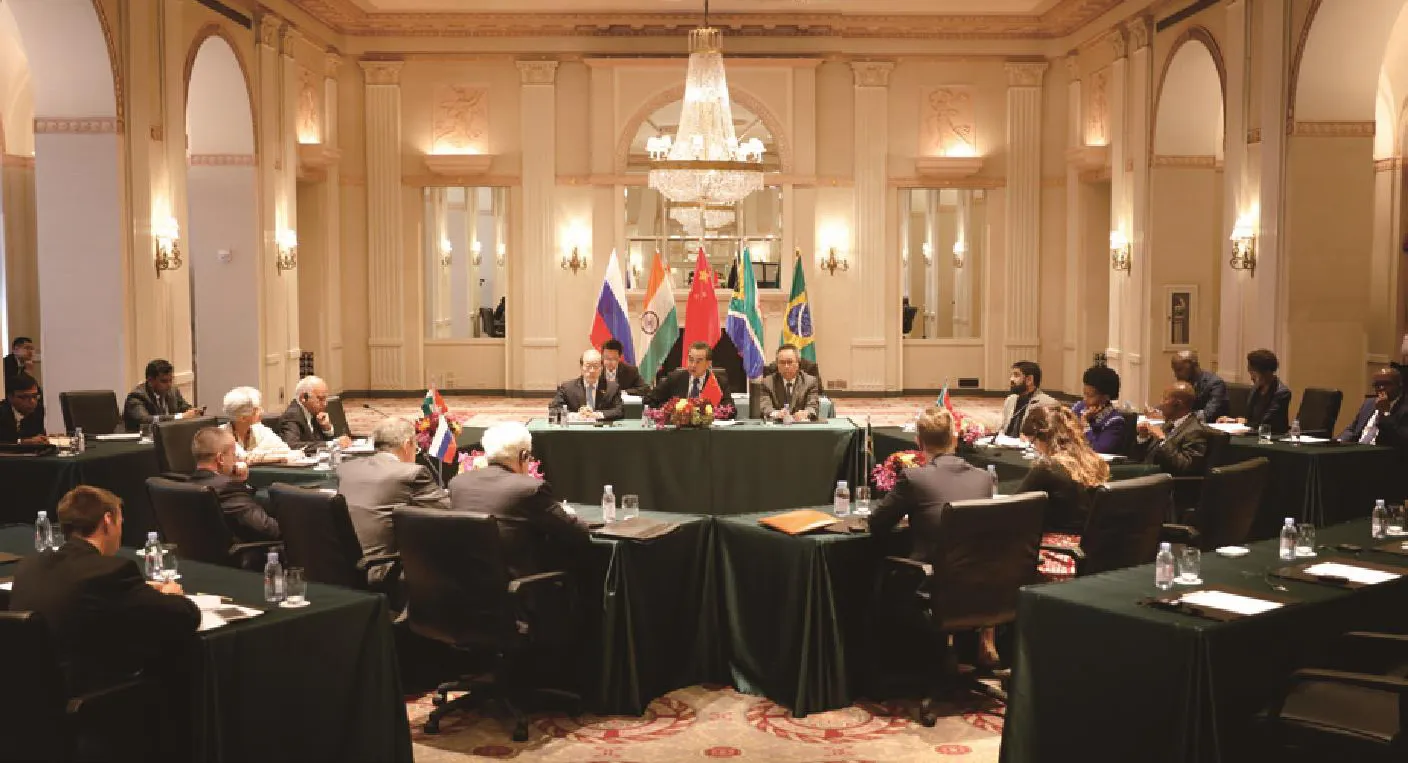
Foreign ministers of the five BRICS members hold a meeting on September 20 in New York City during the 71st Session of the UN General Assembly

The author is an op-ed contributor to Beijing Review and a researcher with the Chinese Academy of International Trade and Economic Cooperation
Slumping private commodity prices are wreaking havoc on many emerging economies, including some of the BRICS nations. Going by world economic history, a bullish primary commodity market generally lasts for approximately a decade,followed by a bearish one that lasts for 10 to 15 years. Therefore, the drop that began in 2012 is projected to continue into the 2020s.
This has dealt a heavy blow to emerging markets. Against this backdrop, closer South-South cooperation—and BRICS collaboration in particular—is needed to drive economic growth.
Difficult times
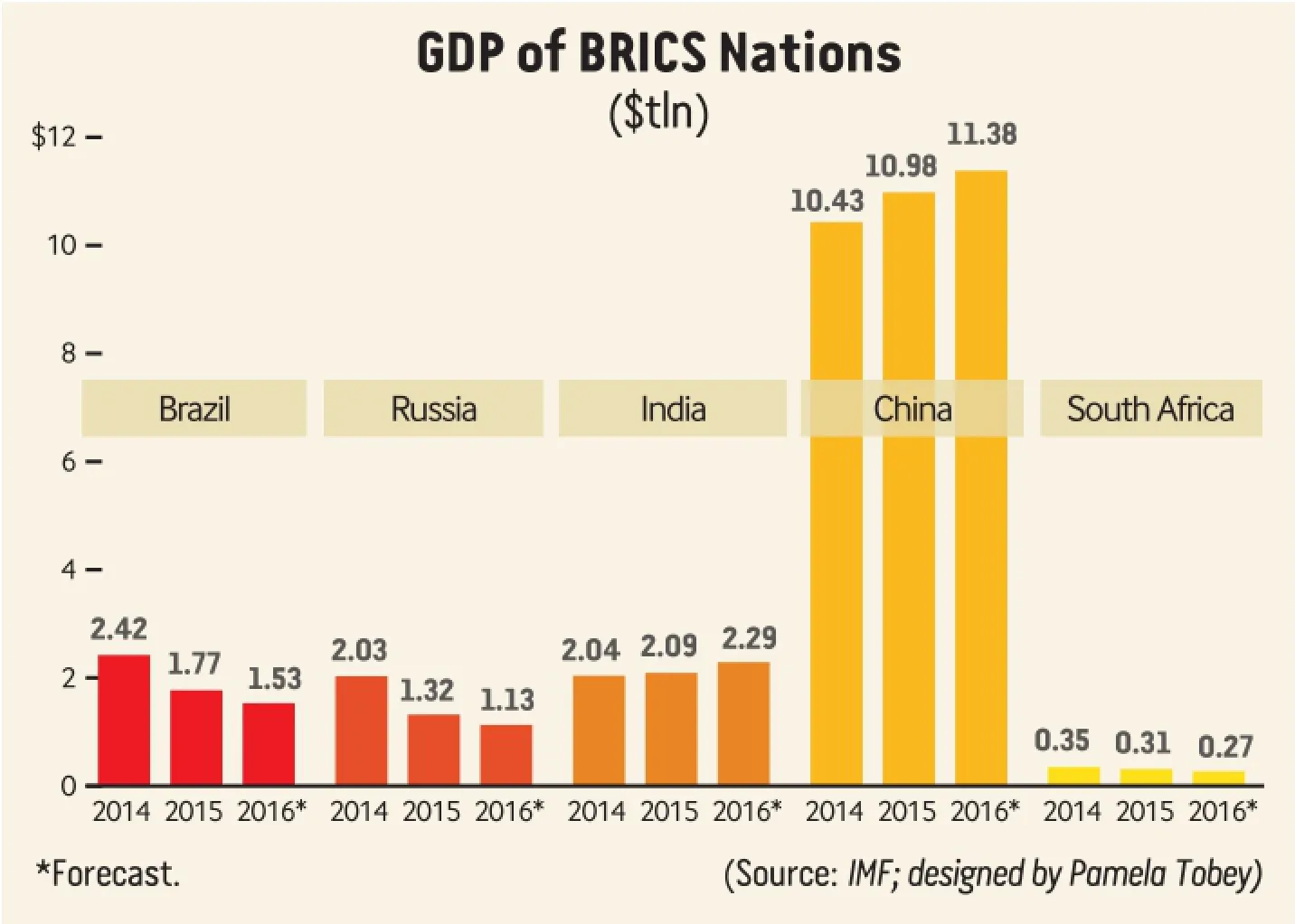
The contemporary economic climate has varying effects on the BRICS countries. Nosediving prices have hurt Russia, Brazil and South Africa, which are major primary commodity exporters and highly reliant on the sector as an integral source of growth and jobs.
On the other side of the equation,China, the world’s largest manufacturer and goods trader, has benefited from the price plunge. In theory, the economy of India, a net importer of primary commodities, should have had much to gain from the price drop. However, India’s economic performance lags far behind China’s,since the former is experiencing higherthan-average inflation and exchange rate volatility. Subsequently, China has accounted for a growing percentage of the BRICS GDP total in recent years.
Emerging markets highly reliant on exports should simultaneously utilize resources from international financial institutions such as the IMF, and fully tap into South-South cooperation—including BRICS cooperation—to forge a financial safety net and lower the risk of currency and financial crises.
Even China and India—both beneficiaries of the current drop in commodity prices—should do so, because in a deeply interconnected world where countries’ in-terests are more intertwined than ever, no country can flourish when others are trapped in economic turmoil.
Moreover, for late developing countries and regions, carrying out economic and trade cooperation with East Asian countries is critically important. Given their different industrial structures, to generate the same amount of GDP, East Asian countries need to use more raw materials and energy than the United States or Europe, creating a larger export market for these commodities. Combined with the higher rate of growth they tend to enjoy compared to developed nations, these newly industrialized East Asian countries are a great source of demand for imported materials.
For East Asian economies with advanced manufacturing, such as China,developing South-South cooperation has significance beyond securing stable raw material and energy supplies. It also means gaining a foothold in the fastestdeveloping consumer and investment markets, thereby reducing an overreliance on developed economies. In the long run,it will help East Asian countries shake off their dual role as developed countries’ factories as well as cash cows. This will vastly improve their leverage in the global economic system.
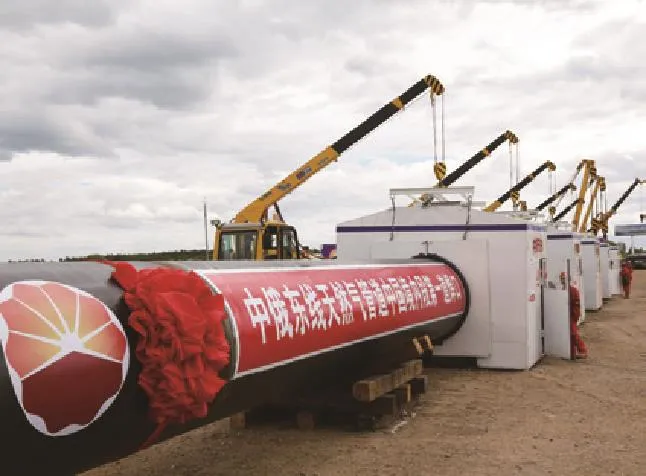
Construction of a China-Russia natural gas pipeline underway in Heihe,northeast China’s Heilongjiang Province
Through BRICS summits, the bloc’s member states have increasingly formalized and enhanced their collaboration,which, while underpinned by traditional cooperation in goods trade and direct investment, has now evolved to include services and finance. Large strides have been made with the establishment of the New Development Bank (NDB) and the Contingent Reserve Arrangement, as peo-ple expect more tangible results from the BRICS-led institutions.
For years, laggard infrastructure construction has impeded development in most developing countries and regions, including some of the BRICS nations. Breaking the shackles of poor infrastructure is a common objective for a cluster of emerging economies. Large-scale infrastructure investment can be a powerful tool to create effective demand in a country. The BRICS-led NDB should take action to offer financing for such construction.
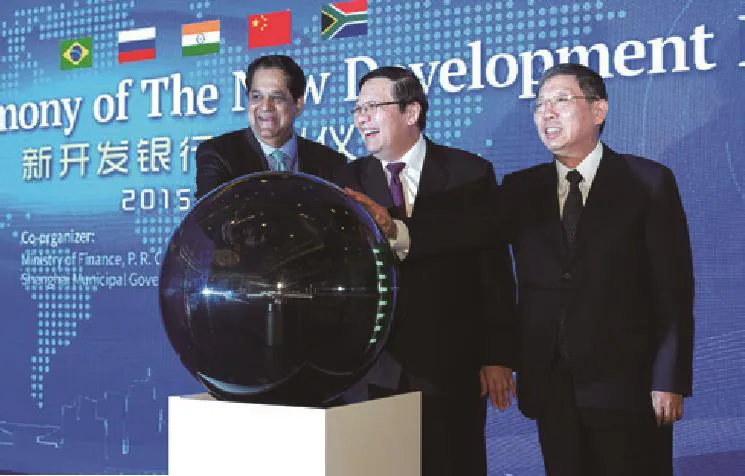
Inauguration of the New Development Bank in Shanghai on July 21, 2015
A new goal
Developing BRICS cooperation is part of the efforts for the New International Economic Order (NIEO), which is a set of proposals put forward during the 1970s by some developing countries to promote their interests by improving their terms of trade, increasing development assistance,and other means.
While some similarities to the 1970s remain, today’s fight is different from the one undertaken back then in regard to content and objectives. With a strong Cold-War mindset, the NIEO aimed to subvert the entire economic order and establish a whole new set of practices. Today, however, the goal is to mend and improve the current system.
China is one of the most influential developing countries in the world by economic strength. It proposed the Silk Road Economic Belt and 21st-Century Maritime Silk Road, and the establishment of the Asian Infrastructure Investment Bank; it is promoting Regional Comprehensive Economic Partnership free trade agreement negotiations in the Asia Pacific, and is calling for the WTO Doha round negotiations to be reset.
Unlike the former Soviet Union’s attempts to create a new set of rules which completely ignored the old system, China’s efforts are driven by a desire to improve the current international economic order by offering alternative, more efficient platforms for trade.
Why did China choose a different path? The situation is far different from the 1970s, when developing countries had barely any clout in the international economic order and saw dismantling it as their only chance of survival. However, at present, developing countries hold a considerable stake in the current economic order and the BRICS have been leading the global economic expansion for years.
If they subvert the current system, their own interests will be undermined and it will provoke a counter response from the biggest beneficiary and leader of the current order—the West. A more productive and realistic option is to reform the mechanism with developing nations on board, creating more prosperity for all involved.
China has focused on nurturing new forces without abandoning the old economic system. It enabled the broader economy to continuously expand, buying time for the relocation of human and other resources before the system was overhauled. Thus, the pain of economic restructuring and mass job layoffs were reduced. It’s easier to carry out reforms in times of economic expansion rather than during recession. This applies domestically to China as well as globally to reform the international economic order.
As a concrete example, the NDB is a complement to Western-dominated international development financing organizations, such as the World Bank, rather than a replacement; the latter’s experience could serve as a precious reference for the former. The NDB’s unique resources could make up for the World Bank’s shortcomings. China has been the largest and one of the most reliable borrowers of the World Bank, thus, such experience could help the NDB better meet borrowers’ demand and conform to business rules.
The Chinese Government seeks to work with developing countries to rise above contemporary challenges. Developing countries should maintain social and macroeconomic stability and keep improving their domestic environment for trade and investment. More importantly, economic cooperation should not get distracted or sidelined because of political differences.
China, together with the other BRICS nations, hopes to learn the lessons of the 1970s and start a new chapter in cooperation in conformity with business rules. Only by respecting objective economic laws can cooperation between the five be durable and development opportunities harnessed. ■
Copyedited by Dominic James Madar
Comments to liuyunyun@bjreview.com