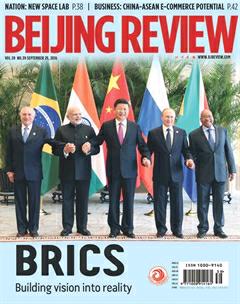
A STEPPING STONE
2016-10-22 02:35:42ChenRan
Beijing Review 2016年39期
?
BRICS INSIGHT
A STEPPING STONE
The Hindi language is helping young people in China look beyond stereotypes and discover ‘Incredible India’ By Chen Ran

The Taj Mahal
In the eyes of many Chinese, India may not be a top destination for first-time traveling or higher studies. But Li Yalan is an exception. She was the first Chinese student admitted by the Mahatma Gandhi International Hindi University, founded in 1997 to fulfil the dream of Gandhi, Father of the Indian nation, that Hindi should not be only a national language of India,but also gain the status of a world language.
During her first overseas sojourn, Li never felt lonely. Instead, she felt at home in the peaceful city of Wardha, in west India’s Maharashtra State, where she lived and studied.“My teachers, classmates and neighbors were all kind and friendly,” Li said.
On July 19, 2006, Li, then 25, arrived in Nagpur, Maharashtra’s third largest city and one hour’s drive from Wardha. It was a bad time. Seven days earlier, a series of bombings had hit the state capital, Mumbai, leaving 89 dead and 181 injured. “My family and friends were all worried about my safety, but I was safe,” Li recalled.
Stereotypes demolished
Li’s bond with India had begun in 2003, when she was going to do her Master’s at Peking University and was recommended to take Indian language and literature as her major. Peking University was the first higher education institution in China to offer disciplines related to India, beginning in the 1940s. After graduation, Li obtained a job at Beijing Foreign Studies University (BFSU) and subsequently was chosen for a Chinese Government-sponsored one-year Hindi diploma course in India. At that time, BFSU was gearing up to become China’s second university to introduce Hindi as a discipline. In 2007, the university’s School of Asian and African Studies officially started to enroll students majoring in Hindi.
Before her departure for India, Li was warned to brace for the “poor conditions”in India. The warnings, she said, were mainly regarding hygiene, infrastructure and security. Fortunately, what she encountered did not match those stereotypes. “My neighbors didn’t treat me like an alien, partly because I could speak Hindi. They sought to share their everyday life with me. That reminded me of my home,” she said.
Besides many similarities between China and India, Li found the locals’ curiosity about China remarkable. For instance, a college student who had run into her asked her whether Chinese women were still binding their feet. Then she met a security guard whose only knowledge of China was Bruce Lee and hiskungfu movies, and he asked her if she was also a kungfu guru. “Sadly, they had little access to learning what China is really like, and vice versa,”Li said.
Initially, she was cagey about speaking to people in Hindi because of its complex grammar. But the conversations with her neighbors not only improved her Hindi, but more importantly, helped her project her motherland in an approachable way.
“We should abandon our old thinking and prejudices about each other, because you can never truly understand today’s China or India without knowing their rich past.” That was her thought after her fourth visit to India. “I think India truly deserves to be called ‘Incredible India.’It is like a kaleidoscope, where you can see so many different facets. And Hindi is a stepping stone to knowing about India.”
When she started teaching Hindi in BFSU in 2007, Li shared her India experiences with her students and encourage them to explore India historically and culturally from a global perspective. Wang Siyuan was her student from 2011 to 2015. Born in Hami in northwest China’s Xinjiang Uygur Autonomous Region, Wang had chosen Hindi, a language he had never heard of, out of sheer curiosity. However, the complex grammar once made him regret his choice.
Then he got a break. Thanks to an educational exchange agreement between the governments of China and India, Wang and his classmates were given sponsorships to study Hindi in India in their second year of college. The Hindi nightmare that had dogged him for more than a semester was finally exorcized during his 10-month stay at the same university where Li had obtained her diploma.
Just like Li, Wang was also unsure of his Hindi in the first couple of weeks, as the locals’conversations were too fast for him to follow. Then things changed. “They liked to chat with us and ask questions about China, and I was happy to answer them. I learnt a lot from offcampus activities,” Wang said. “I was stunned to realize how diverse their culture is, and how incredible India is.”
Wang, a self-described adventurous gourmet, enjoyed learning about Indian cuisines from the university’s chefs. “I also bought recipe books and tried to cook curry, but never made it,” he laughed. “The chef I looked up to always enjoyed a cup of tea with a lot of milk and sugar in tranquility before beginning to labor behind the stove. I appreciated that attitude.”
Curry, yoga, Bollywood…these are the things that come to Chinese people’s minds when talking about India. Wang said they are all cultural symbols of India but are not the be-all and end-all of Indian culture. “When I stood before the Taj Mahal, I was speechless. When I went to India to learn Hindi, I never anticipated all the surprises that were waiting for me,” he mused.
When he completes his Master’s in international relations at BFSU, Wang plans to research Indian politics, and he thinks his Hindi skills will strengthen his research.
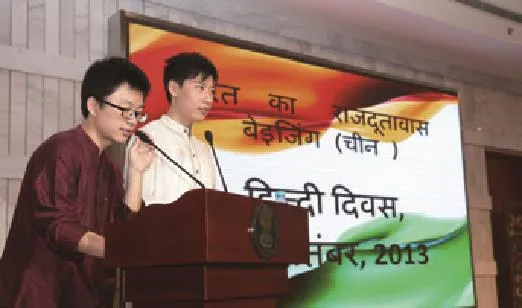
Zhang Shaohua (left) and his classmate participate in the speech contest on Hindi Day at the Indian Embassy in Beijing on September 14, 2013
Reshaping the future
Zhang Shaohua, Wang’s classmate, works in Beijing as the editor of the Hindi version of News Republic, a multi-lingual news app developed by Cheetah Mobile. Just like Wang, Zhang’s spoken Hindi also took a leap forward and his interest in journalism was further ignited during his stint at the Central Institute of Hindi, an academic institution under the Indian Ministry of Education in the city of Agra. He took part in a training project on culture, conducted several interviews and went on field trips in remote areas.
“During those trips, I knew more about the country. Neither the rituals conducted on the upper bank of the Ganges nor the overcrowded trains present the real India. You don’t see the real India until you have been there and seen it for yourself,” Zhang said. “Actually, my knowledge of India gets enriched day by day by editing news in Hindi.”
The media is usually the first channel for people to know about other countries. How to make the reporting balanced to unveil the true face of a different country is a common challenge to media workers. “That’s why communication among media professionals plays a key role in facilitating mutual understanding,”Zhang explained.
That view is echoed by Zhang Minyu, who studied Hindi and India for 11 years at Peking University and is now a faculty member at BFSU’s newly established Department of Area Studies under the School of Asian and African Studies. Zhang offers BFSU first-year students Design Your Study: Rediscovering India as a Case, a course based on his eight visits to India. It aims to nurture independent and critical thinking in students and also to make them view India from a global perspective, given India’s rising status in the world and continuous improvement of China-India relations.
Zhang’s research focus has now shifted from analyzing the differences between China and India to the common humanity shared by the two ancient nations. “A simple comparison between China and India does no good to reshaping the future of Sino-Indian ties. Instead, it is holding us back from viewing India in a comprehensive way and could lead to misunderstanding, even misjudgment,” he noted.
He believes young people with a solid language foundation and knowledge of India will become the major force behind the people-to-people exchanges between China and India. More importantly, both the BRICS framework and the Belt and Road Initiative require more talented young people who are not only fluent in several languages, but also show a capability to push exchanges forward.
More than 10 universities across China specializing in foreign studies have opened Hindi courses. Besides Russian and Portuguese studies, which have existed for decades, BFSU plans to introduce Zulu and Afrikaans in the near future, a first in China, to strengthen ties with South Africa, one of China’s largest trade partners in Africa.
“Stereotypes prevent people from understanding one another. Language can help bring barriers down,” Zhang said. ■
Copyedited by Sudeshna Sarkar
Comments to chenran@bjreview.com