
Younger and Older learners’Advantages on Language Acquisition in Different Learning Settings
2016-01-07 23:26:59賴信含
校園英語·中旬 2015年12期
【Abstract】The question of whether, and how, age affects L2 outcomes has been a major issue in SLA for several decades, and a number of recent publications provide reviews from different points of view. The author has made a comprehensive survey on the researches on the relationship between age and attainment in second language acquisition. Based on age differences theory, the author agrees the opinion that younger learners are more successful in informal and naturalistic L2 learning contexts, and older learners are more successful in formal instructional settings. Then, the younger learners and older learners advantages are discussed and put into contrastive analysis. Therefore, in second language teaching and learning, it is necessary to exert the learning advantages of different age groups, have a specific focus on listening, speaking, reading and writing, select teaching strategies suitable for different ages, and make a scientific teaching and learning plan.
【Key words】age differences; younger learners advantages; older learners advantages; learning setting
The study of individual differences has sought to explain why some learners succeed more than others, and has been seen as complementary to mainstream research in SLA. Researchers have paid attention to how individual differences impact on language acquisition. There are many individual differences factors, for example, age, language aptitude, learning style, learning strategy, personality, learner beliefs, willingness to communicate and so on.
There is a controversial topic in SLA. It is postulated that younger learners are probably more successful in informal and naturalistic learning contexts, and older learners are more successful in formal instructional settings. Do you agree or disagree? The question, in the authors opinion, is about how individual difference—age impacting on language acquisition.
As for age differences, many arguments are inconsistent, some showing older, others showing younger performers to be superior. One popular belief about second language acquisition is that younger studying better. It supposes that younger acquirers are better at second language acquisition than older acquirers (Walburg, Hase and Pinzur Rasher 1978). However, others dont think so. Recently, certain research reports claim to counter this hypothesis. Under certain conditions, younger learners are more successful in informal and naturalistic learning contexts and older learners are more successful in formal instructional settings.
Steinberg(1993) views that younger learners are superior to older learners in naturalistic learning contexts. These are three reasons:
1)In both quality and quantity, communicative activities of children enable them to communicate with far more utterances of natural language. Restrictions of social circumstances often obstruct adults acquisition of a new language.
2)From psychological perspective, children would be better at learning syntax, cause children has a better memory than adults. Although adults make up for the area of lacking memory ability by adjusting and using the strategies of memorizing, all these will simply add extra pressure on language learning. So, children, especially younger children, have advantages in SLA.
3)The ability of adapting organs of pronunciation to new languages decreases with age. This gives children a significant advantage in pronunciation and intonation over adults.
As we all known, critical period hypothesis is the subject of a long-standing debate in linguistics and language acquisition over the extent to which the ability to acquire language is biologically linked to age. The hypothesis claims that there is an ideal time window to acquire language in a linguistically rich environment, after which further language acquisition becomes much more difficult and effortful. The critical period hypothesis states that the first few years of life is the crucial time in which an individual can acquire a first language if presented with adequate stimuli. If language input doesn't occur until after this time, the individual will never achieve a full command of language—especially grammatical systems. Many scholars think that 10-year-old learners put an end to the critical period, someone think it would be earlier, for example, Long (1990) supposed 6-year-old is the end of critical period. Thats the reason why most older learners cannot reach a native-like level when past the critical period.
Johnson and Newport (1991) also found evidences to support critical period hypothesis. In their study, native Chinese speakers who learned English as a second language were tested on the universal principle subjacency as it applies to wh-question formation in English. Subjects arrived in the U.S.A. between the ages of 4 and 38 years. Non-native performance on subjacency was found for subjects of all ages of arrival. Performance declined continuously over age of arrival until adulthood.
However, some scholars think either younger learners or older learners are better in SLA according to different circumstances. Krashen, Long and Scarcella (1979) examined investigations of child-adult differences in eventual attainment in second language acquisition and studied which compare children and adults acquiring second languages in informal, natural environments, as well as formal, classroom environments. There study presents the relationship between age, rate, and eventual attainment in second language acquisition:
1)Adults proceed through early stages of syntactic and morphological development faster than children (where time and exposure are held constant).
2)Older children acquire faster than younger children(again, in early stages of morphological and syntactic development where time and exposure are held constant).
3)Acquirers who begin natural exposure to second languages during childhood generally achieve higher second language proficiency than those beginning as adults.
Others opponents viewed that older learners do better in SLA than younger learners.
Steinberg (1993) thinks that formal and instructional context, adults do better and quicker in their studies than children. The ability of induction and deduction of adults are better. Whats more, adult know how to be a good student. Formal and instructional context requires students be able to last a long time to concentrate. In this aspect, older learner does well than younger learner.
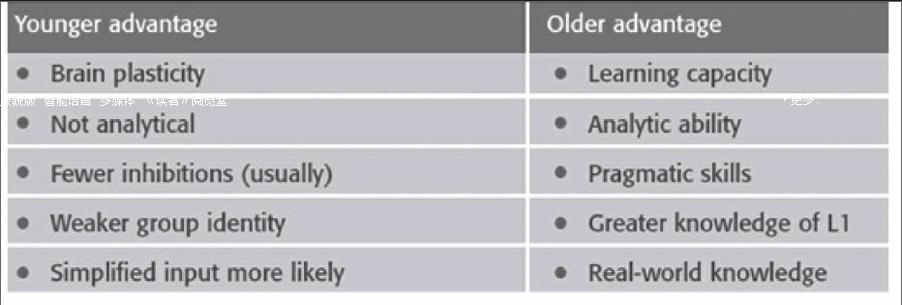
Some studies define relative “success” as initial rate of learning (where, contrary to popular belief, older learners have an advantage) while other studies define it as ultimate achievement (where learners who are introduced to the L2 in childhood indeed do appear to have an edge). The question of whether, and how, age affects L2 outcomes has been a major issue in SLA for several decades, and a number of recent publications provide reviews from different points of view. Some of the advantages which have been reported for both younger and older learners are listed in the following chart.
The chart about age differences in SLA is quoted from Introducing Second Language Acquisition.
In conclusion, the author discusses main individual differences factors in second language acquisition, and the relationship between age and eventual attainment in second language acquisition. Newport (1990) suggests that one reason younger learners develop more native-like grammatical intuitions is that they are in a non-analytic processing mode. This calls for the qualification: younger learners are probably more successful in informal and naturalistic L2 learning contexts, and older learners in formal instructional settings.
References:
[1]Johnson,L.& E.Newport.1991.Critical period effects on universal properties of language:the status of subjacency in the acquisition of a second language.Cognition 39,215-258.
[2]Krashen,S.,Long,M.& R.Scarcella.1979.Age,rate and eventual attainment in second language acquisition.TESOL Quartely 13,573-582.
[3]Long.M.1990.Maturational constrains on language development.Studies in Second Language Acquisition 12,251-286.
[4]Muriel,S.2006.Introducing Second Language Acquisition.Cambridge:Cambridge University Press.
[5]Newport,E.1990.Maturational constraints on language learning.Cognitive Science,14:11–28.
[6]Steinberg,D.1993.An Introduction to Psycholinguistics.London:Longman.
[7]Walburg,H.,K.Hase,and S.Pinzur Rasher.1978.English acquisition as a diminishing function of experience rather than age.TESOL Quarterly 1 2,4:427-437.
作者簡介:賴信含(1990-),女,漢族,江西南昌人,碩士生,江西師范大學(xué)教育學(xué)院,研究方向:英語教育。
猜你喜歡
華人時刊(2022年13期)2022-10-27 08:55:52
體育科技文獻(xiàn)通報(2022年3期)2022-05-23 13:46:54
當(dāng)代陜西(2022年4期)2022-04-19 12:08:52
計算機應(yīng)用(2022年2期)2022-03-01 12:33:42
遼金歷史與考古(2021年0期)2021-07-29 01:06:54
計算機應(yīng)用(2021年4期)2021-04-20 14:06:36
計算機應(yīng)用(2021年1期)2021-01-21 03:22:38
科技傳播(2019年22期)2020-01-14 03:06:54
福建基礎(chǔ)教育研究(2019年9期)2019-05-28 01:34:27
民用飛機設(shè)計與研究(2019年4期)2019-05-21 07:21:24
