英文摘要
2013-12-29 00:00:00
中國遠程教育
2013年10期
Seven Tasks for Building Lifelong Learning’s Lijiaoqiao:
Informed by Hong Kong’s Experiences
Zhang Weiyuan and Fu Xuanqing
Building lifelong learning’s Lijiaoqiao, which refers to qualifications framework (QF) in the international context, has become the focus of attention in global lifelong learning development. After six years of research, trial and evaluation, Hong Kong QF was officially launched in the form of an ordinance in 2008. Based on experiences in Hong Kong, this article attempts to describe and analyze seven tasks for building lifelong learning’s Lijiaoqiao, i.e. institutional cooperation and legislation, formulation of qualification levels and generic competency standards, development of quality assurance and accreditation mechanisms of academic and vocational qualifications, establishment of industry-specific qualification levels and competency standards, adherence to the outcome-based course development principle, establishment of a recognition-of-prior-learning mechanism, and credit accumulation and transfer. It is hoped that experiences in Hong Kong will be of relevance to building China’s lifelong learning Lijiaoqiao.
Keywords: lifelong learning; quality assurance; qualifications framework; competency standards; outcome-based; credit accumulation and transfer
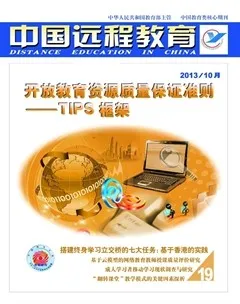
Quality Assurance Guidelines for Open Educational
Resources: TIPS Framework
Paul Kawachi
Open Educational Resources (OER) are currently seen as a viable way forward for achieving education for all. In particular developing countries can benefit through creating indigenous OER as well as through importing and adapting OER from developed regions. These Guidelines set out to increase the author-base by offering ideas to teachers in primary and secondary schools - so that when they look at creating their own OER they have recourse to these guidelines to help them. Not all the criteria listed here are relevant to each OER or to each author, and no prescriptive purpose is intended. The aim is to offer a starting point for building a culture of quality and professional reflection among teachers who are interested in creating their own OER. Student-created materials are excellent at imparting the higher-order critical thinking skills for lifelong learning - so the intended audience here includes also students who may want to learn through creating their own OER. The framework of criteria is offered here as a work-in-progress, and hopes to stimulate feedback from users of the guidelines so as to improve them. This paper presents a short-form T.I.P.S. framework where the TIPS acronym stands for the Teaching and learning process, the Information and material content, the Presentation, product and format, and System, technical and technology.
Keywords: Open Educational Resources (OER); quality assurance; guidelines; TIPS Framework; authoring digital resources
Online Teaching Quality Evaluation Based on Cloud Model
Li Chenying and Zhang Yan
This study aims to develop a method based on cloud model for online teaching quality evaluation. First, an evaluation index system was developed by using the Delphi method and a cloud model of evaluation standards was constructed. Then, in order to overcome the fuzziness and uncertainty in evaluation, cloud weight was used. Next, Euclidean distance was used to establish evaluation levels, illustrated by an example. It is argued that this method can improve evaluation of online teaching quality, and that teachers, students and administrators can make informed decisions, based on evaluation results.
Keywords: online education; teaching quality evaluation; cloud model; cloud weight
A Survey of Adult Learners’ Mobile Learning
Chen Yiqin
As a new generation of E-learning, mobile learning is top on the research agenda. Insights into the current situation of and needs for mobile leaning are prerequisites for implementing mobile learning projects. This article reports on a survey, among some 60,000 adult learners currently enrolling on the online education courses offered by Renmin University of China, of their possession and use of mobile devices, types of mobile devices used and methods for accessing information, mobile learning methods, frequency and time of mobile learning, mobile learning content, types of resources accessed, purposes of mobile learning, factors distracting attention from mobile learning, and costs of mobile learning. Conclusions drawn from the survey can inform the design of mobile learning projects in many aspects.
Keywords: mobile learning; adult learners; questionnaire survey
The Efficacy of Proactive Learning Support: A Case Study on
Efforts to Retain Online Adult English Learners
Gao Chunli
High dropout rate has been an issue of great concern to many online educational institutions. This paper describes and discusses a series of proactive learning support service designed to help retain adult English learners. Three aspects of learners’ learning performance were identified as critical indicators, i.e., submission of assignments, participation of course-based summative assessment as well as paying for tuition. Proactive learning support was accordingly initiated at both academic and learner management levels. The efficacy of proactive learning support is discussed, based on data collected from questionnaires, observations and semi-structured interviews. The practice has proven to meet its goal. However, new issues arise after provision of proactive learning support for four years. There is concern that some learners seem to be more dependent who demonstrate weaker abilities for self-directed learning and self-management, and who take proactive learning support for granted. This paper goes on to explore whether those learning support services are overactive.
Keywords: online English education; adult learners; retaining rate; learner support
Educational Technology Competency Training for Primary and Secondary
School Teachers from the Perspective of Educational Ecology
Wen Jikui, Du Shanshan and Huang Jingzhong
Training is the main means of enhancing in-service teachers’ educational technology. Nevertheless, the current model of educational technology competency training for primary and secondary school teachers remains to be improved, hence affecting training quality. Educational ecology provides a new perspective on this kind of training because it advocates integral system and dynamic openness as well as focuses on teachers’ cognition and harmonious development. Informed by this theory, the improved model emerged as a result of analysis of training needs, objectives and content, analysis of trainees, learning activity design, and training evaluation, proving to significantly enhance training quality.
Keywords: educational ecology; primary and secondary school teachers; educational technology competency; training
登錄APP查看全文