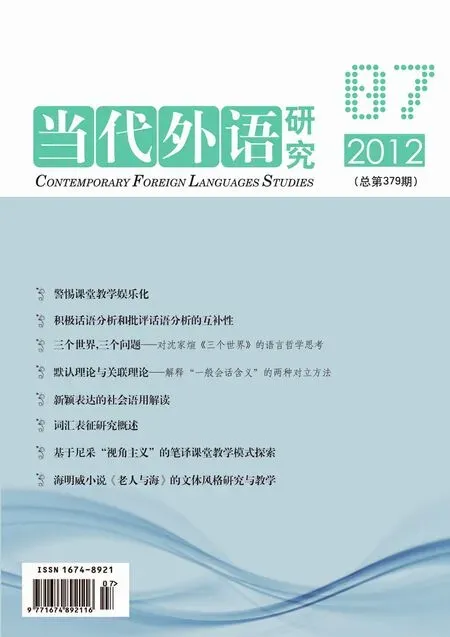
Abstracts of Major Papers in This Issue
2012-04-01 17:16:45
當代外語研究 2012年7期
ComplementaritybetweenPDAandCDA, by HU Zhuanglin, p.3
Following a brief review of the development of positive discourse analysis(PDA) and critical discourse analysis (CDA), the paper argues for the point that the reason for James Martin to develop PDA is by no means to replace CDA with PDA, but to emphasize the complementarity between the two.This can be proved by his discussion on the relations between CDA and PDA, CDA realis and CDA irrealis, deconstruction and construction, ideational meaning and interpersonal meaning, bad news and good news, etc.Finally, the paper suggests the principle of seeking truth from facts in collecting data and doing analysis.
ThreeWorldsandThreeQuestions:APhilosophicalResponsetoShenJiaxuan’s“PhysicalWorld,MentalWorld,andLinguisticWorld”, by DU Shihong, p.9
Shen Jiaxuan’s view of a correspondence among three worlds not only has philosophical foundations but also harbors an accounting power for discourse interpretation.According to Shen Jiaxuan, “terrestrial space”, “human mind” and “linguistic utterance” are respectively in accordance with “the physical world”, “the mental world” and “the linguistic world”.The three worlds, with the mental one as the mediator, are in parallel in verbal interaction.Based on this view, the present article attempts to tackle three philosophically-speculative questions: What’s the justification for the natural expression “pretending to shake one’s head”? Why is “a length-less stick” possible in the linguistic world but impossible both in the physical and mental worlds? Why is a psychiatric patient unable to achieve coherence while he is able to produce grammatical sentences? After a thorough conceptual investigation into the mechanism disclosed from the three questions, a conclusion is drawn as follows: Verbal interaction displays the correspondence among the three worlds, with which discourse is carried on between discourse participants.As for the correspondence of the three worlds, the physical world is the foundation of the two, the linguistic world is the realization of the two, and the mental world, which is the mediator between the other two, is in charge of conceptual blending so as to mirror the physical world and expand the linguistic bounds as well.
ExploringtheCognitiveMotivationinFillmore’sFrameSemantics, by CHEN Zhongping & BAI Jiehong, p.14
Frame Semantics founded by Fillmore symbolizes a theoretical shift from Fillmore’s Case Grammar and contributes significantly to Cognitive Linguistics, but previous studies seldom give an in-depth exploration of the cognitive orientation in Frame Semantics.This paper investigates the concept of frame in Frame Semantics by examining its developmental path from case frame through linguistic frame to cognitive frame and analyzing their features respectively, reveals emphatically the cognitive semantic properties of frame as both a conceptual and an interpreting tool in Frame Semantics, and illustrates Frame Semantics’ theoretical ideals which highlight frame’s role in organizing experience and interpreting meaning and hence advocate an encyclopedic view of meaning.Findings show that Frame Semantics, seeing language as rooted in human’s life experience and approaching word and text meaning in terms of cognitive frames, provides organic and comprehensive conceptual content for language understanding and therefore constitutes a pioneering force for the development of Cognitive Linguistics, particularly Cognitive Semantics.
DefaultTheoryandRelevanceTheory:TwoRivalApproachestoGeneralizedConversationalImplicatures, by ZHANG Shaojie & ZHANG Yanfei, p.19
Generalized conversational implicatures have moved to the forefront of attention in post-Gricean pragmatics, resulting from the imperfections of Grice’s theory of conversational implicatures, which leads to two rival approaches to this type of implicature: Default Theory and Relevance Theory.This paper presents an overview of these two approaches and elaborates on their theoretical concerns.Based on the two accounts, it points out that generalized conversational implicatures are the salient, unmarked default meanings that depend on the hearer’s inference by way of the conventional use of language; hence, conventions provide a shortcut for default inferences.
ASocial-PragmaticApproachtoSomeNovelUsesofBEI, by XIONG Xueliang, p.24
In Chinese, novel uses of BEI cannot be sufficiently accounted for merely by syntax and semantics.Related social and pragmatic factors should be considered to justify the ‘constructional conflict’ as evidenced in various ‘BEI ×’ expressions prevalent nowadays.The prototypical BEI-passives can be subcategorized into the direct-passive and the indirect passive.In the indirect passive expressions the subject is the negatively affected INDIRECT PATIENT of a related event marked by BEI and is not the participant of the event.However, in the BEI-× construction which obviously belongs to another category, the incompatibility between BEI and its following non-transitive expression can be endowed with new meanings through reinter- pretations propelled by pertinent social-pragmatic contexts.
AFunctionalAnalysisoftheDe-fuzzificationofLinguisticHedges, by XU Zhanghong & HE Ziran, p.29
With the advent of fuzzy-set theory, linguistic researchers have shown a considerable interest in hedges in verbal communication, and have delved into this phenomenon from diversified perspectives.However, some researchers in China are so concerned with the fuzzification of hedges as to neglect the de-fuzzification of the latter.Based on an analysis of the data on hedge studies, this article attempts to explore the underlying causes of the neglect and restore the true picture of hedges.It argued that (1) hedges, as a type of meta-language, are used to modify and process fuzzy language; (2) hedges are the linguistic manifestations of the speakers’ meta-pragmatic awareness, contributing to the efficiency of communication between speaker and hearer on a higher level; (3) hedges are intentionally employed to approximate the objective world, with a view to representing preciseness and truthfulness to the highest degree; (4) pragmatic failures result from the absence or inappropriate use of hedges in communication.
AReviewofLexicalRepresentationResearch, by ZHAO Cuilian, p.38
As an important endeavor in psycholinguistics, mental lexicon research may be complex and difficult on account of the complexity and instability of lexical representations.This paper reviews the research from three aspects: (1) the three models of mental lexicon, i.e., the Network Model (based on associative meaning), the Distributed Model (based on semantic similarity), and the Lexical Access Model (concerned with the ways of identifying and accessing lexical entries); (2) six traditional research methods that fall under two major types,i.e., lexical-level experiments such as lexical decision and word naming, and conceptual-level experiments such as semantic priming, categorization, word association, and word translation; (3) factors that influence lexical representation and access, including word frequency, word types, morphological and phonological structures, semantic relations, and L2 proficiency.After a brief introduction of each topic, the paper elaborates on its applicability, problems and relations with others.A brief account of the significance of the research is given at the end.
UniversityStudents’PerceptionoftheGrammarofSpokenEnglish, by YAN Yi, p.45
Since the advent of spoken corpora, our knowledge of native speakers’ grammar of spoken English has been unprecedentedly advanced.Drawing on the current research in this field, the present study, based on a survey conducted among first- and second-year undergraduates at a university in Beijing, attempts to examine spoken grammar from the perspective of Chinese university students.The preliminary findings reveal a consensus of opinion among the majority of participants about the importance and usefulness of spoken grammar in learning English though their knowledge about it still needs to be expanded.The implications for the teaching of spoken English are also discussed in the light of the findings.
DesigningTranslationTeachingModelsBasedonNietzsche’s“Perspectivism”:ACaseStudyofTranslationClass, by YIN Yan & RAO Pingping, p.53
The concept of “perspectivism” is a philosophical view developed by Friedrich Nietzsche, holding that all ideations take place from particular perspectives.This study was designed to use an interdisciplinary approach to explore an effective way to teach translation in class.It suggests that student translators should be encouraged to output translation of different versions from their individual perspective.An innovative teaching method, “Selecting texts for translation→Grouping students and translating independently→Discussion among student translators→Group presentation→Summarizing translation theory and skills” was used to substitute the traditional one, “Introducing translation skills→Commenting on translation examples→Showing model standard version of translation”.Advocating a diversified perspective, this innovation frees students from their reliance on a model standard translation version and encourages students to produce greater translation diversity, each with their own unique perspective.Within a reasonable period of time after its implementation, it is found that this innovation in translation teaching (1) facilitates active interactions and idea exchange among students in classroom; (2) enhances the students’ ability of collaboration, verbal expression and choosing the right translation strategies; (3) allows the students an opportunity to gain a more in-depth experience of translation theory and skills, and (4) encourages students to be critical in thinking and to translate independently without being confined exclusively to a given standard version of translation.
DifferentLinguisticRepresentationsofCognitiveActiveZonesandTranslationbetweenEnglishandChinese, by HUO Mingjie, p.58
Prominent items tend to serve as cognitive reference points to invoke other entities.Active zone, an important concept of cognitive semantics, has essentially to do with cognitive reference point.In representing the same conceptual structure, English and Chinese deal with active zones differently.The difference is due to different degrees of lexicalization of concepts and categories.This easily results in problems in translation.In translation, the linguistic representation of an active zone depends on whether the reference point can evoke the same meaning as that of source text.If so, the active zone is not represented, and if not, it represented.In this translating path, attention is paid to the cognitive mechanism of language instead of linguistic form.
TheStylisticAnalysisandTeachingofHemingway’sTheOldManandtheSea, by JIA Guodong, p.67
The style of brevity and precision of Hemingway has been reviewed positively by critics.On the basis of a stylistic model, this study focuses on the statistical analysis ofTheOldManandtheSeawith the intention of verifying the style with the quantitative data.Meanwhile this study applies the result of research to the teaching of Hemingway’s classics so that the students can understand the essence and thoughts of his works via language and style.It proves that the relationship between research and teaching could be complementary, i.e.the research should serve the purpose of improving teaching and teaching should inspire insights of research.
TheRiseandDevelopmentofMetafictioninContemporaryChina:WithanEyeonAvant-gardeFiction, by LI Lin & LI Jin, p.72
Since 1960s, metafiction entered into its full-fledged development in the western world, especially in the US, and became the dominant fictional genre in the postmodernist period.Since 1980s, the cultural and academic exchanges between China and western world have been increasingly frequent, which readily prepared for the emergence and growth of Chinese metafiction.Represented by novels of Ma Yuan, Ge Fei and Yu Hua, Chinese metafiction are usually named Avant-garde stories or experimental stories, which have reformed the art of Chinese narrative fiction, and meanwhile helped to push Chinese contemporary literature to merge into the international literary trend.Using the western metafiction theories, this study examines metafiction in China, analyses its artistic features and problems, and predicts its future.