
The Song of the River態度資源分析及其翻譯
2010-10-17 06:03:44李慧君
華北理工大學學報(社會科學版) 2010年6期
李慧君
(湖南科技大學外國語學院,湖南湘潭411201)
The Song of the River態度資源分析及其翻譯
李慧君
(湖南科技大學外國語學院,湖南湘潭411201)
態度;情感;判斷;鑒賞
人際功能是語言最為重要的功能之一,人們通過語言交流進行情感交流,建立人際關系。在語言交流的過程中,良好的態度可以幫助人們建立良好的人際關系,有效地實現人際交流的目的。文本作為一種重要的人際交流形式,其中的態度資源及其分布可以有效的幫助實現人們情感的傳遞和意義的表達。譯者在處理態度意義的翻譯時,應遵循翻譯的目的,采取適當的翻譯策略,實現高質高效的文本表達和人際交流。
語言學對評價系統的研究是系統功能語言學的新發展,它是一整套運用語言表達態度的資源,態度系統是評價系統的核心。馬丁(Martin,2007)認為態度系統可分為三個子系統:情感、判斷、鑒賞。
一 態度系統
態度系統是整個評價體系的核心,介入用于研究態度的來源,級差體現態度的強弱。態度系統的中心是情感子系統,判斷子系統和鑒賞子系統都是以情感系統為基礎的。
整個態度系統是對人品或物值的評價,一般說來,人的情感(affect)、對事物或人品的判斷(judgement)以及人們對事物的鑒賞(appreciation)都可以分為正反兩面,通常分為好或壞兩個最基本的概念。但在好與壞之間有著多種不同的標度,有時對同樣的事物不同群體也有著不同的評價標度。情感表達、人品判斷和物值鑒賞三者都有正面與負面、顯性與隱性之分,這都反映出不同文化群體的不同價值觀念和審美觀念。
本文以散文《The Song of the River》為研究對象,探討態度資源在散文中的分布和散文譯文中態度意義的轉化情況。散文原文《The Song of the River》是一篇驚心動魄,震撼力很強的文章。我們知道散文是一種自由、靈活的抒寫見聞感受的文體,它在內容上往往是對真實事件、人物、環境或自然景色所抒發的感情,是一種比較素靜的文學形式,具有較強的生命力。散文的一個重要特征是“形散神不散,形散神聚”。散文的“形散”是指取材自由,“神不散”是指立意必須明確而集中。其取材十分廣泛自由,不受時空限制,但材料必須為中心思想服務,即以一條線索組織材料,集中地表現中心思想。散文在體現中心思想方面有自己的獨特方式,散文作者往往是抓住自己在生活中感受最深的某一事物,挖掘這一事物所包含的深刻意義或象征意義,并展開豐富的聯想,借以提示中心思想。
《The Song of the River》是一篇寫景抒情的散文。作者毛姆是當代英國著名小說家。他于20世紀20年代末曾來到中國,并有機會沿長江溯流而上進入四川,并將沿途的所見所聞撰寫成On a Chinese Screen。The Song of the River就是其中一篇,毛姆在這篇文章中著力描寫了他在長江上聽到的兩種勞動人民的歌聲和他聽到歌聲的感受和心情。雖然他的這種描述已是大半個世紀前舊中國的情況,但文章情景交融,情感真摯,讀者現在讀來仍然生動感人。文章之所以能達到這種效果,文中的態度資源發揮著重要的作用,下文通過對《The Song of the River》中的態度資源進行分析來了解其在原文中的分布情況和作用。
二 《The Song of the River》原文的態度資源分析
情感、判斷、鑒賞三種態度資源在《The Song of the River》中的分布在這篇散文的情感表達中發揮著重要的作用。通過檢索《The Song of the River》原文,可以發現情感,判斷,鑒賞三種資源在這篇散文中所占比例分別為:

表1 原文的態度分布
通過上表可以看出,在這篇散文中鑒賞所占的比例要遠遠大于情感和判斷。在情感、判斷、鑒賞三者中,鑒賞通常是用于對客觀事物的評價,它在三者中相對較為客觀。文中較多地使用了鑒賞這種客觀的形式,來表達作者的主觀情感。這種客觀的鑒賞資源在字里行間不自覺地體現出作者對于這些苦難的勞動者的深深同情和憐憫,“道是無情卻有情”,這種客觀的形式沒有影響作者主觀情感的表達,相反它讓作者的這種情感表達更為強烈、有說服力和震撼力,讓人信服。
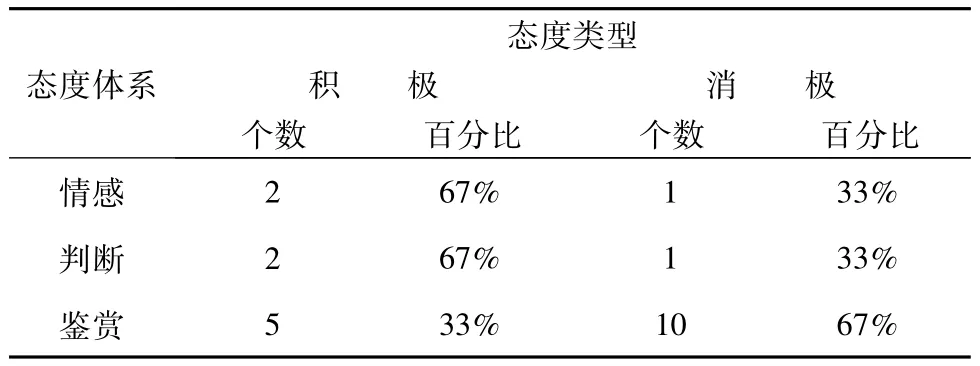
表2 原文的態度類型
作者在原文中借助積極的情感和判斷,表達了對這些勞動人民苦難生活的深深同情和憐憫。同時這種情感也在消極的鑒賞中真實地流露出來,例如最后一段中,…It is the cry of souls(invoked unhappiness:misery).It is a sigh of despair (invoked unhappiness:misery).It is heart-rending(invoked unhappiness:misery).[It is hardly(focus+engagement:deny)human](valuation).It is the cry of souls(invoked unhappiness: misery)in infinite(graduation:quantification:distribution)distress(unhappiness:misery),only just(graduation:intensification:quality)musical,and that last note is the ultimate(graduation)sob(unhappiness:misery)of humanity.可以看到有下劃線的大部分詞和詞組都體現消極的態度意義,勞工們的生活是如此的艱辛,讓人憐憫,但是他們并沒有向生活低頭,而是express the straining(metaphor-appreciation:complexity+) heart,the breaking(hyperbole-complexity+)muscles,and at the same time the indomitable(valuation)spirit of man which overcome(invoked capacity)the pitiless(metaphor:complexity+ judgment:propriety)force of nature,他們仍然相信生活,愿意去戰勝無情的大自然,這使得他們更為可敬。作者如此巧妙地運用了文中這些蘊含態度意義的詞句表達了自己的真情實感,使得文章情景交融,真摯感人,較好地實現了與讀者進行情感交流的目的。
三 《The Song of the River》態度意義翻譯例析
毛姆的這篇作品閃爍著人性的光輝,它折射出一位善良的外國人眼中中國纖夫和苦力的形象,在這些彎腰曲背的個體身后可以看到作者關切的目光,聽到作者深深的嘆息。因此在翻譯這篇散文時,譯者不僅要全面再現原文的場景,更重要的是要體現出字里行間作者對受苦受難的勞動者的深深同情與憐憫,以及對他們不畏艱難的精神的敬佩。譯者在處理本文的態度意義時,應結合文本的交流目的,采取適當的原則和策略作為指導,較好地實現文本地交流目的。下文就文中態度意義的翻譯作簡單的例析。
1)a …and at the close of the weary(affect:quality)day there is the hearty(affect:satisfaction:pleasure)meal…
(W.S.Maugham The Song of the River)
1)b 在筋疲力盡的一天結束時可以痛快的吃上一段飽飯……
(陳文伯譯河之歌)
在例1中,形容詞“hearty”是一個評價形容詞,它的使用表示作者理解這頓飯對于這些纖夫們的意義是非同尋常的,一般人不會覺得吃一頓飯有什么特別,但對于這些饑腸轆轆艱苦勞碌一天的纖夫來說那卻是一天的慰藉,別無他求吃飽而已。作者陳述的語調很平靜,但通過“筋疲力盡的一天”和“一頓飽飯”這組很平常的詞,讀者卻能體會到他們生活中深深的辛酸,辛勤的勞動者對于自己艱苦生活的要求很簡單,一頓飽飯而已,即便如此,他們的生活還是那么沒有保障,隨時要應對各種更為艱難的情況。就這樣,他們還是愿意去與生活抗爭,這也使得讀者對他們的敬佩之情油然而生。譯者在此并未使用夸張的詞語,但這些纖夫們的艱辛生活和作者的深刻同情和憐憫已經躍然紙上,作者的情感通過這些帶有態度意義的詞語生動地體現出來。
2)a You hear it,loud(appreciation:impact/quality)and strong(appreciation:impact/reaction:quality);from the rowers as they urge the junk with its high(appreciation:quality)stern,the mast lashed(metaphor:complexity)alongside,down the swift (quality)running(metaphor:complexity)stream.
(W.S.Maugham The Song of the River)
2)b 它響亮而有力,那是船夫,他們劃著木船順流而下,船尾翹得老高,桅桿系在船邊。
(陳文伯譯河之歌)
例2中標注的詞‘strong’、‘loud’被置于特定的語境中描寫船夫們的號子時,它們具有比詞語本身更強的意義。船工的歌聲并不優美動人,但卻是他們在艱苦的環境中堅強生活意志的象征。船工們努力而堅定想要控制自己的生命之舟,因此這兩個詞被譯為“響亮而有力”,在此用于描繪船工們的號子,實際上也是描繪這些勤勞堅強的人們,含有更多積極正面的意義。譯文根據原文的真實情感和譯入語做了適當的調整,這種調整兼顧了翻譯的目的和忠實通順的原則,在此是積極有效的。
3)a It is the cry of souls(invoked unhappiness:misery)in infinite(graduation:quantification:distribution)distress(unhappiness:misery),only just(graduation:intensification:quality) musical,and that last note is the ultimate(graduation)sob(unhappiness:misery)of humanity.Life is too(graduation:intensification:quality)hard(appreciation:quality;invoked unhappiness: misery),too(graduation:intensification:quality)cruel(appreciation:quality;invoked unhappiness:misery),and this is the final despairing(appreciation:quality)protest(dissatisfaction).That is the song of the river.
(W.S.Maugham The Song of the River)
3)b 它是靈魂在無盡的悲凄中的呼喊,只不過有著音樂的節奏而已。那終了的一聲簡直就是人性泯滅的低泣。生活太艱難、太殘酷,這喊聲正是最后絕望的抗議。這就是河之歌。
(陳文伯譯河之歌)
例3的整個結束段都飽含著凄苦和絕望,和著苦力們的號子,字里行間都滲透著他們的血和淚。每一個單獨的標注詞都表達出痛苦和不滿的態度,當它們匯聚在一起,則形成了勞動者靈魂深處強有力的吶喊。“無盡的悲凄中的呼喊”十分精確的傳達了原文cry of souls in infinite distress的態度意義,表達了作者的對人性的悲嘆。此外,only just musical譯為“只不過有著音樂的節奏而已”,精確的描寫了號子對于船工們的意義,它們并不是真正意義上的音樂,而僅僅是以音樂的形式萌生出來的對于生活的吶喊。句式“生活太艱難、太殘酷”切合‘Life is too hard(appreciation:misery),too cruel(appreciation:misery)’,兩個并列句式形成詠嘆,表達出纖夫和苦力們的無助和凄苦。最后一個‘that is’譯為“這就是”,而不是“那就是”,似乎讀者本人正身臨其境地聆聽著船工們的號子,讓讀者覺得真實可信。這與原文的寫作和情感交流目的契合,容易激起讀者的共鳴,譯文在此處理十分恰當。
通過對翻譯例文的統計分析發現,譯文的態度與原文的態度不盡相同,譯文中存在適當的符合原文寫作意旨的調整,統計數據見下表:

表3 原文與譯文態度資源對比
積極情感所占比例由原文的33%上升為與譯文中的67%,消極情感由原文的67%下降至譯文中的33%,存在約34%的調整;判斷資源在原文與譯文中基本一致;鑒賞資源存在一定的調整,積極鑒賞由原文的33%上升為73%,消極鑒賞由原文的67%下降為27%,鑒賞類型存在約50%的調整。通過譯例分析,可以發現譯文的調整符合翻譯目的和基本原則,有利于實現有效的情感表達和人際交流目的。
四 結論
通過以上對文本中用于情感表達的態度資源進行的數據統計和分析,我們可以得出以下結論:原文態度子系統中情感資源和判斷資源的數量相對較少;情感資源和判斷資源中積極資源所占比例均大于消極資源所占比例;鑒賞資源數量相對最多,而且消極鑒賞多于積極鑒賞。譯文與原文的態度類型數據大體一致,但是在譯文中,態度資源的分布和類型存在適當的調整,這說明譯作與原作要表達的基本態度和情感是一致的,原文和譯文都考慮了如何較好地實現與讀者的情感交流,并合理地使用態度資源來實現人際交流的目的。譯者處理態度意義的調整有利于實現文本的人際功能,在應對此類翻譯時,譯者應遵循翻譯的目的,采取適當的翻譯策略,高質高效地再現出文本的態度意義,實現語言最為重要的人際功能,實現語言在人際交流中的橋梁作用。
注釋::
①文中英文原文來自W.S.Maugham的The Song of the River
②文中譯例來自陳文伯的譯作《河之歌》
③文中統計數據來自對評價標注原文的檢索和統計(請見附評價標注原文)
[1] Martin,J.R.&Rose,D.Working with Discourse:Meaning beyond the Clause.(Beijing:P eking University Press.,2007)22.
[2] Martin,J.R.&White,P.R.R.The Language of Evaluation:Appraisal in English.(Palgrave Macmillan Houndmills,Basingstoke,Hampshire.2005)45.
[3] Maugham,W.S,The Song of the River.On a Chinese Screen.(New York:George H.Doren CO,1922)89.
[4] Nord,C.Translation as a Purposeful Activity.(Shanghai:Shanghai Foreign Language Education Press,2001)80.
[5] White,P.R.R.Appraisal-the language of evaluation and stance.V erschueren,J.,?stman,J.,Blommaert,J.,& Bulcaen,Chris (eds).The Handbook of Pragmatics.Amsterdam/Philadelphia: John Benjamins Publishing Co,2002 pp.1-27.
[6] 陳文伯[譯].河之歌.毛姆W.S.[J].新讀寫,2008(2):32.
[7] 陳曉燕.英漢社論語篇態度資源對比分析[J].外國語,2007 (3):39-45.
[8] 黃國文.翻譯研究的功能語言學途徑[J].中國翻譯,2004 (5):15-19.
[9] 馬偉林.人際功能的拓展——評價系統述評[J].南京社會科學,2007(6):142-146.
[10] 王振華.“硬新聞”的態度研究——“評價系統”應用研究之二[J].外語教學,2004(5):31-35.
[11] 張美芳.語言的評價意義與譯者的價值取向[J].外語與外語教學,2002(7):15-16.
[12] 祝德純.散文創作與鑒賞[M].北京:中國社會科學出版社,2002:17.
附:評價標注原文
The Song of the River
W.S.Maugham
You hear it all(graduation:quantification:extent)along the river.You hear it,loud(appreciation:impact/quality)and strong (appreciation:impact/reaction:quality);from the rowers as they urge the junk with its high(appreciation:quality)stern,the mast lashed(metaphor:complexity)alongside,down the swift(quality) running(metaphor:complexity)stream.You hear it from the trackers,a more(graduation:intensification:quality)breathless (capacity)chant,as they pull desperately(/graduation:intensification)against the current,half a dozen(graduation:quantification:number)of them perhaps(engagement:entertain)if(entertain)they are taking up wupan,a couple of hundred(graduation: quantification:number)if(entertain)they are hauling a splendid (appreciation:quality)junk,its square sail set over a rapid.Onthe junk,a man stands amidships beating a drum incessan tly (graduation:intensification and quantification:extent)to guide their efforts,and they pull with all(graduation:intensification: quality)their strength,like men possessed(metaphor:appreciation:complexity),bent double(hyperbole:appreciation:complexity+graduation:quantification);and sometimes(graduation:intensification and quantification)in the extremity(graduation:intensification:quality)of their travail they crawl on the ground,on all(graduation:quantification:number)fours,like the beasts (metaphor——appreciation:complexity)ofthe field.They strain,strain fiercely(graduation:intensification:process),against the pitiless(personification——appreciation:complexity+ judgment:propriety)might(capacity + entertain)ofthe stream.The leader goes up and down the line and when he sees one who is not(engagement:deny)putting all(graduation:intensification:quality)his will into the task he brings down his split bamboo on the naked back.Each(graduation:quantification: number)one must(engagement:entertain)do his utmost(intensification)or the labor of all(graduation:intensification:quality)is vain(appreciation:valuation).And still(engagement:counter) they sing a vehement(quality),eager(affect:inclination:desire) chant,the chant of the turbulent(quality)waters.I do not(engagement:deny)know(engagement)how words can(judgment: capacity+entertain)describe what there is in it of effort.It serves to express the straining(metaphor——appreciation:complexity +)heart,the breaking(hyperbole-complexity+)muscles,and at the same time the indomitable(valuation)spirit of man which overcome(invoked capacity)the pitiless(metaphor:complexity+ judgment:propriety)force of nature.Though(engagement:counter)the rope may(engagement:entertain)part and the great(graduation:quantification:mass)junk swing back,in the end the rapid will be passed;and at the close of the weary(quality)day there is the hearty(affect:satisfaction:pleasure)meal…
But(engagement:counter)the most(graduation:intensification:quality)agonizing(appreciation:quality)song is the song of the coolies who bring the great(graduation:quantification:mass) bales from the junk up the steep steps to the town wall.Up and down(inversion;graduation:intensification:process)they go,endlessly(graduation:quantification:extent:distribution-time),and endless(quantification:extent:distribution-time)as their toil(affect:unhappiness:misery)rises their rhythmic(appreciation: quality)cry.He,aw-ah,oh.They are barefoot and naked to the waist.The sweat pours down(hyperbole——graduation)their face and their song is a groan of pain(unhappiness:misery).It is the cry of souls(invoked unhappiness:misery).It is a sigh of despair (invoked unhappiness:misery).It is heart-rending(invoked unhappiness:misery).[It is hardly(focus+engagement:deny)human](valuation).It is the cry of souls(invoked unhappiness: misery)in infinite(graduation:quantification:distribution)distress(unhappiness:misery),only just(graduation:intensification:quality)musical,and that last note is the ultimate(graduation)sob(unhappiness:misery)of humanity.Life is too(graduation:intensification:quality)hard(appreciation:quality;invoked unhappiness:misery),too(graduation:intensification:quality) cruel(appreciation:quality;invoked unhappiness:misery),and this is the final despairing(appreciation:quality)protest(dissatisfaction).That is the song of the river.
Key words:attitude;affect;judgment;appreciation
Abstract:The interpersonal function is one of the most important functions of language.People establish interpersonal relations and conduct emotional communication through languages.Effective attitudinal expressions can serve the communicative purpose of interpersonal communication,and aid the establishment of harmonious interpersonal relations.On the translation of attitudinal meanings,the translators should adopt appropriate translation strategy in line with the purpose of the translation mission and the source texts to realize the high-quality and efficient translation of texts and interpersonal communication.
A Brief Analysis of Attitude in The Song of the River and the Translation
LI Hui-jun
(School of Foreign Studies,Hunan Universtiy of Science and Technology,Xiangtan Hunan 411201,China)
H 315.9
A
1673-2804(2010)06-0178-04
2009-12-24
湖南省教育廳2010年研究項目10 C0715
猜你喜歡
新少年(2022年9期)2022-09-17 07:10:54
科教新報(2022年12期)2022-05-23 06:34:16
吉林廣播電視大學學報(2021年4期)2022-01-14 02:35:48
今日農業(2021年14期)2021-10-14 08:35:28
小天使·一年級語數英綜合(2020年6期)2020-12-16 02:56:41
海峽姐妹(2020年8期)2020-08-25 09:30:18
作文成功之路·小學版(2020年5期)2020-06-11 12:48:26
小天使·一年級語數英綜合(2018年11期)2018-11-23 09:47:26
資源再生(2017年3期)2017-06-01 12:20:59
北極光(2014年8期)2015-03-30 02:50:51
