LOLIMOT模型在CNG發動機NOx排放預測試驗中的應用
2024-05-15 15:27:08劉佳奇盧熾華劉志恩
重慶大學學報
2024年1期
劉佳奇 盧熾華 劉志恩
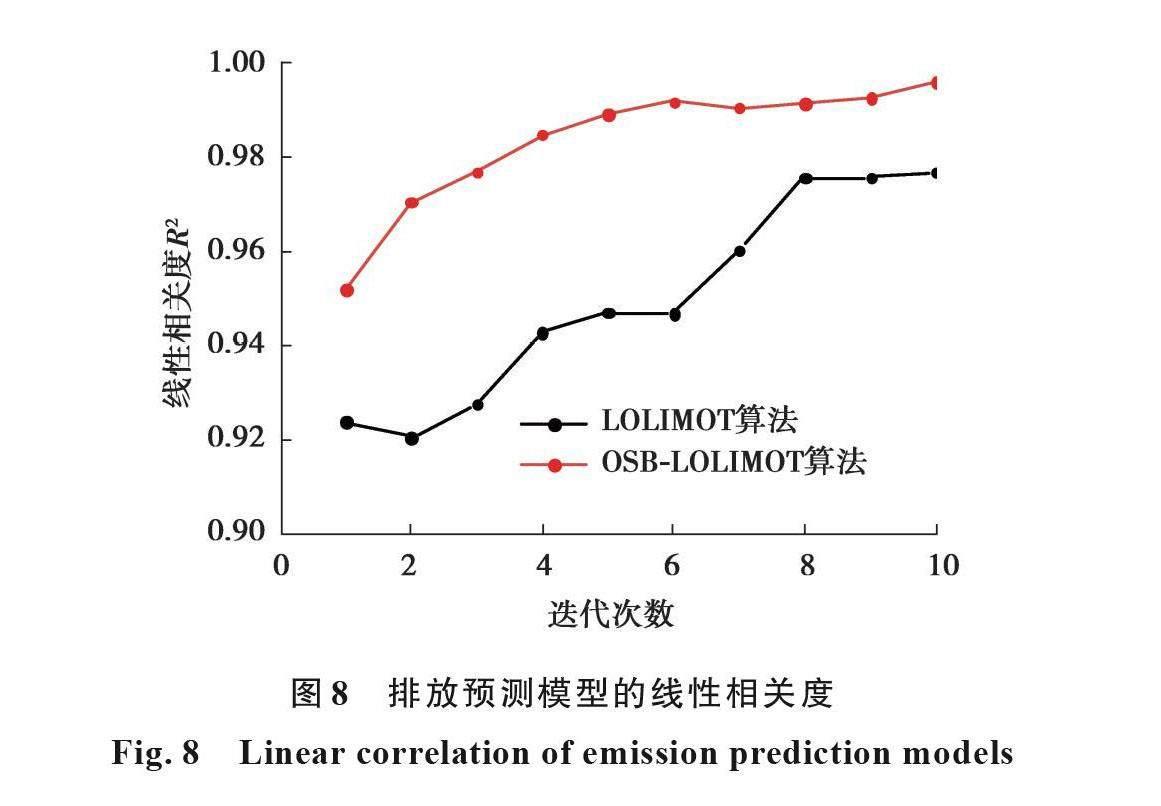
摘要:為解決在選擇性催化還原技術(selective catalytic reduction,SCR)的控制策略開發中局部線性模型樹(local linear model tree,LOLIMOT)排放模型預測精度不足的問題,提出一種通過優化空間邊界,將原模型的超矩形輸入空間約束在物理意義范圍內的改進LOLIMOT模型。通過某天然氣發動機的辨識試驗,從分布特征和計算原理角度,分析了該方法對預測結果的影響。結果表明:與原算法相比,改進算法的線性相關度R2提升了1.9%,驗證了改進策略的有效性。改進LOLIMOT算法具備較高的收斂速度和穩定性,在排放模型領域具備一定的應用優勢。
關鍵詞:天然氣發動機;NOx排放;預測模型;局部線性模型樹
中圖分類號:TK421.5????????? 文獻標志碼:A????????? 文章編號:1000-582X(2024)01-009-12
Application of LOLIMOT to CNG engine NOx emission prediction test
LIU Jiaqi1,2, LU Chihua1,2, LIU Zhien1,2
(1. Hubei Key Laboratory of Advanced Technology for Automotive Components, Wuhan University of Technology, Wuhan 430070, P. R. China; 2. Hubei Collaborative Innovation Center for Automotive Components Technology, Wuhan 430070, P. R. China)
Abstract: To solve the problem of insufficient prediction accuracy of the local linear model tree (LOLIMOT) emission model in the development of the selective catalytic reduction technology (SCR) control strategy, a method of optimizing the space boundary is proposed. This method aims to constrain the super-rectangular input space of the original model within the scope of physical definitions in the modified LOLIMOT model. Through the identification test of a compressed natural gas (CNG) engine, the effects of this method on prediction results are analyzed considering distribution characteristics and calculation principles. The results show that compared with the original algorithm, the linear correlation R2 of the improved algorithm is increased by 1.9%, verifying the effectiveness of the proposed strategy. The modified LOLIMOT algorithm demonstrates higher convergence speed and stability, offering valuable application advantages in the field of emission models.
Keywords: compressed natural gas (CNG) engine; nitrogen oxides emissions; prediction model; local linear model tree
為滿足國Ⅴ排放標準要求,天然氣發動機普遍采用選擇性催化還原技術SCR來降低NOx排放。傳統SCR系統控制策略標定試驗需要耗費大量的時間和成本,同時考慮到NOx傳感器精度對測量的影響,通常基于模型預測NOx排放,主要包括基于物理模型的方法和基于數據驅動模型的方法。基于物理模型的方法采用現象學多區模型來預測燃燒過程中排放物的形成,不適用于實時計算,并且預測精度很大程度上取決于模型及參數的選擇[1]。
基于數據驅動模型的方法在開發時間和成本上具有顯著優勢,所建立的黑盒模型被廣泛應用于發動機排放預測。胡杰等[2]基于神經網絡偏最小二乘法(neural network partial least squares,NNPLS)算法建立NOx排放預測模型,采用偏最小二乘法進行數據篩選。Yusaf等[3]運用人工神經網絡(artificial neural network,ANN)預測天然氣發動機的NOx排放。……
登錄APP查看全文