基于等離子體增強上轉換發光的窄帶1 550 nm 光探測
2024-02-20 09:15:04周博明覃子晟王姝歡楊棕媛江葦瑤趙赫然鮑民杰程惠寧季亞楠
發光學報 2024年1期
關鍵詞:實驗室
周博明, 覃子晟, 王姝歡, 楊棕媛, 江葦瑤, 趙赫然,曹 鵬, 鮑民杰, 程惠寧, 季亞楠
(大連民族大學 物理與材料工程學院, 國家民委新能源與稀土資源利用重點實驗室,遼寧省光敏材料與器件重點實驗室, 遼寧 大連 116600)
1 Introduction
In recent decades, photodetectors(PDs) have developed rapidly and have been widely used in our daily life.The narrowband near-infrared(NIR) PDs have great development potential in many industrial fields including remote light detection, optoelectronics, satellite maps and medical devices[1-2].Especially for photodetection at 1 550 nm wavelength, which is crucial to industrial imaging applications and military, such as laser-beam profile inspection, visualization of military targeting lasers, and night vision[3-5].However, the majority of PDs are non-selective and are operated over a broad range of wavelengths determined by the bandgap of the photoactive materials[6-7].There are lots of emerging materials have been developed for narrowband NIR detection over recent decades, for example, quantum dots, two-dimensional semiconductor materials[8-10].Moreover,using an external optical bandpass filter/optical microcavity couple with broadband devices or charge collection narrowing conception can also obtain narrowband PDs[11].Though these materials demonstrate pretty high electronic mobility as well as consume low power, and the above mentioned strategies are also proved to be effective, they are not suitable for next-generation electronic devices in further applications due to their limitations of complexity, high cost, and strictly controlled manufacturing process[12-13].For example, some conventional semiconductor compounds such as InxGa1-xAs, Si and HgTe,etc.These materials have encountered a bottleneck in modern electronics and photonics in terms of spectral coverage, low resolution, non-transparency, inflexible, and complementary metal-oxide-semiconductor incompatibility[14-15].Though the maturity of InGaAs-based NIR PDs technologies, there are still some major roadblocks for large-scale deployment.
Lanthanide-doped upconversion nanoparticles(UCNPs) are generally considered as the most effective NIR absorption materials, which can convert photons in low-energy states to those in the high-energy states, thereafter easily detect NIR light up to wavelength of 1 550 nm[16-17].Owing to the narrow absorbance of rare earth ions in NIR range, the fullwidths at half maximum of UCNPs-based PDs’ are usually below 30 nm[4,18].Apart from that, the UCNPs-based PDs are also suitable for transparent and flexible optoelectronic devices[19].But the UCNPs usually have low quantum yields, hence some efficient auxiliary strategies have been commonly used to improve the upconversion luminescence(UCL) intensities, such as core-shell design[20], photonic crystal effect[21], as well as introduction of localized surface plasmon resonance(LSPR) effect[22].Especially, the LSPR effect can significantly boost the excitation rate and emission efficiency of UCNPs due to the local field amplification in the proximity of noble metal nanostructures (like Au, Ag, or Pt) in the plasmonic modulation of UC emission[23-24].In the reported works of PDs based on the UCNPs hitherto,most focus on detection at wavelength of 980 nm[18,25-26].Considering these advantages the above mentioned, it is necessary to combine UCNPs with semiconductor materials to enable devices to achieve NIR narrowband photodetection at 1 550 nm.
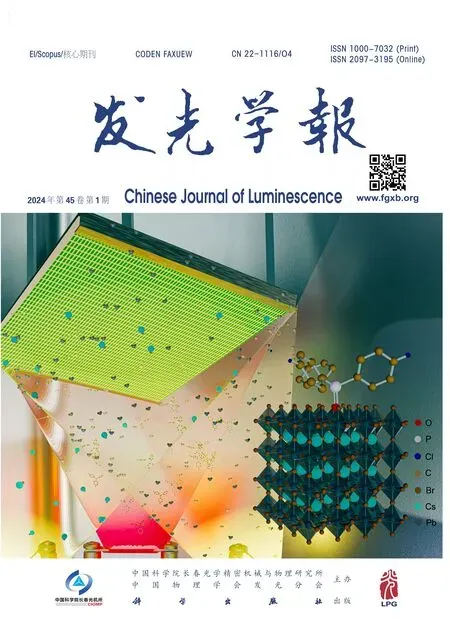
In this work, we selected noble metal Ag nanorods(NRs) as plasmonic architecture and synthesized NaYF4∶4%Er UCNPs, thereafter fabricated the Ag NRs/NaYF4∶4%Er UCNPs as hybrid plasmonic UC films.As a result, we obtained ~13 folds of UCL intensities enhancement.Thereafter, the narrowband 1 550 nm PDs were developed based on MAPbI3/Ag NRs/UCNPs composites, the responsivity (R) and detectivity(D*) are ~48.5 mA/W and 5.7×10⁸Jones,respectively.
2 Experimental
2.1 Chemicals and Materials
Hexadecyl trimethyl ammonium bromide(CTAB), ascorbic acid(AA), cetyltrime-thylammonium chloride (CTAC, 97%), polyvinyl pyrrolidone(PVP), sodium borohydride(NaBH4), sodium oleate(NaOL), sliver nitrate(AgNO3), and chloroauric acid(HAuCl4), deionized water.Yttrium(Ⅲ) acetate hydrate (Y(CH3CO2)3, 99.9%), erbium(Ⅲ) acetate hydrate (Er(CH3CO2)3, 99.9%), sodium hydroxide(NaOH, ≥98%), ammonium fluoride(NH4F,≥98%), oleic acid(OA, 90%), 1-octadecence(ODE,90%), cyclohexane (99.5%), absolute alcohol.Dimethyl sulfoxide (DMSO), N,N-dimethylformamide(DMF, ≥99%), PbI2(99.9%), Methylammonium iodide(MAI, ≥99.5%), chlorobenzene.Unless otherwise noted, all the chemicals were used without further purification.
2.2 Synthesis of Ag NRs
The Ag NRs were obtained by a typical seeded growth method[27].The first part: CTAB(5 mL, 0.2 mol·L-1) was mixed with HAuCl4(5 mL, 0.5 mmol·L-1).A freshly prepared NaBH4solution(0.6 mL,0.01 mol·L-1) was diluted to 1 mL then added to the above mixture solution under the vigorous agitation.After stirring for 3 min, the color of solution changed from yellow to light brown, and aged for 30 min to be used as seed liquid.The second part: 0.025 g NaOL was dissolved in 5 mL deionized water, and reacted with 0.137 g CTAB at 50 ℃.After the temperature cooled down to 30 ℃, added 18 μL Ag NO3solution(0.1 mol·L-1) into the above mixtures and let stand for 15 min.Then added HAuCl4solution(5 mL, 1 mmol·L-1) to the above solution, kept stirring until the solution becomes colorless.At this point,72 μL of HCl (37% in water 12.1 mol·L-1) was needed to adjust pH of the solution.After stirring for 15 min, added AA(1.25 mL, 64 mmol·L-1) solution and kept vigorously stir for 30 s and used as a growth solution.The third part: added 125 μL seed solution to 10 mL growth solution, and kept stirring for 30 s, after that let it stand 12 h at room temperature.The final product were isolated and washed by centrifugation with deionized water.
2.3 Synthesis of NaYF4∶4%Er UCNPs
We used solvothermal method to prepare the UCNPs[28].A mixture of 3 mL OA, 7 mL ODE, and 2 mL aqueous solution containing a total amount of 0.4 mmol lanthanide(Y(CH3CO2)3and Er(CH3CO2)3)with 24∶1 ratios were added into a 50-mL threenecked flask.The mixture was heated at 150 ℃ for 1 h and then cooled to 30 ℃.Then 6 mL methanol solution containing 1 mmol NaOH and 1.6 mmol NH4F was added and stirred at 50 ℃ for 45 min.After that the methanol was evaporated at 100 ℃for 1 h.Subsequently, the reaction solution was then heated to 300 ℃ for 1.5 h under nitrogen atmosphere.The product was collected by centrifugation,and washed with ethanol for three times, and finally re-dispersed in 5 mL of cyclohexane.
2.4 Fabrication of Ag NRs/UCNPs Hybrids
Herein, we used three-phase self-assembly method to fabricate monolayer Ag NRs and UCNPs films to obtain Ag N Rs/UCNPs hybrid structures[28-29].The precipitate of Ag NRs(UCNPs, the following is omitted) were dispersed in dilute HCl (10 mL, 1 mol·L-1) and amply dissolved by ultrasonic.The mixture was centrifuged to remove the excess OA ligands, then dispersed in the ethanol solution of PVP(1%, wt/v) again.Repeat last operation, and the PVP-coated Ag NRs were prepared.The CH2Cl2(800 μL), deionized water(1.8 mL) and PVP-coated Ag NRs solution(50 μL) were subsequently added into an reaction bottle with vigorously shaking for 30 s.Then n-hexane(6 mL) was added into the above mixture.Thereafter, the Ag NRs can be driven to the upper interface of the deionized water and n-hexane phase.Finally, the monolayer Ag NRs film was successfully transferred onto a glass substrate(1 cm×1 cm) by dip-coating method.
2.5 Fabrication of UCNPs/MAPbI3 and Ag NRs/UCNPs/MAPbI3 PDs
The MAI and PbI2were mixed in DMSO solution to prepare the perovskite precursor.The perovskite films were fabricated on the UCNPs glass substrate by utilized two-step method at the nitrogen atmosphere.Notably, the chlorobenzene(100 μL)was kept on the spinning substrate for ~20 s prior to the end of the spinning program during the second step.Then the MAPbI3films need to be annealed at 100 ℃ for 10 min.Finally, approximately 100 nm Ag electrodes deposited onto the MAPbI3layersviathermal evaporation.
2.6 Measurement and Characterization
All characterizations about the morphology as well as phase structures were separately measured by transmission electron microscope(Hitachi H-8100IV, Japan) and X-ray diffraction(XRD).The absorption spectra were obtained by ultraviolet(UV)/visible (Vis)-NIR scanning spectrophotometer instrument(Shimadzu UV-3600PC, Japan).The emission spectrum and luminescence kinetics data were acquired by the spectrometer(Horiba, Japan), Edinburgh instruments FLS1000, and digital phosphor oscilloscopes(Tektronix DPO5104, America), respectively.All the photodetection performance tests of UCNPs/MAPbI3hybrids and Ag NRs/UCNPs/MAPbI3PDs were gained by sourcemeter(Keithley 2400,America).
3 Results and Discussion
We prepared NaYF4∶4%Er UCNPs by using the solvent thermal method, and their transmission electron microscopy(TEM) image in Fig.1(a) shows that the UCNPs are homogeneous and monodispersed with a diameter of (23.2±1.5) nm.The XRD pattern of UCNPs films is displayed in Fig.1(b), which is greatly consistent with the standard card of β-NaYF4(PDF 16-0344).Noble metal nanorods have been the focus of lots of recent researches due to their potential use as active components or interconnects in fabricating electronic, photonic, and solar cells,et al[30].Compared with Au NRs, Ag NRs have controllable aspect ratios, high purity, and high dimensional uniformity[31].Ag NRs seem to be particularly worthy of synthesis and study, as bulk silver shows the highest electrical and thermal conductivities of all metals[32-33].Hence, we have been successfully synthesized Ag NRs through hydrothermal method[27].Fig.1(c) displays the SEM image of some Ag NRs that had a mean diameter of ~(1.45±0.25)μm with 14.5 aspect ratio.The extinction spectra of Ag NRs solution and random aggregated Ag NRs films were shown in Fig.1(d).The longitudinal absorption peak after Ag NRs deposition becomes broadened, which can be attributed to the absorption of SPR around 1 550 nm.Hereafter, UCNPs were further assembled on the glass substrate through spin-coated method, and the Ag NRs/UCNPs hybrid films were fabricated by also using the aforementioned route.Their top-view SEM image was exhibited in Fig.1(e) and 1(f), respectively.
In Fig.2(a), UC energy level diagram of β-NaYF4∶4%Er UCNPs excited at 1 550 nm, and Er3+can absorb multiple photons at NIR region with narrowband absorption thereafter emit photons at higher energies in the Vis range.Correspondingly, the UCL spectra of UNCPs and Ag NRs/UCNPs hybrids are shown in Fig.2(b).The classic green and red UC emissions of Er3+ions in both of the UCNPs and Ag NRs/UCNPs hybrids samples are observed.To be brief, Er3+ions were pumped by 1 550 nm excitation light and then generated green emission at 525/545 nm (2H11/2/4S3/2→4I15/2) and red emission at 656 nm(4F9/2→4I15/2) through energy transfer and/or multiple excited state absorption processes.And the UCL intensities of UCNPs in Ag NRs/UCNPs hybrids are significantly enhanced by a factor of approximately 12.65.The power-dependent UCL intensity of the2H11/2,4S3/2→4I15/2and4F9/2→4I15/2emission transitions in pure UCNPs and Ag NRs/UCNPs hybrids is exhibited in Fig.2(c).From the In-In plot(IUCL∝Pn), slopesnfor the2H11/2,4S3/2→4I15/2and4F9/2→4I15/2emissions in the above two kinds samples are separately close to 3, the photon number required to populate the2H11/2,4S3/2and4F9/2levels for all of the samples.Suchnvalues indicates that the emissions at 525/545 nm and 656 nm were three-step UC(2 Fig.2 (a)The upconversion energy level diagram of β-NaYF4∶4%Er UCNPs excited at 1 550 nm.(b)The upconversion emission of Er3+ ions under illumination at 1 550 nm of pure UCNPs and Ag NRs/UCNPs hybrids, respectively.(c)The powerdependent UCL intensity of the 4S3/2/2H11/2-4I15/2(left panel) and 4F9/2→4I15/2(right panel) emission transitions in pure UCNPs and Ag NRs/UCNPs hybrids Fig.3 The luminescence dynamics of 4S3/2/2H11/2-4I15/2(a) and 4F9/2-4I15/2(b) emissions in pure UCNPs and Ag NRs/UCNPs hybrids at 1 550 nm excitation Encouraged by the advantages of UCNPs in optoelectronic devices, on the basis of enhancing UCL with Ag NRs, we fabricated narrowband NIR PDs.The PDs were composed of Ag NRs/UCNPs hybrid films, high-quality perovskite semiconductor(MAPbI3) layers, and silver electrodes are top of them,as shown in Fig.4(a)(left).The working mechanism of the devices is depicted in Fig.4(a)(right),the NaYF4∶4%Er UCNPs can be excited by 1 550 nm light and emit visible light in the spectral range of 500-700 nm through photon upconversion processes.The MAPbI3layers can absorb the lights in the region from 300-750 nm, therefore the upconverted light can be absorbed by the MAPbI3layers thereby producing photocurrents under the action of bias voltage.The normalized emission and absorption spectra of UCNPs and MAPbI3are shown in Fig.4(b), and the illustration is the top-view SEM picture of the MAPbI3layers.Subsequently, the photoresponse properties of these UCNPs based PDs were characterized.Fig.4(c) shows the on/off photocurrent-time(I-t) response curves of the devices obtained from the UCNPs/MAPbI3as well as Ag NRs/UCNPs/MAPbI3PDs under the 1 550 nm illumination.The photocurrents reached 0.001 μA in pristine UCNPs/MAPbI3PDs and 0.012 μA in Ag NRs/UCNPs/MAPbI3PDs under the same illumination power densities(2 mW/cm2).The photocurrents of Ag NRs/UCNPs/MAPbI3PDs were greatly improved compared with the pristine UCNPs/MAPbI3PDs, and the amplification factors of photocurrents were estimated to be ~12 folds for 1 550 nm illumination, which corresponds to the UCL enhancement in Fig.4(c).The photocurrents response under excitation of different laser powers was shown in Fig.4(d). Fig.4 (a)Schematic illustration of the structure and device’s mechanism of NIR narrowband PDs at 1 550 nm based on the Ag NRs/UCNPs/MAPbI3 hybrids.(b)The absorpion of MAPbI3 layers and emission spectra from 4S3/2/2H11/2-4I15/2 and 4F9/2→4I15/2 in Ag NRs/UCNPs.The inset is the top-view SEM picture of the MAPbI3 layers.(c)On-off photocurrents of UCNPs/MAPbI3 and Ag NRs/UCNPs/MAPbI3 PDs under 1 550 nm excitation at a power density of 2 mW·cm-2.(d)The reponse photocurrents of the UCNPs/MAPbI3 and Ag NRs/UCNPs/MAPbI3 PDs upon changing the excitation power densities from 15 mW·cm-2 to 960 W·cm-2 We can see that the photocurrents of UCNPs/MAPbI3and Ag NRs/UCNPs/MAPbI3PDs increase with the laser power density.We further investigated the responsivity(R), detectivity(D*), and external quantum efficiency(EQE) of the devices as a function of input illumination power, as exhibited in Fig.5(a)-(c).R,D*and EQE(ηEQE) satisfy the following equations, respectively: Fig.5 Dependence of the R(a), D*(b) and EQE(c) of UCNPs/MAPbI3 and Ag NRs/UCNPs/MAPbI3 PDs on the incident light power intensity, respectively.Time-resolved photocurrents of the fabricated UCNPs/MAPbI3(d) and Ag NRs/UCNPs/MAPbI3(e) PDs IlightandIdarkseparately represent the photocurrents of photodetection devices under the illumination and dark environment;PandSseparately represent the illumination power density and effective illuminated area;λis the wavelength of incident light (1 550 nm);h,canderepresent the Planck's constant, elementary charge, and the velocity of light, respectively[36].TheR,D*and EQE of Ag NRs/UCNPs/MAPbI3PDs can be reached 48.5 mA/W, 5.7×10⁸Jones, and 3.9%,respectively.While for UCNPs/MAPbI3PDs, these photodetection performance can only separately reached 2.82 mA/W, 0.5 × 10⁸Jones, and 0.23%.TheR,D*and EQE parameters of these two kinds of PDs have similar trend, which decrease with enhancing the illumination power densities.This is owing to the electron-hole recombination loss in MAPbI3layers, which can be found in previous works.We have achieved approximately 11.4 folds improvement in the photodetection performance of hybrids PDs,which attributed to the LSPR effect of Ag NRs that enhances UC.In Fig.5(d)-(e), the rising time and falling time of devices are abbreviated astrandtf, respectively.Thetr(tf) is the time when the photocurrent rises(falls) from 10% to 90%(90% to 10%) of the maximum value after irradiation(turning off light source)[37].Thetrandtfof UCNPs/MAPbI3PDs and Ag NRs/UCNPs/MAPbI3PDs is ~110 ms and ~97 ms,~160 ms and ~90 ms, respectively.It can be seen that the introduction of Ag NRs layers has little effect on the response time change of PDs, because of the plasmon induced absorption enhancement of UCNPs rather than the increase of emission rate. In summary, we have demonstrated narrowband 1 550 nm photodetection using Ag NRs/NaYF4∶4%Er UCNPs/MAPbI3-based PDs.The UCL can be enhanced by the plasmonic effect of Ag NRs, and correspondingly the response properties of the PDs are significantly improved.Based on this, we obtained good performance of Ag NRs/UCNPs/MAPbI3PDs,the optimizedRandD*and EQEis ~48.5 mA/W,5.7×108Jones, and 3.9%, respectively.Although the device photodetection performance is still not as good as that of some advanced two-dimensional materials-based PDs, this would be compensated by the simplicity of fabrication and lower cost of the hybrid UCNPs-based PDs.Overall, the convenient design on UCNPs-based PDs presented in this work provides an alternative approach to realize NIR narrowband photodetection that is not limited to any specific perovskite semiconductor materials. Response Letter is available for this paper at:http://cjl.lightpublishing.cn/thesisDetails#10.37188/CJL.20230248.


4 Conclusion
猜你喜歡
電子競技(2020年8期)2020-12-23 04:09:40
電子競技(2020年7期)2020-10-12 10:45:48
電子競技(2020年5期)2020-08-10 08:43:10
電子競技(2020年4期)2020-07-13 09:18:06
電子競技(2020年2期)2020-04-14 04:40:38
電子競技(2020年11期)2020-02-07 02:49:36
電子競技(2020年9期)2020-01-11 01:06:21
電子競技(2020年10期)2020-01-11 01:06:06
電子競技(2019年22期)2019-03-07 05:17:26
電子競技(2019年21期)2019-02-24 06:55:52