
加工需求驅動下詞匯閱讀神經通路的動態協作機制
2024-01-09 01:22:11黨敏蔡文琦陳發坤王小娟楊劍峰
心理科學進展 2024年1期
關鍵詞:模型
黨敏 蔡文琦 陳發坤 王小娟 楊劍峰
摘 ?要??建構統一的認知和神經生理模型是詞匯閱讀認知神經科學研究面臨的核心問題。閱讀的認知理論模型一致認為閱讀是語音和語義加工通路分工協作的結果, 認知神經科學研究也表明詞匯閱讀是背側和腹側神經通路動態協作的結果。為了系統地闡述閱讀網絡的這種動態協作機制, 結合神經功能和生理基礎兩個層面, 從以下三個方面對最新研究進展進行系統疏理:首先, 指出潛在的加工需求是背/腹側神經通路動態協作的實質; 然后進一步闡明潛在加工需求驅動了不同正字法深度下背/腹側神經通路的分工合作模式; 最后, 深入剖析了潛在加工如何通過語言經驗塑造了神經通路間的動態協作。從而揭示出閱讀神經通路動態協作的實質可能是特定任務下加工需求驅動的結果, 這種動態協作可能成為跨語言普遍的詞匯閱讀理論模型。
關鍵詞??詞匯閱讀, 模型, 通路, 動態協作
分類號??B842
1??引言
隨著認知神經科學的迅速發展, 詞匯閱讀的腦機制研究取得了豐富的成果。基于對詞匯閱讀加工成分(如字形、語音和語義)相關功能腦區的識別, 研究者嘗試建立與認知理論模型相統一的神經生理模型(Smith et al., 2021)。詞匯閱讀的兩大認知理論模型(雙通路理論, Coltheart et al., 2001; 聯結主義三角模型, Seidenberg, 2011)雖然在模型結構、算法實現和內在加工機制上都存在差異, 但它們一致認為詞匯閱讀需要依賴于語音、語義兩條加工通路的相互協作。相應地, 研究者指出, 閱讀的神經生理模型存在背側和腹側兩條分工不同的神經通路。背側通路主要是經由視覺分析之后通達左側顳頂皮層和額下回島蓋部; 而腹側通路是經由腹側枕顳皮層通達顳中回和額下回眶額部及三角部(Carreiras et al., 2014; Taylor et al., 2013)。基于白質纖維束的研究也為這兩條神經通路提供了生理解剖基礎(Saur et al., 2008; Wandell & Le, 2017)。
對詞匯閱讀中背/腹側神經通路的功能探討一度成為研究者廣泛關注和爭論的問題。近年來, 基于神經網絡思想的研究發現閱讀的神經生理模型并不能簡單地分離為不同功能的神經通路。一方面, 研究者發現即使是加工與視覺詞匯相似的刺激材料, 都需要廣泛的閱讀相關腦區的參與激活, 不存在刺激類型特異或加工成分特異的閱讀相關腦區, 詞匯閱讀是由相關腦區組成的神經網絡活動的結果(Wang et al., 2011)。另一方面, 大量研究發現的詞匯閱讀的腦機制是在特定實驗條件下背側和腹側通路動態協作的結果(Dickens et al., 2019; Hoffman et al., 2015; Oliver et al., 2017)。
從而, 詞匯閱讀的背側和腹側神經通路的動態協作可能在認知和神經層面達成統一, 成為普遍的閱讀理論模型。本文基于神經網絡的最新取向從以下方面對此展開論述:首先, 闡明背/腹側通路在刺激屬性和任務需求驅動下表現出動態協作的實質; 其次, 揭示不同正字法深度下背/腹側通路分工合作模式的跨語言差異; 最后, 深入剖析這兩條神經通路的動態協作是如何在語言經驗塑造作用下發展起來的。從而指明閱讀網絡內神經通路間的動態協作可能成為跨語言普遍的閱讀神經機制。
2??閱讀背/腹側神經通路的分工協作
長期以來, 研究者通過對比不同的詞匯類型或者對比不同閱讀任務的加工區別, 揭示出閱讀涉及的字形、語音和語義加工相關的功能腦區。越來越多的研究表明, 閱讀相關腦區的激活具有動態變化的特點。這些腦區的激活不僅受到自下而上刺激屬性的影響(Guo et al., 2022b; Taylor et?al., 2019), 還受到了自上而下任務需求的調節(Ludersdorfer et al., 2019; Mattheiss et al., 2018)。此外, 有研究結果顯示閱讀相關腦區的激活同時受到了刺激屬性和任務需求交互作用的調節(Pattamadilok et al., 2017; Yang et al., 2012)。下面詳細分析閱讀神經網絡是如何在刺激和任務的調節下, 通過腦區間的動態協作來完成詞匯閱讀過程的。
2.1 ?刺激類型特異的閱讀神經通路
基于功能定位的思想, 研究者提出閱讀加工的雙通路模型(Dual Route Cascaded Model, DRC), 并認為不同的詞匯類型依賴于不同的加工通路(Coltheart et al., 2001)。一條是存儲著形素?音素轉換規則的亞詞典通路, 主要負責形?音規則的低頻詞和可發音假詞的閱讀; 還有一條是通過查字典的方式提取相應語音信息的詞典通路, 主要負責形?音不規則的低頻例外詞的閱讀, 高頻真詞也通過詞典通路完成閱讀。
通過不同類型詞匯閱讀的腦機制對比, 研究者嘗試揭示詞匯閱讀的大腦神經通路。真詞和假詞閱讀的對比研究發現, 假詞更多地激活了背側頂葉皮層, 如左側頂下小葉和緣上回并延伸至中央前回, 而真詞更多地激活了左側顳中回以及額下回的腹側腦區(Dickens et al., 2019; Woolnough et al., 2022)。采用參數相關的方法(Protopapas et?al., 2016)以及元分析結果(Taylor et al., 2013)都得到了類似的發現。對比規則詞和例外詞閱讀的研究也發現, 兩種詞匯閱讀對背側和腹側神經通路具有不同程度的依賴(Price, 2012; Taylor et al., 2014)。例如, 有研究表明, 規則詞更多激活了背側通路的左側頂下小葉與中央前回, 而例外詞閱讀更多激活了腹側通路的左側顳下回, 顳中回和顳上回(Cummine et al., 2013)。
基于有效連接分析的fMRI研究發現, 不同類型的詞匯閱讀不僅存在功能腦區的激活差異, 還存在著腦區間的連接差異。例如, Levy等人(2009)通過建構結構方程模型, 發現假詞使左側枕顳交接區到頂葉皮層的背側通路腦區間的有效連接增強, 而真詞使左側枕顳交接區到額下回(BA 45)的腹側通路腦區間有效連接增強。建構詞匯閱讀的動態因果模型也得到了類似的結果。例如, 有研究發現假詞使左側緣上回與額下回島蓋部等背側腦區的功能連接增強(Barton? et al., 2023; Junker et al., 2023), 而真詞則使左側梭狀回前部與顳中回、腹側額下回等腦區的功能連接增強(Mechelli et al., 2005; Woollams et al., 2018)。此外, 對比規則詞與例外詞的研究發現, 規則詞的閱讀更多依賴從腹側枕顳皮層到背側通路(左側中央前回)的連接, 而例外詞的閱讀則更加依賴從腹側枕顳皮層到腹側通路(左側顳前葉)的連接(Hoffman et al., 2015)。
2.2閱讀神經通路間的動態協作
基于神經網絡的思想, 研究者提出了閱讀的聯結主義模型, 認為閱讀需要字形、語音和語義系統之間的相互作用(又稱三角模型, 詳見綜述: Seidenberg, 2011; 楊劍峰?等, 2018)。該理論指出, 詞匯閱讀需要語音和語義加工的共同作用, 在神經生理層面則體現為閱讀神經網絡內不同腦區以及神經通路動態協作的結果。從而, 研究者認為不存在對特定詞匯類型敏感的閱讀功能腦區或神經通路(Wang et al., 2011), 閱讀不同類型詞匯或跨語言的閱讀機制, 則是不同認知加工/神經通路間動態協作的結果。
閱讀不同類型的詞匯需要背側、腹側神經通路的分工協作, 具體表現為詞匯閱讀中語音與語義加工腦區分工合作的模式差異。隨著詞匯中涉及的語音信息增多, 語音加工腦區(左側額下回)的激活增強; 隨著詞匯中語義信息的增多, 對應的語義加工腦區(左側顳中回和角回)激活增強(Frost et al., 2005)。參數相關的fMRI研究也發現, 隨著詞匯拼讀一致性降低, 負責語義到語音編碼的左側顳中回和顳下溝表現出激活增強; 而隨著詞匯頻率和語義可表象性的增加, 負責字形到語義編碼的雙側角回和左側楔前葉表現出激活增強(Graves et al., 2010)。Boukrina和Graves(2013)則使用有效連接的搜索算法探討了隨語義信息的變化, 語音和語義腦區之間連接模式的變化趨勢。結果發現, 加工語義高表象詞匯時閱讀網絡會表現出語義加工腦區(顳下溝)促進語音加工腦區(顳上回后部)的激活優勢; 與之相反, 加工語義低表象詞匯時表現為語音加工腦區促進語義加工腦區的激活優勢。除了對真詞的考察, Wang等人(2016)對不同假字類型誘發的腦激活進行考察, 同樣發現了閱讀網絡中語音(左側額下回和腦島)和語義加工腦區(左側顳中回后部和角回)的分工協作。
2.3潛在加工需求可能是閱讀神經通路動態協作的實質
為了闡明閱讀加工成分對應的大腦神經機制, 研究者普遍的做法是對比不同閱讀任務的腦機制差異。研究表明, 相同的任務需求下, 即使是不同的語言體系也會表現出類似的神經激活(Krafnick et al., 2016; Rueckl et al., 2015), 從而通過任務對比就可以識別閱讀相關的加工成分。比如, 正字法任務更多地激活與字形加工相關的梭狀回(Guo & Burgund, 2010; Welcome & Joanisse, 2012); 語音任務更多地激活負責形?音轉換加工的左側顳頂皮層(D?bska et al., 2019; Qu et al., 2022); 而語義加工任務則需要與語義表征和計算相關的顳中回后部和腹側額下回等腦區的參與(Hodgson et al., 2021; Zhang et al., 2019)。
任務對比差異不僅體現在個別腦區的激活差異, 還體現在腦區間的功能連接差異。例如, 研究者要求被試完成三種不同類型的閱讀任務:出聲閱讀、動嘴默讀與不動嘴默讀。結果發現, 雖然這三種任務都表現出從左側額下回到頂下小葉以及顳上回的功能連接, 但隨著任務對發音動作需求的減弱, 閱讀相關腦區之間不僅表現出功能連接數量的增多, 而且還伴隨著從運動皮層(左側輔助運動區)到閱讀相關腦區功能連接數量的減少(Wan et al., 2018)。另一項研究通過聽覺和閱讀任務的比較發現, 雖然這兩種任務都引起左側枕顳溝中部腦區與左側額頂控制網絡(額下聯合區)的功能連接, 但與此同時, 聽覺比閱讀任務表現出左側枕顳溝中部與背側注意網絡(頂下溝后部)更強的功能連接(Qin et al., 2021)。這說明, 任務需求差異反映了潛在的認知加工不同, 并體現在了腦區間的連接模式上。
研究者通過操縱語音和語義任務來探討閱讀的背側和腹側神經通路。相關研究發現, 語音任務使背側通路相關腦區之間的功能連接得到增強。例如, 在押韻判斷任務下, 隨著語音加工需求的增加, 從左側頂下小葉到左側額下回的功能連接顯著增強(Zhu et al., 2016)。相應地, 語義任務使腹側通路相關腦區的功能連接得到增強。例如, Jackson等(2016)的研究發現被試在完成語義判斷任務時激活了核心的語義網絡, 且隨著加工需求的增加, 左側背外側顳前葉與左側角回、額下回、前額葉皮層中部以及枕葉的功能連接也隨之增強。Zhang等(2019)不僅在語義判斷任務中發現左側額下回和顳中回之間較強的功能連接, 還發現這些腦區的功能連接越強, 被試的行為表現越好。同時考察語音和語義任務的研究發現, 同音判斷任務使中央前回與背外側額葉皮層(BA 9/46)和背側額下回的功能連接增強, 而語義判斷任務使左側顳中回與背外側額葉皮層(BA 46)和腹側額下回之間的功能連接增強(Liu et al., 2022)。根據以往研究, 閱讀網絡會在語音或語義加工需求的調節下, 表現出背側和腹側神經通路動態的分工協作。
潛在的認知加工可能是閱讀神經通路動態協作的根本原因。表現為閱讀相關腦區同時受到刺激類型和任務需求交互作用的影響(Pattamadilok et al., 2017; Yang et al., 2012)。對漢字閱讀fMRI研究的元分析結果也顯示, 刺激對比和任務對比共享了相同的閱讀腦網絡, 并且, 刺激對比發現的腦區激活都可以被任務對比所解釋(Zhao et al., 2017)。因此, 潛在的認知加工可能決定了閱讀相關腦區的參與激活。比如, 認為存在漢字特異激活的左側額中回(Tan et al., 2005), 在加工法語詞匯時同樣得到了激活(Feng et al., 2020)。可見, 跨語言普遍性以及語言特異性的問題歸根結底可能是任務需求的問題。
3??閱讀背/腹側通路分工協作跨語言差異的實質
詞匯閱讀是否具有跨語言普遍的認知和神經機制, 是研究者長期關注的問題。跨語言比較的研究認為正字法深度是影響詞匯閱讀網絡的一個重要因素(Paulesu et al., 2000)。通過對深層和淺層正字法條件下發展性閱讀障礙者與正常讀者的對比, Richlan?(2014)也指出, 正字法深度差異是預測發展性閱讀障礙行為表現與腦損傷的一個重要參考。
基于神經網絡的思想, 越來越多的研究者認為跨語言的詞匯閱讀具有普遍的認知加工機制(見綜述:?Smith et al., 2021), 并激活了普遍的大腦神經網絡(Nakamura et al., 2012; Rueckl et al., 2015)。而前人發現的跨語言特異腦區, 如左側顳頂皮層或額中回的激活只是特定實驗室條件下發現的結果(Murphy et al., 2019; Wang et al., 2015)。因此, 跨語言差異主要是受語料屬性及其對應加工策略的影響, 從而在神經層面表現出閱讀功能腦區間的協作模式差異。下面從閱讀腦機制的跨語言比較和二語腦機制研究兩個層面對此進行詳細闡述。
3.1??閱讀神經通路的跨語言比較
早期的跨語言比較研究發現, 不同正字法深度下的詞匯閱讀需要依賴不同的功能腦區激活。對比不同正字法深度的詞匯閱讀, 研究者發現形?音對應規則(透明文字)的意大利語要更多激活左側顳頂皮層, 而形?音對應相對不規則(不透明文字)的英語詞匯閱讀需要更多激活腹側枕顳皮層和左側額葉腦區(Paulesu et al., 2000)。Tan等人(2005)對比漢語和英語詞匯閱讀的元分析發現, 相較于不透明的漢語, 形音對應規則的英語閱讀更多激活了負責形?音轉換加工的左側顳頂皮層后部, 而漢字閱讀更多激活了負責尋址語音加工的左側額中回。跨語言比較的結果表明, 閱讀形?音對應相對規則的透明文字, 需要更多負責形?音轉換加工的顳頂皮層參與, 而閱讀不透明的文字需要更多腹側通路, 如腹側枕顳區和額葉的參與。
閱讀的跨語言差異還表現為閱讀腦區間的連接模式差異。例如, 對比日語漢字(Kanji)和平假名(Hiragana)在詞匯判斷任務中腦區間有效連接的差異。結果發現, 不透明的日語漢字使左側視覺皮層到腹側枕顳皮層的雙向連接增強, 而透明的平假名使背側通路, 從左側視覺皮層到緣上回及布洛卡區之間的雙向連接增強(Duncan et al., 2014)。采用多變量模式分析技術, Li等人(2022)將閱讀任務的神經激活模式與漢字的語音特征相關聯, 發現腹側通路的相關腦區, 如左側額下回、顳下回、顳中回和雙側梭狀回與漢字的語音信息具有顯著相關。而拼音文字的相關研究則發現背側通路腦區, 如左側顳上回(Wang et al., 2023)和緣上回(Graves et al., 2023)對英語語音信息的激活模式更敏感。
而且, 腦區激活的跨語言差異具有神經解剖的生理基礎。采用彌散張量成像技術(Diffusion Tensor Imaging, DTI), 研究者發現不透明的烏爾都語使腹側白質纖維束, 連接枕葉與眶額皮層的下額枕束的部分各向異性值(Fractional Anisotropy, FA的大小反映纖維束的髓鞘化程度)顯著大于透明正字法的印地語, 表明腹側通路對不透明語言的加工更加有利(Kumar & Padakanaya, 2019)。對比漢語與英語被試的大腦結構連接, 研究者發現透明正字法的英語使背側白質纖維束, 連接頂下小葉與額葉皮層的上縱束的FA值顯著高于漢語, 表明背側通路對透明語言的加工更重要(Zhang et al., 2014)。而漢語被試則表現出對腹側白質纖維束的獨特依賴。例如, 來自漢語閱讀障礙兒童的DTI研究發現, 除了表現出與字母語言相似的背側白質纖維束損傷外, 漢語閱讀障礙兒童還表現出腹側白質纖維束, 連接視覺皮層到視覺詞形區(Visual Word Form Area, VWFA)下縱束的損傷(Su, Zhao, et al., 2018)。最新的綜述研究也表明, 連接詞匯閱讀相關腦區的背側弓狀束和腹側下額枕束與下縱束分別構成了漢字閱讀的背側與腹側結構通路(Guo et al., 2022a)。
跨語言的腦機制差異, 主要還是潛在加工需求的差異。在相同的任務下, 即使是不同的語言體系也會表現出類似的神經激活。例如, 一項4種語言的對比研究發現, 成人被試在完成相同的語義分類任務時, 西班牙語、英語、希伯來語和漢語讀者腦機制的語言變異性有限。即4種語言共同誘發了普遍性的閱讀腦網絡, 包括與語音和語義加工相關的雙側額下回、顳中回到顳上回, 左側頂下小葉以及皮層下的雙側腦島、殼核與丘腦(Rueckl et al., 2015)。兒童研究也得到了類似的發現。如, 采用字詞識別任務分別對漢語和法語兒童進行考察, 發現這兩種語言在左側梭狀回、顳上回、中央前回和額中回具有普遍性激活(Feng et al., 2020)。
隨著閱讀單位由詞匯向更加自然的語料(如段落、語篇)過渡, 閱讀者更注重對大單元語義和語法進行整合加工, 詞匯等小單元的字形、語音和語義通達等細節分析則會更加自動化, 從而跨語言的差異變小(Wang et al., 2015)。Dehghani等人(2017)考察了母語為英語、漢語以及波斯語三類被試對篇章語義的神經表征解碼。結果發現, 三種語言的篇章解碼表現出相似的神經激活模式, 這些腦區包括后內側皮質, 內側前額葉以及外側頂葉皮層。最近, Malik-Moraleda等(2022)對12個語系中45種語言誘發的激活模式進行考察并發現, 額?顳?頂語言網絡的左偏側化以及關鍵腦區的語言功能具有跨語言的普遍性。
因此, 不同正字法深度導致的閱讀腦機制差異主要表現為對背側和腹側神經通路的不同依賴程度。形?音對應規則的透明正字法語言更多激活了背側神經通路, 而依賴語音詞典或語義提取的不透明正字法語言更多地激活了腹側神經通路。
3.2雙語研究的證據
探討雙語者在兩種語言下的詞匯閱讀腦機制, 為閱讀背側/腹側神經通路的分工合作提供豐富的證據。
首先, 雙語者在閱讀兩種不同正字法深度的詞匯時, 會根據輸入語言選擇性地依賴背側或腹側神經通路。相對而言, 形?音對應透明的文字在閱讀時需要更多使用形?音轉換規則, 從而更依賴背側通路中左側枕顳皮層和顳上回的激活, 而形?音對應不透明的文字在閱讀時更多依賴于腹側通路, 如腹側枕顳皮層的激活(Cao et al., 2017; Das et al., 2011; Jamal et al., 2012)。來自印地語?英語雙語兒童的研究也支持了背/腹側通路的跨語言差異(Cherodath & Singh, 2015)。此外, 漢?英雙語者的研究得到了類似的發現。即閱讀漢字更依賴于腹側通路的梭狀回和顳中回后部腦區, 而閱讀英語更依賴于背側通路的左側顳頂皮層(Sun et al., 2011; Tan et al., 2003)。對漢?英雙語者的神經因果研究發現, 經顱直流電刺激(tDCS)抑制雙語者的腹側通路腦區只選擇性地干擾了漢字閱讀, 而抑制雙語者的背側腦區則對英語和漢字閱讀都產生了干擾。該研究從神經因果的角度表明雙語者在閱讀不同語言詞匯時會選擇性地依賴閱讀的神經通路(Bhattacharjee et al., 2020)。
其次, 閱讀相關腦區的功能連接分析也發現, 雙語者加工不同語言的詞匯時, 腦區間的功能連接會根據輸入語料的不同表現出動態變化的連接模式。對比母語相同的兩類雙語者, 西班牙?巴斯克雙語者在加工正字法透明度較高的巴斯克語時會誘發腹側枕顳區與背側通路, 如左側顳頂皮層和額下回島蓋部更強的功能連接; 而西班牙?英語雙語者在加工正字法相對不透明的英語時, 雙語者的腹側枕顳區與腹側通路, 如額下回三角部有更強的功能連接(Oliver et al., 2017)。英語?威爾士語雙語者的研究發現在語義分類任務中, 正字法不透明的英語比威爾士語在左側視覺詞形區后部與腹側通路腦區, 如顳下回、顳中回以及梭狀回具有更強的功能連接(Tainturier et al., 2019)。此外, 漢?英雙語者的研究也發現, 被試在閱讀漢字時表現出腹側通路梭狀回前部與顳前葉和額下回更強的連接, 而閱讀英語時則表現出背側通路腦區顳頂皮層與額下回更強的連接(Dong et al., 2020)。
最后, 語言間正字法透明度的相似性(正字法距離)會影響到閱讀腦區的動態激活。比如, 研究者以韓?漢?英三語者為被試, 使用韻律判斷任務來檢驗三種語言的激活腦區。通過計算這些語言的激活相似程度, 結果發現, 相比于韓語和漢語之間較低的正字法透明度相似性, 韓語和英語之間較為相似的正字法透明度誘發了大腦更高的激活相似性(Kim et al., 2016)。另外一項維吾爾?漢?英三語者的研究成果也表明, 正字法透明度的相似性影響語言間跨語言模式的相似性。與漢語相比, 維吾爾語和英語詞匯閱讀在語音加工的大腦區域, 如左側顳上回后部、緣上回、角回和中央前回表現出更大的跨語言模式相似性。研究者認為這可能是由于維吾爾語和英語詞匯閱讀都更加需要從正字法到語音映射的背側通路的參與(Dong et?al., 2021)。Shen和Tufo(2022)探討了語言間正字法距離對閱讀相關腦區靜息態連接的影響。結果發現, 語言間的正字法透明度越不相似(正字法距離越大), 左側緣上回和右側緣上回、額中回、額下回和腦島之間, 梭狀回與左側楔前葉之間的功能連接越強。可見, 語言間正字法透明度的相似性也會影響到母語和二語的大腦激活, 進而對閱讀的背側和腹側通路產生影響。
4??閱讀經驗對背側和腹側通路動態協作的塑造作用
成人閱讀的認知和神經機制是長期閱讀經驗積累的結果。基于相同的閱讀計算機制, 不同正字法深度的書寫系統具有不同的輸入語料特性, 閱讀者根據輸入語料的特性發展出與之相適
閱讀經驗能夠促進VWFA與閱讀相關的語音和語義加工腦區的功能連接增強。對比兒童與成人的靜息態功能連接, 研究發現成人比兒童在VWFA與左側緣上回以及VWFA與左側額下回的功能連接更強(Li et al., 2017)。任務態功能連接的研究得到了類似的發現。如, 在語音判斷任務中, 正常成人比兒童表現出從VWFA到左側頂下小葉以及從VWFA到左側額中回更強的有效連接(Siok et al., 2020)。這一現象也在不同群體的兒童腦激活上有所體現。比如, 最新的研究發現, 隨著兒童閱讀技能的提高, 有閱讀經驗的兒童比初學兒童表現出從VWFA到閱讀相關腦區(左側頂下小葉、中央前回與額下回)有效連接的增強(di Pietro et al., 2023)。而與正常發展兒童相比, 閱讀障礙兒童往往表現出VWFA與額下回等閱讀相關腦區的功能連接異常。研究者發現無論是在閱讀任務(Morken et al., 2017; Wang et al., 2020)還是靜息狀態下(Koyama et al., 2013; Schurz et al., 2015), 閱讀障礙兒童的VWFA與左側化閱讀相關腦區之間往往表現出減弱的功能連接。
閱讀經驗還塑造了功能腦區皮層下白質連接的神經基礎。對兒童閱讀習得的大腦結構發育進行考察發現, 隨著閱讀技能的獲得, 學齡兒童(9~10歲)比學前兒童(5~6歲)表現出VWFA和左側化閱讀網絡, 如左側頂下小葉、顳中回、輔助運動皮層與中央前回更多的結構連接(Simon et al., 2013)。來自追蹤研究的證據也顯示, 學前兒童(5.5~6.5歲)在接受一年的詞匯學習后, VWFA和左側顳頂皮層的結構連接表現出徑向擴散率(radial diffusivity, RD)的顯著降低, 表明詞匯學習可以促進白質纖維束髓鞘化的成熟(Moulton et al., 2019)。閱讀強化訓練也能在一定程度上增強VWFA和其它閱讀腦區間的結構連接。例如, 在一項縱向干預研究中, 實驗組(7~12歲)兒童接受為期8周的語音和正字法強化訓練, 而控制組參加正常的學校學習。結果發現, 隨著干預時間和閱讀技能的增長, 實驗組兒童弓狀束和下縱束的FA值快速增加, 表明與控制組相比, 實驗組兒童這兩條神經纖維的髓鞘化程度更高(Huber et al., 2018)。更多的研究發現, 經VWFA連接額?顳?枕葉的下額枕束與學前兒童(5~6歲)的字母和語音意識相關, 而與早期學齡兒童(7~8歲)的正字法加工有更強的相關, 表明閱讀經驗影響了下額枕束在閱讀中的功能(Vanderauwera et al., 2018)。
4.2閱讀經驗增強了形?音加工區與其它閱讀功能腦區的連接
研究顯示左側顳頂皮層(Temporal Parietal Cortex, TPC)隨著兒童語音加工能力的成熟, 詞匯閱讀過程中會誘發左側TPC更強的激活(Cao et?al., 2015; Moulton et al., 2019)。而存在詞匯閱讀障礙的群體往往表現出左側TPC腦區的激活不足(Braid & Richlan, 2022; Richlan & Wimmer, 2011)。
閱讀經驗改變了左側TPC與閱讀網絡中其它腦區之間的功能連接, 也成為拼音文字系統閱讀能力發展的重要生理指標。采用縱向追蹤的研究發現, 兒童語音加工能力與左側TPC到梭狀回和額下回腦區連接強度的變化存在顯著相關(Yu et?al., 2018)。與兒童初學者相比, 有一定閱讀經驗的兒童從梭狀回到TPC的有效連接更強; 而閱讀障礙兒童比正常組兒童表現出從TPC到梭狀回更強的有效連接(di Pietro et al., 2023)。漢語發展性閱讀障礙研究也發現, 閱讀障礙兒童存在梭狀回與TPC的連接異常(Cao et al., 2008)。
相應地, 閱讀經驗增強了TPC與其它閱讀功能腦區的神經生理連接。TPC腦區主要通過背側弓狀束將腹側枕顳皮層與額下回相連, 在詞匯閱讀的語音加工中起著重要作用(Lerma-Usabiaga et?al., 2018)。隨著閱讀能力的獲得, 連接左側TPC與腹側枕顳皮層的弓狀束后部的FA值變大, 反映了閱讀經驗對背側語音通路的塑造作用(de Schotten et al., 2014)。研究發現, 弓狀束的FA值與兒童的語音意識(Zuk et al., 2021)以及語音編碼能力(Cross et al., 2023)顯著相關。而且, 兒童(7~12歲)的閱讀能力與弓狀束的發育模式顯著相關。具體的, 閱讀能力高于平均水平的兒童隨著年齡增長, 左側弓狀束的FA值逐漸變大; 而閱讀能力低于平均水平的兒童, 左側弓狀束的FA值隨時間推移逐漸下降(Yeatman et al., 2012)。閱讀障礙兒童的研究也發現, 與正常組兒童相比, 這些兒童往往表現出左側弓狀束更小的FA值(van der Auwera et al., 2021; Su, de Schotten, et al., 2018)。
4.3閱讀經驗塑造了背、腹側通路的分工合作
正常閱讀者的背側通路和腹側通路具有不同的發展軌跡。在詞匯學習初期, 兒童主要依靠形素到音素的轉化規則進行發音, 背側通路在閱讀中發揮著重要作用。隨著年齡和閱讀能力的增長, 兒童越來越依賴腹側通路并能夠快速地識別整詞, 而不需要進行形?音轉換的加工(Pugh et al., 2001)。一項對兒童和成人腦激活對比的元分析研究也發現, 兒童的詞匯閱讀更依賴于形?音轉換加工的背側腦區, 隨著閱讀能力的增長, 成人讀者表現出對腹側通路的依賴增強(Martin et al., 2015)。
隨著兒童閱讀經驗的增長, 對兩條神經通路依賴性的動態變化反映了閱讀能力的發展。例如, Younger等人(2017)發現高、低閱讀能力組兒童(8~14歲)表現出閱讀神經通路不同的發展趨勢。其中, 高閱讀能力組隨時間表現出背側通路由強變弱以及腹側通路的穩定增強; 而低閱讀能力組的背側通路隨時間幾乎沒有連接差異, 且腹側通路隨時間表現出逐漸減弱的趨勢。Caffarra等人(2021)綜述前人的研究指出, 隨著詞匯習得以及閱讀熟練度的提高, 正常兒童的腹側枕顳皮層后部及其通過垂直枕束與頂葉皮層相連(背側通路)的結構連接強度逐漸減弱, 而腹側枕顳皮層前部及其通過弓狀束與顳葉與額葉相連(腹側通路)的結構連接逐漸增加; 然而, 對于閱讀障礙兒童, 這一轉變過程可能會延遲或受損。
而且, 隨著兒童年齡和閱讀經驗的增長, 閱讀腦網絡的背側語音和腹側語義腦區之間相互作用逐漸增強。比如, 兒童在兩個不同年齡段(T1, T2)完成語義判斷任務, 結果發現與T1?(M= 10.1歲)的腦激活相比, 兒童在T2?(M= 12.0歲)時表現出左側顳中回后部對弱關聯詞匯更強的激活及其與頂下小葉更強的功能連接, 研究者認為這一現象主要反映了語音加工對早期語義表征的促進(Lee et al., 2016)。
綜上所述, 語言經驗對VWFA和TPC兩個閱讀重要腦區及其與其它腦區的連接機制具有重要的塑造作用。也正是隨著語言經驗的不斷豐富和發展, 閱讀背/腹側神經通路的分工協作機制也逐漸形成, 從而表現出在特定刺激和任務條件下閱讀神經網絡的激活差異。
5??總結與展望
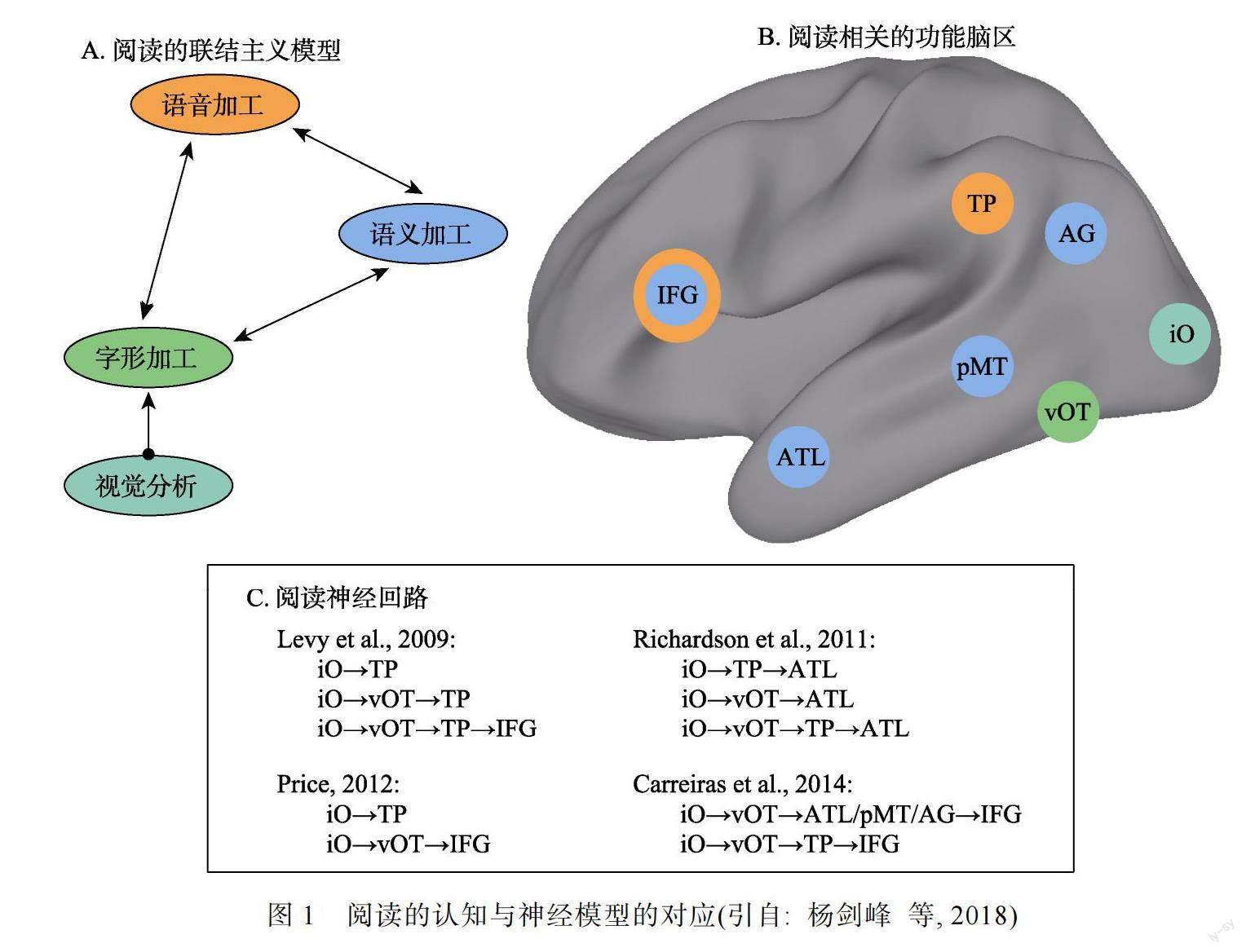
本文涉及的重要理論問題是認知和神經生理統一的閱讀理論模型。研究者基于不同的認知模型嘗試建立認知加工與大腦功能的對應關系。基于視覺加工的背/腹側神經通路, 研究者提出了詞匯閱讀的背/腹側神經通路(Pugh et al., 2000); 基于雙通路理論, 研究者對比不同類型詞匯閱讀的腦區激活差異, 在腦機制上提出了雙通路神經生理模型(Jobard et al., 2003); 隨后更多的研究者嘗試在不同的加工任務下識別詞匯閱讀的神經通路(Levy et al., 2009; Richardson et al., 2011)。而在聯結主義閱讀理論取向下, 研究者在識別詞匯閱讀的語音/語義加工通路的同時, 還考察了加工通路在刺激屬性和加工任務雙重驅動下的動態協作機制(Carreiras et al., 2014; Price, 2012)。如圖1所示, 研究者嘗試建立認知與神經統一的理論模型, 但是還有很多問題亟待解決, 如語義加工涉及了眾多腦區的參與, 未來還需要厘清語義加工神經通路的具體機制。
在神經網絡的研究取向下, 探討詞匯閱讀中神經通路間的動態協作機制是研究者關注的熱點和焦點問題, 目前的研究可以得出以下結論:1)?特定實驗條件下發現的閱讀腦區激活由潛在的加工需求決定, 并表現出閱讀背/腹側神經通路的動態協作; 2) 背/腹側神經通路的動態協作是跨語言普遍的閱讀腦機制; 3) 閱讀經驗對背/腹神經通路動態協作機制的形成起著至關重要的作用。
本文嘗試將閱讀的認知和神經模型統一為潛在加工需求下閱讀神經通路的動態協作機制, 但是, 對一些基本問題還需要進一步厘清:首先, 需要深入闡明潛在加工需求的實質。這里的潛在加工需求是指特定實驗任務下涉及的具體加工, 不同的任務需求對閱讀中的正字法、語音和語義加工具有不同的依賴。而特定任務下不同的閱讀加工成分是否具有實質相同的加工需求, 如加工負荷(Taylor et al., 2013), 或者在多大程度上不同的閱讀加工成分能夠統一為基本的認知加工, 這些問題都還需要深入細致地探討。
其次, 需要闡明動態性的具體體現。一方面, 本文提出的動態性體現在受到實驗任務和實驗材料(詞匯屬性、語言特性)的影響時, 背/腹側閱讀通路表現出腦區激活或功能連接在空間拓撲上的變化。另一方面, 從閱讀經驗對背側和腹側通路動態協作的塑造作用, 嘗試從發展的角度論述閱讀通路協作模式的動態性變化。具體表現為隨著兒童學習經驗的積累, 腦區的參與程度(激活強度和白質密度等)、以及體現在閱讀的背側和腹側通路的連接效率呈現出不同的趨勢。但是, 在“時間”維度上, 文中關于兒童閱讀發展的大尺度研究與其略有相關, 對于更加精細的加工進程層面, 本文沒有提及。如果能從加工進程的“時間”維度闡明閱讀神經通路間的動態協作, 無疑將有利于揭示閱讀網絡動態性的時空特征。
同時, 未來的研究還需要對詞匯閱讀的神經網絡展開深入探討:1) 閱讀相關腦區的功能認識還存在爭論, 很大程度上可能是特定刺激或任務對比導致的潛在加工需求不同并導致了特定的實驗結果。這就需要透過實驗任務或刺激條件的表象, 從潛在加工本質的角度來考察閱讀相關腦區的功能。2) 從神經網絡的角度探討閱讀的腦機制, 不僅需要考察腦區/神經通路間的動態協作機制, 還需要考察特定腦區作為跨認知功能網絡的一部分, 在不同認知加工需求下表現出來的動態激活特性。同時, 詞匯閱讀與視覺客體加工神經網絡的普遍性與特異性問題還需要深入探討。閱讀神經網絡在多大程度上是語言特異性或領域一般性的, 是未來研究需要解決的重要理論問題。3) 當前詞匯閱讀的認知和神經生理模型還不統一, 未來研究需要進一步構建并完善詞匯閱讀的理論模型。
參考文獻
楊劍峰, 黨敏, 張瑞, 王小娟. (2018). 漢字閱讀的語義神經回路及其與語音回路的協作機制. 心理科學進展, 26(3), 381?390.
Barton?, M., Rapcsak, S. Z., Zvon?ák, V., Mare?ek, R., Cvr?ek, V., & Rektorová, I. (2023). Functional neuroanatomy of reading in Czech: Evidence of a dual-route processing architecture in a shallow orthography. Frontiers in Psychology, 13, 1037365.
Bhattacharjee, S., Kashyap, R., O'Brien, B. A., McCloskey, M., Oishi, K., Desmond, J. E., ... Chen, S. H. A. (2020). Reading proficiency influences the effects of transcranial direct current stimulation: Evidence from selective modulation of dorsal and ventral pathways of reading in bilinguals. Brain and Language, 210, 104850.
Bouhali, F., de Schotten, M. T., Pinel, P., Poupon, C., Mangin, J. F., Dehaene, S., & Cohen, L. (2014). Anatomical connections of the visual word form area. Journal of Neuroscience, 34(46), 15402?15414.
Boukrina, O., & Graves, W. W. (2013). Neural networks underlying contributions from semantics in reading aloud. Frontiers in Human Neuroscience, 7, 518.
Braid, J., & Richlan, F. (2022). The functional neuroanatomy of reading intervention. Frontiers in Neuroscience, 16, 921931.
Caffarra, S., Karipidis, I. I., Yablonski, M., & Yeatman, J. D. (2021). Anatomy and physiology of word-selective visual cortex: From visual features to lexical processing. Brain Structure & Function, 226(9), 3051?3065.
Cao, F., Bitan, T., & Booth, J. R. (2008). Effective brain connectivity in children with reading difficulties during phonological processing. Brain and Language, 107(2), 91?101.
Cao, F., Brennan, C., & Booth, J. R. (2015). The brain adapts to orthography with experience: Evidence from English and Chinese. Developmental Science, 18(5), 785?798.
Cao, F., Sussman, B. L., Rios, V., Yan, X., Wang, Z., Spray, G. J., & Mack, R. M. (2017). Different mechanisms in learning different second languages: Evidence from English speakers learning Chinese and Spanish. Neuroimage, 148, 284?295.
Carreiras, M., Armstrong, B. C., Perea, M., & Frost, R. (2014). The what, when, where, and how of visual word recognition. Trends in Cognitive Sciences, 18(2), 90?98.
Chen, Y., Huang, L., Chen, K., Ding, J., Zhang, Y., Yang, Q., ... Guo, Q. (2020). White matter basis for the hub-and-spoke semantic representation: Evidence from semantic dementia. Brain, 143(4), 1206?1219.
Cherodath, S., & Singh, N. C. (2015). The influence of orthographic depth on reading networks in simultaneous biliterate children. Brain and Language, 143, 42?51.
Church, J. A., Coalson, R. S., Lugar, H. M., Petersen, S. E., & Schlaggar, B. L. (2008). A developmental fMRI study of reading and repetition reveals changes in phonological and visual mechanisms over age. Cerebral Cortex, 18(9), 2054?2065.
Coltheart, M., Rastle, K., Perry, C., Langdon, R., & Ziegler, J. (2001). DRC: A dual route cascaded model of visual word recognition and reading aloud. Psychological Review, 108(1), 204?256.
Cross, A. M., Lammert, J. M., Perters, L., Frijters, J. C., Ansari, D., Steinbach, K. A., … Joanisse, M. F. (2023). White matter correlates of reading subskills in children with and without reading disability. Brain and Language, 241, 105270.
Cummine, J., Gould, L., Zhou, C., Hrybouski, S., Siddiqi, Z., Chouinard, B., & Borowsky, R. (2013). Manipulating instructions strategically affects reliance on the ventral-lexical reading stream: Converging evidence from neuroimaging and reaction time. Brain and Language, 125(2), 203?214.
Das, T., Padakannaya, P., Pugh, K. R., & Singh, N. C. (2011). Neuroimaging reveals dual routes to reading in simultaneous proficient readers of two orthographies. Neuroimage, 54(2), 1476?1487.
D?bska, A., Chyl, K., Dzi?giel, G., Kacprzak, A., ?uniewska, M., Plewko, J., ... Jednoróg, K. (2019). Reading and spelling skills are differentially related to phonological processing: Behavioral and fMRI study. Developmental Cognitive Neuroscience, 39, 100683.
Dehaene, S., & Cohen, L. (2011). The unique role of the visual word form area in reading. Trends in Cognitive Sciences, 15(6), 254?262.
Dehaene, S., Cohen, L., Morais, J., & Kolinsky, R. (2015). Illiterate to literate: Behavioural and cerebral changes induced by reading acquisition. Nature Reviews Neuroscience, 16(4), 234?244.
Dehghani, M., Boghrati, R., Man, K., Hoover, J., Gimbel, S. I., Vaswani, A., ... Kaplan, J. T. (2017). Decoding the neural representation of story meanings across languages. Human Brain Mapping, 38(12), 6096?6106.
di Pietro, S. V., Willinger, D., Frei, N., Lutz, C., Coraj, S., Schneider, C., ... Brem, S. (2023). Disentangling influences of dyslexia, development, and reading experience on effective brain connectivity in children. Neuroimage, 268, 119869.
Dickens, J. V., Fama, M. E., deMarco, A. T., Lacey, E. H., Friedman, R. B., & Turkeltaub, P. E. (2019). Localization of phonological and semantic contributions to reading. The Journal of Neuroscience, 39(27), 5361?5368.
Dong, J., Li, A., Chen, C., Qu, J., Jiang, N., Sun, Y., ... Mei, L. (2021). Language distance in orthographic transparency affects cross-language pattern similarity between native and non-native languages. Human Brain Mapping, 42(4), 893?907.
Dong, J., Lu, C., Chen, C., Li, H., Liu, X., & Mei, L. (2020). Functional dissociations of the left anterior and posterior occipitotemporal cortex for semantic and non-semantic phonological access. Neuroscience, 430, 94?104.
Duncan, K. J. K., Twomey, T., Jones, O. P., Seghier, M. L., Haji, T., Sakai, K., ... Devlin, J. T. (2014). Inter- and intrahemispheric connectivity differences when reading Japanese Kanji and Hiragana. Cerebral Cortex, 24(6), 1601?1608.
Feng, X., Altarelli, I., Monzalvo, K., Ding, G., Ramus, F., Shu, H., ... Dehaene-Lambertz, G. (2020). A universal reading network and its modulation by writing system and reading ability in French and Chinese children. Elife Sciences, 9, e54591.
Frost, S. J., Mencl, W. E., Sandak, R., Moore, D. L., Rueckl, J. G., Katz, L., ... Pugh, K. R. (2005). A functional magnetic resonance imaging study of the trade-off between semantics and phonology in reading aloud. Neuroreport, 16(6), 621?624.
Graves, W. W., Desai, R., Humphries, C., Seidenberg, M. S., & Binder, J. R. (2010). Neural systems for reading aloud: A multiparametric approach. Cerebral Cortex, 20(8), 1799?1815.
Graves, W. W., Purcell, J., Rothlein, D., Bolger, D. J., Rosenberg-Lee, M., & Staples, R. (2023). Correspondence between cognitive and neural representations for phonology, orthography, and semantics in supramarginal compared to angular gyrus. Brain Structure and Function, 228(1), 255?271.
Guo, W., Geng, S., Cao, M., & Feng, J. (2022a). The brain connectome for Chinese reading. Neuroscience Bulletin, 38(9), 1097?1113.
Guo, W., Geng, S., Cao, M., & Feng, J. (2022b). Functional gradient of the fusiform cortex for Chinese character recognition. eNeuro, 9(3), 1?12.
Guo, Y., & Burgund, E. D. (2010). Task effects in the mid-fusiform gyrus: A comparison of orthographic, phonological, and semantic processing of Chinese characters. Brain and Language, 115(2), 113?120.
Hodgson, V. J., Lambon Ralph, M. A., & Jackson, R. L. (2021). Multiple dimensions underlying the functional organization of the language network. Neuroimage, 241, 118444.
Hoffman, P., Lambon Ralph, M. A., & Woollams, A. M. (2015). Triangulation of the neurocomputational architecture?underpinning reading aloud. Proceedings of the National Academy of Sciences, 112(28), E3719? E3728.
Houdé, O., Rossi, S., Lubin, A., & Joliot, M. (2010). Mapping numerical processing, reading, and executive functions in the developing brain: An fMRI meta-analysis of 52 studies including 842 children. Developmental Science, 13(6), 876?885.
Huber, E., Donnelly, P. M., Rokem, A., & Yeatman, J. D. (2018). Rapid and widespread white matter plasticity during an intensive reading intervention. Nature Communications, 9(1), 2260.
Jackson, R. L., Hoffman, P., Pobric, G., & Lambon Ralph, M. A. (2016). The semantic network at work and rest: Differential connectivity of anterior temporal lobe subregions. Journal of Neuroscience, 36(5), 1490?1501.
Jamal, N. I., Piche, A. W., Napoliello, E. M., Perfetti, C. A., & Eden, G. F. (2012). Neural basis of single-word reading in Spanish-English bilinguals. Human Brain Mapping, 33(1), 235?245.
Jobard, G., Crivello, F., & Tzourio-Mazoyer, N. (2003). Evaluation of the dual route theory of reading: A metanalysis of 35 neuroimaging studies. Neuroimage, 20(2), 693?712.
Junker, F. B., Schlaffke, L., Lange, J., & Schmidt-Wilcke, T. (2023). The angular gyrus serves as an interface between the non-lexical reading network and the semantic system: Evidence from dynamic causal modeling. Brain Structure Function, Advance online publication. https://doi.org/10. 1007/s00429-023-02624-z
Kim, S. Y., Qi, T., Feng, X., Ding, G., Liu, L., & Cao, F. (2016). How does language distance between L1 and L2 affect the L2 brain network? An fMRI study of Korean-Chinese-English trilinguals. Neuroimage, 129, 25?39.
Koyama, M. S., Martino, A. D., Kelly, C., Jutagir, D. R., Sunshine, J., Schwartz, S. J., ... Milham, M. P. (2013). Cortical signatures of dyslexia and remediation: An intrinsic functional connectivity approach. Plos One, 8(2), e55454.
Krafnick, A. J., Tan, L. H., Flowers, D. L., Luetje, M. M., Napoliello, E. M., Siok, W. T., ... Eden, G. F. (2016). Chinese character and English word processing in children's ventral occipitotemporal cortex: FMRI evidence for script invariance. Neuroimage, 133, 302?312.
Kumar, U., & Padakannaya, P. (2019). The effect of written scripts dissimilarity over ventral and dorsal reading pathway: Combined fMRI & DTI study. Reading and Writing, 32(9), 2311?2325.
Lee, S. H., Booth, J. R., & Chou, T. L. (2016). Temporo- parietal connectivity uniquely predicts reading change from childhood to adolescence. Neuroimage, 142, 126? 134.
Lerma-Usabiaga, G., Carreiras, M., & Paz-Alonso, P. M. (2018). Converging evidence for functional and structural segregation within the left ventral occipitotemporal cortex in reading. Proceedings of the National Academy of Sciences, 115(42), E9981?E9990.
Levy, J., Pernet, C., Treserras, S., Boulanouar, K., Aubry, F., Démonet, J. F., & Celsis, P. (2009). Testing for the dual-route cascade reading model in the brain: An fMRI effective connectivity account of an efficient reading style. Plos One, 4(8), e6675.
Li, A., Yang, R., Qu, J., Dong, J., Gu, L., & Mei, L. (2022). Neural representation of phonological information during Chinese character reading. Human Brain Mapping, 43(13), 4013?4029.
Li, Y., Zhang, L., Xia, Z., Yang, J., Shu, H., & Li, P. (2017). The relationship between intrinsic couplings of the visual word form area with spoken language network and reading ability in children and adults. Frontiers in Human Neuroscience, 11, 327.
Liu, C. Y., Tao, R., Qin, L., Matthews, S., & Siok, W. T. (2022). Functional connectivity during orthographic, phonological, and semantic processing of Chinese characters?identifies distinct visuospatial and phonosemantic networks. Human Brain Mapping, 43(16), 5066?5080.
Lopez-Barroso, D., de Schotten, M. T., Morais, J., Kolinsky, R., Braga, L. W., Guerreiro-Tauil, A., ... Cohen, L. (2020). Impact of literacy on the functional connectivity of vision and language related networks. Neuroimage, 213, 116722.
Ludersdorfer, P., Price, C. J., Kawabata Duncan, K. J., deDuck, K., Neufeld, N. H., & Seghier, M. L. (2019). Dissociating the functions of superior and inferior parts of the left ventral occipito-temporal cortex during visual word and object processing. Neuroimage, 199, 325?335.
Malik-Moraleda, S., Ayyash, D., Galle?e, J., Affourtit, J., Hoffman, M., Mineroff, Z., ... Fedorenko, E. (2022). An investigation across 45 languages and 12 language families reveals a universal language network. Nature Neuroscience, 25, 1014?1019.
Martin, A., Schurz, M., Kronbichler, M., & Richlan, F. (2015). Reading in the brain of children and adults: A meta-analysis of 40 functional magnetic resonance imaging studies. Human Brain Mapping, 36(5), 1963? 1981.
Mattheiss, S. R., Levinson, H., & Graves, W. W. (2018). Duality of function: Activation for meaningless nonwords and semantic codes in the same brain areas. Cerebral Cortex, 28(7), 2516?2524.
Mechelli, A., Crinion, J. T., Long, S., Friston, K., Lambon Ralph, M. A., Patterson, K., ... Price, A. R. (2005). Dissociating reading processes on the basis of neuronal interactions. Journal of Cognitive Neuroscience, 17(11), 1753?1765.
Morken, F., Helland, T., Hugdahl, K., & Specht, K. (2017). Reading in dyslexia across literacy development: A longitudinal study of effective connectivity. Neuroimage, 144(Pt A), 92?100.
Moulton, E., Bouhali, F., Monzalvo, K., Poupon, C., Zhang, H., Dehaene, S., ... Dubois, J. (2019). Connectivity between the visual word form area and the parietal lobe improves after the first year of reading instruction: A longitudinal MRI study in children. Brain Structure and Function, 224(4), 1519?1536.
Murphy, K., Jogia, J., & Talcott, J. (2019). On the neural basis of word reading: A meta-analysis of fMRI evidence using activation likelihood estimation. Journal of Neurolinguistics, 49, 71?83.
Nakamura, K., Kuo, W. J., Pegado, F., Cohen, L., Tzeng, O. J., & Dehaene, S. (2012). Universal brain systems for recognizing word shapes and handwriting gestures during reading. Proceedings of the National Academy of Sciences, 109(50), 20762?20767.
Oliver, M., Carreiras, M., & Paz-Alonso, P. M. (2017). Functional dynamics of dorsal and ventral reading networks in bilinguals. Cerebral Cortex, 27(12), 5431? 5443.
Pattamadilok, C., Chanoine, V., Pallier, C., Anton, J. L., Nazarian, B., Belin, P., & Ziegler, J. C. (2017). Automaticity of phonological and semantic processing during visual word recognition. Neuroimage, 149, 244? 255.
Paulesu, E., McCrory, E., Fazio, F., Menoncello, L., Brunswick, N., Cappa, S. F., ... Frith, U. (2000). A cultural effect on brain function. Nature Neuroscience, 3(1), 91?96.
Price, C. J. (2012). A review and synthesis of the first 20 years of PET and fMRI studies of heard speech, spoken language and reading. Neuroimage, 62(2), 816?847.
Protopapas, A., Orfanidou, E., Taylor, J. S. H., Karavasilis, E., Kapnoula, E. C., Panagiotaropoulou, G., ... Kelekis, D. (2016). Evaluating cognitive models of visual word recognition using fMRI: Effects of lexical and sublexical variables. Neuroimage, 128, 328?341.
Pugh, K. R., Mencl, W. E., Jenner, A. R., Katz, L., Frost, S. J., Lee, J. R., ... Shaywitz, B. A. (2000). Functional neuroimaging studies of reading and reading disability (developmental dyslexia). Mental Retardation and Developmental Disabilities, 6(3), 207?213.
Pugh, K. R., Mencl, W. E., Jenner, A. R., Katz, L., Frost, S. J., Lee, J. R., ... Shaywitz, B. A. (2001). Neurobiological studies of reading and reading disability. Journal of Communication Disorders, 34(6), 479?492.
Qin, L., Lyu, B., Shu, S., Yin, Y., Wang, X., Ge, J., ... Gao, J. H. (2021). A heteromodal word-meaning binding site in the visual word form area under top-down frontoparietal control. Journal of Neuroscience, 41(17), 3854?3869.
Qu, J., Pang, Y., Liu, X., Cao, Y., Huang, C., & Mei, L. (2022). Task modulates the orthographic and phonological representations in the bilateral ventral Occipitotemporal cortex. Brain Imaging and Behavior, 16(4), 1695?1707.
Richardson, F. M., Seghier, M. L., Leff, A. P., Thomas, M. S., & Price, C. J. (2011). Multiple routes from occipital to temporal cortices during reading. The Journal of Neuroscience, 31(22), 8239?8247.
Richlan, F. (2014). Functional neuroanatomy of developmental dyslexia: The role of orthographic depth. Frontiers in Human Neuroscience, 8, 347.
Richlan, F., Kronbichler, M., & Wimmer, H. (2011). Meta-analyzing brain dysfunctions in dyslexic children and adults. Neuroimage, 56(3), 1735?1742.
Rueckl, J. G., Paz-Alonso, P. M., Molfese, P. J., Kuo, W. J., Bick, A., Frost, S. J., ... Frost, R. (2015). Universal brain signature of proficient reading: Evidence from four contrasting languages. Proceedings of the National Academy of Sciences, 112(50), 15510?15515.
Saur, D., Kreher, B. W., Schnell, S., Kümmerer, D., Kellmeyer, P., Vry, M. S., ... Weiller, C. (2008). Ventral and dorsal pathways for language. Proceedings of the National Academy of Sciences, 105(46), 18035?18040.
de Schotten, M. T., Cohen, L., Amemiya, E., Braga, L. W., & Dehaene, S. (2014). Learning to read improves the structure of the arcuate fasciculus. Cerebral Cortex, 24(4), 989?995.
Schurz, M., Wimmer, H., Richlan, F., Ludersdorfer, P., Klackl, J., & Kronbichler, M. (2015). Resting-state and task-based functional brain connectivity in developmental dyslexia. Cerebral Cortex, 25(10), 3502?3514.
Seidenberg, M. S. (2011). Reading in different writing systems: One architecture, multiple solutions. In P. McCardle, J. Ren, & O. Tzeng (Eds.), Dyslexia across language: Orthography and the gene-brain-behavior link?(pp. 151?174). Baltimore, MD: Paul Brooke Publishing.
Shen, Y., & Tufo, S. N. D. (2022). The influence of orthographic depth on multilinguals neural networks. Neuropsychologia, 164, 108095.
Simon, G., Lano?, C., Poirel, N., Rossi, S., Lubin, A., Pineau, A., & Houdé, O. (2013). Dynamics of the anatomical changes that occur in the brains of schoolchildren as they learn to read. Plos One, 8(12), e81789.
Siok, W. T., Jia, F., Liu, C. Y., Perfetti, C. A., & Tan, L. H. (2020). A lifespan fMRI study of neurodevelopment associated with reading Chinese. Cerebral Cortex, 30(7), 4140?4157.
Smith, A. C., Monaghan, P., & Huettig, F. (2021). The effect of orthographic systems on the developing reading system: Typological and computational analyses. Psychological Review, 128(1), 125?159.
Stevens, W. D., Kravitz, D. J., Peng, C. S., Tessler, M. H., & Martin, A. (2017). Privileged functional connectivity between the visual word form area and the language system. Journal of Neuroscience, 37(21), 5288?5297.
Su, M., de Schotten, M. T., Zhao, J., Song, S., Zhou, W., Gong, G., ... Shu, H. (2018). Vocabulary growth rate from preschool to school-age years is reflected in the connectivity of the arcuate fasciculus in 14-year-old children. Developmental Science, 21(5), e12647.
Su, M., Zhao, J., de Schotten, M. T., Zhou, W., Gong, G., Ramus, F., & Shu, H. (2018). Alterations in white matter pathways underlying phonological and morphological processing in Chinese developmental dyslexia. Developmental Cognitive Neuroscience, 31, 11?19.
Sun, Y., Yang, Y., Desroches, A. S., Liu, L., & Peng, D. (2011). The role of the ventral and dorsal pathways in reading Chinese characters and English words. Brain and Language, 119(2), 80?88.
Szwed, M., Dehaene, S., Kleinschmidt, A., Eger, E., Valabregue, R., Amadon, A., & Cohen, L. (2011). Specialization for written words over objects in the visual cortex. Neuroimage, 56(1), 330?344.
Tainturier, M., Sorvisto, P., & Mullins, P. G. (2019, October). Effects of orthographic depth on functional connectivity within reading pathways in proficient bilinguals. Academy of Aphasia 57th Annual Meeting. Macau, Macao, SAR China.
Tan, L. H., Laird, A. R., Li, K., & Fox, P. T. (2005). Neuroanatomical correlates of phonological processing of Chinese characters and alphabetic words: A meta-analysis. Human Brain Mapping, 25(1), 83?91.
Tan, L. H., Spinks, J. A., Feng, C. M., Siok, W. T., Perfetti, C. A., Xiong, J., ... Gao, J. H. (2003). Neural systems of second language reading are shaped by native language. Human Brain Mapping, 18(3), 158?166.
Taylor, J. S., Rastle, K., & Davis, M. H. (2013). Can cognitive models explain brain activation during word and pseudoword reading? A meta-analysis of 36 neuroimaging studies. Psychological Bulletin, 139(4), 766?791.
Taylor, J. S., Rastle, K., & Davis, M. H. (2014). Interpreting response time effects in functional imaging studies. Neuroimage, 99, 419?433.
Taylor, J. S. H., Davis, M. H., & Rastle, K. (2019). Mapping visual symbols onto spoken language along the ventral visual stream. Proceedings of the National Academy of Sciences, 116(36), 17723?17728.
Vanderauwera, J., de Vos, A., Forkel, S. J., Catani, M., Wouters, J., Vandermosten, M., & Ghesquière, P. (2018). Neural organization of ventral white matter tracts parallels the initial steps of reading development: A DTI tractography study. Brain and Language, 183, 32?40.
van der Auwera, S., Vandermosten, M., Wouters, J., Ghesquiére, P., & Vanderauwera, J. (2021). A three-time point longitudinal investigation of the arcuate fasciculus throughout reading acquisition in children developing dyslexia. Neuroimage, 237, 118087.
Wan, N., Hancock, A. S., Moon, T. K., & Gillam, R. B. (2018). A functional near‐infrared spectroscopic investigation of speech production during reading. Human Brain Mapping, 39(3), 1428?1437.
Wandell, B. A., & Le, R. K. (2017). Diagnosing the neural circuitry of reading. Neuron, 96(2), 298?311.
Wang, F., Karipidis, I. I., Pleisch, G., Fraga-Gonzalez, G., & Brem, S. (2020). Development of print-speech integration in the brain of beginning readers with varying reading skills. Frontiers in Human Neuroscience, 14, 289.
Wang, J., Tong, F., Joanisse, M. F., & Booth, J. R. (2023). A sculpting effect of reading on later representational quality of phonology revealed by multi-voxel pattern analysis in young children. Brain and Language, 239, 105252.
Wang, X., Yang, J., Shu, H., & Zevin, J. D. (2011). Left fusiform BOLD responses are inversely related to word-likeness in a one-back task. Neuroimage, 55(3), 1346?1356.
Wang, X., Yang, J., Yang, J., Mencl, W. E., Shu, H., & Zevin, J. D. (2015). Language differences in the brain network for reading in naturalistic story reading and lexical decision. Plos One, 10(5), e0124388.
Wang, X., Zhao, R., Zevin, J. D., & Yang, J. (2016). The Neural correlates of the interaction between semantic and phonological processing for Chinese character reading. Frontiers in Psychology, 7, 947.
Welcome, S. E., & Joanisse, M. F. (2012). Individual differences in skilled adult readers reveal dissociable patterns of neural activity associated with component processes of reading. Brain and Language, 120(3), 360?371.
Woollams, A. M., Halai, A., & Lambon Ralph, M. A. (2018). Mapping the intersection of language and reading: The neural bases of the primary systems hypothesis. Brain Structure Function, 223(8), 3769?3786.
Woolnough, O., Donos, C., Curtis, A., Rollo, P. S., Roccaforte, Z. J., Dehaene, S., ... Tandon, N. (2022). A spatiotemporal map of reading aloud. The Journal of Neuroscience, 42(27), 5438?5450.
Woolnough, O., Donos, C., Rollo, P. S., Forseth, K. J., Lakretz, Y., Crone, N. E., ... Tandon, N. (2021). Spatiotemporal dynamics of orthographic and lexical processing in the ventral visual pathway. Nature Human Behaviour, 5(3), 389?398.
Yang, J., Shu, H., McCandliss, B. D., & Zevin, J. D. (2013). Orthographic influences on division of labor in learning to read Chinese and English: Insights from computational modeling. Bilingualism: Language and Cognition, 16(2), 354?366.
Yang, J., Wang, X., Shu, H., & Zevin, J. D. (2012). Task by stimulus interactions in brain responses during Chinese character processing. Neuroimage, 60(2), 979?990.
Yeatman, J. D., Dougherty, R. F., Ben-Shachar, M., & Wandell, B. A. (2012). Development of white matter and reading skills. Proceedings of the National Academy of Sciences, 109(44), E3045?E3053.
Younger, J. W., Tucker-Drob, E., & Booth, J. R. (2017). Longitudinal changes in reading network connectivity related to skill improvement. Neuroimage, 158, 90?98.
Yu, X., Raney, T., Perdue, M. V., Zuk, J., Ozernov-Palchik, O., Becker, B. L. C., ... Gaab, N. (2018). Emergence of the neural network underlying phonological processing from the prereading to the emergent reading stage: A longitudinal study. Human Brain Mapping, 39(5), 2047? 2063.
Zhang, M., Chen, C., Xue, G., Lu, Z., Mei, L., Xue, H., ... Dong, Q. (2014). Language-general and -specific white matter microstructural bases for reading. Neuroimage, 98, 435?441.
Zhang, Q., Wang, H., Luo, C., Zhang, J., Jin, Z., & Li, L. (2019). The neural basis of semantic cognition in Mandarin Chinese: A combined fMRI and TMS study. Human Brain Mapping, 40(18), 5412?5423.
Zhao, R., Fan, R., Liu, M., Wang, X., & Yang, J. (2017). Rethinking the function of brain regions for reading Chinese characters in a meta-analysis of fMRI studies. Journal of Neurolinguistics, 44, 120?133.
Zhu, L., Nie, Y., Chang, C., Gao, J. H., & Niu, Z. (2014). Different patterns and development characteristics of processing written logographic characters and alphabetic words: An ALE meta-analysis. Human Brain Mapping, 35(6), 2607?2618.
Zhu, L., Niu, Z., Nie, Y., Yang, Y., Li, K., Jin, Z., & Wei, J. (2016). The brain effective connectivity of Chinese during rhyming task. Plos One, 11(9), e0162158.
Ziegler, J. C., Bertrand, D., Toth, D., Csepe, V., Reis, A., Faisca, L., ... Blomert, L. (2010). Orthographic depth and its impact on universal predictors of reading: A cross-language investigation. Psychological Science, 21(4), 551?559.
Zuk, J., Yu, X., Sanfilippo, J., Figuccio, M. J., Dunstan, J., Carruthers, C., ... Gaab, N. (2021). White matter in infancy is prospectively associated with language outcomes in kindergarten. Developmental Cognitive Neuroscience, 50, 100973.
Dynamic collaboration of reading neural pathways driven by the processing demands
DANG Min, CAI Wenqi, CHEN Fakun, WANG Xiaojuan, YANG Jianfeng
(School of Psychology, Shaanxi Normal University, Xian 710062, China)
Abstract: Constructing unified cognitive and neurophysiological models is the central problem in the cognitive neuroscience of word reading. The cognitive models agree that reading is the collaborative outcome of phonological and semantic processing pathways, and studies of cognitive neuroscience have also shown that reading results from a dynamic collaboration between dorsal and ventral neural pathways. In order to systematically elaborate this dynamic collaboration mechanism of the reading network, the latest research progress is systematically disentangled from the following three aspects by combining the two levels of neural function and physiological basis. Firstly, it points out that the underlying processing demand is the essence of the dynamic collaboration between dorsal and ventral neural pathways. Secondly, it further elucidates how underlying processing demand drives the division of labor and collaborative patterns between the dorsal and ventral neural pathways under different levels of orthographic depths. Finally, it profoundly analyzes how latent processing shapes the dynamic collaboration between neural pathways through the language experience. In conclusion, the essence of the division and collaboration between neural pathways might be driven by processing demand under the specific task. It might become a universal cross-language word reading model.
Keywords:?word reading, model, pathway, dynamics of collaboration
猜你喜歡
童話王國·奇妙邏輯推理(2024年5期)2024-06-19 16:03:38
網絡安全與數據管理(2022年1期)2022-08-29 03:15:20
導航定位學報(2022年4期)2022-08-15 08:27:00
中學生數理化·中考版(2022年8期)2022-06-14 06:55:24
新世紀智能(數學備考)(2021年9期)2021-11-24 01:14:36
成都醫學院學報(2021年2期)2021-07-19 08:35:14
新世紀智能(數學備考)(2020年9期)2021-01-04 00:25:14
中學生數理化·七年級數學人教版(2020年10期)2020-11-26 08:24:50
數學物理學報(2020年2期)2020-06-02 11:29:24
光學精密工程(2016年6期)2016-11-07 09:07:19
