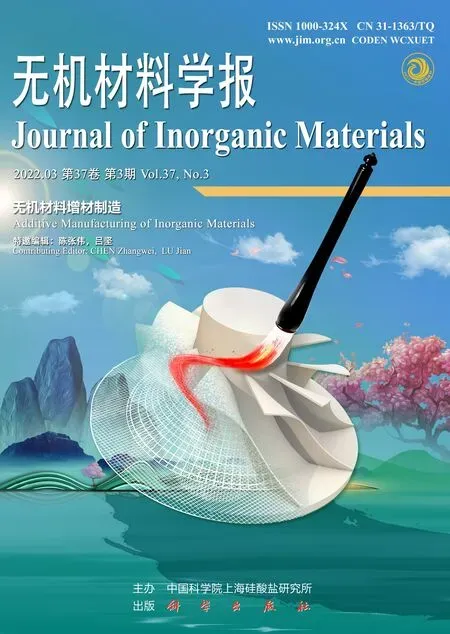
聚能為筆, 化陶成墨, 鐫刻神筆馬良新篇章
2022-06-28 02:06:04陳張偉呂堅
無機材料學報 2022年3期
關鍵詞:研究
陳張偉, 呂堅
聚能為筆, 化陶成墨, 鐫刻神筆馬良新篇章
陳張偉1, 呂堅2
(1. 深圳大學 增材制造研究所, 深圳 518060; 2. 香港城市大學 機械工程學系, 先進結構材料研究中心, 香港 999077)
陶瓷, 是一種歷史悠久且應用廣泛的無機非金屬材料, 在人類文明進程中扮演著至關重要的角色。如今, 陶瓷因其優異的物理和化學性能得到大量的研究和使用, 結構和功能屬性復雜的先進陶瓷材料尤其在機械電子、能源環保、航空航天、生物醫療等高新技術領域占據不可或缺的地位。然而, 陶瓷材料固有的高硬度和高脆性, 使得在制造高度復雜的三維空間形狀或定制化結構與功能產品的時候, 傳統的模具成形和加工技術往往面臨難度高、周期長的技術局限。
增材制造的出現則為突破上述局限提供了全新思路。增材制造技術最早被稱為無模制造或快速原型技術, 直到21世紀才日漸普及并通稱為3D打印技術。美國在20世紀80年代發明的適用于有機樹脂溶液的“立體光刻-Stereolithography (SL)”光固化增材制造技術, 和90年代誕生于德國適用于金屬粉末的“選區激光熔化-Selective Laser Melting (SLM)”增材制造技術是具有劃時代意義且最具代表性的增材制造技術。國際上已經開發了十余種應用于各類材料的增材制造技術。與有機材料和金屬材料相比, 一般陶瓷材料的物理和化學活性較低且熔點較高, 因此部分用于有機和金屬材料的增材制造工藝無法直接用于陶瓷增材制造。盡管如此, 目前已知的大部分陶瓷增材制造技術仍源自有機材料和金屬材料增材制造技術, 導致陶瓷材料的增材制造發展困難, 且發展歷史也相對短暫。增材制造在制造高度復雜結構時所展示的獨特靈活性, 以及組織與功能的定制化優勢, 讓國內外研究人員趨之若鶩, 紛紛投身于陶瓷材料增材制造及其應用研究當中。
近年來, 我國在陶瓷增材制造領域涌現出許多優秀的研究團隊與企業。根據2021年7月由深圳大學陳張偉教授等學者創辦的“第一屆中國陶瓷增材制造前沿科學家論壇(FAME2021)”的初步統計, 目前我國已有超過60所專門從事陶瓷增材制造與應用探索研究的科研院所, 而發展和制造與陶瓷增材制造技術相關的材料、打印工藝裝備以及后處理工藝裝備的生產商則超過了20家。目前, 產學界以陶瓷粉末和樹脂或黏接劑混合的漿料進行光固化, 以SL和數字光處理(Digital Light Processing, DLP)或墨水直寫(Direct Ink Writing, DIW)增材制造工藝的研究占絕大多數。除此以外, 其他研究則以激光選區燒結(Selective Laser Sintering, SLS)和激光定向能量沉積(Laser Directed Energy Deposition, LDED)等采用陶瓷混合粉末及高功率激光的工藝進行直接增材制造為主。在陶瓷材料種類方面, 大部分學者圍繞氧化物陶瓷材料, 如SiO2、ZrO2、Al2O3及其混合或復相材料, 以及PZT、BTO、TCP等先進陶瓷材料開展研究。主要應用方向包括承重組件或功能性部件, 如催化載體、鑄型、隔熱、壓電、傳感、人工骨、齒科、超高溫部件、精密光學件等。而近年來研究人員也紛紛面向結構功能一體化部件, 圍繞非氧化物陶瓷如SiC、Si3N4、AlN, 甚至更為復雜、可生成多元陶瓷的聚合物前驅體轉化陶瓷(Polymer-Derived Ceramics, PDCs)體系等進行增材制造工藝研究, 并取得突出進展。
總體而言, 陶瓷增材制造過程是以陶瓷基材料為“墨”, 以光能、機械能、熱能等能源為“筆”, 就如同中國神話故事“神筆馬良”一樣“畫出”各種結構功能一體化的復雜陶瓷器件。值得注意的是, “神筆馬良”最終練就的是“所畫即所得”的效果。筆者認為, 這恰恰就是增材制造或3D打印追求的終極目標, 即“所打(印)即所得”。當然, 在陶瓷增材制造領域實現“所打即所得”還需要克服諸多挑戰。由于陶瓷具有紛繁復雜的材料性質, 在采用各類方法進行增材制造的過程中均涉及材料體系的制備、成形工藝的適配、熱處理或后處理工藝的優化等問題。正因如此, 在用于成形制造、變形和缺陷抑制、組織和性能調控等方面的材料選取及控制上均需要予以細致全面的考慮和權衡。
2021年下半年, 在FAME2021大會召開之際, 《無機材料學報》編輯部邀請香港城市大學呂堅院士和深圳大學陳張偉教授擔任特邀編輯, 以“無機材料增材制造”為主題組織征稿并制作專輯, 華中科技大學吳甲民副教授亦參與了這次專輯的組織工作。本專輯收錄了我國部分陶瓷增材制造的最新研究成果和綜述文章, 體現了我國陶瓷增材制造研究的前沿進展。由于時間和篇幅所限, 還有一些優秀的研究未能及時收錄在本專輯中。希望本專輯能夠拋磚引玉, 為促進我國陶瓷增材制造研究與應用發展提供有益參考。我們相信在全球學者的不懈努力和推動下, 聚能為筆, 化陶成墨, 陶瓷增材制造一定能夠鐫刻神筆馬良新篇章, 完成從“聚沙成塔”的工藝工程研究到“點石成金”的高附加值普及應用的飛躍。
Marking a New Chapter like ‘Ma Liang the Magic Brush’ with Focused Energies as Pens and Ceramics as Inks
CHEN Zhangwei1, LU Jian2
(1. Additive Manufacturing Institute, Shenzhen University, Shenzhen 518060, China; 2. Centre for Advanced Structural Materials, Department of Mechanical Engineering, City University of Hong Kong, Hong Kong 999077, China)
Ceramics are a series of inorganic nonmetallic materials with a long history and have been extensively used. They have been playing a vital role in the human civilization process. Nowadays, as one of the three pillars in the material systems for modern industry, ceramics with excellent physical and chemical properties have been increasingly used and researched and become indispensable in the high-tech application fields such as machinery and electronics, energy and environmental protection, aerospace and biomedical industries, especially for the advanced ceramics with complex and integrated structural and functional properties. However, due to their inherent high hardness and brittleness, when manufacturing ceramic products with highly complex three-dimensional shapes or customized structures and functions, the traditional molding and machining technologies often face certain technical limitations with great difficulty and long production cycle.
The emergence of additive manufacturing (AM) paves a new way to break through above limitations. AM technology is earliest known as freeform fabrication (FFF) or rapid prototyping (RP) technology, was gradually popular with the general public and is now commonly known as 3D printing technology in this century. ‘Stereolithography (SL)’ photopolymerization additive manufacturing technology suitable for organic resin solutions and ‘Selective Laser Melting (SLM)’ additive manufacturing technology for metal powders, were invented in the US and Germany in the 1980s and 1990s, respectively. These two epoch-making technologies are the most significant representatives of all AM technologies. At present, over ten types of additive manufacturing technologies have been developed for various raw materials. However, compared with organic and metallic materials, ceramics generally possess lower physical and chemical activities and higher melting points; some AM processes used for organic and metallic materials cannot be directly applied to ceramic materials. Nevertheless, currently most of the ceramic AM technologies are derived from that made for organic and metallic materials. This makes the development of AM technologies for ceramic materials difficult, and thus its development history is relatively shorter. However, the magic and charm of AM lie in its unique flexibility of manufacturing highly complex shapes, as well as the advantages of customized structures and functions, which extensively attract worldwide researchers to investigate AM of ceramic materials and their applications.
In recent years, a number of excellent research groups and industrial organizations have sprung up in the field of ceramic AM. According to the statistics preliminary generated from the 1stNational Forum on Additive Manufacturing of Ceramics (FAME2021) initiated by Prof. CHEN Zhangwei of Shenzhen University in July 2021, there are approximately over 60 institutes in China specializing in the research of ceramic AM and applications, while more than 20 industrial manufacturers are involved in the development and fabrication of materials, printing process equipment, and post-processing equipment that are relevant to ceramic AM technology. Among them, the majority of research focuses on the AM of photopolymerization (including SL and Digital Light Processing (DLP)) or Direct Ink Writing (DIW) using the mixtures of ceramic powders and resins/adhesives. The rest mainly utilizes ceramic powders and high-power lasers such as Selective Laser Sintering (SLS), Laser Directed Energy Deposition (LDED), and other processes for direct AM of ceramics. In terms of the types of ceramic materials involved, most research focuses on oxide ceramic materials, such as SiO2, ZrO2, Al2O3, and their mixed or multiphase materials, as well as PZT, BTO, TCP, and other advanced ceramics. The main application directions include load-bearing components and functional parts, such as catalytic carriers, casting molds, heat insulation, piezoelectric, sensors, artificial bones, dentistry, ultra-high temperature parts, optics, and other fields. Besides, in recent years, researchers have also turned to AM of non-oxide ceramics such as SiC, Si3N4, AlN, and even more complex Polymer-Derived Ceramics (PDCs) that generate polynary ceramics, and substantial progress has been achieved.
In general, the ceramic AM processes take ceramic-based materials as ‘inks’ and focused energies such as light energy, mechanical energy and heat energy as ‘pens’, to ‘draw’ a variety of complex ceramic devices with integrated structures and functions, which is similar with the Chinese fairy tale of ‘Ma Liang the Magic Brush’. It is noteworthy that the outcome of ‘Ma Liang the Magic Brush’ was ‘What You Draw Is What You Get’. In our opinion, this is exactly the ultimate goal of AM or 3D printing, namely ‘What You Print Is What You Get’. There are still numerous challenges to overcome to achieve ‘What You Print Is What You Get’ in the field of ceramic AM. Due to the complicated material properties of ceramics, the process of shaping by various AM technologies involves the preparation of the material feedstock systems, the adaptation of forming process, and the optimization of heat treatment and post-treatment process. Therefore, material selection and controls over the forming process, deformation and defect, structures and properties, and other aspects require overall investigation and careful balance.
In the second half of 2021, while the conference of FAME2021 was held, the Editorial Board of theinvited Prof. LU Jian from the City University of Hong Kong (CUHK) and Prof. CHEN Zhangwei from Shenzhen University (SZU) as guest editors to organize this Special Issue (SI) themed ‘Additive Manufacturing of Inorganic Materials’. Prof. WU Jiamin from Huazhong University of Science and Technology (HUST) also contributed to the organization of the SI. This SI focuses on some of the latest research outcomes and review articles in the field of ceramic AM in China, representing the frontier progress of ceramic AM research in China. Due to the limitations of time and space, some excellent work cannot be included in this SI in a timely manner. We hope that the SI can provide a useful reference for promoting the research and application development of ceramic AM in China. With ceramics as inks and focused energies as pens, would ceramic AM mark the new chapter like ‘Ma Liang the Magic Brush’, manifesting a significant leap from the processing and engineering research of ‘Accumulating sands to form a pagoda’ to the popularized application of high added value of ‘Turning stones into gold by touching’? We believe that with the unremitting efforts and progress made by researchers worldwide, this dream will eventually come true in the near future!

陳張偉, 深圳大學長聘教授、增材制造研究所所長、深圳大學優秀學者。英國帝國理工學院哲學博士(2014)、博士后。帝國理工校長獎學金獲得者, 帝國理工年度唯一John Kilner Prize優秀博士論文獎獲得者。從事以陶瓷材料為主的增材制造與創新應用研究10余年。受邀擔任中國機械工程學會增材制造分會委員、中國硅酸鹽學會測試技術分會理事、特陶分會青年委員, 以及中國醫療器械行業協會3D打印醫療器械專業委員會團體標準指導專家;擔任SCI期刊《Journal of Advanced Ceramics》和EI期刊《材料工程》編委、SCI期刊《無機材料學報》和《Crystals》增材制造專輯特邀編委、《Open Ceramics》客座編輯, 以及《SVOA Materials Science and Technology》《Frontiers in Materials and Nanoscience》《精密成形工程》《航空材料學報》期刊編委/青年編委等;參與制定中國機械工程學會《中國機械工程技術路線圖(2021版)》陶瓷增材制造相關內容。作為創始主席發起創辦了“第一屆中國陶瓷增材制造前沿科學家論壇FAME2021”, 該論壇入選“2021年度中國科協重要學術會議指南”。受邀擔任國內外重要增材制造會議共同主席并做大會報告/特邀報告近20次。擔任《Nature Communications》 《Materials Horizons》等三十余本高水平期刊審稿人, 以及中國國家自然科學基金、加拿大工程和自然科學研究基金NSERC、新加坡A STAR政府基金、新西蘭政府Marsden Fund基金以及廣東、北京、陜西、深圳等多個省市項目評審專家。2017至今主持和參與陶瓷增材制造相關的國家和省市級項目20余項, 并與華為等知名企業開展合作研究。在《Acta Materialia》《Additive Manufacturing》《Virtual and Rapid Prototyping》《Materials Research Letter》《Journal of Advanced Ceramics》 《Journal of the European Ceramic Society》 《無機材料學報》 《機械工程學報》 《硅酸鹽學報》等國內外期刊發表高水平論文70余篇, 單篇最高被引超600次, 入選ESI高被引和熱點論文1篇。申請和授權發明專利10余項。研究成果獲中央主流媒體《科技日報》的長篇專訪報道以及新華網、人民網、環球網等知名媒體平臺的轉載報道。2017年至今共指導博士后8名、博士生3名、碩士生近20名。
E-mail: chen@szu.edu.cn

呂堅, 香港城市大學機械工程學系及材料科學與工程系講座教授, 法國國家技術科學院院士。香港材料研究會理事長, 香港創新科技及再工業化委員會委員, 廣東省大灣區激光與增材制造產業技術創新聯盟副理事長, 中國增材制造聯盟專家委員會副主任委員, 中國力學學會特邀理事, 廣東省松山湖材料實驗室戰略咨詢委員會及學術委員會委員。2006年獲法國國家榮譽騎士勛章, 2011年當選法國國家技術科學院院士;2017年獲法國國家榮譽軍團騎士勛章;2018年獲中國工程院第十二屆光華工程科技獎。曾先后擔任法國機械工業技術中心(CETIM)高級研究工程師和實驗室負責人, 法國特魯瓦技術大學機械系統工程系系主任, 法國教育部與法國國家科學中心(CNRS)機械系統與并行工程實驗室主任, 香港理工大學機械工程系系主任、副院長, 香港城市大學科學與工程學院院長, 香港城市大學副校長(研究與科技)兼周亦卿研究生院院長, 香港力學學會理事長, 香港研究資助局(RGC)委員等職。目前擔任《Nano Materials Science》《Science China Technological Sciences》等高水平期刊的主編或編委。研究方向涉及3D/4D打印材料、工藝與性能, 先進結構與功能納米材料的制備與物理及化學性能;生物與仿生材料;實驗力學與塑性力學;以及結構材料預應力工程等。研究團隊在《Nature》(封面文章), 《Science》《Nature Materials》《Science Advances》《Advanced Materials》《Materials Today》《Nature Communications》等知名期刊上發表論文450余篇, 引用30700余次(Google Scholar)。取得51項國內外專利授權, 其中4D打印陶瓷技術已經獲得美國專利局授權3項專利, 并被歐盟委員會選為100項可能對全球經濟產生重大影響的顛覆性技術(100 Radical Innovation Breakthroughs for the future)之一。
E-mail: jianlu@cityu.edu.hk
1000-324X(2022)03-0237-04
10.15541/jim20211003
猜你喜歡
體育科技文獻通報(2022年3期)2022-05-23 13:46:54
天津外國語大學學報(2021年3期)2021-08-13 08:32:18
遼金歷史與考古(2021年0期)2021-07-29 01:06:54
科技傳播(2019年22期)2020-01-14 03:06:54
遼金歷史與考古(2019年0期)2020-01-06 07:45:20
民用飛機設計與研究(2019年4期)2019-05-21 07:21:24
電子制作(2018年11期)2018-08-04 03:26:04
汽車工程學報(2017年2期)2017-07-05 08:13:02
國際商務財會(2017年8期)2017-06-21 06:14:14
電子制作(2017年23期)2017-02-02 07:17:19