智能服裝購買意愿影響機制實證研究
2022-05-25 17:14:59葉晶裘玉英陳亭羽凡欣
絲綢 2022年5期
關鍵詞:購買意愿
葉晶 裘玉英 陳亭羽 凡欣



摘要: 智能服裝作為服裝前沿技術,受到越來越多的企業和消費者的關注。了解消費者對智能服裝購買意愿,有助于智能服裝產業的發展。本文基于實證研究,構建消費者智能服裝購買意愿的結構方程模型,通過調研問卷收集數據,并采用偏最小二乘法對模型進行假設驗證。研究結果表明:感知有用性和態度正向顯著影響消費者智能服裝的購買意愿;消費者態度受感知有用性和易用性的影響;感知有用性受感知易用性、智能服裝表達性的影響;智能服裝的功能性和表達性均顯著影響感知易用性。最后為智能服裝的發展提出了相關建議。
關鍵詞: 技術接受模型;智能服裝;購買意愿;偏最小二乘法;結構方程模型;FEA模型
中圖分類號: TS941.1文獻標志碼: A文章編號: 10017003(2022)05007708
引用頁碼: 051111DOI: 10.3969/j.issn.1001-7003.2022.05.011
智能服裝通過集成紡織科學、材料科學、微電子技術、軟件技術和通信技術,在保證服裝穿著舒適性的前提下,通過感知人體和環境的變化,為用戶提供智能分析、決策支撐和反饋控制[1-3]。智能服裝的三個基本要素是感知、反饋和反應。根據采用技術的不同,智能服裝可分為功能性材料類智能服裝和電子信息類智能服裝[4]。相較于傳統的功能性服裝只針對特定職業需求和較為固定的功能指向及封閉的配件系統,智能服裝拓展了應用范圍、提升了功能并改變了產品屬性。
目前,國內學者對智能服裝的研發已進行較為深入的研究,但研究智能服裝商業化的文獻數量較技術研究少,而且大多是綜述性研究,實證性的研究相對較少。國內大多數學者采用調研問卷的形式研究消費者的智能服裝購買行為,但大多側重在消費者需求[5-6]。另一方面,國外學者從創新性[7-8]、價格[9]、信任[10]、社會接受度和產品屬性[11]等不同的角度,研究了智能服裝消費者購買行為。技術接受模型(Technology acceptance model,TAM)被認為是解釋用戶對新技術接受和使用意愿的最有效模型[12],國內部分學者已采用TAM來研究服裝領域內的消費者行為,如虛擬試衣的使用意愿[13]和網購服裝意愿[14],而采用TAM研究用戶智能服裝購買意愿的卻寥寥無幾。
因此,本研究以技術接受模型為理論基礎,以功能性-表達性-美學性(Function-expressive-aesthetic,FEA)模型為外部變量,提出了一個擴展的技術接受模型。在已有文獻的基礎上提出若干研究假設,運用調研問卷對消費者智能服裝購買意愿進行調研,運用SPSS軟件對調研數據進行數據,并采用偏最小二乘結構方程模型(Partial least squares structural equation model,PLS-SEM)對研究假設進行檢驗,旨在揭示消費者對智能服裝購買意愿的影響機理和路徑。最后,針對智能服裝的研發提出相應建議。
1理論模型與研究假設
1.1技術接受模型及相關假設
Davis[12]在理性行為理論的基礎上,提出了TAM來研究用戶對信息系統的接受度。該模型是研究用戶對新技術接受行為最常用的模型,感知有用性和易用性作為核心變量,都會影響用戶對新技術的態度。同時,感知易用性影響感知有用性,態度和感知有用性均影響用戶的使用或購買意愿。目前,部分國外學者以TAM為理論基礎,研究消費者的智能服裝購買行為[15-16]。智能服裝作為眾多前沿技術的結合體,非常適合運用技術接受模型進行研究。由于前人的研究大多基于國外消費者,所以本研究以TAM為基礎,研究國內用戶智能服裝購買意愿。
感知有用性是指消費者認為使用特定系統會對其表現有幫助的程度[12]。Wang等[17]在研究親子智能服裝時發現,感知有用性影響消費者的購買態度和意愿。Noh等[16]以韓國消費者為調研對象研究生物智能服裝的購買意愿時,發現感知有用性對韓國消費者購買意愿有顯著影響。基于國外學者的研究分析,本研究提出針對中國消費者的研究假設:
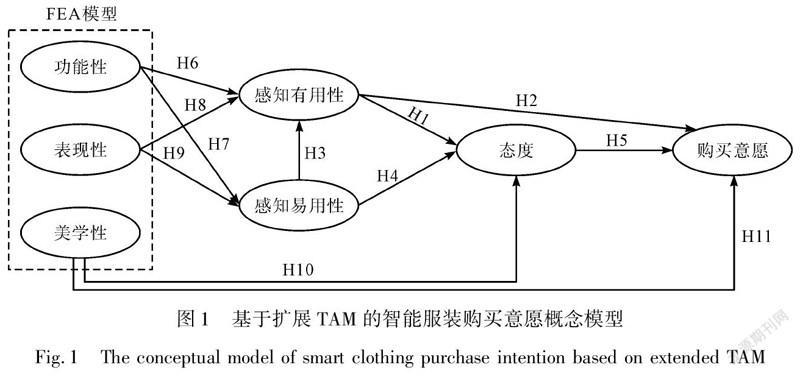
H1:感知有用性正向影響態度。
H2:感知有用性正向影響購買意愿。
感知易用性指消費者認為使用特定系統時的難易程度[12]。Park等[18]和Hwang等[19]研究均發現感知易用性正向影響感知有用性。Kim等[20]和Chae[7]研究均發現感知易用性正向影響用戶對智能服裝的態度。這些結論不是針對中國消費者,在跨文化背景下是否成立,還不能確定。所以,本研究提出如下假設,用以驗證相關結論針對中國消費者是否成立:
H3:感知易用性正向影響感知有用性。
H4:感知易用性正向影響態度。
態度是指個體對周圍環境滿意或不滿意的反應,這種反應體現在其信念、感覺或行為意向[21]。Bakhshian等[11]和Hwang等[19]研究發現消費者的態度顯著影響智能服裝使用意愿。基于上述分析,本研究提出如下假設:
H5:態度正向顯著影響購買意愿。
1.2FEA模型
隨著信息技術的不斷發展,許多學者試圖在外部變量中加入新理論或模型來擴展技術接受模型。外部變量作為外部客觀條件的一些刺激因素,會影響用戶的感知有用性和易用性。Lamb等[22]提出了以消費者需求為主的FEA功能性服裝設計模型,部分學者采用FEA模型進行了功能性服裝的設計[23-24]。盡管智能服裝具有復雜性,但必須滿足消費者對服裝的需求[19]。因此,本研究將FEA模型作為技術接受模型的外部變量,研究其對消費者智能服裝的態度和購買意愿的影響。
1.2.1功能性
在FEA模型中,功能性需求包含合身性、移動性、保護性和舒適性,這些因素都與服裝的實用性有關,影響用戶對新技術的接受[19]。Bakhsian等[25]研究發現,可穿戴設備的功能正向影響消費者的購買期望。Hwang等[19]研究太陽能智能服裝時,發現舒適性對消費者的感知有用性和易用性有顯著的正向影響。因此,本研究提出如下假設:
H6:功能性正向影響感知有用性。
H7:功能性正向影響感知易用性。
1.2.2表達性
表達性涉及身份的象征性傳播特征,如價值觀、角色和自尊[17]。基于服裝的社會文化和心理層面,表達性指服裝產品應該與用戶的地位與自我形象相匹配。在智能服裝方面,Ko等[26]將表達性定義為對創新的感知程度與潛在用戶現有的價值觀、需求等的匹配性,同時發現,匹配性對用戶智能服裝的接受度有正向顯著影響。Wang等[17]研究發現,親子智能服裝的表達性對用戶感知有用性和易用性有正向影響。因此,本研究提出如下假設:
H8:表達性正向影響感知有用性。
H9:表達性正向影響感知易用性。
1.2.3美學性
美學性主要指服裝中設計元素的使用[22],如通過線條、廓形、顏色、紋理、圖案等元素創造一個令人愉悅的設計[27],美學性是消費者評價服裝的重要標準。服裝通過顏色、款式、設計及其他元素進行視覺傳達,智能服裝也屬于服裝類別,有研究發現美學性會影響消費者對服裝的態度和購買行為[28-29],Malmivaara[30]研究認為,美學性是影響消費者智能服裝產品接受度和穿戴性的重要因素。Wang等[17]研究發現,美學性對智能服裝消費者態度有正向影響,而對智能服裝的購買意愿沒有影響。Hwang等[19]研究發現,美學性對智能服裝消費者態度和購買意愿有顯著影響。綜合上述分析,本研究提出如下假設:
H10:美學性正向影響態度。
H11:美學性正向影響購買意愿。
基于上述研究假設,本研究構建了基于TAM和FEA的消費者智能服裝購買意愿模型,如圖1所示。
2研究設計
2.1問卷設計與數據收集
調研問卷主要由三部分構成:一是智能服裝的視頻介紹,視頻選取了國內外三款典型的智能服裝進行介紹,包括智能監測、智能交互和智能調節等功能;二是調研對象的基本情況;三是測量模型。為了保證問卷的信效度,本研究參照國內外相關研究文獻中已通過實證檢驗的成熟量表,設計了初始問卷。問卷從7個變量出發,每個變量由4~5個題目構成,共設計出31道測量項。然后邀請30名在校本科生進行小規模的預調研,對問卷中表述模糊的題項進行調整,形成最終問卷。所有變量均采用Likert 5級量表進行測量,1分表示“非常不同意”,5分表示“非常同意”。本研究依托網絡平臺“問卷星”投放并收集調研問卷,調研時間為2021年5月至10月,刪除答題時間過短問卷后,共收集到212份有效問卷。量表具體內容如表1所示。
2.2樣本描述統計分析
本研究采用SPSS24對樣本統計分析(表2)。此次調研對象中,女性調研樣本占82.1%,83.5%的調研對象為18~25歲,本科以上學歷比例高達97.2%,月均可支配收入在1 000~3 000元占75.5%。近47%的用戶對智能服裝不太了解,42%的用戶對智能服裝有不同程度的了解。
3數據分析與假設檢驗
本研究采用偏最小二乘法進行數據分析,相較于基于協方差的結構方程模型,PLS對正態分布的要求較低,且更加適合中小規模的樣本[36-37]。本研究使用SmartPLS3.2.9軟件進行數據分析和假設檢驗。
3.1多重共線性檢驗
本研究使用方差膨脹因子(VIF)進行多重共線性檢驗。根據Hair等[38]的研究發現,當VIF≤3時,潛變量之間不存在共線性情況。本研究對所有潛變量VIF值進行檢驗,發現所有潛變量的VIF值介于1.443~2.964,皆小于閾值3,說明各潛變量之間不存在多重共線性問題。針對樣本正態分布情況,本研究使用SPSS中的Q-Q圖進行判斷,結果表明各變量均服從正態分布。
3.2信效度檢驗
信度(Reliability)檢驗主要用于檢驗問卷的內部穩定性和一致性,通常要求Cronbach’s α值和組合信度(Composite reliability,CR)均大于0.700[39]。本研究的信度檢驗結果如表3所示,所有潛變量的Cronbach’s α和CR值均大于0.700,說明所有變量具有較高的信度。
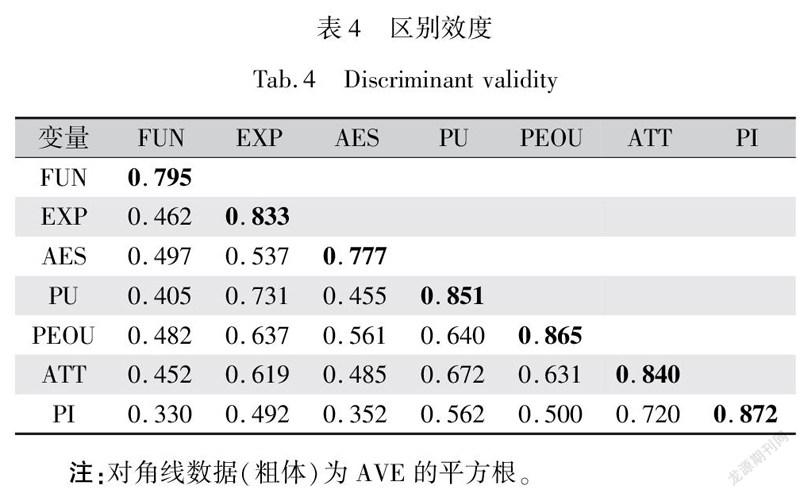
效度(Validity)主要用于檢驗測量結果能準確反映問卷所要解釋構念的程度,包括聚合效度和區別效度。由表3可知,各變量的因子載荷大于0.700,且平均方差萃取(Average variance extracted,AVE)值大于0.500時,表示具有良好的聚合效度。由表4可以看出,所有變量AVE的平方根大于各潛變量間的相關系數,表示潛變量間具有良好的區別效度。
3.3假設檢驗
本研究采用PLS-SEM來檢驗研究模型中各路徑假設,使用Bootstrapping反復抽樣法抽取5 000次進行參數計算與評價模型系數的顯著性,具體結果如表5所示。
從表5可以看出,本研究的11個假設中,除假設H6和H11不顯著外,其余假設的路徑系數T值均大于1.960,并且在0.050的水平上顯著,假設成立。
3.4結果分析
從表5可以看出,在TAM模型的檢驗中,感知有用性對消費者態度(β=0.433,p<0.001)和購買意愿(β=0.148,p=0.045)均具有正向顯著影響,假設H1和H2得到驗證。由于智能服裝具有各種不同的功能,這些功能能夠提高消費者的生活質量和工作效率等,滿足消費者的需求,從而使消費者對智能服裝產生積極的態度。同時,消費者也會因此而購買智能服裝。感知易用性均正向顯著影響感知有用性(β=0.287,p<0.001)和態度(β=0.280,p=0.001),假設H3和H4得到驗證。由于智能服裝的交互和穿著方法簡單,同時智能服裝又滿足了消費者對功能的需求,會使消費者感知到智能服裝的有用性,同時也會對智能服裝持積極的態度。最后,消費者的態度正向顯著影響購買意愿(β=0.631,p<0.001)。當消費者對智能服裝持積極的態度后,消費者就會產生購買意愿。由此可見,本研究與原始TAM的結論相吻合,說明TAM在解釋國內消費者的智能服裝購買意愿時仍有很好的適配性。
在FEA模型中,功能性對感知有用性的影響未能達到顯著,假設H6未能通過檢驗,分析認為原因是功能性題項設計沒有提供更多的功能項說明,使得消費者覺得問卷中提到的這些功能不能對其提供很好的幫助。功能性對感知易用性(β=0.239,p<0.001)有正向顯著影響,假設H7通過檢驗,說明智能服裝在滿足復雜功能需求的前提下,同時穿著和交互簡單,這會讓消費者很容易接受智能服裝。在表達性方面,可以發現表達性對用戶感知有用性(β=0.540,p<0.001)和易用性(β=0.527,p<0.001)具有正向顯著影響,假設H8和H9通過驗證,說明用戶在穿著智能服裝時,非常重視服裝的表達性。表達性包含創新,這就意味著消費者認為智能服裝穿著簡單,不需要花費更多的時間學習使用新技術,同時滿足了消費者需求,消費者就會選擇智能服裝。在美學性方面,美學性正向顯著影響消費者態度(β=0.131,p=0.041),假設H10通過驗證,說明美學性是消費者選購智能服裝的一個重要因素。設計的智能服裝具有很強的審美性,并與當下的時尚風格相兼容,可以讓消費者在不失去時尚感的情況下使用最新的服裝技術,進而改變消費者對智能服裝的看法。另一方面,美學性對購買意愿的影響未達到顯著,假設H11未能通過檢驗,分析認為原因是現在的智能服裝在設計上不能符合當下的設計風格,使得消費者缺少購買意愿。
3.5策略建議
根據上述研究結果,本研究提出如下策略建議:
1) 在未來的智能服裝設計中,要充分重視智能服裝的表達性和功能性,既要滿足消費者的需求、期望和感知,又要符合消費者的生活方式。研發智能服裝時需要考慮到舒適性、保護性等功能,降低消費者的穿戴負擔,突出產品的實用性,如隨意折疊、洗滌和易于護理,同時智能服裝的開發應該迎合用戶的不同功能需求。
2) 未來智能服裝的設計和使用應考慮有用性與易用性。智能服裝使用交互方面,目前智能服裝大多是單方面的信息收集和呈現,缺乏與用戶的交流。在未來的智能服裝交互中,可以加入語音識別交互、手勢交互、生物反饋交互或情景感知。通過簡單的交互,讓消費者更加熟練穿著,提高工作效率與生活質量。
3) 雖然美學性對消費者購買意愿的影響不大,但也不容忽視。現階段的智能服裝多是服裝和電子元器件的簡單相加,設計感較差。若使智能服裝被年輕消費者接受,智能服裝的面料、款式、色彩等應與當前的時尚風格相兼容,增強智能服裝的科技感和美感,使其更容易進入服裝消費領域。
4結語
本研究以技術接受模型(TAM)和FEA模型為理論研究基礎,建立消費者智能服裝購買意愿模型,設計相應的調研問卷。對收集的數據運用SPSS軟件和SmartPLS軟件進行分析,運用PLS-SEM對研究假設進行檢驗。通過分析可知,FEA模型中功能性和表達性均顯著影響感知易用性;感知有用性、易用性和美學性均正向顯著影響消費者對智能服裝的態度;感知有用性和態度均影響用戶購買意愿,而美學性對購買意愿無影響。
此外,本研究還存在一定的局限性:1) 沒有將智能服裝的價格因素納入考慮范圍。2) 智能服裝的類別較多,沒有具體研究某種類別的智能服裝的購買意愿,后期的研究可以考慮選擇某一類別的智能服裝進行深入。3) 調研樣本量偏少,且調研對象集中在18~25歲,可能會對樣本的代表性和結論產生一定的影響,未來研究需增加調研數量和范圍。
參考文獻:
[1]陳雁. 服裝設計與工程學科發展趨勢與關鍵議題[J]. 紡織學報, 2019, 40(1): 182-188.CHEN Yan. Trends and key subjects of apparel design and engineering[J]. Journal of Textile Research, 2019, 40(1): 182-188.
[2]沈雷, 李儀, 薛哲彬. 智能服裝現狀研究及發展趨勢[J]. 絲綢, 2017, 54(7): 38-45.SHEN Lei, LI Yi, XUE Zhebin. Current situation and development trend of intelligent garment[J]. Journal of Silk, 2017, 54(7): 38-45.
[3]田苗, 李俊. 智能服裝的設計模式與發展趨勢[J]. 紡織學報, 2014, 35(2): 109-115.TIAN Miao, LI Jun. Design mode and development tendency of smart clothing[J]. Journal of Textile Research, 2014, 35(2): 109-115.
[4]郝靜雅, 李艷梅. 智能服裝發展現狀及趨勢[J]. 紡織導報, 2020(4): 62-65.HAO Jingya, LI Yanmei. Development and trend of intelligent clothing[J]. China Textile Leader, 2020(4): 62-65.
[5]胡彩麗, 方方, 溫雯, 等. 跑步智能可穿戴產品的消費需求與現狀匹配分析[J]. 毛紡科技, 2019, 47(10): 60-65.HU Caili, FANG Fang, WEN Wen, et al. Matching analysis of consumer demand and current status of running intelligent wearable products[J]. Wool Textile Journal, 2019, 47(10): 60-65.
[6]陳桂清, 陳沖, 徐增波, 等. 智能溫控服裝的開發需求調研及其分析[J]. 毛紡科技, 2018, 46(9): 55-60.CHEN Guiqing, CHEN Chong, XU Zengbo, et al. Survey and analysis on the development demands of intelligent temperature control garment[J]. Wool Textile Journal, 2018, 46(9): 55-60.
[7]CHAE J. Consumer acceptance model of smart clothing according to innovation[J]. International Journal of Human Ecology, 2009, 10(1): 23-33.
[8]KO E, SUNG H, YOON H. The effect of attributes of innovation and perceived risk on product attitudes and intention to adopt smart wear[J]. Journal of Global Scholars of Marketing Science, 2008, 18(2): 89-111.
[9]PARK H, NOH M. The influence of innovativeness and price sensitivity on purchase intention of smart wear[J]. Journal of the Korean Society of Clothing and Textiles, 2012, 36(2): 218-230.
[10]PARK H, NOH M. The influence of consumers’ innovativeness and trust on acceptance intention of sensor-based smart clothing[J]. Journal of the Korean Society for Clothing Industry, 2012, 14(1): 24-36.
[11]BAKHSHIAN S, LEE Y A. Social acceptability and product attributes of smart apparel: Their effects on consumers’ attitude and use intention[J]. The Journal of The Textile Institute, 2022, 113(4): 671-680.
[12]DAVIS F D. Perceived usefulness, perceived ease, and user acceptance of information technology[J]. MIS Quarterly, 1989, 13(3): 319-340.
[13]葉晶, 郭香梅. 基于技術接受模型的虛擬試衣使用意愿研究[J]. 絲綢, 2021, 58(3): 58-64.YE Jing, GUO Xiangmei. Research on the intention to use virtual fitting based on the technology acceptance model[J]. Journal of Silk, 2021, 58(3): 58-64.
[14]方靖, 龐琛, 季曉芬. 消費者服裝產品知識對網上購買服裝意向的影響[J]. 絲綢, 2009(8): 34-36.FANG Jing, PANG Chen, JI Xiaofen. The influence of apparel knowledge on online clothing purchase intention[J]. Journal of Silk, 2009(8): 34-36.
[15]MAHMOOD N, LEE Y A. Factors influencing older adults’ acceptance of health monitoring smart clothing[J]. Family and Consumer Sciences Research Journal, 2021, 49(4): 376-392.
[16]NOH M, LI Q, PARK H. An integration model for innovative products in Korea and China: Bio-based smart clothing[J]. International Journal of Product Development, 2016, 21(1): 59.
[17]WANG W, WANG S. Toward parent-child smart clothing: Purchase intention and design elements[J]. Journal of Engineered Fibers and Fabrics, 2021, 16(1): 1-13.
[18]PARK Y, CHEN J V. Acceptance and adoption of the innovative use of smartphone[J]. Industrial Management & Data Systems, 2007, 107(9): 1349-1365.
[19]HWANG C, CHUNG T, SANDERS E A. Attitudes and purchase intentions for smart clothing[J]. Clothing and Textiles Research Journal, 2016, 34(3): 207-222.
[20]KIM H, LEE J Y, MUN J M, et al. Consumer adoption of smart in-store technology: Assessing the predictive value of attitude versus beliefs in the technology acceptance model[J]. International Journal of Fashion Design, Technology and Education, 2017, 10(1): 26-36.
[21]HAGGER M S, CHEUNG M W, AJZEN I, et al. Perceived behavioral control moderating effects in the theory of planned behavior: A meta-analysis[J]. Health Psychology, 2022, 41(2): 155-167.
[22]LAMB J M, KALLAL M J. A conceptual framework for apparel design[J]. Clothing and Textiles Research Journal, 1992, 10(2): 42-47.
[23]姜茂欣, 魯虹, 黃婉蓉, 等. 基于LilyPad Arduino的寵物狗智能夜行服研發[J]. 現代紡織技術, 2021, 29(3): 65-70.JIANG Maoxin, LU Hong, HUANG Wanrong, et al. Development of intelligent night wear for pet dogs based on LilyPad Arduino[J]. Advanced Textile Technology, 2021, 29(3): 65-70.
[24]胡帆. 針對膝骨關節炎功能護膝的研究與設計[D]. 上海: 東華大學, 2017.HU Fan. Design Research on Functional Kneecap for Knee Osteoarthritis Patients[D]. Shanghai: Donghua University, 2017.
[25]BAKHSHIAN S, LEE Y. Impact of Functional-expressive-aesthetic-tracking Scale on Consumers’ Perceptions toward Using Wearable Technology[Z]. International Textile and Apparel Association, 2019.
[26]KO E, SUNG H, YUN H. Comparative analysis of purchase intentions toward smart clothing between Korean and US consumers[J]. Clothing and Textiles Research Journal, 2009, 27(4): 259-273.
[27]谷雪陽. 基于開口通風的三合一戶外沖鋒衣功能設計研究[D]. 上海: 東華大學, 2021.GU Xueyang. Research on the Function Design of Three-in-one Outdoor Jacket Based on Open Ventilation[D]. Shanghai: Donghua University, 2021.
[28]KIM I, JUNG H J, LEE Y. Consumer’s value and risk perceptions of circular fashion: Comparison between secondhand, upcycled, and recycled clothing[J]. Sustainability, 2021, 13(3): 1208.
[29]MCCANN J. End-user based design of innovative smart clothing[M]// McCann & Bryson. Smart Clothes and Wearable Technology. Kidlington: Elsevier, 2009: 45-69.
[30]MALMIVAARA M. The Emergence of Wearable Computing[M]. Cambridge: Woodhead Publishing, 2009: 3-24.
[31]YANG H, YU J, ZO H, et al. User acceptance of wearable devices: An extended perspective of perceived value[J]. Telematics and Informatics, 2016, 33(2): 256-269.
[32]DONG-HEE S. User acceptance of mobile Internet: Implication for convergence technologies[J]. Interacting with Computers, 2007, 19(4): 472-483.
[33]BRADFORD M, FLORIN J. Examining the role of innovation diffusion factors on the implementation success of enterprise resource planning systems[J]. International Journal of Accounting Information Systems, 2003, 4(3): 205-225.
[34]CYR D, HEAD M, IVANOV A. Design aesthetics leading to mloyalty in mobile commerce[J]. Information & Management, 2006, 43(8): 950-963.
[35]HEEJUNG H. Influencing factors on purchase intention for smart healthcare clothing by gender and age-focused on TAM, clothing attributes, health-lifestyle, and fashion innovativeness[J]. The Research Journal of the Costume Culture, 2019, 27(6): 615-631.
[36]CHIN W W, MARCOLIN B L, NEWSTED P R. A partial least squares latent variable modeling approach for measuring interaction effects: Results from a Monte Carlo simulation study and an electronic-mail emotion/adoption study[J]. Information Systems Research, 2003, 14(2): 189-217.
[37]HAENKEIN M, KAPLAN A M. A beginner’s guide to partial least squares analysis[J]. Understanding Statistics, 2004, 3(4): 283-297.
[38]HAIR J F, RISHER J J, SARSTEDT M, et al. When to use and how to report the results of PLS-SEM[J]. European Business Review, 2019, 31(1): 2-24.
[39]HAIR J F, RINGLE C M, SARSTEDT M. PLS-SEM: Indeed a silver bullet[J]. Journal of Marketing Theory and Practice, 2011, 19(2): 139-152.
An empirical study on the influence mechanism of smart clothing purchase intentions
YE Jing QIU Yuying CHEN Tingyu FAN Xin
(1a.College of Design; 1b.College of Materials and Textile Engineering, Jiaxing University, Jiaxing 314001, China;
2.Graduate Institute of Management, Chang Gung University, Taoyuan 33302, China)
Abstract: With the improvement of people’s living standards and the growth demand for personalization and intelligence, smart clothing, as a combination of clothing and cutting-edge technology, has attracted attention from an increasing number of clothing technology enterprises and ordinary consumers. Many organizations predict that smart clothing will develop rapidly in the future and occupy a certain share of the clothing market. As an ideal wearable device, smart clothing is gradually shifting its target consumers from professional fields such as sports and healthcare to ordinary consumers. While meeting the basic wearable functions,smart clothing also uses science and technology to add special functions related to daily life. As a result, smart clothing is no longer unattainable and is becoming more and more relevant to the lives of ordinary consumers. At present, there are many studies on smart clothing technology, while there is relatively little research on consumers’ willingness to purchase smart clothing in China. Researching consumers’ purchase intentions for smart clothing is conducive to the development of the smart clothing industry.
Based on the technology acceptance model and the characteristics of smart clothing, the FEA (functionality, expressiveness, and aesthetics) model was introduced as an external variable to construct the structural equation model (SEM) of consumers’ purchase intentions of smart clothing, and we put forward 11 research hypotheses. Based on the scale proposed and verified by many scholars at home and abroad, and combined with the characteristics of smart clothing,six independent variables of functionality, expressiveness, aesthetics, perceived usefulness, perceived ease of use, and attitudes were extracted to design the research questionnaire, which were measured with 5-point Likert scale. Then, the research questionnaire was employed to collect data, and the SPSS 24.0 software was used to conduct descriptive statistical analysis of the basic individual information. Next, in order to assess the model using the PLS-SEM, the SmartPLS 3.2.9 software was applied to test the reliability and validity, and the results indicated that the reliability and validity of the variables greatly exceeded the recommended threshold, which was of statistical significance. Finally, the bootstrapping method was used to empirically verify the hypotheses of the model, and a total of nine hypotheses were supported.
The results of the empirical analysis show that: ⅰ) From the perspective of the FEA model, expressiveness has a significantly positive impact on perceived usefulness and ease of use; functionality positively and significantly affects the perceived ease of use, while the effect on perceived usefulness is not significant. Aesthetics positively and significantly affects consumer attitudes, while it has no impact on purchase intentions. ⅱ) From the perspective of the TAM model, it indicates that the hypotheses between the variables have positive and significant effects on each other, which can well explain consumers’ willingness to purchase smart clothes. ⅲ) Among all the hypotheses, consumers’ attitudes have the greatest influence on purchase intentions.
Based on the above results, we propose some suggestions for the smart clothing: ⅰ) From the perspective of the functionality of smart clothing, it is necessary to meet the needs of comfort, protection, and practicality when consumers wear smart clothing, and satisfy their different functional needs, so as to improve the perceived usefulness of smart clothing. ⅱ) From the perspective of expressiveness, smart clothing should conform to consumers’ lifestyles. ⅲ) From the perspective of aesthetic performance, the design of smart clothing should follow the current fashion trends in order to make smart clothing be better integrated into daily life. ⅳ) From the perspective of ease of use, the future design of smart clothing can improve consumers’ wearing proficiency, work efficiency, and quality of life by enhancing the interaction between consumers and smart clothing, and then make consumers form the willingness to purchase by influencing their attitudes. Through this study, a certain theoretical foundation is laid for the subsequent research on the purchase intentions of different kinds of smart clothing.
Key words: technology acceptance model; smart clothing; purchase intentions; partial least squares; structural equation model; FEA model
猜你喜歡
商業經濟研究(2017年1期)2017-02-10 18:39:15
中國經貿(2016年22期)2017-01-16 17:56:04
商情(2016年42期)2016-12-23 15:00:44
商業經濟研究(2016年21期)2016-12-05 11:33:57
商場現代化(2016年26期)2016-11-21 07:29:37
商(2016年15期)2016-06-17 08:08:45
商場現代化(2016年8期)2016-05-10 16:35:50
商業經濟研究(2016年1期)2016-01-13 11:16:17
軟科學(2015年4期)2015-04-20 02:01:15
軟科學(2015年2期)2015-04-20 01:17:42