
基于可穿戴傳感器的軀干參考點選取分析
2022-04-21 14:13:36陳玲江紅霞劉基宏
絲綢 2022年4期
陳玲 江紅霞 劉基宏

摘要: 為探究不同參考點是否滿足軀干參考對象的選取條件,將軀干參考點劃分為兩種,分別為胸骨上切跡點和劍突點。本研究讓受試者穿著6款不同支撐強度的運動文胸,利用加速度傳感器捕捉著裝狀態下軀干點的運動數據。通過SPSS軟件對采集的數據進行處理,求取人體在跑步狀態下兩種軀干點合加速度的均值、標準差、方差、平均絕對值及極差,從而有效地選取軀干參考點。結果顯示:運動文胸支撐強度不會影響軀干參考對象的選取,當選取胸骨上切跡點作為軀干參考對象,軀干運動數據波動更小,更加穩定。本研究可為加速度傳感器應用在運動文胸中判斷參考點的選取提供數據參考。
關鍵詞: 運動文胸;軀干參考點;支撐強度;加速度傳感器;運動狀態;合加速度
中圖分類號: TS941.17文獻標志碼: A文章編號: 10017003(2022)04005207
引用頁碼: 041108DOI: 10.3969/j.issn.1001-7003.2022.04.008(篇序)
隨著體育運動發展和健身意識的增強,越來越多的女性開始意識到在運動中保護乳房健康的重要性,與此同時,對運動文胸的需求也在增加[1]。運動文胸是女性在運動時穿著的專門內衣,相對于普通文胸,運動文胸可以有效減少女性在運動過程中乳房運動幅度,從而起到保護乳房的作用[2]。因此,乳房動態位移成為判斷運動文胸對其保護作用的一個重要參數。
大多數研究通過計算乳房運動相對軀干運動產生的位移差值,從而得到乳房位移數據[3]。乳房運動通常由乳頭點的運動代替整個乳房運動,在選取軀干運動參考點的時候,不同的研究中會選取不同的軀干點。因此,選取軀干參考點成為計算乳房位移的重中之重。近年來,大部分在軀干參考點劃分上的研究主要為兩種參考點。第一,選取胸骨上切跡記點(Suprasternal Notch,SN)[4-7]。例如,李上校等[4]參考王方圓等[5]的軀干選取方式,認為選取SN點相對較穩定,可以代表軀干的運動,以乳房點位移和速度的絕對值減去SN點的相關值,獲得相對位移、速度,并由此計算出乳房各點的合速度;陳曉娜等[6]在探究文胸鋼圈對乳房位移影響研究中均選取SN點的位移代表軀干位移,B點(乳頭點)的位移代表乳房位移,獲得乳房相對位移分析鋼圈是否能有效提高文胸對運動時女性乳房豎直位移的控制;Zhou等[3]總結了歷年的乳房運動位移研究,其中SN點位移可以代表軀干進行乳房位移計算。這些研究都是主觀選取軀干參考對象,沒有進行數據分析。第二,選取劍突點(Xiphoid Process,XP)作為軀干參考點[7-8]。XP點為胸骨最尾點,鄭晶晶等[7]認為SN點在運動過程中會受到頭部運動的部分影響,所以選擇表皮運動影響較小的XP點作為軀干代表點,得到乳房位移百分比并結合主觀舒適性,分析文胸的防震效果;Michelle等[8]認為軀干位移可以由XP點的位移表示,按照乳房位移減少率將乳房支撐劃分為低、中、高三個等級。
然而,這些研究對于軀干參考點的選擇都是主觀判定,沒有給予太多的實驗證明,缺乏一定的科學性。由于參考點不同,所以不同實驗中的乳房位移數據不具有可比性。因此,本研究綜合選取SN與XP兩種參考點,采用加速度傳感技術,檢測SN點與XP點運動時的x軸、y軸、z軸三個方向的加速度,合加速度可以用來描述人體運動狀態[9],從而分析兩種參考點的運動劇烈程度及數據穩定程度,這為選取運動劇烈程度低、數據更加規律穩定的參考點來研究乳房運動提供了一個途徑。
1實驗
1.1對象
本實驗選擇8名體型接近的女性作為受試者,其平均年齡21歲,平均身高164.1 cm,平均體重55.6 kg,平均體質量指數(BMI)為20.7 kg/m,平均上下胸圍差12.8 cm,由專業人員測量受試者的乳房基本信息。受試者在實驗前填寫問卷調查,確保受試者身體狀況良好,無運動系統、神經系統等疾病,沒有接受過乳房手術,無妊娠史和哺乳史。在實驗前告知受試者相關的測試流程及注意事項,受試者填寫基本信息并簽訂研究內容知情同意書[10],受試者基本信息如表1所示。
1.2樣本文胸
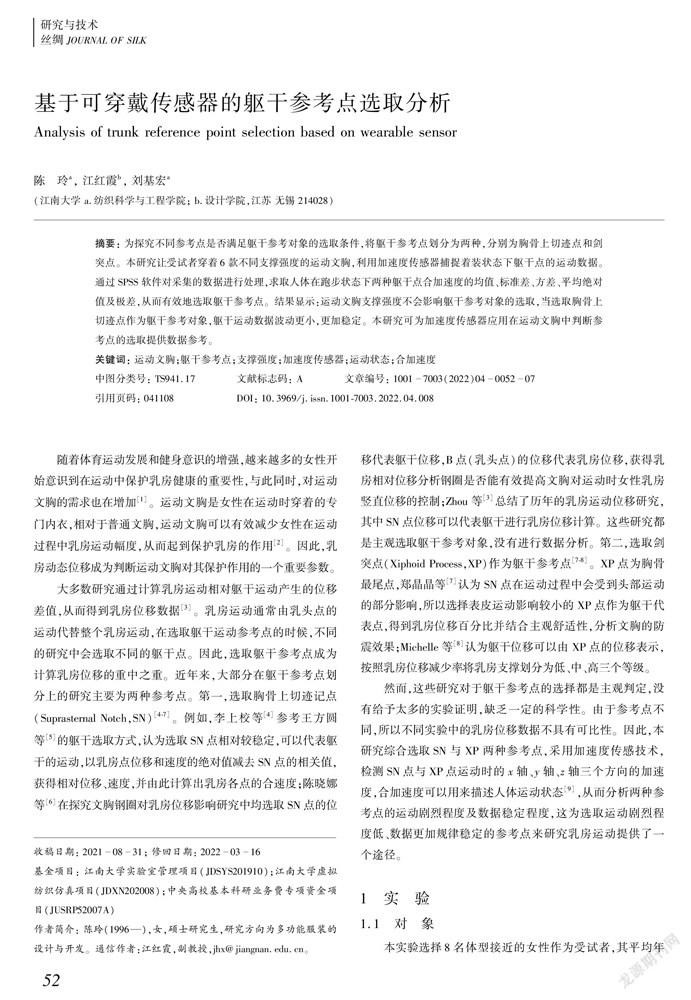
由于乳房位移測試中穿著不同強度運動文胸,因此本研究選取6款不同支撐強度的運動文胸作為樣本,避免由于穿著文胸不同造成參考點的選取誤差。運動文胸樣品款式及編號如圖1所示,6款文胸的編號從1#~6#,文胸尺碼為同一尺寸75 B,上胸圍85~90 cm,下胸圍73~77 cm,適合大部分B/C乳房罩杯的女性穿著。為了減少實驗誤差,本實驗選取運動文胸時盡力挑選主體材質和款式不同的運動文胸。
表2詳細記錄了樣本文胸的主體面料、襯里、下圍帶及肩帶款式等信息。由表2可知,樣本文胸的主體材料主要由聚酯纖維與氨綸、棉與氨綸及錦綸與氨綸的配比而成,這些材料質量輕,具有良好的彈性,墊板的材料都是100%聚酯纖維。
1.3測試原理及設備
本實驗用BWT901藍牙姿態傳感器(深圳維特智能科技有限公司)進行測試,其內置模塊為JY901型芯片,加速度計體積為15.24 mm×15.24 mm×2 mm。該加速度儀器由高精度的陀螺儀、加速度計、地磁場傳感器組成,在保證儀器收集數據的情況下,自動求解出運動狀態下物體的實時三軸加速度數據。一般情況下,加速度計的加速度精度為0.01 g,角度的靜態精度為0.05度,動態精度為0.1度[10]。
為了確保速度計傳感器在收集數據時可以穩定使用,并且數據傳輸不能中斷且有效,因此,在上位機與加速度計之間的數據傳輸選取藍牙2.0的方式進行。
1.4測試
1.4.1校準
在上位機軟件上選擇波特率為9 600,幀率10 Hz。實驗校準一般分為兩步:時間校準和傳感器校準。首先,讀取傳感器配置,點擊“校準時間”選項完成時間校準。其次,傳感器校準中,將模塊保持水平靜止,點擊配置欄里的加速度校準和磁場校準系統自動去除加速度計的零偏與航向角的偏離。當所有校準完畢,則進入正式實驗。
1.4.2傳感器粘貼點位置
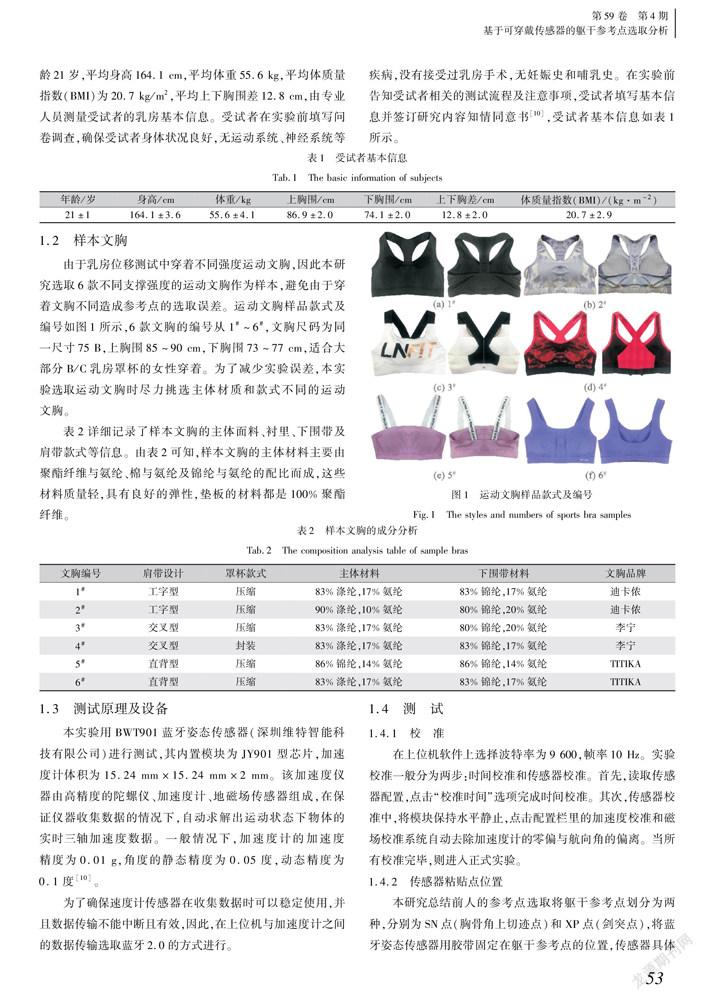
本研究總結前人的參考點選取將軀干參考點劃分為兩種,分別為SN點(胸骨角上切跡點)和XP點(劍突點),將藍牙姿態傳感器用膠帶固定在軀干參考點的位置,傳感器具體的粘貼位置如圖2所示。
1.4.3過程
實驗在江南大學的氣候倉中進行,根據夏季人體最佳舒適感,選擇室溫為(23±0.5) ℃,室內相對濕度為65%±3%,且風速低于0.1 m/s。實驗中會使用到一張桌子,兩臺電腦,一臺跑步機,剪刀,膠圈等實驗用品。
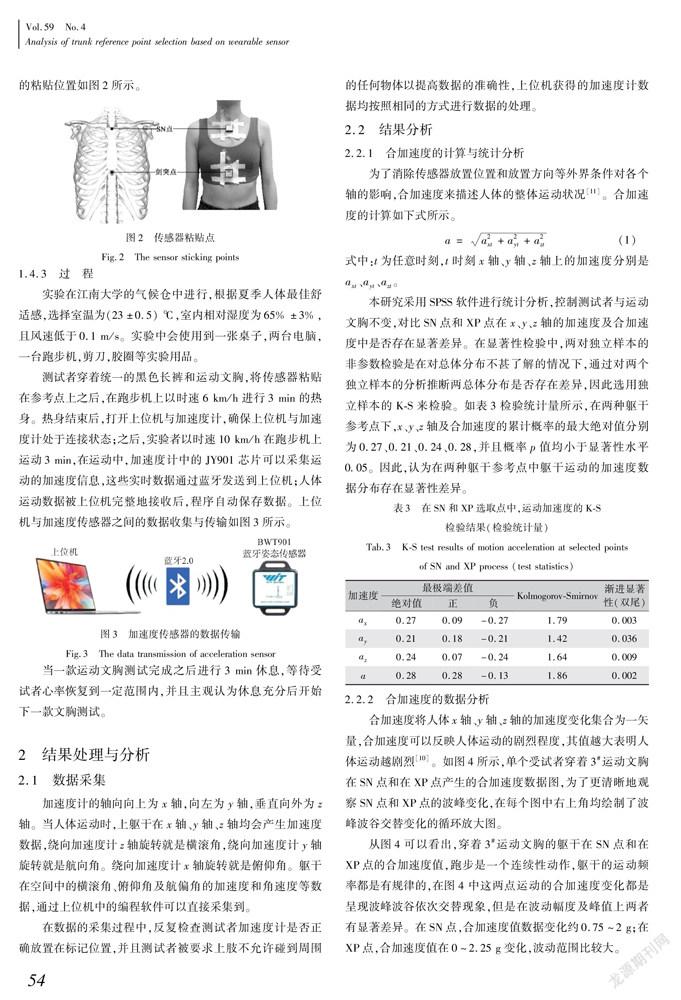
測試者穿著統一的黑色長褲和運動文胸,將傳感器粘貼在參考點上之后,在跑步機上以時速6 km/h進行3 min的熱身。熱身結束后,打開上位機與加速度計,確保上位機與加速度計處于連接狀態;之后,實驗者以時速10 km/h在跑步機上運動3 min,在運動中,加速度計中的JY901芯片可以采集運動的加速度信息,這些實時數據通過藍牙發送到上位機;人體運動數據被上位機完整地接收后,程序自動保存數據。上位機與加速度傳感器之間的數據收集與傳輸如圖3所示。
當一款運動文胸測試完成之后進行3 min休息,等待受試者心率恢復到一定范圍內,并且主觀認為休息充分后開始下一款文胸測試。
2結果處理與分析
2.1數據采集
加速度計的軸向向上為x軸,向左為y軸,垂直向外為z軸。當人體運動時,上軀干在x軸、y軸、z軸均會產生加速度數據,繞向加速度計z軸旋轉就是橫滾角,繞向加速度計y軸旋轉就是航向角。繞向加速度計x軸旋轉就是俯仰角。軀干在空間中的橫滾角、俯仰角及航偏角的加速度和角速度等數據,通過上位機中的編程軟件可以直接采集到。
在數據的采集過程中,反復檢查測試者加速度計是否正確放置在標記位置,并且測試者被要求上肢不允許碰到周圍的任何物體以提高數據的準確性,上位機獲得的加速度計數據均按照相同的方式進行數據的處理。
2.2結果分析
2.2.1合加速度的計算與統計分析
為了消除傳感器放置位置和放置方向等外界條件對各個軸的影響,合加速度來描述人體的整體運動狀況[11]。合加速度的計算如下式所示。
本研究采用SPSS軟件進行統計分析,控制測試者與運動文胸不變,對比SN點和XP點在x、y、z軸的加速度及合加速度中是否存在顯著差異。在顯著性檢驗中,兩對獨立樣本的非參數檢驗是在對總體分布不甚了解的情況下,通過對兩個獨立樣本的分析推斷兩總體分布是否存在差異,因此選用獨立樣本的K-S來檢驗。如表3檢驗統計量所示,在兩種軀干參考點下,x、y、z軸及合加速度的累計概率的最大絕對值分別為0.27、0.21、0.24、0.28,并且概率p值均小于顯著性水平0.05。因此,認為在兩種軀干參考點中軀干運動的加速度數據分布存在顯著性差異。
2.2.2合加速度的數據分析
合加速度將人體x軸、y軸、z軸的加速度變化集合為一矢量,合加速度可以反映人體運動的劇烈程度,其值越大表明人體運動越劇烈[10]。如圖4所示,單個受試者穿著3#運動文胸在SN點和在XP點產生的合加速度數據圖,為了更清晰地觀察SN點和XP點的波峰變化,在每個圖中右上角均繪制了波峰波谷交替變化的循環放大圖。
從圖4可以看出,穿著3#運動文胸的軀干在SN點和在XP點的合加速度值,跑步是一個連續性動作,軀干的運動頻率都是有規律的,在圖4中這兩點運動的合加速度變化都是呈現波峰波谷依次交替現象,但是在波動幅度及峰值上兩者有顯著差異。在SN點,合加速度值數據變化約0.75~2 g;在XP點,合加速度值在0~2.25 g變化,波動范圍比較大。
如表4所示,對比了穿著不同運動文胸是否對軀干參考點的選取帶來影響,軀干點合加速度范圍與合加速度均值均為8名測試者運動數據的平均值,由此計算出每款運動文胸在跑步狀態下SN點和XP點的合加速度的數值范圍及均值等數據。
從表4中的合加速度數據可以發現,運動中穿著6件不同款式的運動內衣時,軀干在SN點的合加速度范圍是小于軀干XP點的合加速度范圍值。將這些數據求取平均值可以發現,軀干在SN點的合加速度均值也是小于軀干XP點的合加速度均值,這說明不管穿著運動文胸的強度如何,在SN點的軀干運動明顯小于XP點的軀干運動,在XP點的軀干運動更為劇烈。因此,對于軀干參考點的選取不受運動文胸強度的影響。
2.2.3軀干參考點的穩定性分析
合加速度的極差反映的是數據變化的最大范圍,同時合加速度的標準差、方差和平均偏差均反映加速度傳感器數據的離散程度[2];離散程度可以反映數據穩定性,離散程度越大,數據越不穩定,反之數據越穩定[2]。合加速度標準差、方差、平均偏差、極差的計算如下式所示。
式中:x為第i時刻采樣得到的合加速度信號值,x為所有時刻采樣數據的平均值,x、x為采集合加速度數據的最大值和最小值。
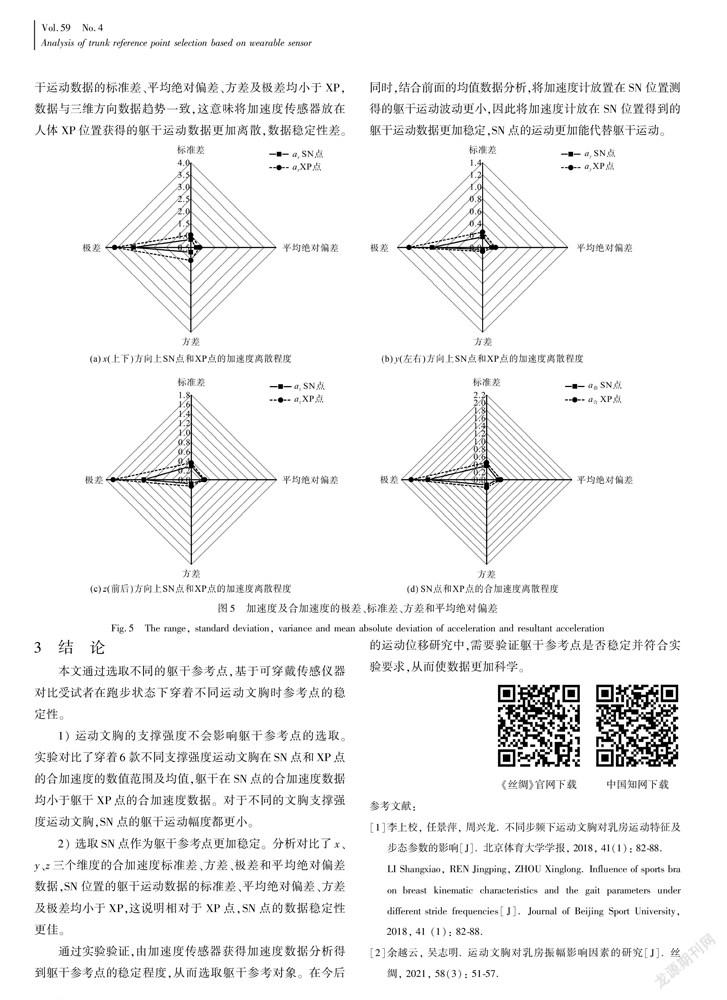
合加速度的極差、標準差、方差和平均偏差均用來反映SN點和XP點的軀干運動穩定性,在該點的數據穩定性越高,說明該點的軀干運動更加穩定,因此該點可以更好地代替軀干進行乳房位移計算。由于SN點與XP點的穩定性與文胸強度沒有關系,如圖5所示,圖5中的極差、標準差、方差和平均偏差均為8名測試者穿著6款運動文胸的軀干運動數據的平均數值,故從三個維度的加速度及合加速度的極差、標準差、方差和平均偏差來比較數據的穩定性。
在x(上下)方向上,SN點數據的標準差、平均絕對偏差及方差均小于1,XP點的數據標準差與方差均大于1,SN點的數據離散程度總體小于XP位置的數據離散程度;在y(左右)方向,SN點的離散數值均小于1,XP的離散數據均高于SN,這證明離散程度更大;在z(前后)方向上,SN的數據表現很穩定,XP的極差值為1.64,數據波動幅度很大;從三個維度來看,XP位置的軀干數據標準差、平均絕對差、方差及極差均大于SN點數據。從兩點的合加速度角度分析,SN位置的軀干運動數據的標準差、平均絕對偏差、方差及極差均小于XP,數據與三維方向數據趨勢一致,這意味將加速度傳感器放在人體XP位置獲得的軀干運動數據更加離散,數據穩定性差。同時,結合前面的均值數據分析,將加速度計放置在SN位置測得的軀干運動波動更小,因此將加速度計放在SN位置得到的軀干運動數據更加穩定,SN點的運動更加能代替軀干運動。
3結論
本文通過選取不同的軀干參考點,基于可穿戴傳感儀器對比受試者在跑步狀態下穿著不同運動文胸時參考點的穩定性。
1) 運動文胸的支撐強度不會影響軀干參考點的選取。實驗對比了穿著6款不同支撐強度運動文胸在SN點和XP點的合加速度的數值范圍及均值,軀干在SN點的合加速度數據均小于軀干XP點的合加速度數據。對于不同的文胸支撐強度運動文胸,SN點的軀干運動幅度都更小。
2) 選取SN點作為軀干參考點更加穩定。分析對比了x、y、z三個維度的合加速度標準差、方差、極差和平均絕對偏差數據,SN位置的軀干運動數據的標準差、平均絕對偏差、方差及極差均小于XP,這說明相對于XP點,SN點的數據穩定性更佳。
通過實驗驗證,由加速度傳感器獲得加速度數據分析得到軀干參考點的穩定程度,從而選取軀干參考對象。在今后的運動位移研究中,需要驗證軀干參考點是否穩定并符合實驗要求,從而使數據更加科學。
參考文獻:
[1]李上校, 任景萍, 周興龍. 不同步頻下運動文胸對乳房運動特征及步態參數的影響[J]. 北京體育大學學報, 2018, 41(1): 82-88.
LI Shangxiao, REN Jingping, ZHOU Xinglong. Influence of sports bra on breast kinematic characteristics and the gait parameters under different stride frequencies[J]. Journal of Beijing Sport University, 2018, 41 (1): 82-88.
[2]余越云, 吳志明. 運動文胸對乳房振幅影響因素的研究[J]. 絲綢, 2021, 58(3): 51-57.
YU Yueyun, WU Zhiming. Research on the impact of sports bra on the amplitude of breast movements[J]. Journal of Silk, 2021, 58(3): 51-57.
[3]ZHOU J, YU W, NG S P. Methods of studying breast motion in sports bras: A review[J]. Textile Research Journal, 2011, 81(12): 1234-1248.
[4]李上校, 任景萍, 閆穎, 等. 行走過程中文胸對乳房運動學參數的影響[J]. 北京體育大學學報, 2014, 37(7): 75-79.
LI Shangxiao, REN Jingping, YAN Ying, et al. The Influence of bra on breast’s kinematics parameters during walking[J]. Journal of Beijing Sport University, 2014, 37(7): 75-79.
[5]王方圓. 基于位移與壓力的運動文胸舒適性研究[D]. 上海: 東華大學, 2013.
WANG Fangyuan. Study on the Comforts of Sports Bra by the Combination of Displacement and Pressure[D]. Shanghai: Donghua University, 2013.
[6]陳曉娜, 王二會. 文胸鋼圈對乳房豎直位移的影響[J]. 紡織學報, 2019, 40(7): 133-137.
CHEN Xiaona, WANG Erhui. Influence of bra underwire on vertical breast displacement[J]. Journal of Textile Research, 2019, 40 (7): 133-137.
[7]鄭晶晶, 趙清瑤, 閻玉秀. 跑步運動中運動文胸對乳房振幅的影響[J]. 紡織學報, 2020, 41(3): 130-135.
ZHENG Jingjing, ZHAO Qingyao, YAN Yuxiu. Effect of sports bra on breast displacement amplitude during running[J]. Journal of Textile Research, 2020, 41(3): 130-135.
[8]NORRIS M, BLACKMORE T, HORLER B, et al. How the characteristics of sports bras affect their performance[J]. Ergonomics, 2021, 64(3): 410-425.
[9]孫成開, 梅先明, 徐佩佩, 等. 基于可穿戴加速度傳感器的人體運動狀態識別研究[J]. 現代絲綢科學與技術, 2019, 34(3): 10-14.
SUN Chengkai, MEI Xianming, XU Peipei, et al. Research on human activity state recognition based on wearable accelerometer[J]. Modern Silk Science & Technology, 2019, 34(3): 10-14.
[10]張俊杰, 孫光民, 李煜, 等. 基于加速度傳感器的上肢運動信息采集與姿態識別[J]. 北京工業大學學報, 2017, 43(7): 978-986.
ZHANG Junjie, SUN Guangmin, LI Yu, et al. Upper limb motion information acquisition and gesture recognition based on acceleration sensor[J]. Journal of Beijing University of Technology, 2017, 43(7): 978-986.
Analysis of trunk reference point selection based on wearable sensorCHEN Linga, JIANG Hongxiab, LIU Jihonga(a.College of Textile Science and Engineering; b.School of Design, Jiangnan University, Wuxi 214028, China)
Abstract: In recent years, the participation degree of females in sports has increased significantly. At the same time, they begin to realize that it is very important to protect breast health during exercise. Therefore, the demand for sports bras is increasing step by step, and the market size of sports bras is also further expanding. The phenomenon of sagging breasts is easily caused by the vibration of the chest when females are running without wearinga bra. Sports bras designed to meet the needs of females during exercise can effectively reduce the vibration of the breast in the movement to protect its safety, thereby meeting people’s daily sport needs. Therefore, in most studies of sports bras, the amplitude of breast vibration is defined as breast displacement, which is regarded as an important parameter of sports bras for breast protection, and it is used to evaluate the protective effect of sports bra on the breast. As for females wearing a sports bra to run, the smaller the breast displacement, the better protection of the bra to the breast, and vice versa. In most studies, the breast displacement is calculated as the breast reference point displacement minus the trunk reference point displacement. The nipple point is often selected as the breast reference object, however, it is inconsistent with the selection of the trunk reference point. As for trunk reference points, most of them are selected based on subjective feelings, and there is no relevant data proof and basis. As a result, the breast displacement data of each research result cannot be compared for correlation.
In order to explore whether different reference points meet the selection conditions of trunk reference objects in the breast displacement study, so as to provide an experimental basis for the selection of trunk reference points, different trunk reference points were selected to compare the stability of reference points when subjects wore different sports bras to run based on wearable sensing instruments. Firstly, the trunk reference points were divided into suprasternal notch points and xiphoid process points, respectively by summarizing the selection of previous reference points. Secondly, the subjects were asked to wear six different sports bras and exercise at a normal running speed. The acceleration data generated by suprasternal notch point and xiphoid process point during human movement were collected by the Bluetooth attitude sensor. On this basis, SPSS software was used to process the trunk motion data to obtain the resultant acceleration range and mean value of the two points of reference for the trunk, which can reflect the intensity of human motion. The larger the value, the more intense the human movement, and vice versa. Whether the subjects wearing different styles of sports bras will affect the selection of reference points on the trunk was analyzed. After that, the mean, standard deviation, variance, mean absolute value and range of resultant acceleration of the trunk point in the running state of the human body were calculated and compared, which can reflect the dispersion degree of the acceleration sensor data, and the dispersion degree in turn reflect the data stability. The greater the degree of dispersion, the more unstable the data, and vice versa. In this way, the stability of the reference point can be judged and the trunk reference point can be selected effectively. In this study, Bluetooth attitude sensor was introduced to directly acquire the acceleration data generated by the human body, which provided data reference for the selection of reference points of the trunk and increased the accuracy of data. In addition, in order to avoid the selection error of reference points caused by wearing different bras, the numerical range and mean value of resultant acceleration of the two reference points under wearing six sports bras with different support strengths were compared to study the influence of sports bras with different support strengths on the reference points. For another, the mean, standard deviation, variance, mean absolute value and range of the resultant acceleration data of the two trunk reference points were obtained through analyzing the resultant acceleration data generated by the human body and collected by the Bluetooth attitude sensor by the mathematical dispersion degree statistical analysis method. The dispersion degree of resultant acceleration was used to represent the stability of trunk reference points to determine the selection of human reference points. It is found that the resultant acceleration values of the six sports bras at the suprasternal notch point are smaller than those at the xiphoid point, which indicates that the movement is less intensified at the SN point, and the support strength of sports bras will not affect the selection of the trunk reference point. In addition, the standard deviation, variance, range and mean absolute deviation of resultant acceleration are analyzed from three dimensions of x, y and z. It is found that compared with the xiphoid point, the standard deviation, variance, range and average absolute deviation of resultant acceleration at SN point are smaller, and the stability of data is better. Therefore, in the breast displacement experiment, it is better to select the suprasternal notch point as the trunk reference object.
Through experimental verification, the acceleration sensor is applied to determine the selection of reference points in sports bra to provide data reference. The acceleration data obtained by the acceleration sensor is used to analyze the stability of the trunk reference points, so as to select the trunk reference object. In the future motion displacement research, it is necessary to verify whether the trunk reference point is stable and meets the experimental requirements, which will increase the accuracy of the calculated breast displacement data.
Key words: sports bra; trunk reference point; support strength; acceleration sensor; motion state; resultant acceleration
