苯嗪草酮疏果劑對蘋果邊果營養與激素含量的影響
2021-06-30 00:54:20薛曉敏韓雪平聶佩顯王金政
農業工程學報 2021年7期
薛曉敏,韓雪平,聶佩顯,董 放,王金政
苯嗪草酮疏果劑對蘋果邊果營養與激素含量的影響
薛曉敏,韓雪平,聶佩顯,董 放,王金政
(山東省果樹研究所,泰安 271000)
為明確苯嗪草酮疏果劑對蘋果邊果的疏除作用,以9年生天紅2號/SH38/八棱海棠為試材,在最大邊果直徑6 mm左右時噴300 mg/kg苯嗪草酮2次,清水為對照,生理落果后調查坐果率及坐果比例;噴藥后7、9、11、17、29 d采集處理和對照邊果,測定氮磷鉀礦質營養,淀粉、葡萄糖、果糖、蔗糖和山梨醇碳水化合物,可溶性蛋白質含量以及玉米素(Z)、赤霉素(GA3)、生長素(IAA)和脫落酸(ABA)激素含量。結果顯示,苯嗪草酮處理后,花序坐果率和花朵坐果率較對照降低17.95%和27.63%,坐單果比例顯著提高,坐三果及三果以上的比例顯著降低(<0.01);處理總體上提高了邊果無機營養含量,顯著降低了可溶性蛋白質含量(<0.05);淀粉含量較對照提高了5.57%~37.20%,但不同程度地降低了蔗糖、葡糖糖、果糖及山梨醇含量,從而使可溶性碳水化合物含量較對照降低了9.55%~52.60%;處理后脫落酸含量顯著升高(<0.05),(Z+GA3+IAA)/ABA比值顯著降低。說明苯嗪草酮在蘋果上具有較好的疏除邊果作用,其疏除作用與可溶性蛋白質含量降低,可溶性碳水化合物供應不足,以及ABA含量升高及生長型激素/抑制型激素比值降低有關。
激素;營養;苯嗪草酮;坐果率;蘋果
0 引 言
蘋果疏花疏果是調整樹體負荷、提高果實品質、減輕大小年結果的必要技術,包括人工疏花疏果、化學疏花疏果和機械疏花疏果。人工疏花疏果主要在中國應用,美國、德國的商業化果園開始試驗示范機械疏花疏果,化學疏花疏果則是歐美發達國家普遍采取的蘋果生產花果調控技術[1-4]。疏果相對于疏花來說,安全系數高,更受果農青睞。研究表明,萘乙酸、西維因、6-BA、ACC、乙烯利等在一定濃度范圍內均有疏除幼果、平衡負載量作用[5-8],對其疏除機理也有相關報道,如西維因阻礙營養物質運輸養分、萘乙酸干擾激素代謝、乙烯利促進乙烯生成等造成幼果脫落[9-10]。苯嗪草酮是一種光合系統Ⅱ(PSⅡ)抑制劑,主要用作除草劑。2014年安道麥公司發布苯嗪草酮可作為一種低毒、安全的果樹疏果劑,主要應用在蘋果和梨上,不少學者開展了相關研究[11-12]。本課題組從光合和熒光角度研究了苯嗪草酮對蘋果葉片抑制作用的影響[13],但是,對于苯嗪草酮如何影響幼果的生理代謝國內外均未見相關報道。
本文以矮砧蘋果樹為試材,研究了在最大邊果直徑6 mm左右時噴施苯嗪草酮對蘋果的疏果效應及對邊果營養和激素含量的影響,從碳水化合物及激素調控角度初步揭示了苯嗪草酮的疏果機制,為生產提供了參考依據。
1 材料與方法
1.1 試驗材料
試驗在山東省果樹研究所天平湖基地(北緯36°12′55.36″,東經117°01′09.87″,海拔168 m)進行。試材為9年生天紅2號/SH38/八棱海棠(‘天紅2號’為紅富士芽變品種),株行距0.75 m×4.0 m,采用高紡錘樹形、行間生草、樹盤覆蓋、肥水一體化技術,管理水平中等偏上。試驗地有機質質量分數0.79%,速效氮86.11 mg/kg,速效磷73.71 mg/kg,速效鉀116.32 mg/kg。
1.2 處理方法
選取長勢基本一致健康的蘋果樹30株,設噴藥和對照2個處理,各處理15株樹,5株樹為1個小區,3次重復,處理和對照之間保留2株樹作為保護株。每株樹隨機選3個主枝,統計花序數和花朵數,掛牌標記。
2018年4月21日進行了苯嗪草酮試驗濃度篩選試驗,設置100、200、300、400、500 mg/kg 5個濃度處理,清水為對照。選用背負式電動噴霧器對全樹進行噴布,噴至幼果濕潤輕微滴水為止。生理落果后調查有掛牌的主枝坐果情況,統計花序坐果率和花朵坐果率,花序坐果率(%)=坐果花序數/總花序數×100%,花朵坐果率(%)=坐果數/總花朵數×100%。
2019年4月19日在最大邊果直徑6 mm左右時噴300 mg/kg苯嗪草酮,4月22日噴第二次;對照噴清水。噴施方法同2018年,生理落果后調查坐果率和坐果比例,單果率(%)=坐單果花序數/總花序數×100%,雙果率(%)=坐雙果花序數/總花序數×100%,三果及以上(%)=100?(單果率+雙果率)。
1.3 取樣與測定
分別在第一次噴藥處理后7、9、11、17及29 d從處理及對照試驗樹上取邊果,前3次每個小區(5株樹)共采果90個左右,后2次每個小區(5株樹)共采果60個左右,均為3個重復,去除果柄及萼片后,用鋁箔紙包好,放入液氮罐中速凍,帶回實驗室放至?80 ℃冰箱保存,用于測定氮磷鉀、碳水化合物、蛋白質及激素。
1.3.1 礦質營養測定
全氮測定用半微量蒸餾法,全磷測定用鉬銻抗吸光光度法,全鉀測定用火焰光度計法,具體測定步驟參考崔建宇等[14]方法。所有指標均重復3次。
1.3.2 碳水化合物含量測定
單糖和低聚糖提取參考Kang 等[15]方法,葡萄糖、果糖、山梨醇用水提取,稱取約0.2 g樣品,加入1 mL水,勻漿,過夜浸提。蔗糖用乙腈提取,稱取約0.2 g樣品,加入1 mL 80%乙腈,勻漿,50 ℃水浴30 min,8 000離心10 min,取上清液,針頭式過濾器過濾后待測。用Waters 1525高效液相色譜儀測定,示差檢測器為Shodex RI-201H。葡萄糖、果糖、山梨醇用Carbomix Ca-NP 8%色譜柱(300 mm×7.8 mm,10m),柱溫80oC,流動相為水,流速0.4 mL/min,進樣體積10L;蔗糖用Sepax HP-Amino氨基柱(4.6 mm×250 mm,5m),柱溫40 ℃,流動相乙腈∶水=80∶20,流速0.4 mL/min,進樣體積10L。根據葡萄糖、果糖、山梨醇、蔗糖標準曲線和樣品峰面積計算含量。
將提取可溶性糖的殘余物用高氯酸水解成葡萄糖,蒽酮比色法測定葡萄糖含量,測定波長為620 nm,由葡萄糖標準曲線計算淀粉含量。
1.3.3 可溶性蛋白質含量測定
可溶性蛋白含量測定采用考馬斯亮藍染色法[16]。
1.3.4 激素含量測定
激素提取方法參考Yan 等[17],稱取約0.2 g樣品,加入1 mL預冷的20%甲醇,4 ℃浸提過夜;8 000離心10 min,取上清液,殘渣用0.5 mL 20%甲醇水溶液浸提2 h,離心后取上清液,合并2次上清,40 ℃減壓蒸發至不含有機相,加入2 mL石油醚60~90 ℃萃取脫色3次,移去石油醚;向下層水相中加入2 mL乙酸乙酯萃取,轉移上層有機相至新的EP管,重復萃取3次,合并3次有機相,氮吹吹干,加入0.2 mL流動相溶解,混勻,針頭式過濾器過濾后待測。采用RIGOL L3000高效液相色譜儀,Kromasil C18反相色譜柱(250 mm×4.6 mm,5m),波長為254 nm,柱溫30 ℃,流動相流速0.8 mL/min,進樣體積10L,走樣時間35 min。
1.4 數據分析
所有數據均采用SPSS軟件進行差異顯著性比較,應用GraphPad Prism 5 軟件繪圖。
2 結果與分析
2.1 苯嗪草酮適宜濃度篩選
不同濃度苯嗪草酮處理對坐果率的調查結果如圖1所示。可以看出,與清水對照相比,100~500 mg/kg的苯嗪草酮處理降低了花序坐果率和花朵坐果率,其中對照與200~500 mg/kg處理間的花序坐果率存在顯著性差異(<0.05),而對照與所有苯嗪草酮處理的花果坐果率均存在顯著性差異(<0.05)。200~400 mg/kg 3個濃度之間差異性不顯著,以300 mg/kg的花序坐果率和花朵坐果率最低,分別為72.39%和23.52%,故選300 mg/kg作為后續試驗的噴施濃度。
注:不同小寫字母表示不同濃度處理0.05水平差異性顯著。
Note: Different small letter indicates significant difference at 0.05 level between different concentrations.
圖1 不同濃度苯嗪草酮處理對坐果率的影響
Fig.1 Effect of metamitron with different concentrations on fruit setting rate
2.2 苯嗪草酮處理對坐果率和坐果比例的影響
由圖2a可見,與對照相比,幼果期苯嗪草酮處理顯著降低了坐果率(<0.01),其中花序坐果率降低17.95%,花朵坐果率降低27.63%。同時,苯嗪草酮處理顯著提高了花序坐單果比例(<0.01),處理單果率為44.80%,為對照的5.28倍,且保留的單果均為中心果,說明苯嗪草酮僅對邊果起作用,對中心果無影響;處理顯著降低了花序坐三果及以上的比例(<0.01),處理為對照的47.91%;坐雙果比例也有所增加,但未達到顯著水平(圖2b)。說明苯嗪草酮在富士蘋果上有較好的疏果作用,疏除力強,單果率高,分布均勻。
2.3 苯嗪草酮對無機營養的影響
由表1可以看出,苯嗪草酮處理后,所有時期的全氮含量均高于對照,在噴施后7和9 d二者差異不顯著,可能與處理時間較短有關;噴施11 d之后,處理的全氮含量均顯著高于對照(<0.05)。苯嗪草酮處理對全磷和全鉀的影響更為顯著,幾乎所有處理的全磷和全鉀含量均顯著高于對照(<0.05),噴后11、29 d處理的全磷含量為對照的2.05和1.67倍,全鉀含量為對照的1.93和1.51倍。說明苯嗪草酮的疏果作用不是由于氮磷鉀無機養分的缺失造成的。
注:**表示處理與對照間0.01水平差異性顯著,下同。
Note: ** indicates significant difference at 0.01 level between treatment and control, the same below.
圖2 苯嗪草酮處理對坐果率及坐果比例的影響
Fig.2 Effect of metamitron treatment on fruit setting rate and ratio
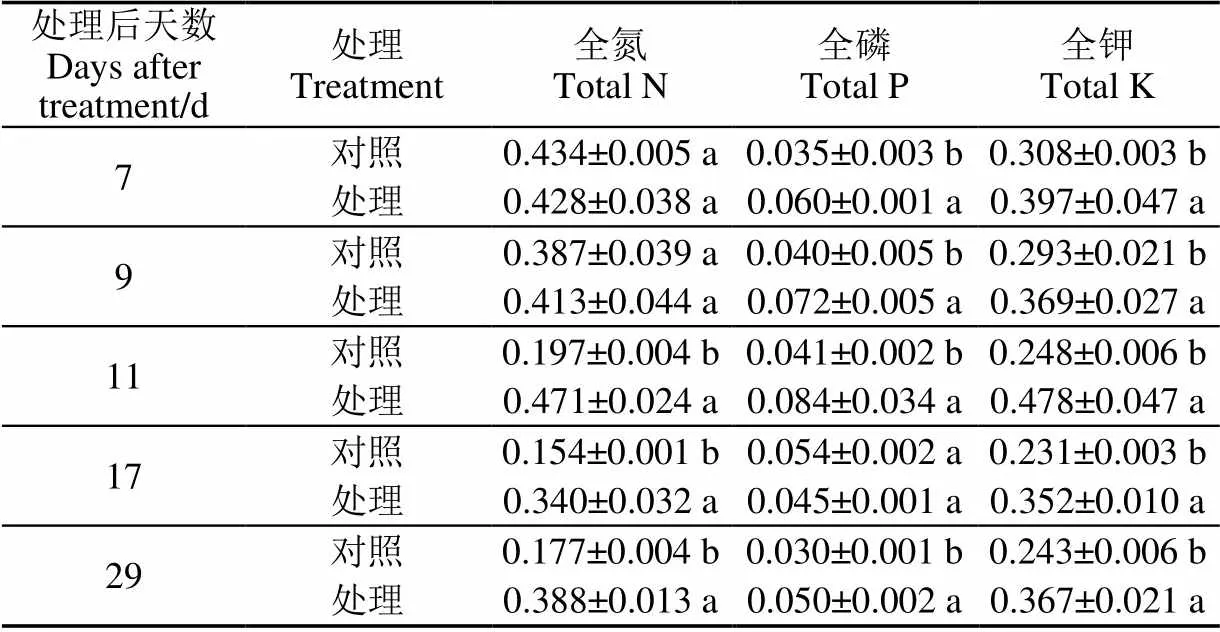
表1 苯嗪草酮處理對氮磷鉀營養元素的影響
注:不同小寫字母表示處理與對照間0.05水平差異性顯著。
Note: Different small letter indicates significant difference at 0.05 level between treatment and control.
2.4 苯嗪草酮處理對有機營養的影響
蘋果有機營養成分主要是碳水化合物,包括淀粉、葡萄糖、果糖、蔗糖、山梨醇[18]。由圖3a可以看出,盡管蘋果幼果中淀粉含量較低,但苯嗪草酮處理的淀粉含量多明顯高于對照,增幅為5.57%~37.20%;圖3b~圖3e為可溶性碳水化合物葡萄糖、果糖、蔗糖及山梨醇含量,可以看出,整體趨勢為對照的可溶性碳水化合物含量高于苯嗪草酮處理。為了整體比較處理與對照可溶性碳水化合物含量,對葡萄糖、果糖、蔗糖及山梨醇的總含量進行了分析,如圖3f所示,可見苯嗪草酮處理的可溶性碳水化合物均顯著低于對照(<0.05),降幅為9.55%~52.57%。而可溶性碳水化合物是幼果發育的直接營養物質,說明苯嗪草酮疏果可能是由于可溶性碳水化合物的供應不足造成的。
注:*表示處理與對照間0.05水平差異性顯著,下同。
Note: * indicates significant difference at 0.05 level between treatment and control, the same below.
圖3 苯嗪草酮處理對果實碳水化合物含量的影響
Fig.3 Effect of metamitron treatment on fruit carbohydrate content
2.5 苯嗪草酮處理對可溶性蛋白質含量的影響
如圖4所示,苯嗪草酮處理后蘋果幼果可溶性蛋白質含量明顯降低,差異達顯著水平(<0.05)。各個時期處理的可溶性蛋白質含量分別為對照的71.42%、72.37%、69.68%、64.20%和86.02%,說明苯嗪草酮處理使蘋果幼果的總體代謝能力減弱,進而造成幼果脫落。
2.6 苯嗪草酮處理對激素的影響
蘋果幼果脫落受內源激素調控[19-21]。在處理早期(7和9 d),對照的玉米素含量顯著高于處理(<0.05);而在處理后期,對照的玉米素含量則明顯低于處理(圖5a)。苯嗪草酮處理對赤霉素也有影響(圖5b)。苯嗪草酮處理顯著提升了幼果生長素水平(<0.05),圖5c可見,所有處理的IAA含量均明顯高于對照,差異性多為顯著水平(<0.05)。脫落酸是幼果脫落的主導激素種類,苯嗪草酮處理后脫落酸含量普遍升高,各時期ABA含量均顯著高于對照(<0.05),處理為對照的1.37~3.11倍,說明苯嗪草酮提高了幼果的脫落酸含量,從而促進了幼果脫落(圖5d)。同時,對(Z+GA3+IAA)/ABA的比值(值)進行了分析,如圖5e所示,除噴施早期(7d)外,對照的值均高于處理,其中9、17和29 d 3個時期二者間差異達顯著水平(<0.05),降幅最大為51.55%,說明低值與幼果脫落相關。
3 討 論
苯嗪草酮作為一種蘋果疏果劑有近十年的時間,不少學者對不同生態條件下的不同品種進行了噴施時期、噴施濃度、對產量品種調控效應等研究[22-24]。Steven等[25]研究認為,苯嗪草酮適宜噴施濃度為300 mg/kg,適宜噴施時期為盛花后23和38 d,與對照相比,花朵坐果率降低了50.63%,單株產量降低了37.10%,單果質量提高了8.54%,分析為苯嗪草酮影響葉綠素熒光所致,使開放的PSⅡ反應中心的能量捕捉效率值、PSⅡ光合量子產量及相對電子傳導率均下降。嘎啦果適宜噴施時期為中心果直徑6.0~13.5 mm,濃度為1.65 kg/hm2,噴施2次疏果效應更好,分析認為嘎拉幼果脫落與葉綠素熒光及夜間溫度有關[11,26]。富士適宜噴施時期為幼果直徑5~10 mm,濃度為350 mg/kg,落果率35.6%~50.9%,且顯著提高了成熟期單果質量和商品果比例[8]。本試驗中,幼果直徑6 mm左右噴施300 mg/kg苯嗪草酮2次,花朵坐果率24.20%,比對照降低27.63%,與多數學者的疏除效應一致。然而,也有學者認為苯嗪草酮適用的幼果直徑較大,可作為一種補救型疏果劑[27-28]。
不少學者認為,礦質養分及碳水化合物不足是導致幼果脫落的主要因素之一[29-31]。楊波等[32]研究發現,扁桃在生理脫落期,正常幼果的N、P、K、B、Zn 5種礦質元素的濃度均高于落果,認為扁桃幼果脫落與礦質元素濃度降低有關;而本試驗結果則表明,處理的氮磷鉀含量多高于對照,分析認為,疏果劑處理后果實變小直至萎蔫脫落,氮磷鉀含量在其中相對“濃縮”,從而高于正常發育的果實,這與關軍鋒等[33]的研究結果一致。徐昌杰等[31]研究認為,柑橘幼果脫落與淀粉含量降低有關,本試驗結果則顯示,苯嗪草酮處理后幼果的淀粉含量沒有降低,降低的是可溶性碳水化合物含量,而可溶性碳水化合物含量對幼果發育的作用更為直接。
眾多研究表明,不少果樹幼果脫落與激素含量及激素比例有關。易落果的柑橘品種具有較高的ABA含量與較低的GA3含量[34];同樣扁桃幼果脫落與ABA含量升高及GA3和IAA含量降低有關[35];蘋果幼果脫落與ZT、IAA、GA的減少及ABA的增加有關[36]。本試驗中,苯嗪草酮處理后ABA含量顯著升高,與前人的研究相一致;另外果實脫落往往不是由某一激素單獨控制的,而是由多種激素協同作用的結果,因此本研究對(Z+GA3+IAA)/ABA進行了分析,顯示苯嗪草酮處理后(Z+GA3+IAA)/ABA比值降低,說明苯嗪草酮疏果作用與低的(Z+GA3+IAA)生長素類激素/ABA比值有關。
4 結 論
1)在邊果直徑 6 mm時噴施2次300 mg/kg苯嗪草酮,具有疏除邊果的作用,花序坐果率和花朵坐果率較對照降低17.95%和27.63%,差異達極顯著水平(<0.01);處理的單果率44.80%,為對照的5.28倍,差異達極顯著水平(<0.01)。
2)苯嗪草酮處理后,淀粉含量不降反升,漲幅為5.57%~37.20%;可溶性碳水化合物總量(葡萄糖、果糖、蔗糖、山梨醇)顯著降低(<0.05),降幅最大的為52.57%;可溶性蛋白質含量顯著降低(<0.01),降幅最大的為35.80%。
3)激素測定結果顯示,苯嗪草酮處理后脫落酸含量顯著升高(<0.05),處理為對照的1.37~3.11倍;生長型與抑制型激素比值[(Z+GA3+IAA)/ABA]降低,降幅最大的為51.55%。
[1] 王學府,孟玉平,曹秋芬,等. 蘋果化學疏花疏果研究進展[J]. 果樹學報,2006,23(3):437-441.
Wang Xuefu, Meng Yuping, Cao Qiufen,et alAdvances in research on chemical thinning for apple trees[J]. Journal of Fruit Science, 2006, 23(3): 437-441. (in Chinese with English abstract)
[2] Lordan J, Alins G, àvila G, et al. Screening of eco-friendly thinning agents and adjusting mechanical thinning on ‘Gala’, ‘Golden Delicious’ and ‘Fuji’ apple trees[J]. Scientia Horticulturae, 2018, 239: 141-155.
[3] Goulart C, Braga de AndradeS, Bender A, et al. Metamitron and different plant growth regulators combinations in the chemical thinning of ‘Eva’ apple trees[J]. Journal of Experimental Agriculture International, 2017, 18(2): 1-6.
[4] Gabardo G C, Petri J L, Kretzchmar A A, et al. Different sources and concentrations of 6-BA in chemical thinning of post-flowering in apple trees[J]. Journal of Experimental Agriculture International, 2019, 32(6): 1-9.
[5] Basak A. Use of benzyladenine endothall and ammonium thiosulfate for fruitlet thinning in some cultivars[J]. Acta Horticulturae, 2000, 517: 217-226.
[6] Eccher G, Begheldo M, Boschetti A, et al. Roles of ethylene production and ethylene receptor expression in regulating apple fruitlet abscission[J]. Plant Physiology, 2015, 169(1): 125-137.
[7] Fruk M, Vukovi? M, Jatoi M, et alTiming and rates of application of NAA as blossom and fruitlet chemical thinner on apple cv. Braeburn[J]. Emirates Journal of Food and Agriculture, 2017, 29(2): 156-162.
[8] Gabardo G C, Kretzchmar A A, Petri J L, et alInfluence of post-flowering chemical thinning on development and fruit quality of ‘Fuji Suprema’ and ‘Maxigala’ apple trees[J]. Journal of Experimental Agriculture International, 2019, 32(4): 1-13.
[9] Mili? B, Tarlanovi? J, Keserovi? Z, et alThe growth of apple central fruits as affected by thinning with NAA, BA and Naphthenic Acids[J]. Erwerbs-Obstbau, 2017, 59(3): 185-193.
[10] Gonzalez Luis, Torres E, Carbó J, et alEffect of different application rates of metamitron as fruitlet chemical thinner on thinning efficacy and fluorescence inhibition in Gala and Fuji apple[J]. Plant Growth Regulation, 2019, 89(3): 259-271.
[11] Raphael A S. The photosynthesis inhibitor metamitron is an effective fruitlet thinner for ‘Gala’ apple in the warm climate of Israel[J]. Scientia Horticulturae, 2014, 178: 163-167.
[12] Stevanovic M, Dolovac N, Marisavljevic D, et al. Efficacy of metamitron in apple thinning in Serbia[J]. Communications in Agricultural and Applied Biological Sciences, 2015, 80(2): 261-267.
[13] 薛曉敏,韓雪平,王來平,等. 苯嗪草酮對蘋果坐果和光合生物學特征的影響[J]. 應用生態學報,2021,32(2):557-563.
Xue Xiaomin, Han Xueping, Wang Laiping, et alEffects of metamitron on fruit set and photosynthetic biological characteristics of apples[J]. Chinese Journal of Applied Ecology, 2021, 32(2): 557-563. (in Chinese with English abstract)
[14] 崔建宇,陳范駿,朱洪群. 土壤、植物與環境分析實驗[M]. 北京:中國農業大學出版社,2007.
[15] Kang J, Yu H P, Tian C H, et alSuppression of photosynthetic gene expression in roots is required for sustained root growth under phosphate deficiency[J]. Plant Physiology, 2014, 165: 1156-1170.
[16] 李合生. 植物生理生化實驗原理和技術[M]. 北京:高等教育出版社,2000.
[17] Yan H Y, Wang F, Han D D, et al. Simultaneous determination of four plant hormones in bananas by molecularly imprinted solid-phase extraction coupled with high performance liquid chromatography[J]. Analyst, 2012, 137: 2884-2890.
[18] 齊秀東,魏建梅,李永紅. 蘋果果實質地軟化過程中碳水化合物代謝及其關鍵酶基因表達的變化[J]. 園藝學報,2015,42(3):409-417.
Qi Xiudong, Wei Jianmei, Li Yonghong. Carbohydrate metabolism and the key gene expression in apple during fruit texture softening[J]. Acta Horticulturae Sinica, 2015, 42(3): 409-417. (in Chinese with English abstract)
[19] Luckwill L C. The hormone content of the seed in relation to endosperm development and fruit drop in the apple[J]. The Journal of Horticultural Science and Biotechnology, 2015, 24(1): 32-44.
[20] Wani A W, Hassan G I, Dar S Q, et alInfluence of different phytohormones and nutrients on fruit set and chemometric attributes of apple[J]. An International Journal of Plant Research. 2017, 30: 492-498.
[21] Luckwill L C. Studies of fruit development in relation to plant hormones: II. the effect of naphthalene acetic acid on fruit set and sruit development in apples[J]. The Journal of Horticultural Science and Biotechnology, 2015, 28(1): 25-40.
[22] Rosa N, Verjans W, Oliveira C, et al. Comparison between 6-benzyladenine and metamitron as thinning agents in ‘Royal Gala’, ‘Cripps Pink’ and ‘Red Delicious’ apple cultivars[J]. Acta Horticulturae, 2018, 1221: 51-58.
[23] Lafer G. Effects of chemical thinning with metamitron on fruit set, yield and fruit quality of ‘Elstar’[J]. Acta Horticulturae, 2010, 884: 531-536.
[24] Greene D W. Use of metamitron alone and in combination with 6-benzyladenine for thinning apples[J]. Acta Horticulturae, 2014, 1042: 167-172.
[25] Steven J M, John D O. Comparison of the effects of metamitron on chlorophyll fluorescence and fruit set in apple and peach[J]. Hort Science, 2012, 47(4): 509-514.
[26] Gonzalez L, Torres E, àvila G, et alEvaluation of chemical fruit thinning efficiency using Brevis? (Metamitron) on apple trees (‘Gala’) under Spanish conditions[J]. Scientia Horticulturae, 2020, 261: 1-8.
[27] Greene D, Costa G. Fruit thinning in pome and stone fruit: State of the Art[J]. Acta Horticulturae, 2013, 998: 93-102.
[28] Gabardo G C, Petri J L, Hawerroth F J, et alUse of metamitron as an apple thinner[J] Revista Brasileira de Fruticultura, 2017, 39(3): 1-9.
[29] 呂秉鼎,胡佳佳,湯麗云,等. 陽春砂落果規律及其生理機制[J]. 植物生理學報,2021,57(2):429-438.
Lü Bingding, Hu Jiajia, Tang Liyun, et al. The study on the fruit dropping law and physiological mechanism of[J]. Plant Physiology Journal, 2021, 57(2): 429-438. (in Chinese with English abstract)
[30] Ruiz R, Guardiola J L. Carbohydrate and mineral nutrition of orange fruitlets in relation to growth and abscission[J]. Physiology Plant, 1994, 90: 27-36.
[31] 徐昌杰,張上隆. 柑橘幼果發育期碳水化合物代謝及其與生長發育的關系[J]. 果樹學報,2001,8(1):20-23.
Xu Changjie, Zhang Shanglong. Carbohydrate metabolism of citrus fruitlets in relation to growth and abscission[J]. Journal of Fruit Science. 2001, 18(1): 20-23. (in Chinese with English abstract)
[32] 楊波,車玉紅,郭春苗. 扁桃幼果生理脫落與礦質元素濃度的關系[J]. 新疆農業科學,2015,52(5):852-857.
Yang Bo, Che Yuhong, Guo Chunmiao. Relationship between young almond fruits dropping and the concentration of mineral elements[J]. Xinjiang Agricultural Sciences, 2015, 52(5): 852-857. (in Chinese with English abstract)
[33] 關軍鋒,馬智宏,張華,等. 授粉受精期蘋果幼果發育與Ca,Mg,K含量的變化[J]. 河北農業科學,1999,3(3):1-5.
Guan Junfeng, Ma Zhihong, Zhang Hua, et alThe apple fruit development and changes in contents of Ca, Mg, K during the pollination and fertilization stage[J]. Journal of Hebei Agricultural Sciences, 1999, 3(3): 1-5. (in Chinese with English abstract)
[34] 董倩倩,龔桂芝,彭祝春,等. 柑橘采前落果與果實不同部位內源激素含量關系分析[J]. 植物生理學報,2018,54(10):1569-1575.
Dong Qianqian, Gong Guizhi, Peng Zhuchun, et alAnalysis on the relationship between pre-harvest fruit drops and content of endogenous hormone in different parts of fruit in citrus[J]. Plant Physiology Journal. 2018, 54(10): 1569-1575. (in Chinese with English abstract)
[35] 楊波,車玉紅,郭春苗,等. 扁桃生理落果期不同組織激素濃度的動態變化及其對落果的影響[J]. 西北植物學報,2015,35(1):118-124.
Yang Bo, Che Yuhong, Guo Chunmiao, et alDynamic change of hormones in the different tissue of almond during the physiological fruit drop and its effect on fruit drop[J]. Acta Bot. Boresl.-Occident. Sin, 2015, 35(1): 118-124. (in Chinese with English abstract)
[36] 張曉明,黃衛東,韓振海. 蘋果坐果的激素調控[J]. 植物生理學報,1998,24(4):361-366.
Zhang Xiaoming, Huang Weidong, Han Zhenhai. Study on the hormonal regulation of fruit setting in apple tree[J]. Acta Phytophysiologica Sinica, 1998, 24(4): 361-366. (in Chinese with English abstract)
Effects of fruit thinning agent “metamitron” on nutrition and hormone content of apple lateral fruits
Xue Xiaomin, Han Xueping, Nie Peixian, Dong Fang, Wang Jinzheng
(,271000,)
The work aimed to clarify the effects of metamitron as the fruit thinning agent on the apple fruit setting rate as well as the mineral nutrition, carbohydrates, and hormones of lateral fruitlets, thus providing a reference for applying chemical thinning technology of apples. Thirty 9-year-old apple trees (Tianhong 2/SH38/Malus micromalus) were used as test materials, and 300 mg/kg metamitron solution was sprayed 2 times when the diameter of the biggest lateral fruits were around 6 mm. Spraying water was used as the control. The setting rate of inflorescence and flower were investigated after physiological fruit drop. The mineral nutrition, carbohydrate, soluble protein, and hormone content of lateral fruits were measured after spraying 7, 9, 11, 17, and 29 d. The total nitrogen, phosphorus, and potassium were determined by semi-micro distillation, Mo-Sb-Vc colorimetry, and flame photometer, respectively. Glucose, fructose, sorbitol, sucrose, and hormone contents were determined by HPLC, while the soluble protein content was determined by Coomassie brilliant blue staining. The results showed that the fruit setting rate of inflorescence and flowers decreased by 17.95 and 27.63% compared with the control, respectively. The proportion of inflorescence with single fruit increased by 5.28 times in the treatment, while that of sitting three fruits and more decreased significantly, which was 47.91% of the control. The results of fruit setting rate and fruit setting ratio showed that metamitron could significantly reduce the fruit setting rate, and the single fruit rate was high, with the setting fruits distributed evenly. The total nitrogen content was higher than that of the control at all stages, and the difference between the control and the treatment was significant except 7 and 9 d. The total phosphorus and potassium contents of almost all treatments were significantly higher than those of the control. The total phosphorus contents of 11 and 29 d after spraying was 2.05 and 1.67 times of the control, and the total potassium content was 1.93 and 1.51 times of the control, respectively. The results of mineral nutrition showed that the fruit thinning effect of metamitron was not caused by the deficiency of inorganic nutrients. The content of the soluble protein decreased significantly compared with the control, and the content of each treatment period was 71.42%, 72.37%, 69.68%, 64.20%, and 86.02% of the control, respectively. The starch content of metamitron treatment was significantly higher than that of the control, with an increase of 5.57%-37.20%, yet the content of sucrose, glucose, fructose, and sorbitol decreased with different degrees. Therefore, the soluble carbohydrate content decreased significantly to 9.55%-52.57%. Soluble carbohydrates are the direct nutrients for the development of young fruits, so fruit thinning of metamitron may be caused by insufficient supply of soluble carbohydrates. The abscisic acid content generally increased after the treatment, and the ABA content in each period was 1.37-3.11 times that of the control. The ratio of (Z+GA3+IAA)/ABA decreased significantly, which could cause falling off of young fruits. As a result, metamitron has a good fruit thinning effect on apples, related to the decreased soluble protein content, an insufficient supply of soluble carbohydrate, increased ABA content, and decreased (Z+GA3+IAA)/ABA ratio.
hormone; nutrition; metamitron; fruit setting; apple
2020-09-22
2021-02-07
現代農業蘋果產業技術體系(CARS-27)
薛曉敏,研究方向為水果遺傳育種與栽培。Email:xuexiaomin79@126.com
王金政,研究員,研究方向為水果遺傳育種與栽培。Email:wjz992001@163.com
10.11975/j.issn.1002-6819.2021.07.025
S661.1
A
1002-6819(2021)-07-0206-06
薛曉敏,韓雪平,聶佩顯,等. 苯嗪草酮疏果劑對蘋果邊果營養與激素含量的影響[J]. 農業工程學報,2021,37(7):206-211. doi:10.11975/j.issn.1002-6819.2021.07.025 http://www.tcsae.org
Xue Xiaomin, Han Xueping, Nie Peixian, et al. Effects of fruit thinning agent “metamitron” on nutrition and hormone content of apple lateral fruits[J]. Transactions of the Chinese Society of Agricultural Engineering (Transactions of the CSAE), 2021, 37(7): 206-211. (in Chinese with English abstract) doi:10.11975/j.issn.1002-6819.2021.07.025 http://www.tcsae.org