果蔬中農藥殘留檢測分析研究進展
2021-05-06 03:16:56李俊霞馬麗雅林河通
江蘇農業科學 2021年6期
李俊霞 馬麗雅 林河通


摘要:果蔬中殘留農藥對人類的健康造成威脅,因此檢測果蔬中農藥殘留具有重要意義。本文綜述了果蔬中農藥殘留檢測分析方法的原理及應用,包括前處理方法和檢測技術。總結了應用較廣的前處理技術:液液萃取、固相萃取、QuEChERS、分析比較色譜法、色譜-質譜聯用法、酶聯免疫法及生物傳感器等檢測技術。另外,介紹了納米材料在果蔬農藥殘留分析中的應用。
關鍵詞:果蔬;農藥殘留;前處理;檢測
水果和蔬菜中含有豐富的維生素、礦物質和膳食纖維,合理攝入果蔬不僅能夠減少中風和缺血性心臟病的風險,而且還可以降低腸胃的患癌率[1],是現代生活中不可或缺的部分。但是果蔬生長周期長,存在極大的病蟲害隱患,而農藥或復合農藥的施用在確保果蔬產量和質量的過程中發揮著重要作用[2-4]。同時,農藥種類和劑量的不合理施用,會造成果蔬中農藥殘留甚至超標現象,影響果蔬的出口貿易和人類健康[5-8]。近年來,食品安全問題已經成為全球熱點,加強果蔬中農藥殘留檢測具有重大意義。
由圖1可知,果蔬中農藥殘留檢測所涉及的主要步驟包括樣品前處理(提取、凈化及富集),檢測(測定目標物)及數據分析(評估可靠性)[9]。農藥殘留種類多、樣品基質復雜、干擾物多等是目前果蔬中農藥殘留檢測面臨的挑戰[10-12],因此,須要選擇合適的前處理和檢測技術,以提高果蔬中農藥殘留檢測的精確度和靈敏度[13]。本文綜述了近年來國內外在果蔬中農藥殘留的前處理及檢測技術,并分析比較優劣,以期為相關領域工作者提供借鑒。
1 農藥殘留前處理技術
目前多種前處理技術已經在果蔬中農藥殘留檢測方面得以應用,樣品前處理是農藥殘留檢測過程中至關重要的步驟。針對基質的差異性和目標物的多樣性,果蔬中農藥殘留前處理技術應具有差異性,應結合果蔬種類、數據分析要求、檢測儀器等確定合適的前處理技術[14]。
1.1 液液萃取法
液液萃取(liquid-liquid extraction,簡稱LLE)也稱溶劑萃取和分離,它主要根據化合物在特殊不混溶液體中的相對溶解度來分離化合物[15]。LLE要使用不同的單一或者混合提取溶劑,例如乙腈[16]、二氯甲烷/丙酮[17]及氯仿/二氯甲烷[18]等溶劑。該技術適應性強并且與大多數儀器兼容,過去10年來,LLE方法已作為常規技術在果蔬農藥殘留檢測中廣泛應用[19-20]。但LLE技術耗時,難以自動化,毒性溶劑如氯仿等消耗大,大量有毒的有機溶劑可能對人類和環境構成潛在威脅。同時,該技術對極性農藥的提取效果較差[15]。
針對液液萃取的弊端,目前該技術已經衍生出大量的改進技術,如分散液-液微萃取(dispersive liquid-liquid micro-extraction,簡稱DLLME)、空氣輔助液-液微萃取(air-assisted liquid-liquid microextraction,簡稱AALLME)、加糖液液萃取(sugaring-out liquid-liquid extraction,簡稱SULLE)、鹽析輔助均相液液萃取(salting-out homogenous liquid-liquid extraction,簡稱SHLLE)等,這些技術在果蔬農藥殘留檢測中的應用見表1。
1.2 固相萃取法
固相萃取(solid-phase extraction,簡稱SPE)是一種柱色譜分離過程,以固體吸附劑作為固定相,將樣品中目標化合物選擇性吸附,分離樣品的基體和干擾物,然后再通過合適的洗脫液進行洗脫,達到分離和富集目標化合物的效果[25]。與LLE相比,SPE消耗有機溶劑更少,分析時間更短,方法回收率更高,同時還能更有效地去除干擾化合物,在樣品預處理中起著越來越重要的作用[26]。但基于SPE技術是將分析物吸附到固體吸附劑上的特質,因此選擇合適的吸附劑非常重要,SPE應用于農藥殘留的幾種常見商業吸附劑的類型及適用范圍見圖2,另外氨基固相吸附劑(—NH2)、復合吸附劑等也常用于果蔬樣品前處理[25,27-29]。
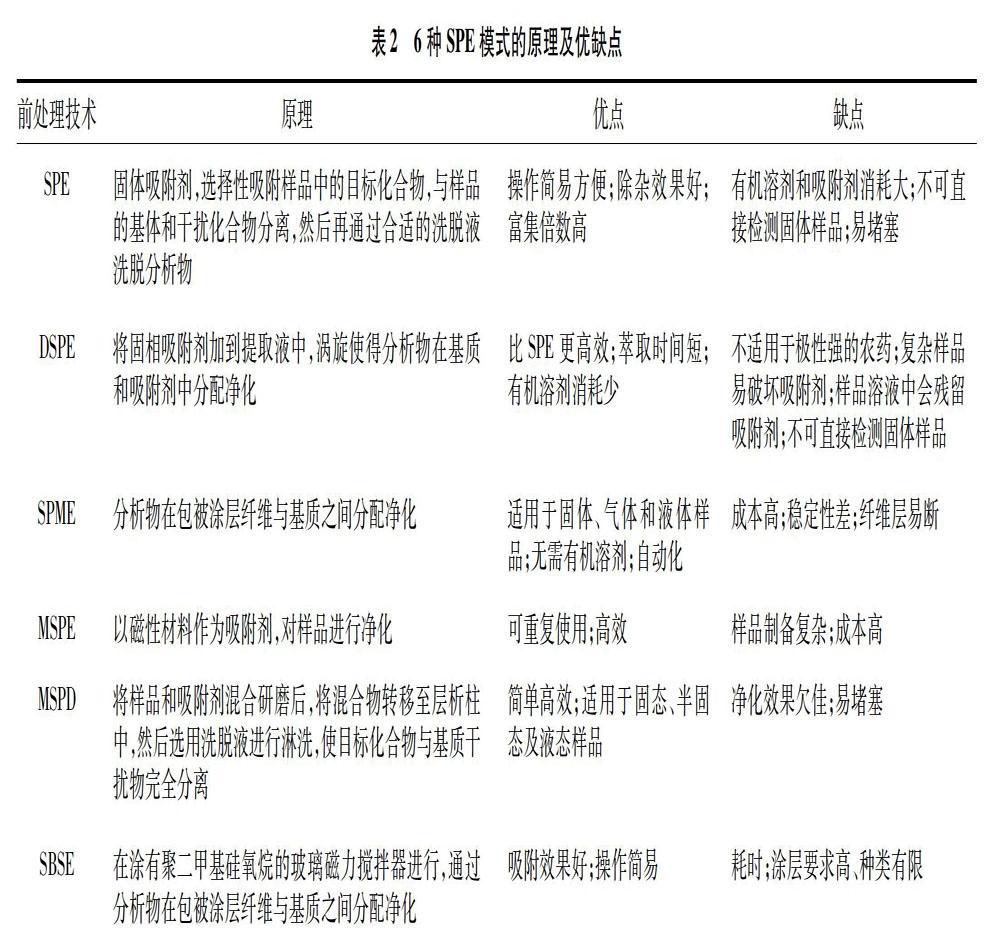
在固相萃取的原理上,SPE技術不斷發展,主要包括以下6種SPE:固相萃取、固相分散萃取(dispersive solid-phase extraction,簡稱DSPE)、固相微萃取(solid-phase microextraction,簡稱SPME)、磁固相萃取(magnetic solid-phase extraction,簡稱MSPE)、基質固相分散萃取(matrix solid-phase dispersion,簡稱MSPD)、攪拌棒吸附萃取(stir bar sorptive extraction,簡稱SBSE),這6種主要SPE模式的原理及優缺點見表2。
近年來,大量的學者在果蔬農藥殘留檢測過程中展開基于固相萃取技術的研究。Guan等利用基質固相分散萃取快速濃縮,然后結合液相色譜-串聯質譜同時分離檢測8種不同果蔬中的9種有機磷農藥[30]。Zuin等比較了攪拌棒吸附萃取和膜輔助溶劑萃取(MASE)前處理技術在測定甘蔗汁中農藥殘留的效果,2種前處理技術結合GC-MS,檢出限均可達到1 μg/L,但SBSE前處理具有更高的靈敏度和重復性[31]。Kin等在氣相色譜儀(電子捕獲檢測器,ECD)檢測前,選用固相微萃取法進行前處理,評估了草莓和黃瓜中有機磷和有機氯農藥殘留水平,具有較低的檢出限(0.01~1.00 μg/L)[32]。
1.3 QuEChERS法
QuEChERS(quick,easy,cheap,effective,rugged,safe)技術分為提取和凈化2個部分,第1個部分是用乙腈和鹽的混合物通過分配進行萃取,第2個部分是通過包含1種或幾種吸附劑的分散固相萃取(d-SPE)進行凈化,去除潛在的干擾化合物,包括有機酸、色素、糖等,具體操作見圖3[33]。該方法因省時、安全、操作簡單、成本低、可去除多種雜質對分析物的干擾而在果蔬農藥殘留分析中得以廣泛應用[34-36]。盡管原始的QuEChERS法在大多數果蔬基質中農藥殘留提取十分有效,但針對特殊基質或特殊農藥,須對QuEChERS方法不斷完善發展。近年來,大量的學者針對QuEChERS方法的提取和凈化部分進行不同程度的改進,主要包括pH值、提取溶劑、凈化的優化。
QuEChERS方法最初使用無緩沖液條件下進行,在應用過程中發現在高或低pH值下降解的敏感化合物的回收率差。為了克服局限性,歐洲標準委員會(CEN)[37]和美國分析化學家協會(AOAC)[38]制定了官方方法: 在提取過程中引入檸檬酸鹽緩沖液(相對較低的緩沖能力)或乙酸鹽緩沖液(較強的緩沖能力)。通過添加緩沖溶液,2種方法均出現pH值為5左右的萃取溶劑,有利于萃取pH值依賴性農藥。Lehotay等在果蔬農藥殘留檢測中添加醋酸鈉形成緩沖萃取劑,測定了32種農藥殘留,回收率為 (95±10)%,包括百菌清等pH值敏感農藥[39]。
目前大量的有機溶劑,如丙酮、乙腈、乙酸乙酯等,廣泛用于果蔬中農藥殘留分析[40],而乙腈(醋酸或甲酸酸化的乙腈)是最常見的萃取溶劑[37,40],不僅在水果和蔬菜等含水量高的基質中提取農藥回收率高[41-42],同時可以穿透樣品基體的水相,添加鹽后可以實現兩相分離[43]。隨著基質的復雜化以及農藥的多樣化,混合萃取溶劑在QuEChERS提取過程中不斷發展。Sivaperumal等用乙腈、乙酸乙酯(體積比為25 ∶ 75)混合溶液萃取,經d-SPE凈化后采用超高效液相色譜串聯飛行質譜(UHPLC-Q-TOF/MS)技術對芒果中68種殘留農藥進行測定,3種濃度水平(10、50、100 μg/kg)的回收率都在70%~122%之間,檢出限和定量限范圍分別為 0.5~7.0 μg/kg、2~25 μg/kg[44]。
凈化是QuEChERS法的關鍵步驟,可以極大程度地影響農藥殘留檢測的定量限和檢出限,其中最常見的凈化劑為MgSO4、石墨化碳黑(GCB)、十八烷基硅烷(C18)等。根據這些傳統凈化劑的優缺點[45],可將果蔬分為3類,一般的果蔬、高色素的果蔬和高色素及脂肪的果蔬。在QuEChERS法中選擇合適的吸附劑組合很大程度上取決于果蔬的類別。一般的果蔬采用N-丙基乙二胺(PSA)+MgSO4進行去除有機酸、部分糖[44,46],高色素的果蔬則一般以PSA、石墨化碳(GCB)+MgSO4的組合去除有機酸、部分糖以及色素[47-48],而對于高色素及脂肪的果蔬,會利用C18可以消除脂肪等非極性雜質的優勢,在此基礎上添加C18凈化劑進行除雜[49]。
1.4 其他前處理技術
除以上幾種比較常用的前處理技術外,凝膠滲透色譜法(gel permeation chromatography,簡稱GPC),超聲波輔助萃取(ultrasound assisted extraction,簡稱UAE),濁點萃取法(cloud point extraction,簡稱CPE)等在果蔬農藥殘留前處理過程中也有所應用。Ramos等開發了超聲輔助基質固相分散法,用于提取和凈化水果中的15種有機磷農藥和9種三嗪類農藥,超聲反應器在50%振幅下進行 1 min 的超聲處理前處理效果最佳,基本沒有基質效應[50]。周璐等建立了濁點萃取-正己烷反萃取氣相色譜(FPD)聯用法對蘋果汁中5種有機磷農藥的殘留進行測定[51]。5種目標物在0.05~2.00 mg/L范圍內線性相關系數范圍為0.998 6~0.999 6,方法的檢出限為0.13~1.50 μg/kg。
2 農藥殘留檢測技術
在過去的幾十年中,已經開發出許多檢測技術來測定果蔬中的農藥殘留,其中色譜法和色譜質譜聯用法是檢測的主要手段。基于其靈敏度、分離和鑒定能力,氣相色譜和液相色譜通常是農藥殘留檢測的首選。但是色譜法對復雜樣品的農藥殘留檢測有一定的限制,針對這一局限性,色譜-質譜聯用法(氣相色譜-質譜聯用技術、液相色譜-質譜聯用技術)得到了廣泛應用。近年來,為了滿足快速、簡單及選擇性高的農藥檢測需求,酶聯免疫分析技術、生物傳感器等檢測技術不斷發展。表3總結了幾種檢測技術在果蔬農藥殘留中的應用。
2.1 色譜法
氣相色譜法(gas chromatography,GC)適用于以氣體和可揮發物質作為分析對象,是一種經典分析方法。其原理是將前處理后的樣品注入氣相色譜柱,升溫汽化固相分離檢測,通過物質的保留時間進行定性,峰高和標準曲線進行定量。通過GC進行農藥殘留分析通常與特定的檢測器結合使用,例如電子捕獲檢測器(ECD)[52]、火焰光度檢測器(FPD)[8,53]、氮磷檢測器(NPD)[55]和火焰電離檢測器(FID)[22-23]。然而,隨著持久性和毒性較低的極性農藥的使用增加,由于其熱穩定性差和高沸點的特質,GC檢測方法的弊端顯現,使用有所減少[15]。
液相色譜法(liquid chromatography,簡稱LC)廣泛應用于農藥殘留分析,絕大部分采用了光電二極管陳列檢測器(PDA)、紫外檢測器(UV)、二極管陣列檢測器(DAD)[26]。高效液相色譜法(HPLC)是液相色譜法中最常用的方法,適用于相對分子量較大、極性較強、沸點較高及熱穩定性較差的農藥的分離檢測,彌補了氣相色譜不能分離熱穩定性和揮發性差的農藥的局限[67]。同時,HPLC因其快速、高效、準確性高等優勢在果蔬農藥殘留檢測中廣泛應用(表3)。
2.2 色譜-質譜聯用法
色譜-質譜聯用技術是結合色譜法和質譜(MS)的新檢測技術,常用在果蔬農藥多殘留分析領域。質譜的引入可以克服結構干擾,有效分離復雜樣品中的農藥,檢測多殘留農藥及其代謝物,還可同時對其進行定量、定性分析,并提供來自精準分子質量和裂解模式的結構信息。質譜分析器種類很多,其中四級桿分析器(quadrupole,簡稱Q)、離子阱分析器(ion trap,簡稱IT)和飛行時間分析器(time of flight mass,簡稱TOF)最為常用。為了達到增加結構信息的目的,大多數情況下選用具有串聯質譜功能的質量分析器,如Q-TOF、Q-Q-Q[15]。在色譜-質譜聯用系統中,被分析的樣品先在色譜系統中分離,然后從色譜柱中洗脫出來的餾分進行電離并進入質量分析器進行測定。農藥覆蓋范圍廣、樣品制備簡便、無需衍生化、靈敏度高、選擇性強等優點[26,68-70]是色譜-質譜聯用技術廣泛應用于農藥檢測、鑒定和定量分析的重要原因。表3總結了色譜-質譜聯用在果蔬農藥殘留檢測的研究。
2.3 其他檢測方法
近年來,酶聯免疫分析技術及生物傳感器法在果蔬農藥殘留檢測中的應用頻頻被報道。酶聯免疫法(ELISA)在免疫分析中使用最為廣泛,是根據抗原與抗體相互作用原理來確定農藥的含量[71]。該技術的缺點是抗體不穩定,會導致實驗結果有偏差,且不能同時準確分析多種農藥成分,只能作為輔助方法進行監測[15],但基于具有簡易快捷的特點以及較高的靈敏度和選擇性,應用在果蔬農藥殘留快速檢測中具有很大的發展潛力。Navarro等使用雙酶聯免疫吸附法檢測了柑橘汁中氯吡硫磷和倍硫磷的殘留量,該方法測得氯吡硫磷的檢出限為(0.20±0.04) μg/L,倍硫磷檢出限為(0.50±006) μg/L,且二者的回收率均為95%~106%[62]。Sun等建立了一種多酶示蹤劑形式的ElISA法測定蔬菜和果汁中西維因和速滅威含量,2種農藥回收率均超過70%,檢出限為0.15 μg/L(西維因)和1.2 μg/L(速滅威)[63]。
生物傳感器通過生物功能物質與合適的轉換元件充分結合,對特定類別的化合物、生物活性物質進行選擇性分析。與傳統檢測技術相比,生物傳感器檢測法具有檢樣微量、成本低、靈敏度高、分析速度快等優點[72],其中壓電生物傳感器、光學生物傳感器、電化學生物傳感器等是果蔬農藥殘留檢測的主要生物傳感器類型[15]。Caetano等構建了基于抑制乙酰膽堿酯酶(AchE)活性的電化學生物傳感器,用于測定番茄中西維因的殘留量,該方法檢出限為3.2 μg/L[64]。
3 納米材料在果蔬農藥殘留檢測的應用
隨著納米材料的不斷發展,研究者們不斷開發基于納米材料的農藥前處理技術和快速檢測方法。納米材料是一種三維空間中至少有一維在納米尺度范圍內(1~100 nm)的材料。近年來,碳納米材料(碳納米管、石墨烯)、半導體納米材料(量子點)及納米氧化物(二氧化鈦、四氧化三鐵)等在果蔬農藥殘留檢測中成為不可或缺的一部分[73-74]。
納米級別的材料具有塊狀材料所不具備的表面效應及強吸附能力[75]。為實現檢出限低、分離和富集一體化的凈化效果,納米材料在固相微萃取、磁固相萃取、基質固相萃取和QuEChERS等果蔬農藥殘留前處理技術中應用廣泛。Chatzimitakos等在基質固相萃取時使用磁性氧化石墨烯進行凈化后,利用GC-MS分離檢測了從蔬菜(白菜、韭菜、菊苣)提取的45種多類農藥[73]。磁性氧化石墨烯具有親水性和強吸附性,可以與高含水量蔬菜有效混合,在3種蔬菜中檢出率均為89%~106%,定量限更是達到0.4~4.0 μg/kg。多壁碳納米管(MWCNT)結合其大表面積和獨特結構,具有強吸附性,是一種固相微萃取的可替代凈化劑。Han等建立了QuEChERS-HPLC-MS/MS法測定韭菜、萵苣和花環菊花中70種農藥殘留,前處理分別采用MWCNT、GCB、PSA作為凈化劑,結果表明,MWCNT的凈化性能優于GCB和PSA,回收率較高,范圍為74%~119%,同時70種農藥的檢出限(0.1~2.4 μg/kg)和定量限(0.3~7.9 μg/kg)都較低[76]。
金屬半導晶體納米材料量子點(quantum dot,簡稱QD)擁有獨特的光學性質,量子點與目標分析物發生物理或化學反應,能夠導致發光增強或猝滅,以此來測定目標物的濃度[77]。量子點表面易進行功能修飾的特點以及光學性質,促進了其在農藥殘留檢測中的應用。Luan等以建立了CdTe量子點為信號傳感器、乙酰膽堿酯酶(AchE)為識別分子的生物傳感器,已經應用于蘋果中有機磷農藥的測定[78]。有機磷農藥抑制了AchE活力,從而改變CdTe/AchE的熒光強度,可以衡量有機磷農藥含量。在最佳條件下,對硫磷和對氧磷的線性范圍為5~100 μg/L,檢測限為10 μg/L。為實現特異性檢測果蔬中農藥殘留,Huang等用O,O-二甲基-(2,2-二氯乙烯基)磷酸酯的分子印跡聚合物(MIPs)包覆混合量子點,選擇性吸附測定敵敵畏,而量子點的加入大大提高了測定敵敵畏的靈敏度,檢出限達到1.27 μg/L,并成功應用于白菜中敵敵畏的測定,回收率為87.4%~101.0%[79]。
4 總結與展望
隨著人們食品安全意識的不斷增強,果蔬的農藥殘留問題越來越受重視。果蔬基質的復雜性、農藥的多樣性,對果蔬農藥殘留分析技術的發展起了推動作用。近年來,樣品前處理過程已進行了很大改進,這些改進技術具有提高靈敏度,減少樣品量、有機試劑、分析時間、基質干擾的發展趨勢。而檢測技術也逐漸從色譜技術向色譜-質譜聯用技術轉移,同時,生物傳感器法和免疫技術近年來在果蔬農藥殘留檢測中不斷開發應用。不同的前處理和檢測技術都具有各自的適用范圍和優缺點,在實際檢測中,需要結合果蔬的種類、農藥的種類和限度,選擇適當的前處理和檢測技術,來提高果蔬中農藥殘留檢測的準確度。
最近幾年,農藥產業迅速發展,出現了不少新型農藥,新型農藥正朝著復合農藥的方向發展,農藥殘留檢測也逐漸向多種組分同時檢測分析的趨勢發展。農藥殘留檢測需要生物技術與多種現代儀器分析技術相結合來提高檢測的準確性和靈敏度。未來的農藥殘留分析將與新材料結合,朝著安全化、微型化和自動化分析的方向發展。研發高效快捷、高靈敏、高通量及自動化的新型農藥殘留檢測技術并將其應用到實踐,將是未來研究熱門方向之一,將為我國農藥殘留檢測打開一個多元化局面。
參考文獻:
[1]World Health Organization. World health statistics 2016:monitoring health for the SDGs,sustainable development goals[M]. Geneva:WHO Press,2016.
[2]Chen F,Zeng L Q,Zhang Y Y,et al. Degradation behaviour of methamidophos and chlorpyrifos in apple juice treated with pulsed electric fields[J]. Food Chemistry,2009,112(4):956-961.
[3]Li R,Wei W,He L,et al. Chlorpyrifos residual behaviors in field crops and transfers during duck pellet feed processing[J]. Journal of Agricultural and Food Chemistry,2014,62(42):10215-10221.
[4]Azam S M R,Ma H,Xu B,et al. Efficacy of ultrasound treatment in the removal of pesticide residues from fresh vegetables:a review[J]. Trends in Food Science & Technology,2020,97:417-432.
[5]何麗芳,王芳宇,鄒征歐,等. 衡陽市蔬菜水果農藥殘留現狀、原因與對策[J]. 衡陽師范學院學報,2012,33(3):82-85.
[6]易承學,徐 虹,蒲彥利,等. 2014年鎮江市夏季蔬菜農藥殘留監測分析[J]. 職業與健康,2015,31(3):326-328.
[7]韋江峰,李 翔,胡支向,等. 柑橘中有機磷類農藥使用調查初探[J]. 農業與技術,2015,35(5):36-37.
[8]Blankson G K,Osei-Fosu P,Adeendze E A,et al. Contamination levels of organophosphorus and synthetic pyrethroid pesticides in vegetables marketed in Accra,Ghana[J]. Food Control,2016,68:174-180.
[9]Samsidar A,Siddiquee S,Shaarani S M. A review of extraction,analytical and advanced methods for determination of pesticides in environment and foodstuffs[J]. Trends in Food Science & Technology,2018,71:188-201.
[10]董亞蕾,劉文婧,曹 進,等. 國內食品中農藥多殘留檢測技術的研究進展[J]. 分析試驗室,2017,36(2):241-248.
[11]Golge O,Kabak B. Determination of 115 pesticide residues in oranges by high-performance liquid chromatography-triple-quadrupole mass spectrometry in combination with QuEChERS method[J]. Journal of Food Composition & Analysis,2015,41:86-97.
[12]Pang G F,Chang Q Y,Bai R B,et al. Simultaneous screening of 733 pesticide residues in fruits and vegetables by a GC/LC-Q-TOFMS combination technique[J]. Engineering,2019,6(4):375-489.
[13]王新雄,成秀娟,徐偉松,等. 農產品農藥殘留檢測技術的研究進展[J]. 廣西農業科學,2008,39(5):700-704.
[14]張人允,曲 瑩,徐佳佳. 食品農藥殘留檢測中樣品前處理技術分析[J]. 食品安全導刊,2019(15):82-83.
[15]Narenderan S T,Meyyanathan S N,Babu B. Review of pesticide residue analysis in fruits and vegetables. Pre-treatment,extraction and detection techniques[J]. Food Research International,2020,133:109141.
[16]李 曄,袁 佗. 濃縮果汁中擬除蟲菊酯類農藥殘留檢測[J]. 中國衛生檢驗雜志,2008(9):1774-1775.
[17]Pose-Juan E,Cancho-Grande B,Rial-Otero R,et al. The dissipation rates of cyprodinil,fludioxonil,procymidone and vinclozoline during storage of grape juice[J]. Food Control,2006,17,1012-1017.
[18]Sannino A,Bolzoni L,Bandini M. Application of liquid chromatography with electrospray tandem mass spectrometry to the determination of a new generation of pesticides in processed fruits and vegetables[J]. Journal of Chromatography A,2004,1036(2):161-169.
[19]Wang P,Yang X,Wang J,et al. Multi-residue method for determination of seven neonicotinoid insecticides in grains using dispersive solid-phase extraction and dispersive liquid-liquid micro-extraction by high performance liquid chromatography[J]. Food Chemistry,2012,134(3):1691-1698.
[20]Grimalt S,Sancho J V,Pozo O J,et al. Quantification,confirmation and screening capability of UHPLC coupled to triple quadrupole and hybrid quadrupole time-of-flight mass spectrometry in pesticide residue analysis[J]. Journal of Mass Spectrometry,2010,45(4):421-436.
[21]Ho Y M,Tsoi Y K,Leung K S. Highly sensitive and selective organophosphate screening in twelve commodities of fruits,vegetables and herbal medicines by dispersive liquid-liquid microextraction[J]. Analytica Chimica Acta,2013,77(5):58-66.
[22]Farajzadeh M A,Khoshmaram L. Air-assisted liquid-liquid microextraction-gas chromatography-flame ionisation detection:a fast and simple method for the assessment of triazole pesticides residues in surface water,cucumber,tomato and grape juices samples[J]. Food Chemistry,2013,141(3):1881-1887.
[23]Farajzadeh M A,Feriduni B,Afshar M M. Development of counter current salting-out homogenous liquid-liquid extraction for isolation and preconcentration of some pesticides from aqueous samples[J]. Analytica Chimica Acta,2015,88 (5):122-131.
[24]Timofeeva I,Shishov A,Kanashina D,et al. On-line in-syringe sugaring-out liquid-liquid extraction coupled with HPLC-MS/MS for the determination of pesticides in fruit and berry juices[J]. Talanta,2017,16 (7):761-767.
[25]王慶齡,裘鈞陶,詹越城,等. 復合小柱結合HPLC-MS/MS法快速測定果蔬及茶葉和大米中34種農藥殘留[J]. 農產品加工,2019(6):56-60.
[26]Jin B H,Xie L Q,Guo Y F,et al. Multi-residue detection of pesticides in juice and fruit wine:a review of extraction and detection methods[J]. Food Research International,2012,46(1):399-409.
[27]Bakrc G T,Acay D B Y,Bakrc F,et al. Pesticide residues in fruits and vegetables from the Aegean region,Turkey[J]. Food chemistry,2014,160:379-392.
[28]Ravelo-Pérez L M,Hernández-Borges J,Rodríguez-Delgado M A. Multi-walled carbon nanotubes as efficient solid-phase extraction materials of organophosphorus pesticides from apple,grape,orange and pineapple fruit juices[J]. Journal of Chromatography A,2008,1211(1/2):33-42.
[29]Fan S,Zhao P,Yu C,et al. Simultaneous determination of 36 pesticide residues in spinach and cauliflower by LC-MS/MS using multi-walled carbon nanotubes-based dispersive solid-phase clean-up[J]. Food Additives & Contaminants,2014,31(1):73-82.
[30]Guan S X,Yu Z G,Yu H N,et al. Multi-Walled carbon nanotubes as matrix Solid-Phase dispersion extraction adsorbent for simultaneous analysis of residues of nine organophosphorus pesticides in fruit and vegetables by rapid resolution LC-MS-MS[J]. Chromatographia,2011,73(1):33-41.
[31]Zuin V G,Schellin M,Montero L,et al. Comparison of stir bar sorptive extraction and membrane-assisted solvent extraction as enrichment techniques for the determination of pesticide and benzo[a]pyrene residues in Brazilian sugarcane juice[J]. Journal of Chromatography A,2006,1114(2):180-187.
[32]Kin C M,Huat T G. Headspace solid-phase microextraction for the evaluation of pesticide residue contents in cucumber and strawberry after washing treatment[J]. Food Chemistry,2010,123(3):760-764.
[33]Anastassiades M,Lehotay S J,Stajnbaher D,et al. Fast and easy multiresidue method employing acetonitrile extraction/partitioning and “dispersive solid-phase extraction” for the determination of pesticide residues in produce[J]. Journal of AOAC International,2003,86(2):412-431.
[34]Biziuk M,Stocka J. Multiresidue methods for determination of currently used pesticides in fruits and vegetables using QuEChERS technique[J]. International Journal of Environmental Science and Development,2015,6(1):18-22.
[35]Dankyi E,Carboo D,Gordon C,et al. Application of the QuEChERS procedure and LC-MS/MS for the assessment of neonicotinoid insecticide residues in cocoa beans and shells[J]. Journal of Food Composition and Analysis,2015,44:149-157.
[36]Prodhan M D H,Papadakis E N,Papadopoulou-Mourkidou E. Analysis of pesticide residues and their variability in cabbage using QuEChERS extraction in combination with LC-MS/MS[J]. Food Analytical Methods,2016,9(12):3470-3478.
[37]Alexandre P. European Committee for Standardization[C]. Amman:Franco Jordanian Forum on Water Sustainability,2014.
[38]Lehotay S J. Determination of pesticide residues in foods by acetonitrile extraction and partitioning with magnesium sulfate:collaborative study[J]. Journal of AOAC International,2007,90(2):485-520.
[39]Lehotay S J,Mastovská K,Lightfield A R. Use of buffering and other means to improve results of problematic pesticides in a fast and easy method for residue analysis of fruits and vegetables[J]. Journal of AOAC International,2005,88(2):615-629.
[40]Kim L,Lee D,Cho H K,et al. Review of the QuEChERS method for the analysis of organic pollutants:persistent organic pollutants,polycyclic aromatic hydrocarbons,and pharmaceuticals[J]. Trends in Environmental Analytical Chemistry,2019,22:e00063.
[41]González-Curbelo M ,Socas-Rodríguez B,Herrera-Herrera A V,et al. Evolution and applications of the QuEChERS method[J]. TrAC Trends in Analytical Chemistry,2015,71:169-185.
[42]Grimalt S,Dehouck P. Review of analytical methods for the determination of pesticide residues in grapes[J]. Journal of Chromatography A,2016,1433:1-23.
[43]Schenck F J,Callery P,Gannett P M,et al. Comparison of magnesium sulfate and sodium sulfate for removal of water from pesticide extracts of foods[J]. Journal of AOAC International,2002,85(5):1177-1180.
[44]Sivaperumal P,Salauddin A,Kumar A R,et al. Determination of pesticide residues in mango matrices by ultra high-performance liquid chromatography coupled with quadrupole time-of-flight mass spectrometry[J]. Food Analytical Methods,2017,10(7):2346-2357.
[45]Alcntara D B,Fernandes T S M,Nascimento H O,et al. Diagnostic detection systems and QuEChERS methods for multiclass pesticide analyses in different types of fruits:an overview from the last decade[J]. Food Chemistry,2019,298:124958.
[46]Suganthi A,Bhuvaneswari K,Ramya M. Determination of neonicotinoid insecticide residues in sugarcane juice using LCMSMS[J]. Food Chemistry,2018,241:275-280.
[47]Chen K,Liu X,Wu X,et al. Simultaneous determination of afidopyropen and its metabolite in vegetables,fruit and soil using UHPLC-MS/MS[J]. Food Additives & Contaminants,2018,35(4):716-723.
[48]Malhat F,Boulangé J,Abdelraheem E,et al. Validation of QuEChERS based method for determination of fenitrothion residues in tomatoes by gas chromatography-flame photometric detector:decline pattern and risk assessment[J]. Food Chemistry,2017,229:814-819.
[49]Lin X Y,Mou R X,Cao Z Y,et al. Analysis of pyrethroid pesticides in Chinese vegetables and fruits by GC-MS/MS[J]. Chemical Papers,2018,72(8):1953-1962.
[50]Ramos J J,Rial-Otero R,Ramos L,et al. Ultrasonic-assisted matrix solid-phase dispersion as an improved methodology for the determination of pesticides in fruits[J]. Journal of Chromatography A,2008,1212(1/2):145-149.
[51]周 璐,陳 敏,張 凱,等. 濁點萃取-正己烷反萃取氣相色譜法測定蘋果汁中5種有機磷農藥殘留[J]. 山東農業大學學報(自然科學版),2011,42(4):492-498.
[52]董 娟,羅小玲,謝 勇,等. 胡蘿卜及胡蘿卜汁中百菌清和擬除蟲菊酯類農藥的分析研究[J]. 現代食品科技,2009,25(1):108-110.
[53]Xiao Q,Hu B,Yu C H,et al. Optimization of a single-drop microextraction procedure for the determination of organophosphorus pesticides in water and fruit juice with gas chromatography-flame photometric detection[J]. Talanta,2006,69(4):848-855.
[54]Liu X,Mitrevski B,Li D,et al. Comprehensive two-dimensional gas chromatography with flame photometric detection applied to organophosphorus pesticides in food matrices[J]. Microchemical Journal,2013,111:25-31.
[55]Mahpishanian S,Sereshti H,Baghdadi M. Superparamagnetic core-shells anchored onto graphene oxide grafted with phenylethyl amine as a nano-adsorbent for extraction and enrichment of organophosphorus pesticides from fruit,vegetable and water samples[J]. Journal of Chromatography A,2015,140 (6):48-58.
[56]Wang X L,Tang Q H,Wang Q Q,et al. Study of a molecularly imprinted solid-phase extraction coupled with high-performance liquid chromatography for simultaneous determination of trace trichlorfon and monocrotophos residues in vegetables[J]. Journal of the Science of Food and Agriculture,2014,94(7):1409-1415.
[57]Topuz S,zhan G,Alpertunga B. Simultaneous determination of various pesticides in fruit juices by HPLC-DAD[J]. Food Control,2005,16(1):87-92.
[58]Tian F J,Qiao C K,Luo J,et al. Development and validation of a method for the analysis of five diamide insecticides in edible mushrooms using modified QuEChERS and HPLC-MS/MS[J]. Food Chemistry,2020,333:127468.
[59]Cervera M I,Portolés T,Pitarch E,et al. Application of gas chromatography time-of-flight mass spectrometry for target and non-target analysis of pesticide residues in fruits and vegetables[J]. Journal of Chromatography A,2012,1244:168-177.
[60]張偉軍. HPLC-MS/MS法同時測定蔬菜中38種農藥殘留[J]. 湖南農業科學,2018(6):91-95.
[61]Lima V G,Campos V P,Santana T C,et al. Determination of agrochemical multi-residues in grapes. Identification and confirmation by gas chromatography-mass spectrometry[J]. Analytical Methods,2017,9(40):5880-5889.
[62]Navarro P,Pérez A J,Gabaldón J A,et al. Detection of chemical residues in tangerine juices by a duplex immunoassay[J]. Talanta,2013,11(6):33-38.
[63]Sun J,Dong T,Zhang Y,et al. Development of enzyme linked immunoassay for the simultaneous detection of carbaryl and metolcarb in different agricultural products[J]. Analytica Chimica Acta,2010,666(1/2):76-82.
[64]Caetano J,Machado S A. Determination of carbaryl in tomato“in natura”using an amperometric biosensor based on the inhibition of acetylcholinesterase activity[J]. Sensors and Actuators B,2008,129(1):40-46.
[65]Tan X,Hu Q,Wu J,et al. Electrochemical sensor based on molecularly imprinted polymer reduced graphene oxide and gold nanoparticles modified electrode for detection of carbofuran[J]. Sensors and Actuators B,2015,220:216-221.
[66]Miao S S,Wu M S,Ma L Y,et al. Electrochemiluminescence biosensor for determination of organophosphorous pesticides based on bimetallic Pt-Au/multi-walled carbon nanotubes modified electrode[J]. Talanta,2016,158:142-151.
[67]Seebunrueng K,Santaladchaiyakit Y,Srijaranai S. Vortex-assisted low density solvent based demulsified dispersive liquid-liquid microextraction and high-performance liquid chromatography for the determination of organophosphorus pesticides in water samples[J]. Chemosphere,2014,103:51-58.
[68]Kujawski M W,Namie s'nik J. Levels of 13 multi-class pesticide residues in Polish honeys determined by LC-ESI-MS/MS[J]. Food Control,2011,22(6):914-919.
[69]Machado I,Gérez N,Pistón M,et al. Determination of pesticide residues in globe artichoke leaves and fruits by GC-MS and LC-MS/MS using the same QuEChERS procedure[J]. Food Chemistry,2017,227:227-236.
[70]趙 麗,農蕊瑜,師 真,等. 分散固相萃取-氣相色譜-質譜聯用測定茶葉中的28種農藥殘留[J]. 江蘇農業科學,2020,48(12):208-215.
[71]Qian G L,Wang L M,Wu Y R,et al. A monoclonal antibody-based sensitive enzyme-linked immunosorbent assay(ELISA)for the analysis of the organophosphorous pesticides chlorpyrifos-methyl in real samples[J]. Food Chemistry,2009,117(2):364-370.
[72]Patel H,Rawtani D,Agrawal Y. A newly emerging trend of chitosan-based sensing platform for the organophosphate pesticide detection using acetylcholinesterase-a review[J]. Trends in food science & technology,2019,85:78-91.
[73]Chatzimitakos T G,Karali K K,Stalikas C D. Magnetic graphene oxide as a convenient nanosorbent to streamline matrix solid-phase dispersion towards the extraction of pesticides from vegetables and their determination by GC-MS[J]. Microchemical Journal,2019,151:104247.
[74]Dabbagh M S,Farajzadeh M A. Introduction of a new procedure for the synthesis of polysulfone magnetic nanoparticles and their application in magnetic solid phase extraction for the extraction of some pesticides from fruit and vegetable juices[J]. Microchemical Journal,2020,158:105238.
[75]Kaur R,Hasan A,Iqbal N,et al. Synthesis and surface engineering of magnetic nanoparticles for environmental cleanup and pesticide residue analysis:a review[J]. Journal of Separation Science,2014,37(14):1805-1825.
[76]Han Y,Zou N,Song L,et al. Simultaneous determination of 70 pesticide residues in leek,leaf lettuce and garland chrysanthemum using modified QuEChERS method with multi-walled carbon nanotubes as reversed-dispersive solid-phase extraction materials[J]. Journal of Chromatography B,2015,1005:56-64.
[77]趙 芳,李為琴,段江蓮,等. 量子點傳感器在農藥殘留檢測中的應用研究進展[J]. 食品研究與開發,2020,41(9):213-220.
[78]Luan E X,Zheng Z Z,Li X Y,et al. Inkjet-assisted layer-by-layer printing of quantum dot/enzyme microarrays for highly sensitive detection of organophosphorous pesticides[J]. Analytica Chimica Acta,2016,916:77-83.
[79]Huang S Y,Tan L,Zhang L,et al. Molecularly imprinted mesoporous silica embedded with perovskite CsPbBr3 quantum dots for the fluorescence sensing of 2,2-dichlorovinyl dimethyl phosphate[J]. Sensors and Actuators B,2020,325:128751. 許洪高,周琪樂,魯 緋,等. 螺旋藻養殖加工和安全性研究進展[J]. 江蘇農業科學,2021,49(6):10-19.
猜你喜歡
中學生數理化·七年級數學人教版(2021年6期)2021-11-22 07:50:58
中學生數理化·七年級數學人教版(2021年6期)2021-11-22 07:50:58
中學生數理化·七年級數學人教版(2021年6期)2021-11-22 07:50:58
中學生數理化·七年級數學人教版(2020年12期)2021-01-18 06:57:46
中學生數理化·七年級數學人教版(2020年12期)2021-01-18 06:57:46
現代農業科技(2016年20期)2016-12-20 09:02:15
企業技術開發·下旬刊(2016年9期)2016-11-23 03:54:44
電腦知識與技術(2016年6期)2016-06-06 11:06:29
海峽科技與產業(2016年3期)2016-05-17 04:32:12
計算機輔助工程(2016年1期)2016-03-15 12:49:55