
RIDE OR DIE
2021-02-22 06:43:25
漢語世界(The World of Chinese) 2021年1期
關鍵詞:生活
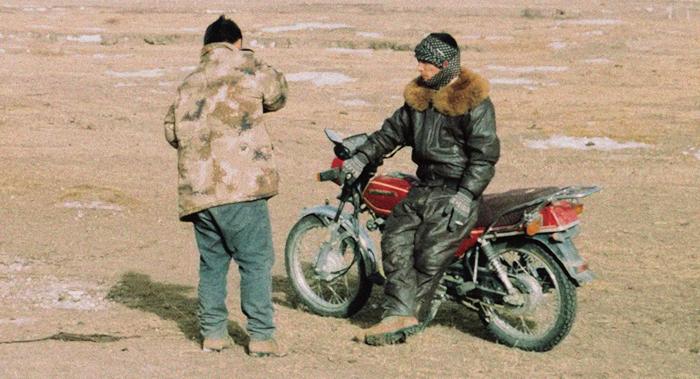


Text and Photography By Mads vesterager Nielsen Freewheeling motorbike cultures in the Middle Kingdom
摩托車是交通工具、身份的象征、炫耀的資本,也是自主或被動選擇的生活方式
I can hear the beastly engines revving from hundreds of meters away. Up close, the machines gleam in the autumn sun. Benellis, chrome Harley Davidsons, dark-tinted BMWs, and Shinerays are all lined up for display on the deck of an abandoned freight train platform in Beijings 798 Art District.
“I come here every weekend to meet the others—this is a lifestyle,” a motorbiker surnamed Wang says through the gasoline fumes that hover between men and machines in the square. He is sitting on a concrete boulder, facing a dozen or so motorbikes that are parked in front of the Ace Cafe, a world-renowned British franchise (at least for motorbike enthusiasts) that is the go-to hangout spot for Beijings bikers. This is both because of its decor and because “dog riders,” as seasoned riders are called in biker lingo, get 10 percent off on any order when they arrive on a motorbike.
I have seen many “dog riders” out on the roads over the past eight years on my own motorbike adventures around China. They wear full-body black leather suits and colorful helmets, giving thumbs ups as they drive by and causing heads to turn. I have also seen many other uses of the motorbike in China—as a tool, a source of pride, and even as a companion.
Through 30,000 kilometers of motorbike journeys, and interactions with riders of all ages and classes, three motorbike cultures have stood out to me for their embrace of the bike as more than just a mode of transportation: among the Tibetan herders of Sichuan, in the coal country of Guizhou, and in the gleaming capital of Beijing.
Although the first motorbikes arrived in China in the early 1900s, homegrown production didnt commence until 1951 when the Peoples Liberation Army started making military motorbikes based on the design of the German K500 for the Korean War. Mass production only began in Chongqing, Guangdong province, and Zhejiang province after market reforms kicked in during the late 1980s and early 90s. These three manufacturing hubs churned out millions of cheap two-wheeled, gasoline-engine vehicles that quickly became a household item all over China.
One of the most iconic vehicles of this era is the Honda Dayang, which started production in 1992 through a joint-venture between Japans Honda Motors and the Guangzhou Motors Group. This was one of the most popular motorbikes in history: It has been produced in the tens of millions. It owes its popularity mainly to two qualities—it is cheap and reliable.
From 1992 onward, the Chinese domestic market grew to 4 million motorbikes, and reached nearly 20 million in the 2000s. As the Chinese government enacted restrictions to address air pollution and safety issues caused by the large number of motorbikes in urban areas, commuters switched to electric scooters, which have much more relaxed licensing requirements and looser regulations, causing the motorbike market to cool. Today there is one motorbike for every five households in China.
Cheap motorbikes have turned into a symbol of backwardness. In cities such as Beijing and Shanghai, they have almost entirely disappeared under the joint forces of regulation and economic development. Only the extremes remain: The secondhand tiddlers which rural riders commandeer on remote or difficult landscapes, or the vastly more expensive imports that are parked outside the Ace Cafe. For work or necessity, leisure or identity, the wheels are continuing to turn in Chinas unique motorbike cultures.
Herding on two wheels
Some herders have even fitted their bikes with prayer flags, making them into small mobile shrines that protect them on their way
Far from the expensive motorbikes of the capital, at altitudes ranging from 3,000 to 3,500 meters, Tibetan herders dart out over the highland steppes on red Lisans, Hondas, and Suzukis. It is time for the yearly administering of worm cures for the oxen, and I have arrived just in time to participate. We assemble by the side of a dirt road next to three motorbikes.
“I prefer this one,” a young herder named Gdong Dkar says, pointing at a bright red Honda model called Dayang, or Great Sun, “but I also drive cars and tractors.” Not bad for a 14-year-old.
Here in Hongyuan county, in the Aba region of northern Sichuan province, herders put their driving skills to good use out on the highland terrain. The motorbike has virtually replaced the horse as the favored mode of transportation, because it works well in off-road conditions and requires less maintenance than a live animal. Some herders have even fitted their bikes with the Kalachakra symbol, prayer flags, swastikas, and even golden plastic prayer mills, making small mobile shrines that protect them on their way.
In the distance, I can see the yaks, looking no bigger than black dots on the horizon. “You drive to the right, I will take the left,” Kelsang, the lead herder, orders like a field commander directing divisions to partake in a grand pincer maneuver. He turns to me and a female herder and instructs, “When [the yaks] come this way, you need to wave your arms, yell, and make yourselves as big as you can—do not let them get past you.”
Less obvious, but equally dreaded among the herders, are the cold temperatures that will slowly eat at the joints and cause chronic pain to the knees. “You need to be safe and make sure your joints are kept warm. Many herders get bad knees at age 30-35 because of the chills,” Kelsang says. There is no technical term for this, but in some biking communities it is known as “burning knees.” “You wont feel it in your knees now, but slowly it will freeze through your sinews.”
James Dean of the mountains
In the mountains, suave Chinese James Deans
drive their motorbikes around the treacherous roads to impress their sweethearts
I
n the karst hills of Guizhou province, I meet motorbikers who are young men working in the local coal plants. “Dont touch their motorcycles; they might take it the wrong way,” a local friend named Cai Hen tells me. Cai grew up here in Liupanshui, a largely rural area of 2.8 million residents in western Guizhou, and counts many bikers among his friends and family.
Cais friends, cousins, and uncles can swing the handle of a motorbike like few others. They have also never left the countryside to work in the city, unlike Cai himself. This is coal country, a rust belt of old coal processing facilities in the Guizhou mountains, where state-owned plants are mixed with local operations that together hold a monopoly on trade and extraction. “The people who stay mostly join local companies, and on the weekends, they drive to the market or the abandoned factories to party,” Cai says.
We enter the grounds of a former coal factory where Cais cousin, Cai Liu, is waiting for us. He is wearing a leather jacket and biting on the end of his cigarette. “Do you know how to drive one of these?” he asks me, nodding at the red motorbike in front of him. Dried mud covers the track guards, and it is rusted at the rear suspension.
“I do,” I say, but I am slightly intimidated. I know I will not be able to drive with the same skill, gusto, and flamboyance as this 20-year-old youngster.
In the mountains, suave Chinese James Deans like Cai Liu, in leather jackets and slicked-back 30 yuan hairdos, drive their motorbikes around the treacherous roads to impress their sweethearts.
“The girls like to drive with us,” he says, “but their parents dont like it when they do.”
Here, several generations of Chinese youngsters have grown up with the motorbike as the vehicle of their dreams and affection, much like the Cadillacs and Thunderbirds of 1950s and 60s American suburbia. Driving from early age gives them incredible command of their two-wheeled vehicle. The legal driving age for motorbikes in China is 18, but due to the great number of motorbikes that are on the roads in this part of the country, it is not uncommon to see kids as young as 12 racing by on two wheels.
Being around motorbikes their entire lives, they learn the tricks by observing and learning from their elder siblings, parents, or relatives. Near collisions seem to happen constantly, and movements are done on the whim of instinct rather than thinking your way through traffic. “[My family] used to share one motorbike, but when I got a job, I bought my own,” Cai Liu says.
Up until the mid-2010s, the majority of motorbikes on the roads in China were not properly registered. The bikes occupied their own gray area, tolerated by the police because it plays an integral part of the local economy and transportation system. Illegal vehicles were easily obtained secondhand through local black markets. This has intensified over the past decade, as the motorbikes were first pushed out of the city, then put under increasing restrictions in the countryside.
Having been the vehicle of choice in urban and rural areas—capable of transporting anything including crops, chickens, geese, or several family members at a time—the motorbike was made the target of a series of government policies. Millions of bikes were taken off the streets by the police during criminal cleanup campaigns from 2015 onward. Routine checks and raids are now carried out. All motorbikes have to be registered at the local motor vehicles department, and the drivers have to carry a motorbike license, or the police may confiscate the motorbike and slap the driver with criminal charges.
In the mountains of Guizhou, though, the motorbike is still thriving. There are plenty of un-registered motorbikes on the roads, many without license plates entirely. Police occasionally grab motorbikes off the street just to be seen as making an effort and meet local government targets.
This is a prospect dreaded by the local bikers. Many of the youngsters feel trapped here in the countryside, away from better job prospects and the lives reflected in the soap operas they watch on their smart phones. If they lose their motorbike, they will lose a part of their identity.
They seem disgruntled, stuck in the mountains, and the frustration comes out on the weekends. “There are often fights at the factory parties. Once a guy got stabbed and everyone fled as fast as they could before the police arrived,” Cai Liu reminisces. They know that the area is underdeveloped, but on the motorbike, it seems like they can outrun that for a moment.
Motor Aces
It is a part of this motorbike culture to revel in the beauty of the machine and gain the respect of other dog riders
Back in Beijing, Wang the biker and I are walking among the motorbikes in 798. “This one costs about 400,000 RMB.” He points to a newly polished Harley Davidson, which is attracting a lot of attention from other “dog riders” and passersby.
“Many of the guys only like their bikes for a couple of months, just like their girlfriends.” He laughs before he goes on. “Then they go on [e-commerce app] Xianyu and exchange their bike for something different.”
But the secondhand game in 798 and the motorbikers in Sichuan and Guizhou are worlds apart. You can still find relatively cheap bikes on Xianyu in Beijing, with or without license plates. The Suzuki 125 GN that I own was bought with a “Jing B” plate for 5,000 RMB, the same design as those that can be acquired secondhand for a couple of hundred yuan in other provinces. The license plate itself costs between 1,000 to 1,500 RMB, but it is only valid to drive outside Beijings Fourth Ring Road, so seasoned riders are less than impressed.
The leisure motorbikers resell their bikes because they want to try out other models. The Harley Davidson that is the awe of the day in 798 has been imported from the US and carries the coveted “Jing A” license plate, which allows the driver access to all districts of Beijing. Because no new Jing A plates are issued anymore, its price has skyrocketed—as of 2020, a Jing A license plate cost between 80,000 and 100,000 RMB, in addition to the cost of the bike.
Anyone who owns these plates is running an expensive hobby, and most of the motorbikes in 798 carry Jing A plates. It is a part of this motorbike culture to revel in the beauty of the machine and gain the respect of other dog riders.
Wang is wearing a six-pence cap. A 52-year-old robotics engineer with two motorbikes and a couple of cars in his garage in southern Beijing, he is the leader of a group of motorbike fans known as the Lucky Number 16. The 149 members of their WeChat group routinely share pictures of motorbikes and the landscapes they travel through on their two-wheelers, and many of them meet at the Ace Cafe with their motorbikes every weekend.
“We are all very peaceful. We like to drink beer, talk about motorbikes and crack jokes,” says Wang. They are inspired by American television series like Sons of Anarchy, but fix a Peppa Pig sticker on their bikes, rather than skulls. “On the motorbike you can get close to nature and you can feel the wind in your face and see the landscape roll by.”
猜你喜歡
風流一代·經典文摘(2018年1期)2018-02-22 09:00:43
黨的生活(黑龍江)(2017年12期)2017-12-23 17:01:20
求學·文科版(2017年10期)2017-12-21 11:55:48
求學·理科版(2017年10期)2017-12-19 13:42:05
民生周刊(2017年19期)2017-10-25 07:16:27
少年博覽·小學高年級(2016年12期)2017-01-16 12:48:35
特別文摘(2016年19期)2016-10-24 18:38:15
爆笑show(2016年3期)2016-06-17 18:33:39
37°女人(2016年5期)2016-05-06 19:44:06
爆笑show(2016年1期)2016-03-04 18:30:28
 漢語世界(The World of Chinese)2021年1期
- 漢語世界(The World of Chinese)的其它文章
- 光影
- 智
- Gilded Expressions
- Master?-s Return
- The Beasts Within
- MOUNTAIN ECHOES