
MOUNTAIN ECHOES
2021-02-22 06:43:25
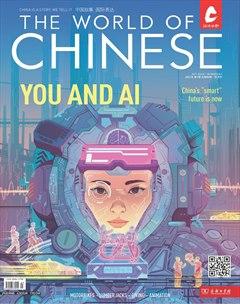
漢語世界(The World of Chinese) 2021年1期


In the past year, the mountainous Liangshan Yi Autonomous Prefecture has been declared a “final battleground” in the national campaign against poverty. Its newly built roads were traversed daily by dozens of journalists from around the country, reporting inspirational news of “cliff villagers” moving down the mountain and into new homes.
Yet for people growing up in this region of southwestern Sichuan province, the mountains are not a political buzzword, but simply home. Last year, Moxi Zishi (???? in Yi script), Mose Yiluo (????), and Shama Shizhe (????), who also goes by Ma Jianlan, founded the platform “Echo of Liangshan (?????????)” in their hometown of Xichang to promote cultural exchange within the region, and between the region and the outside world. They are joined by Guoji Yixin (????) and Jihu Wuzi (Hu Yongmei) (????) as core organizers.
Until February 5, the curatorial team will show the self-titled exhibition “Echo of Liangshan” in Beijings Laii Gallery, bringing together 100 pieces of photography, painting, prints, sound documentary, and experimental video depicting Liangshan from the eyes of 47 ordinary people in the region, “instead of more children with dirty faces and runny noses” common in mainstream portrayals of the region, says Yiluo.
Curators Yiluo, Shizhe, and Wuzi speak to TWOC about growing up in an era of rapid changes in Liangshan, and what they hope art can do in the face of it. “Art is not only about a feeling of beauty, but an act of imagination and cognition,” says Shizhe. “Although we are from Liangshan and belong to the Yi nationality, we are fundamentally all human beings, and these interactions can form a bridge.”
None of the exhibiting artists are professionals—some are students, homestay hosts, police officers, designers, and poets—and neither are the curators: Yiluo is a masters student in international development studies, Shizhe is a lawyer, and Wuzi works in finance. All three are women born in the 1990s who have wandered far from their hometowns geographically, but not in spirit.
“In the end, we hope and bless the land that bears and nurtures us,” says Wuzi, “and it is still abundant and full of hope.”
How did the platform and the exhibition come about?
Shizhe: We had always hoped there could be a platform in Liangshan for young people like us, or people who are interested in Liangshans culture, to share and exchange ideas. We usually study and work all around the country, but when we returned to our hometowns during the pandemic, we didnt have such a platform, so we wondered if we could build one. The platform Echo of Liangshan was officially established in 2020.
We held our first event in April in Xichang, a salon on the theme of marriage and gender. After that, we held a vintage bazaar, book club, movie screenings, and even a costume party—our line-up continued to grow and evolve. Especially for those in our hometown who have the same cultural background as us, but dont have resources to access more cultures, we hope to give them the right to choose how they should live and think.
Then, when some of us gathered back in Beijing again, we hoped we could bring Echo of Liangshan here, so that even those outside of Liangshan can feel the changes occurring there, and give us a platform to tell our stories to the outside world.
Yiluo: I think our current role can be expressed in two words. One is “bridge.” On the one hand, we are connected to Liangshan; on the other, we are connected to people in the outside world who are interested in Liangshan. We can transmit voices in both directions.
Another role is “catalyst”—we were very pleased to see that there were some 2,000 young people who attended our cultural events; some have even started their own. A variety of local youth activities have sprung up one after another. We have set in motion a process for local youth to see more possibilities, and to pursue beauty.
Wuzi: The idea of amplifying the voice of Liangshan has been budding in each of our hearts for many years. We hope to give the people of Liangshan a window through which to understand the world; at the same time, it also allows people outside to understand Liangshan more authentically.
We dont want to beautify Liangshan, or to package it for viewers. We hope that the outside world will no longer understand this land from a perspective of “otherness,” but to truly understand what is happening on this land and to the people on it.
What narratives are you seeking to complicate with this exhibition?
Yiluo: In organizing this exhibition, our curatorial team opened an online submission portal and received 695 works from 47 contributors. We were met with works that were surprising and moving, set in mountains and plains as well as cities. Due to the many backgrounds represented [among our contributors], from poets to police officers, these works show their various living spaces, and reflect their perspectives and dreams. Together they form archipelagos, or constellations—emerging from the eyes of scattered individuals yet connected by a regional thread.
Shizhe: Public attention on Liangshan has increased in recent years, yet many of the labels given to us are related to poverty or drugs. Although these phenomena objectively exist, I feel that poverty is not only material; we are rich in spiritual life. There are many Yi nationalities living in Liangshan, as well as Han people, and there are many interesting collisions of ideas. In the past few years, more and more friends around me have become determined to express our version of self—to give voice to Liangshans diversity, not just images of drugs or poverty.
Wuzi: The public exposure of Liangshan in recent years is an opportunity as well as a challenge. It doubtlessly brings in external resources that drive economic growth and employment. While the well-being of a place is inseparable from the economy, faith and culture are equally indispensable. We need to look at things dialectically.
If a culture is to maintain its vitality, it needs to have some traditional adherents. These people may be the folk artists, craftsmen, elders, and wise people scattered deep in the mountains and fields of Liangshan. But it also needs young people like us—or even younger people—who have perhaps received a better education, and can look at the outside world from a different perspective, in addition to our understandings of our own culture. The culture will be presented more vigorously and youthfully, in different forms, in a “cooler” way. The ideas we uphold are the same, but the way we do things is different. We need to respect and support both.
How has Liangshan shaped your perspectives of yourself and your work?
Wuzi: I think we have all gone through four stages regarding self-identity. The first stage is the long process of growing up in Liangshan. When we lived on the land, we lived and breathed traditional ways of thinking, and we didnt think about our culture from a birds-eye view.
The second stage is when we passed the college entrance exam, moved from Liangshan to the most modern cities in China, and entered good universities. Jianlan and I came to Beijing at 18 years old, and Yiluo went to Shanghai. We actually felt a loss at this time—we may have been eager to use our nationality as a label in order to find a sense of security in a competitive and unfamiliar environment.
And then we enter the third stage, developing in our respective fields, we have built contact with and knowledge from all over the country, and even the world. We want to prove that we are good because of our professional ability, not because we are a minority.
We are now in the fourth stage. Having lived and worked outside for many years, we begin more consciously looking at our identity again. We embrace new attitudes and thoughts, and integrate it into our own ethnic group, our hometown, and our families. At this stage, we may not be trying to shed the label of Yi ethnicity; but as a member of it, how can we embrace this land again? How can we give back to it through our own abilities, to nourish and love it in a better way?
Yiluo: Even as we enter new stages, we will always maintain our love for this land, and do our best to nourish and love it. Meimei [Wuzi] once told me of a quote by a Tibetan writer, Alai, who said something like: “I went into the depths of the world, and found that my origin is also my destination.” This sentence captures our journeys and is the thread running through our lives.
Shizhe: As Yiluo said, even as our origin may be our destination, it doesnt mean we must physically return—Liangshan is always part of our spirit. As the new generation of Yi people, we have more opportunities to seek further horizons, but we shouldnt be limited by our current imaginations. We should look to our future and its countless manifestations.
– Tina Xu (徐盈盈)
AI LOVE YOU
If Tinder or Tantan were a rabbit hole, and Alice fell into it, she would emerge in a striking netherworld similar to AI: Love and Artificial Intelligence at Beijings Hyundai Motorstudio.
Faced with a wall-sized dating profile at the entrance, visitors to the September-to-January exhibition choose between two entrances into the darkened gallery: one framed by a checkmark on the right, and another with “X” for rejection on the left. Mimicking the act of swiping through dating apps, viewers meander through a jarring labyrinth of screens that obfuscate and interrogate the workings of intimacy in the age of artificial intelligence.
The title and concept of the exhibition hinge on wordplay: the linguistic overlap of AI, for “artificial intelligence,” and 愛 (3i), for “love” in Mandarin. The exhibition brings to life the 2019 Blue Prize at Hyundai Motorstudio, a competition in which young curators submit proposals for an exhibition. The winning exhibition on display, curated by Jenny Chen Jiaying, presents multimedia interactive installations, electronic games, and three-dimensional animations by a global roster of 12 artists.
Two paths diverge in a darkened room, but which one you take makes no difference: both will shock and unsettle. The faint halo of the phone screen is likened to a “blue hole” in Chen Zhous eponymous video installation Blue Hole. A young millennial crawls back and forth in a rocky cave cast in cold blue light, looking as vacant and lost as we feel when scrolling mindlessly before bed, searching for something indefinite. The smart phone becomes a liminal dreamscape, charged with expectation and quiet despair.
In Denmark-born artist Stine Dejas The Intimacy Package, the darkness is punctuated by garbled barrages of unsettling sounds, barely audible until ones back brushes up against a speaker. A screen depicts robots, which look like sewing machines, kissing on a twilit beach. The robots rotate along their axes in a way that somewhat mimics sensual necking, pushing the boundary of romance. What does two robots kissing sound like? It can only be described as a kind of slurpy, whispery, sighing buzz.
While some artists depict worlds of speculative fiction, the pieces grounded in reality are perhaps the most terrifying. Ashley Madison Angels At Work in Beijing, by the internet-based collective !Mediengruppe Bitnik, is a five-channel video installation portraying “fembots” that provided “entertainment” to 41,659 registered Beijing users of Ashley Madison, a Canada-based online dating service marketed toward married people seeking an affair.
In 2015, anonymous hackers stole and released Ashley Madisons operational code and customer data, revealing that the platform had created 75,000 female chatbot accounts to strike up conversations with its 32 million male users worldwide. The five Beijing-targeted fembots stare deadpan into space, paired with the fake name, age, and location of the bot. The piece is juxtaposed with Chinese artist Aaajiaos I hate people but I love you, in which a stereotypically sci-fi Asian female android moans, “May I be your friend? Do I look real to you? I hope so—”
But what to do when the lovers are fictional, but the emotions are real? Visitors giggle as they play with American artists Benjamin Berman and Miguel Perezs Monster Match, which invites users to swipe and interact on a fake dating app. Potential suitors include a blue-skinned yogi with a six-pack who “cant live without fair trade oat milk,” and an overalls-wearing vampire who is an entrepreneur of “100 percent pure farm-to-table plasma.” (Count Daniel asks: “What do you do?” “Im a farmer,” the user responds. “Cool, what do you farm?” “Garlic.” The screen shows: Count Daniel has left the chat.)
With humor and horror, visitors laugh and squirm through new metaphors for loneliness, love, and lust. The absurdities of our search for intimacy are laid out like laundry to dry in the darkness of the room in fabricated conversations with parodical beasts, or real instances of AI luring desperate customers into using expensive dating services. Facing the screens of tumescently writhing robots, AI: Love and Artificial Intelligence invites us to face the boundaries blurred by our all-too-human yearnings. – t.x.
 漢語世界(The World of Chinese)2021年1期
- 漢語世界(The World of Chinese)的其它文章
- 光影
- 智
- Gilded Expressions
- Master?-s Return
- The Beasts Within
- Fruit of the South