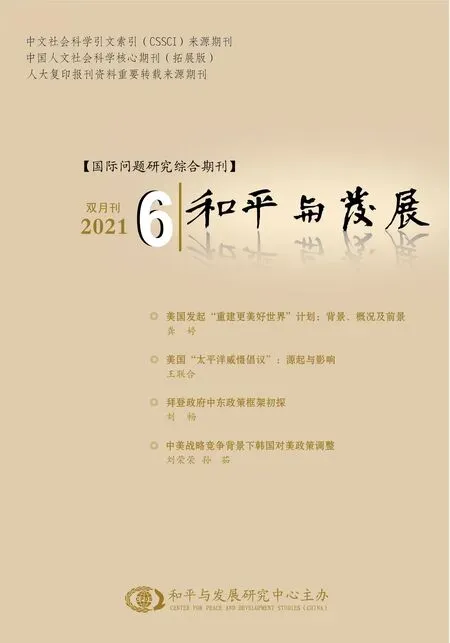
The “Build Back Better World” Plan Launched by the United States: Background, Overview and Prospect
2021-01-12 15:35:20
和平與發展
2021年6期
G7 member states, led by the U.S., launched the “Build Back Better World” (B3W) plan at its 2021 summit, which is intended to support infrastructure investment and financing in developing countries as an “alternative” to the Belt and Road Initiative (BRI).This infrastructure plan involves not only physical infrastructure in the traditional sense, but also soft infrastructure with an international rule-making significance, covering such areas as climate change, digital technology, health, etc, which marks a new phase of the West headed by the U.S.in responding to the BRI.
I.Background to the Launch of the B3W Plan
The launch of the B3W plan is the result of the Biden administration’s efforts to gather allies to compete against China by elevating the status of China to “primary competitor”.It has also derived from the combination of the Biden Administration’s domestic infrastructure investment agenda with the agenda that the U.S.and its allies have pursued internationally in recent years to address the BRI.
First, “outcompete China” has become a key objective of the US global strategy.From a historical perspective, the US global strategy has entered a new cycle in which China is taken as a primary target, while the Biden administration has further consolidated the primacy of “dealing with China”.In his first foreign policy speech, Joe Biden has taken China as the “most serious competitor”.The Interim National Security Strategic Guidance unveiled by the White House last March defined China as “the only competitor potentially capable of combining its economic, diplomatic, military, and technological power to mount a sustained challenge to a stable and open international system.” The Biden administration has emphasized that, to “outcompete China”, the U.S.should restore its competitiveness by fighting COVID-19, reviving the economy, boosting science and technology, and investing in infrastructure, and on the other hand, the U.S.should seek to recover its leadership by resorting to returning to the international agenda, pursuing the “value-based diplomacy”, highlighting science and technology competition, and focusing on the alliance system.
Second, “investing in infrastructure” has become a major approach of the U.S.to revive its domestic and international competitiveness.The Biden administration held that to expand competitiveness requires “investment in the American people, economy and democracy”.For this purpose, the Biden administration has introduced a massive government spending increase program, in which investment in infrastructure has been prioritized.Domestically, investment in infrastructure is the engine for creating jobs and boosting economic growth.The Biden administration also deemed that upgrading infrastructure at home is critical to demonstrating American leadership to the world.The Democratic Party and the Republican Party agreed in June on the Senate’s version of a $1.2 trillion bipartisan “infrastructure bill”.As Joe Biden stated after his first visit as President to Europe in June to the Democratic National Committee, “this infrastructure bill……signals in the world that we can function, we can deliver”.Generally, the Biden administration has made progress on its domestic infrastructure agenda, the bipartisan “infrastructure bill” was finally passed by the House of Representatives and signed into law in November, and the “Build Back Better Act” has also been passed by the House of Representatives and is now moving to the Senate.
Third, “competing against China in infrastructure” has become abipartisan agenda in American in recent years.The Biden administration is continuing the policy of its predecessor to make the “Indo-Pacific” a primary region for infrastructure competition with China, and has expanded it conceptually and geographically.Joe Biden made it explicit that “democratic countries should have an infrastructure plan to rival China's Belt and Road initiative”.The Interim National Security Strategic Guidance also emphasized, “Democratic alliances enable us to ……promote high standards, establish effective international rules, and hold countries like China to account.” In order to link the issue of climate change to the BRI, Biden himself and John Kerry, the president’s special envoy for climate change, have repeatedly proposed that “China should stop funding fossil fuel projects through the BRI.” The U.S.is also trying to turn its “infrastructure competition with China” into a demand that “democracies should compete against China for rules.”
Fourth, “competing jointly with China in infrastructure” has become a prominent area of the U.S.to deepen cooperation with its allies and partners.During the Trump administration, although the U.S.was constantly quarreling with its allies, it had still strengthened the cognition and action of “jointly competing against China in infrastructure” in the Asia-Pacific and transatlantic regions.In recent years, the U.S.has mainly built infrastructure plans with Japan, Australia and India in the Asia-Pacific region, and promoted several projects in Southeast Asia, South Asia and South Pacific, etc.Meanwhile, the competition cognition and strategic coordination between the U.S and Europe over the BRI are also growing.
II.Progress of the B3W Plan
To date, the push for this plan is more dependent on the United States.
In the run-up, the Biden administration, along with its allies, continued a series of previous plans to address the BRI.The U.S.has highlighted the importance of infrastructure cooperation in upgrading the QUAD mechanism with Japan, India and Australia.In March, the joint statement of the first QUAD online summit claimed that the four countries will enhance cooperation in “quality infrastructure investment”.In the transatlantic direction, the U.S.has strengthened public opinion on promoting physical and soft infrastructure cooperation.Writing in the Washington Post ahead of his first trip to Europe as President, Mr.Biden said the U.S.will bring together several countries to “offering a high-standard alternative to China for upgrading physical, digital and health infrastructure.” At the same time, the U.S.is also advancing a number of foreign agendas in areas such as climate change, health and digital technology.
The B3W plan is an embodiment of the Biden administration’s valuebased diplomacy, which focuses on low-and middle-income countries around the world, including Latin America, Africa and the “Indo-Pacific” region, and highlights physical infrastructure as well as areas such as climate change, health, digital technology, and gender equality.In terms of financing, this plan calls for fully leveraging the role of development finance institutions and mobilizing private capital wherever possible to meet developing countries’ $40 trillion infrastructure needs.On guiding principles, the plan follows the rules of Western countries in areas such as foreign aid and infrastructure, which is highly political and ideological, in order to exert influence as a counterweight to the BRI.
It is worth noting that the U.S.also wants to supplement the amount of investment in domestic infrastructure through the B3W plan to create more jobs at home, which essentially serves “America First”.
Of late, the U.S.is trying to sell the B3W plan to the UN and the UN Climate Change Conference, and expand its visibility in the Asia-Pacific, while regarding countries in Africa and Latin America as important cooperation partners.It is said, the U.S.plans to launch several pilot programs in early 2022.Meanwhile, the EU has also launched a series of initiatives on infrastructure cooperation.Ursula Von der Leyen, President of the European Commission, said that the “Global Gateway” of the EU and the B3W “are not only complementary, but they even reinforce each other”.
III.Some Remarks on the Prospect of the B3W Plan
The problem with the B3W plan is that it tries to adopt a “competitive alternation” instead of a “cooperative complementation” approach in the face of mammoth infrastructure investment and financing needs of the world and developing countries.So far, many uncertainties have remained as to whether the B3W plan can be turned from a conception into infrastructure cooperation results widely recognized by developing countries.
First, the promoters try to use “rules” to put pressure on China’s BRI, but it is not likely that developing countries would “take sides”.“Competition for rules” pursued by the B3W plan has linked infrastructure investment with the “value-based diplomacy”, which is highly ideological.Just as a Pakistani expert pointed out, to be successful, the B3W plan has to be inclusive and abide by the principles of investment, not politics.However, G7 intends to stand up to China and exclude the BRI investment, which makes developing and the least developed countries worry.This kind of competition is likely to put developing countries at risk of “taking sides”.
Second, it is doubtful whether the promoters will be unified against China.G7 members remain divided on how to deal with China, and the same is true with the relationship between the B3W plan and the BRI.In general, Britain, Japan and Canada are most closely aligned with the U.S.within G7, while statements made by France, Germany and Italy showed that the EU and European countries have a more complicated relationship with China than the United States.
Third, it is doubtful whether the promoters would form a “collective force”.It is uncertain whether this plan would bring “incremental” benefits to developing countries.If the plan fails to make it different from other existing infrastructure plans and provide sufficient new funding, it is unlikely to give developing countries new and additional support.Meanwhile, it is difficult for the U.S.and other G7 members to resolve internal competition.As the U.S., Europe and Japan have introduced their own infrastructure plans and are concentrating on their respective agenda, it is hard for them to form a “collective force” as a group.Moreover, in the context that Europe is seeking “strategic autonomy” and the U.S.is working on “America First”, it is not likely that Europe would provide substantial and effective input into the plan.Not long ago, the U.S., Britain and Australia launched the AUKUS plan to the detrimental of French interests.As members of the EU, France, Germany and Italy are unlikely to allocate their own resources equally to the EU’s “Global Gateway” and the B3W plan of G7.
Fourth, it is doubtful whether the promoters could provide enough funding.The willingness, ability and competitiveness of G7 to raise government funding for the plan are limited.There are limits to what the US government can offer, thus making it unlikely to do what it hopes to.Since the outbreak of the COVID-19 pandemic, the problem of high debt in developed countries has intensified.The willingness of other G7 members to raise government funding and the amount they can raise are also limited.Private sector investment in infrastructure in developing countries will not only suffer from the traditional problems of long investment return cycle and low benefits, but also be prone to risks such as political instability, insufficient debt paying ability, and imperfect rule of law and business environment.Therefore, enterprises are unwilling to provide large-scale financing.
(The author is an associate research fellow at Department for American Studies, CIIS.This article was received on 8 Oct.2021.)
登錄APP查看全文