ABSTRACTS
2021-01-12 15:35:20
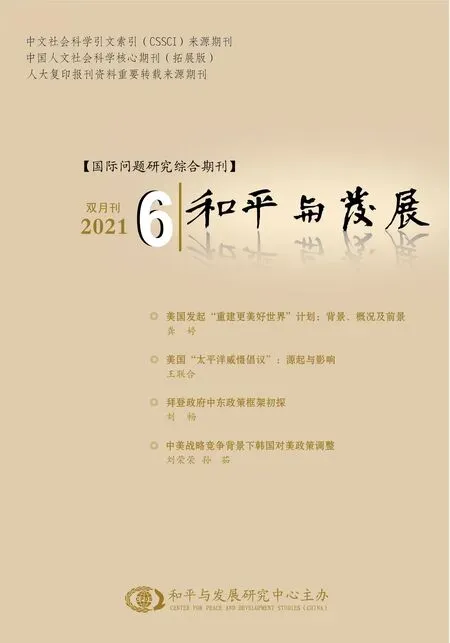
和平與發展
2021年6期
01 The “Build Back Better World” Plan Launched by the United States: Background, Overview and Prospect,by Dr.Gong Ting, associate research fellow at Department for American Studies, CIIS.G7 member states, led by the U.S., launched the “Build Back Better World” Plan at its 2021 summit, which is a vision intended to support infrastructure investment and financing in developing countries as an alternative to the Belt and Road Initiative.This infrastructure Plan involves not only physical infrastructure in the traditional sense, but also soft infrastructure with an international rule-making significance, covering such areas as climate change, digital technology, and health.The launch of this Plan not only is a reflection of the Biden administration focusing on domestic agenda while laying out America’s global strategy “from the inside out”, but also marks a new stage of Western developed countries represented by the U.S.in responding to the Belt and Road Initiative.To date, the Build Back Better World Plan has relied heavily on the U.S.from conception to follow-up, and its basic vision is a hallmark of the value-based diplomacy pursued by the Biden administration.The U.S.and other G7 member states intend to compete with China on infrastructure and international rules under the framework of this Plan, but they still face multiple uncertainties in terms of common perception and resource input, while developing countries remain suspicious of the Plan.
25 The U.S.“Pacific Deterrence Initiative”: Origin and Impacts,by Wang Lianhe, professor and doctoral supervisor at the School of International Relations and Public Affairs, Shanghai International Studies University.Since 2017, a series of strategic documents issued by the U.S.administration have openly regarded competition against China as a major U.S.national security goal.Under the guidance of this strategic objective, the U.S.Indo-Pacific Command submitted a budget report of the “Pacific Deterrence Initiative” to the U.S.Congress in March 2020, which envisioned additional congressional funding for the defense strategy over the next 6 years.The “Pacific Deterrence Initiative” aims to revolutionize the U.S.Indo-Pacific military strategy in five areas, including operational concept, forward deployment, multilateral coordination, long-term preparation and integrated deterrence, by endowing it with sustained and substantial financial support, in order to sharpen U.S.military effectiveness against China, reaffirm its commitment to a free and open Indo-Pacific region, and promote the development of U.S.alliances and partnerships in the region.With the financial support of this initiative, the Biden administration continues its offensive military deployment in relevant areas, thus exerting impacts on China’s major national interests.Meanwhile, as an additional military budget, the implementation of the “Pacific Deterrence Initiative” is subject to restrictions by internal and external factors of the United States.So, its future trend deserves further attention.
46 A Probe into the Biden Administration’s Middle East Policy Framework,by Liu Chang, assistant research fellow at the Department for Developing Countries Studies, CIIS.The Middle East policy of the Biden administration is rooted in America’s continued “strategic retreat” from the Middle East.In order to get out of the Middle East with dignity, help to promote America’s global strategic pivot to the Asia-Pacific region, forge a “constructive Iran”, and cater to the needs of domestic establishment elites, the Biden administration has worked to renegotiate a nuclear deal with Iran, end wars and manage conflicts, rebuild alliance and pursue a “valuebased diplomacy” in the Middle East.In a series of moves to implement this policy, the Biden administration has focused on returning to traditional diplomacy, clearly delineating competition and cooperation, emphasizing the instrumentality of multilateralism and values, and attempting various “rebalancing” approaches to the Middle East.However, the decline of its own power makes it hard for the U.S.to have enough energy to dominate the Middle East, the prospect of its returning to the Iranian nuclear deal remains uncertain, the U.S.is increasingly unable to control its allies, and the fractured security environment in the Middle East may also hamper the U.S.and restrict the implementation of its policies.To effectively deal with the multiple challenges brought to China by the Biden administration’s Middle East policy, China should deepen its cooperation with the regional countries and play a bigger constructive role in the Middle East.
67 The Racist Logic for American Foreign Policy Making,by Pan Yaling, senior research fellow at the Institute of International Relations, Yunnan University and guest research fellow at the Center for American Studies, Fudan University; and Mo Wanting, graduate student at the Institute of International Relations, Yunnan University.Racist logic is an important decisive factor in American foreign policy making, and its influence on American foreign policy making is manifested in three aspects.First, panracializing multiple ethnic groups with similar ethnic backgrounds or ethnic-racializing these ethnic groups by isolating them, based on which to frame American foreign policy, particularly to set policy boundaries for the target racial/ethnic groups, so as to achieve strategic simplification.Second, identifying strategic threats and potential rivals or adversaries by the use of xenophobia of the American society and looking for the “Trojan horse” inside the U.S., so as to achieve strategic focus.Third, seizing the moral high ground by the adoption of humanitarian measures in international refugee and immigration policies, so as to achieve strategic cover.After a long-term practice, elements of the racist logic have achieved a high degree of compatibility: pan-racialization can effectively obscure racist concerns in foreign policy making, while humanitarian measures give it a moral veneer; and the racializing of ethnic groups and the using of xenophobia can successfully shift racist concerns to the “adversaries”.As a result, the influence of racist logic on American foreign policy making is successfully covered up.
90 Policy Adjustment by South Korea toward the U.S.in the Context of China-U.S.Strategic Competition,by Liu Rongrong, associate professor at School of Foreign Languages and Literature, Shandong University; and Sun Ru, Deputy Director, research professor and doctoral supervisor at the Institute of World Politics, CICIR.With China-U.S.strategic competition getting increasingly intensified, South Korea has adjusted its policy toward the United States, showing a trend of simultaneously strengthening its following of the U.S.and pursuit of strategic autonomy.On the one hand, South Korea has boosted cooperation with the U.S.in economy, science and technology, values, security, foreign affairs and other key areas, and got more involved in major areas of China-U.S.strategic competition; and on the other hand, it, capitalizing on the growing demand of cooperation by the U.S.from South Korea, is actively expanding its strategic autonomy, which is opposed by the United States.Therefore, there is an inherent logical contradiction between South Korea’s pursuit of strategic autonomy and its increasing cooperation with the United States.South Korea’s following of the U.S.is not only the result of the latter’s unilaterally increasing pressure and wooing on South Korea, but also a strategic choice made proactively by South Korea out of comprehensive considerations such as seeking strategic initiative, pursuing the dominance of Peninsula affairs, and appropriately checking and balancing China.Of course, South Korea is not one-sided to the U.S., as divergence in threat perceptions and strategic priorities between them has restricted the depth of cooperation between the two sides.Looking ahead to South Korea’s US policy after the 2022 election, its duality of following the U.S.and pursuing strategic autonomy will continue.
111 Toward a Japan-Australia Military Alliance: Development, Motivation and Restraints, by Xie Zifei, assistant research fellow, Information Engineering University.On the basis of shared security interests, Japan and Australia have continuously stepped up bilateral defense exchanges and moved toward a military alliance.Based on a review of their military coordination, equipment and technology cooperation, defense information sharing and synergy of their regional cooperation strategies, this paper has sorted out the development trend of Japan-Australia defense cooperation and their movement toward a military alliance.This paper has also revealed the interest appeals and strategic considerations of the two countries behind their drive for a military alliance, while analyzing in a comprehensive way the internal and external restraints facing Japan and Australia in moving toward a military alliance from the perspectives of alliance dilemma, domestic politics, economic factor and the US factor in order to make a sound judgment of the future strategic direction.From the realistic conditions, it is hard for Japan and Australia to formalize a military alliance in a short run, but they will continue to “huddle together”, get involved in regional security affairs and strengthen military cooperation against a third party for some time to come in the future, which deserves the alert of neighboring countries.
登錄APP查看全文