
A study on intrinsic and extrinsic motivation of English major freshmen and seniors
2020-08-31 14:53:03崔若琰
校園英語·下旬 2020年6期
【Abstract】In order to investigate the effect of English learning time on both intrinsic and extrinsic motivation of English major undergraduate students, a questionnaire adapted from Gardners (2004) Attitude/Motivation Test Battery (AMI) is used to collect data from 38 English major undergraduates including freshmen and seniors in a university in Wuhan. Through data analysis, it is found that English major seniors have stronger intrinsic motivation whilst English major freshmen have stronger extrinsic motivation.
【Key words】intrinsic motivation; extrinsic motivation; English major undergraduates
【作者簡介】崔若琰,武漢大學外國語言文學學院。
1. Introduction
Motivation has been regarded as one of the powerful personality factors influencing English learning along with other affective factors, such as self-esteem, inhibition, risk-taking, anxiety, empathy and so forth. It is “probably the most frequently used catch-all term for explaining the success or failure of virtually any complex task”.
Gardner and Lambert (1972) distinguish between integrative and instrumental motivation. “Yet another but perhaps the most powerful dimension of the whole motivation construct in general is the degree to which learners are intrinsically or extrinsically motivated to succeed in a task”.
Deci (1975) defines intrinsic motivation: “Intrinsically motivated activities are ones for which there is no apparent reward except the activity itself”. Pintrich and Schunk (2002) define intrinsic motivation as “motivation to engage in an activity for its own sake” [3]. Extrinsic motivation refers to “motivation to engage in an activity as a means to an end” , exemplified in people behaving in particular ways to obtain a reward from the surroundings, including material reward, such as money, prizes and grades, and mental reward like positive feedback.
The focus of this study is on the intrinsic and extrinsic motivation of English major freshmen and seniors. The following research questions will be addressed:
Intrinsic motivation and extrinsic motivation, which one is stronger among the English major freshmen and seniors?
Is there any difference in the levels of intrinsic and extrinsic motivation for learning English between freshmen and seniors?
2. Research methodology
2.1 Participants
The participants are 38 English major undergraduates of a university in Wuhan, including 19 freshmen and 19 seniors.
2.2 Research instrument
The questionnaire used in this study is adapted from Gardners (2004) Attitude/Motivation Test Battery, consisting of 20 statements, half of which are concerned with intrinsic motivation and the other half extrinsic motivation. A five-point Likert Scale is adopted in the questionnaire for each statement ranging from strongly disagree to strongly agree. IBM SPSS Statistics 22 is used to run the data for analysis.
2.3 Data collection
The questionnaires are distributed to the 38 students of two intact classes during their normal sessions, and they are given clear instructions for completing the questionnaire.
2.4 Data analysis
IBM SPSS Statistics 22 is used in data analysation. A description of the dataset and an independent-sample t-test are conducted. The focus is on the impact of duration of English learning on the levels of both intrinsic and extrinsic motivation. The independent-sample t-test is to determine if there are any statistically significant differences in the freshmen s and the seniors levels of intrinsic motivation and extrinsic motivation.
2.5 Results and discussion
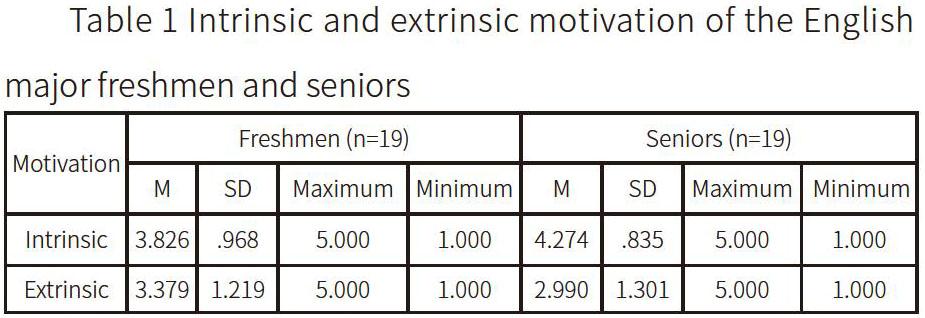
The means of intrinsic motivation of both the freshmen and the seniors are larger than the means of their extrinsic motivation. It seems that for both English major freshmen and seniors, intrinsic motivation is stronger than extrinsic motivation.
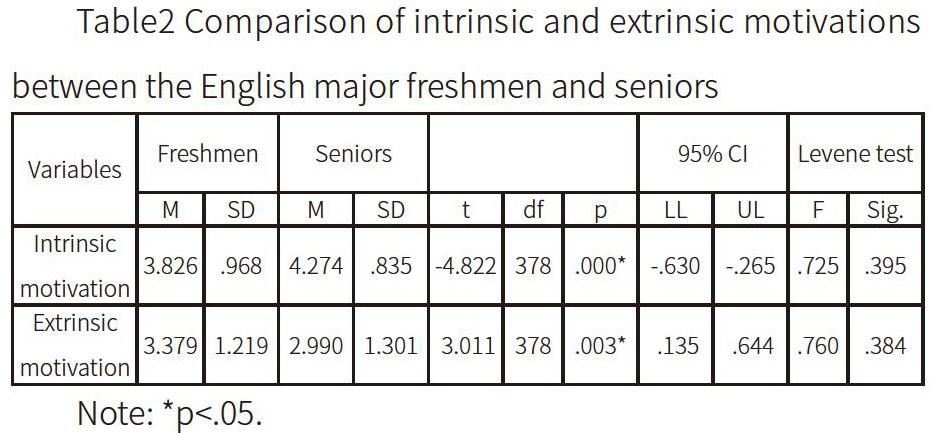
Given an alpha level of 0.05, an independent-sample t-test is conducted to determine whether the freshmen and the seniors have different levels of intrinsic and extrinsic motivation.
The result of the Levene test indicates that variances of the respective two populations are homogeneous, fitting the assumption of independent-sample t-test.
Regarding intrinsic motivation, significant difference exists in the levels of intrinsic motivation of the freshmen and the seniors (p=0.000<0.05). The sample mean of the seniors intrinsic motivation is larger than that of the freshmen. It appears that the intrinsic motivation of English major undergraduates increases as they enter higher grades.
Regarding the extrinsic motivation, the difference in sample means of extrinsic motivation of the freshmen and the seniors is statistically significant (p=0.003<0.05). The sample mean of extrinsic motivation of the seniors is smaller than that of the freshmen. It occurs that the extrinsic motivation of the English major undergraduates decreases as they enter higher grades.
As the English major undergraduates duration of English learning increases, they have received accumulative exposure to the English language and the culture embodied in it. Consequently, they might have developed interest in English itself or the culture of English-speaking countries so that their intrinsic motivation increases. Regarding the lower-grade English major undergraduates, they have just begun the professional studies of English, so they might have less understanding and exposure to the target language and pertinent cultures. Besides, given that the college entrance examination entails the exam-oriented English learning, English is only one of those subjects in which the students study to achieve high scores, though it is undeniable that quite a few students may have already cultivated interest in English learning before entering university. This provides a feasible explanation for the stronger extrinsic motivation of the freshmen.
3. Conclusion
This study investigates the differences in levels of intrinsic and extrinsic motivation of English major freshmen and seniors. The descriptive statistics of the data shows that the English major freshmen and seniors have stronger intrinsic motivation. Besides, according to the result of the independent-sample t-test comparing both intrinsic and extrinsic motivation of the freshmen and the seniors, the higher-grade students seem to have stronger intrinsic motivation whereas the lower-grade students appear to have stronger extrinsic motivation for English learning.
References:
[1]Gardner R. C. Attitude/Motivation Test Battery: International AMTB Research Project, 2004. The University of Western Ontario, Canada[OL]. http://publish.uwo.ca/~gardner/docs/englishamtb.pdf.
[2]Brown H. D. Principles of language learning and teaching (3rd ed.) [M]. Beijing: Foreign Language Teaching and Research Press, 2001: 152-155.
[3]Carreira J. M. New framework of intrinsic/extrinsic and integrative/instrumental motivation in second language acquisition[J]. The Keiai Journal of International Studies, 2005(16):39-64.
