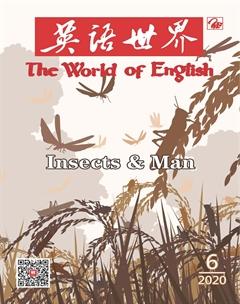
Locust Plague: One of the Worst Agricultural Disasters 蝗災
2020-08-07 09:02:32中國國際電視臺
英語世界 2020年6期
中國國際電視臺


The locust outbreak is affecting large parts of South Asia and the African continents. Massive swarms of locusts have been destroying farmland and threatening millions of lives. Even troops and planes have been mobilized in the Horn of Africa region to fight the most serious plague in decades.
How can an insect with an average mass of 2 grams be so destructive?
Locust plagues often come with serious drought. The insect prefers to lay eggs in dry and loose soil with a lower moisture content. During dry seasons, the groundwater level falls offering more loose soil for the locusts to reproduce. Nearly 5,000 clusters of eggs can be found within a square meter, with more than 100 eggs per cluster.
The reproduction rate of some species is two to five times per year, which adds to the enormous figure. On the dry and sparse grassland, more locusts mean less living space. When the population reaches a certain density under suitable conditions, serotonin in their brains drives them from being solitary to gregarious. They “migrate” together to find new food sources in more moist areas, thus causing an outbreak.
In addition, global warming means warmer winters, therefore more hibernating eggs can survive and hatch in the spring, raising the possibility of the plague next year.
The desert locust is one of the most dangerous of the species. It is the main culprit of the plague that has hit eastern Africa.
Desert locusts can travel between 100 and 200 kilometers per day. A single swarm can cover up to 1,200 square kilometers and can contain between 40 and 80 million locusts per square kilometer.
How many times have humans suffered from locust plagues?
In history, locust plagues have been one of the three worst agricultural natural disasters, alongside flooding and drought.
During the last two millennia, more than 170 outbreaks have been recorded in China. Statistics from 2003 to 2016 show that the land hit by locust outbreaks reached 286 million hectares in China.
In 2004, northern and western Africa experienced the largest infestation of locusts in more than 15 years. It cost 400 million dollars to fight against the plague, and the harvest losses were worth almost 2.5 billion dollars.
Late March 2013, nearly 50 percent of Madagascar was infested by locusts, with each swarm consisting of more than one billion bugs.
Is there no way to stop the locusts?
At present, the primary method of controlling locust infestations is with insecticides sprayed from the ground or the air. That being said, in some less economically developed areas insecticides are unaffordable, let alone the machines and planes needed to spread them.
But there are also biological pest control measures. The locust has natural enemies such as predatory wasps and flies, birds and reptiles.
Every May, swarms of locusts hit northwestern Chinas Xinjiang Uygur Autonomous Region.
In 2019, nearly 200,000 rosy starlings stopped over Hami City in Xinjiang. The birds protected 54 million kilograms of grass from locusts, saving herdsmen 1.6 million yuan and at least 720,000 yuan for buying pesticides.
This biocontrol method has proved effective and requires less human intervention.
Are locusts of no use at all?
The term “locust” is the name given to certain species of short-horned grasshoppers in their swarming phase. They are convenient for use in research and the study of zoology. Like the fruit fly, it is a suitable school laboratory animal.
Locusts are edible. They are considered a delicacy in many African, Middle Eastern and Asian countries.
China has yet to come out of the shadow of locust plagues, according to Kang Le, a research fellow of the Institute of Zoology, Chinese Academy of Sciences. Locusts destroy crops at the estuary of the Yellow River, and the grasslands in Xinjiang and Inner Mongolia autonomous regions.
But it is wrong to overkill them. The overuse of insecticides may control the bug situation in an area for now, but it takes longer for the damaged environment to recuperate. Also, the insect always has its rightful place in the food chain and in the ecosystem.
蝗災暴發正影響著南亞大部和非洲大陸大部分地區。大批蝗蟲摧毀農田,數百萬人生計遭受威脅。“非洲之角”地區甚至調派了軍隊和飛機對抗數十年來最嚴重的災情。
一只平均重量只有2克的昆蟲為何具有如此強大的破壞力?
蝗災常常伴隨旱災而來。蝗蟲喜在含水量較低、干燥疏松的土壤中產卵。在旱季,地下水位下降,土質更加疏松,利于蝗蟲繁殖。1平方米土壤中能發現近5000個卵塊,每個卵塊有100多個卵粒。
某些種類的蝗蟲每年可繁殖二到五代,致使其數量大增。在干燥稀疏的草原地區,蝗蟲數量越多,意味著其生存空間越小。在適當條件下,當蝗蟲密度達到一定程度時,蝗蟲大腦中的血清素會促使其從散居型轉變為群居型。它們會一起向更潮濕的地區“移民”,尋找新的食源,從而引發蝗災。
此外,全球變暖帶來暖冬,因此更多越冬蟲卵得以存活并在春季孵化,增加了來年蝗災暴發的可能性。
沙漠蝗蟲是最危險的蝗蟲之一,是東非地區蝗災的罪魁禍首。
沙漠蝗蟲每天可飛行100至200公里。單一蟲群可覆蓋1200平方公里,每平方公里的蝗蟲數量可達4000萬至8000萬只。
人類迄今遭受過幾次蝗災?
歷史上,蝗災與水災和旱災并稱三大農業自然災害。
過去2000年中,中國共記載了170余次蝗災。2003年至2016年統計數據顯示,中國蝗災發生面積達2.86億公頃。
2004年,非洲北部和西部地區遭遇了至少15年來最大的一次蝗災,抗災費用高達4億美元,災情造成價值近25億美元的收成損失。
2013年3月末,馬達加斯加近50%的地區遭受蝗災,每個蟲群的蝗蟲數量超過10億。
沒有辦法阻止蝗災暴發嗎?
目前,防治蝗災的主要方法是從地面或空中噴灑殺蟲劑。話雖如此,但一些經濟欠發達地區連殺蟲劑都買不起,更不要說用來噴灑殺蟲劑的設備和飛機了。
不過,還有生物治蝗的方法。蝗蟲有很多天敵,例如掠食性黃蜂、蠅類、鳥類和爬行動物。
每年5月,會有大批蝗蟲侵襲中國西北部的新疆維吾爾自治區。
2019年,近20萬只粉紅椋鳥遷徙至新疆哈密市。這些椋鳥保護了5400萬公斤牧草免受蝗蟲侵害,使牧民避免了160萬元的經濟損失,還省下了至少72萬元購買殺蟲劑的費用。
實踐證明,這一生物防治方法頗為有效,且不需要多少人工干預。
蝗蟲一無是處嗎?
“蝗蟲”這一術語是某些短角蝗科動物在集群期的統稱,便于調研和動物學研究時使用。像果蠅一樣,蝗蟲適用于學校實驗。
蝗蟲可以食用,是非洲、中東和亞洲許多國家餐桌上的美味。
中國科學院動物研究所研究員康樂稱,中國尚未擺脫蝗災陰影。蝗蟲會破壞黃河入海口的農作物以及新疆維吾爾自治區和內蒙古自治區的草原。
然而,過度殺滅蝗蟲并不可取。過量使用殺蟲劑或許當下可以控制某個地區的蝗災,但會導致該地區環境受損,恢復期更長。另外,食物鏈和生態系統中始終應有蝗蟲的一席之地。? ? ? ? ? ? ? ? ? ? ? ? ? ? ? ? ? ? ? ?□
(譯者單位:復旦大學)