Unit 4 Don’t eat in class.
2020-06-19 08:33:22
時代英語·初中 2020年1期
關鍵詞:課堂
Section A
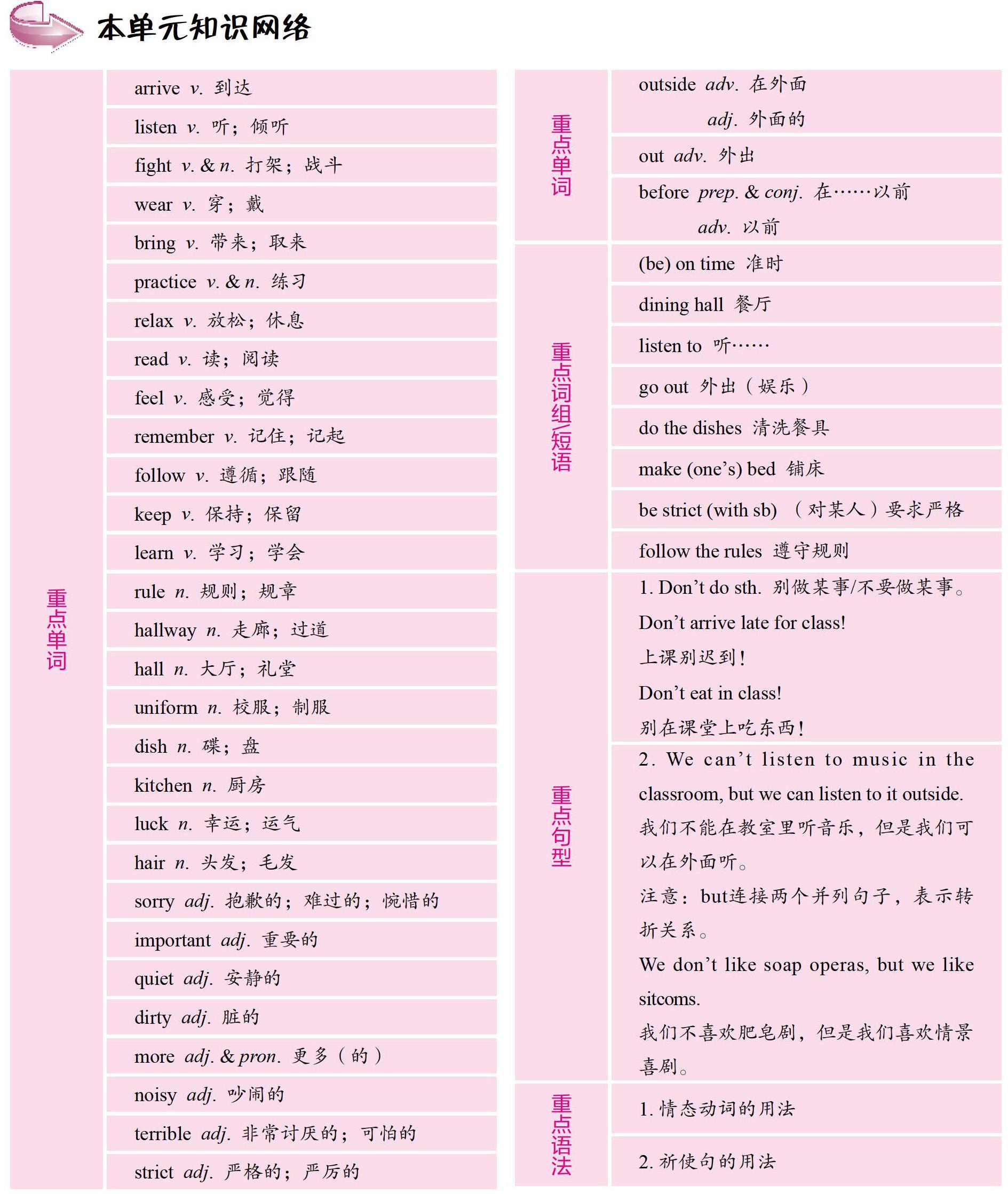
1. Dont arrive late for class. You must be on time.
上課別遲到,你必須準時。
(1)arrive ?v. ?到達
You must arrive at the airport two hours early.
你必須提前兩小時到達機場。
① arrive in + 大地點
We arrived in Beijing by plane.
我們乘飛機到北京。
② arrive at + 小地點
He arrives at school at seven oclock.
他七點鐘到校。
(2)arrive late for = be late for ?遲到
(3)on time“準時,按時”,指按規定的時刻不早不晚;in time“及時”,指沒有遲到,時間還充裕。
Hell certainly be here on time.
他保證按時到。
Can we get to the station in time?
我們能及時到達車站嗎?
2. Dont listen to music in class.
不要在課堂上聽音樂。
hear,listen和sound都有“聽”的意思,但三者是有區別的:
(1)hear“聽說”,側重于聽的結果。
Im sorry to hear that you are ill.
聽說你生病了,我很難過。
(2)listen“聽”,側重于聽的過程。
listen to music/the radio 聽音樂/廣播
Listen to me carefully.
仔細聽我說。
(3)sound ?link v. “聽起來”,后面接形容詞。
It sounds great.
這聽起來很棒。
3. Dont fight.
不要打架。
fight ?v. ?打架;戰斗
(1)fight for“為……而戰斗”,后面常接抽象名詞,表示為事業、自由等而戰斗。
They are fighting for freedom.
他們正為自由而戰。
(2)fight against“為反對……而戰斗”,后接事物名詞、人和國家名詞。
They fight against the enemy.
他們和敵人作戰。
(3)fight with“和……打架;同……(并肩)戰斗”,后只接表示人或國家的名詞。
Dont fight with him.
不要和他打架。
4. Can we bring music players to school?
我們可以把音樂播放器帶到學校嗎?
bring ?v.“帶來;取來”,指把東西從別處帶到說話地。
Bring your homework here tomorrow, please.
請你明天把你的作業帶來。
take ?v.“帶走,拿走”,指把東西從說話地帶到別的地方。
Can you help me (to) take the books to the classroom?
你可以幫我把這些書帶到教室去嗎?
5. Can we wear a hat in class?
我們可以在課堂上戴帽子嗎?
wear ?v. ?穿;戴
Tony wears a T-shirt.
托尼穿著一件T恤。
比較:wear和put on
wear和put on均有“穿”的意思,但wear指“穿著”,側重穿的狀態;put on指“穿上”,側重穿的動作。
Its cold outside. Put on your coat.
外面冷,穿上你的外套。
GRAMMAR FOcuS
祈使句的用法
(1)祈使句是指用來表示請求、命令、建議等的句子。在祈使句中,通常省略主語you,謂語動詞用原形。句末一般用句號,表示較強語氣時,則用感嘆號。
Listen to me!
聽我說!
Let me have a rest.
讓我休息一下。
(2)祈使句表示客氣時,通常加 please。please可放在句首,也可放在句末。放在句末時,一般需要用逗號與前面的詞隔開。
Please come in. / Come in, please.
請進。
(3)祈使句的否定式是在動詞原形前加dont。
Dont run in the street.
不要在街上跑。
Dont smoke here!
不要在這兒吸煙!
情態動詞 can,must和have to
(1)情態動詞can的用法:
含有情態動詞can的一般疑問句用來表示請求許可,應將can置于主語之前,回答時用can/cant。
—Can I have a look?
我可以看一看嗎?
—Yes, you can. / No, you cant.
是的,你能。/ 不,你不能。
(2)情態動詞must的用法:
表示有做某事的必要或義務,是說話人的主觀看法,意為“必須;應該”。 mustnt 常用于否定句中,表示“不允許;禁止”。
I must go now.
我現在得走了。
You mustnt park your car here.
你的車不允許停在這兒。
(3)情態動詞have to的用法:
have to表示客觀需要做的事情,意為“必須;不得不”。使用have to時應注意:
① have to后接動詞原形,意為“必須做……;不得不做……”。
I have to leave.
我不得不離開了。
② have to有人稱、數和時態的變化,其第三人稱單數形式為has to。
She has to do her homework.
她不得不做家庭作業。
③ 含有have to,has to的句子需分別借助助動詞do或does構成疑問句或否定句。
Do they have to get up early?
他們必須早起嗎?
He doesnt have to go if he doesnt want to.
如果他不想去,他就不必去。
活學活用
用can, cant, do, dont, have to填空。
1. —What are the rules at your school?
—____ run in the hallway.
2. —____ we eat in school?
—We can eat in the dining hall, but we ____ eat in the classroom.
3. —What else ____ you have to do?
—We ____ clean the classroom.
Section B
1. practice the guitar
練習吉他
practice ?v. & n. ?練習
Dave practices the guitar before dinner.
大衛在晚餐前練習彈吉他。
practice doing sth ?練習做某事
He practices playing the piano every day.
他每天練習彈鋼琴。
2. There are too many rules!
有太多的規矩了!
(1)there be與have (has)的區別:
There be表示某個地方“存在”某物或某人;而have(has)表示主語“擁有”某人或某物。但如果表示部分與整體的關系時,there be與have(has)這兩種表達方式可以互換。
A week has seven days. = There are seven days in a week.
一星期有七天。
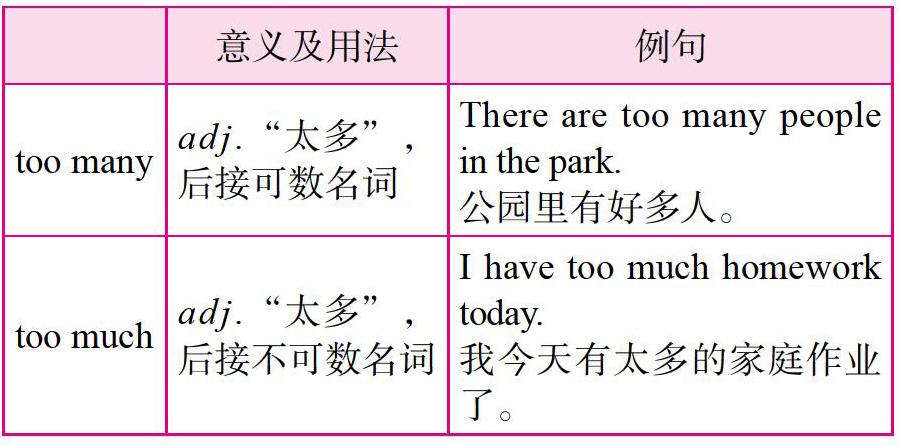
(2)too many與too much的區別:
3. I know how you feel.
我明白你的感受。
feel ?v. ?感受;感覺
Youll feel better after a nights sleep.
你晚上睡個好覺就會覺得舒服些。
feel + adj. 感覺……
I feel relaxed every day.
我每天感覺很輕松。
4. Parents and schools are sometimes strict, but
remember, they make rules to help us.
雖然父母和學校有時很嚴格,但是記住,他
們制定規則是為了幫助我們。
(1)strict ?adj. ?嚴格的;嚴厲的
① be strict with sb ?對某人嚴厲
We should be strict with ourselves.
我們應該對自己嚴格。
② be strict in (doing) sth ?對(做)某事要求嚴格
Our boss is strict in our work.
我們老板對我們的工作要求嚴格。
(2)remember ?v. ?記得,記住
① remember doing sth ?記得做過某事(已做)
I remember seeing him once.
我記得見過他一次。
② remember to do sth ?記得要做某事(未做)
Remember to close the door when you leave.
你離開時記得關門。
(3)make rules ?制定規則
follow the rules ?遵守規則
(4)help sb with sth/ help sb (to) do sth 幫助某人做某事
help oneself (myself/yourself/herself...) to + n. 請隨便吃/喝點兒……
Linda often helps her mother (to) do housework.
琳達經常幫她媽媽做家務。
Please help yourselves to some fruit.
請隨便吃些水果。
單項選擇
( ) 1. —Can we talk about the book in the library?
—___ . We have to be quiet.
A. Yes, we can B. Yes, we do
C. No, we cant D. No, we dont
( ) 2. ___ fighting! The teacher is coming.
A. To stop B. Stopping
C. Stop D. Dont stop
( ) 3. Does she ___ clean the classroom today?
A. has to B. have to
C. has D. have
( ) 4. Our teachers are strict ___ us. We have many rules to follow.
A. with B. in C. on D. to
( ) 5. He cant ___ , but he often ___ to the beach to play.
A. swimming; go B. swim; goes
C. swims; goes D. swim; go
單詞拼寫
1. Im s_____ that I cant help you this time.
2. Anna wants to l_____ to play the guitar. Can you teach her?
3. I dont clean my room, so it is very d_____.
4. Its very i_____for us to keep healthy.
5. My father is very busy and he has no time to r_____ .
用所給詞的適當形式填空
1. Alice usually_____(wear) a red hat.
2. I must do the _____(dish) after dinner.
3. We dont like these_____(rule). They are too strict.
4. Jane never_____ (arrive) late for school.
5._____(listen) to your teacher carefully in class.
按要求完成句子
1. Jim can play basketball on weekends.(改為否定句)
Jim _____basketball on weekends.
2. I want to keep my hair long, too.(改為否定句)
I _____want to keep my hair long,_____ .
3. We cant play sports in the classroom.(改為祈使句)
_____sports in the classroom.
4. My sister can play the piano.(對畫線部分提問)
_____ your sister_____?
5. They can eat in the classroom.(改為一般疑問句)
_____in the classroom?
6. 你能在周末外出嗎?(完成譯句)
Can you _____on the weekend?
7. 我們必須準時到那兒。(完成譯句)
We must get there_____ .
8. 別在教室里吵鬧。(完成譯句)
_____in the classroom.
9. music, listen, to, in, classroom, dont, the(連詞成句)
__________.
10. uniform, does, school, wear, at, he, the, have, to(連詞成句)
__________?
補全對話
A: We have a lot of rules in our school.
B: _____1
A: Dont eat in the classroom. Dont run in the hallways. Dont listen to music in the classroom._____?2
B: _____3
A: We can eat in the dining hall, ?but we cant eat in the classroom.
B: Can we wear hats in school?
A:_____4
B: Do we have to wear uniforms?
A: _____5
B: Oh, there are too many rules.
A. No, we cant.
B. Yes, we have to.
C. What are the rules?
D. Can we eat in school?
E. Dont arrive late for school.
1._____? ?2. _____? ? ?3._____ ? ? ?4. _____ ? ? ? ?5. _____
閱讀理解
A
Rules are everywhere. When you read in the library, play basketball or drive a car, you have to follow some rules. Rules are important to us. Do you know that you must follow some rules on the plane?
Linda and her friend Carl go to the US by plane. She takes the emergency exit seat (靠近緊急出口的座位). She sees a card in her seat.
If you are in an emergency exit seat, read the rules.
You must
· Be at least (至少) 15 years old and healthy to give help.
· Be able (能夠) to speak and read English very well.
You must not
· Take a child (two years old and under).
· Take a pet, like a dog, a bird, etc.
( ) 1. The writer thinks rules are ___ .
A. strict B. terrible C. important D. relaxing
( ) 2. Who is in the emergency exit seat?
A. Linda. B. Carl.
C. Lindas brother. D. Carls brother.
( ) 3. Who can take an emergency exit seat?
A. Jenny, 18, cant see or talk.
B. Michael, 20, is from England.
C. Mr Wang, 40, speaks only Chinese.
D. Tom, 14, takes his sister.
( ) 4. What does the word “pet” mean in Chinese?
A. 行李 B. 寵物 C. 工具 D. 親屬
( ) 5. The passage is about some rules ___ .
A. in the sports hall B. in the library
C. on the train D. on the plane
B
Hong Kong has about forty public beaches (沙灘). Some are very famous in the world. People can go there for a swim. You can go to some beaches by bus. To go to some beaches you must take a boat.
You will swim there without danger (危險) if you remember these instructions (指示):
· Never swim alone.
· Never go out in a boat if you cannot swim.
· Never swim after a meal or when you feel hungry or tired.
· Dont stay in the water too long.
Remember: a red flag means that it is dangerous for anybody to go into the water, and a blue flag means that it is dangerous for children.
根據短文內容,判斷正(T)誤(F)。
( ) 6. There are about 40 public beaches in Hong Kong.
( ) 7. You should swim after a meal.
( ) 8. You can take a bus to go to some of the public?beaches.
( ) 9. You cant swim when youre alone.
( ) 10. A child can swim if there is a blue flag.
完形填空
Do you have family rules? For1 , I have strict family rules. I must2them.
I cant go out or go home late3Monday to Friday. If (如果) I do that, my parents will be not4 . On my school days, I cant5TV or play computer games. I6listen to music when I do my homework. I dont like this rule7music is my favorite. After school every day, I must do my homework first. I also have to get up and go to bed8 . My parents think its good for my ? ? 9 . On the weekend I have to10playing the piano for two hours in the morning. But I can go out to do sports with my friends after that.
These rules are strict but useful for me.
( ) 1. A. me B. them C. us D. you
( ) 2. A. like B. follow C. exercise D. make
( ) 3. A. from B. on C. at D. in
( ) 4. A. strict B. easy C. happy D. right
( ) 5. A. see B. read C. watch D. look
( ) 6. A. need B. neednt C. can D. cant
( ) 7. A. and B. because C. but D. so
( ) 8. A. quietly B. quickly C. late D. early
( ) 9. A. school B. time C. health D. habit
( ) 10. A. help B. love C. finish D. practice
選詞填空
閱讀短文,從方框中選擇適當的詞,并用其正確形式填空(每詞限用一次)。
arrive sorry before talk quiet
fight only make rule strict
Li Hua lives in Beijing. He is not a1boy. He doesnt like to follow the2at school. He thinks the rules are really terrible.
Every Monday morning, he cant3at school on time, because he always watches basketball games on Sunday nights. And he never feels4for it. After class, he likes playing games with his classmates. Sometimes he5with other (其他的) boys in the hallways. His parents know he doesnt perform (表現) well at school, so they are6with him at home. They let him7his bed and do the dishes on weekends.8going to bed, he must read a book. He can9watch TV for an hour every night. Li Hua doesnt like his family rules, either. Sometimes he wants10about the rules with his parents.
1. _____?2. _____ ?3._____?4. _____?5._____
6._____?7._____?8. _____?9._____ ?10. _____
書面表達
假如你是李明,下面是你們學校的一些規章制度。請你寫一封電子郵件,向你的筆友Tom做介紹。內容提示:
1﹒上課不準遲到;2﹒課堂上保持安靜;3﹒見到老師要問好;4﹒不許在教室里吃東西;5﹒不許在課堂上聽音樂,玩游戲。
注意:詞數60左右(開頭已給出,不計入總詞數)。
Dear Tom,
Thanks for your last letter. You want to know the rules in our school. Now let me tell you about them.
Yours,
Li Ming
猜你喜歡
美食(2022年2期)2022-04-19 12:56:24
少兒美術·書法版(2021年10期)2021-10-20 06:14:10
十幾歲(2020年1期)2021-01-23 02:26:46
學生天地(2020年8期)2020-08-25 09:11:46
甘肅教育(2020年12期)2020-04-13 06:25:14
甘肅教育(2020年12期)2020-04-13 06:24:48
十幾歲(2020年16期)2020-02-04 01:46:14
十幾歲(2020年4期)2020-02-02 06:00:22
十幾歲(2020年13期)2020-02-02 02:08:44
作文成功之路·小學版(2019年5期)2019-08-23 08:13:12