Unit 12 What did you do last weekend?
2020-06-19 08:33:22
時代英語·初中 2020年1期
Section A
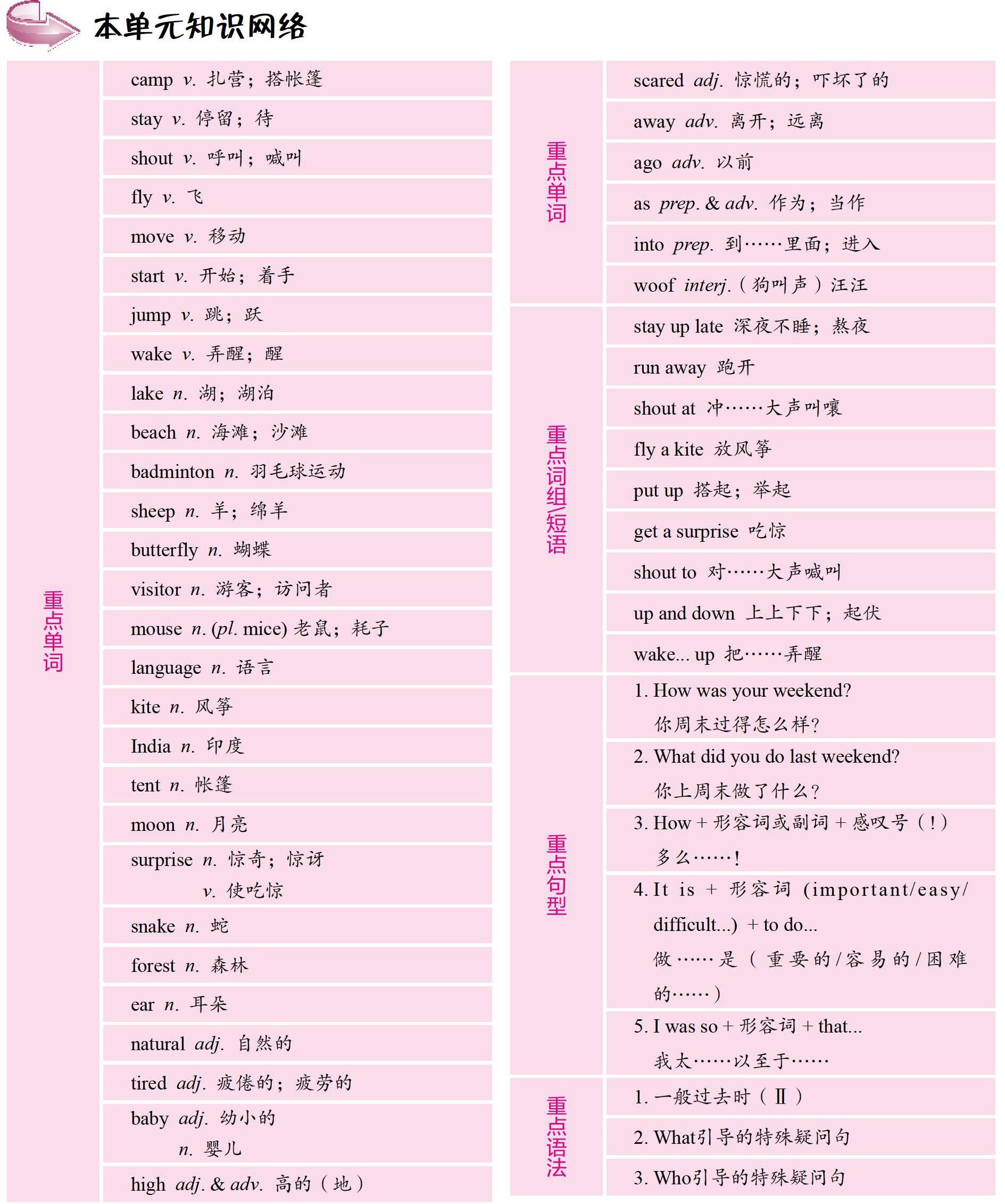
1. Well, on Saturday morning, I played badminton.
嗯,星期六早上我打了羽毛球。
(1)on表示在某一天或某一天的某段時間。
on Monday ?在周一
on Sunday afternoon ?在周日下午
on March 7th, 2015 ?在2015年3月7日
on Christmas Day ?在圣誕節這一天
(2)in表示在某年、某季節、某月、某周和泛指在上午、下午、晚上。
in 2016 ?在2016年 in spring ?在春季
in September ?在九月 in a week ?在一周中
in the morning/afternoon/evening ?在上午/下午/傍晚
(3)at表示某個具體時刻。
at 8 oclock ?在8點鐘 at noon ?在中午
at the moment ?現在 at that time ?在那時
2. I worked as a guide at the Natural History Museum.
我在自然歷史博物館當向導。
as ?prep. ?作為;當作
(1)as后可以接職業、用途、特點等。
English is spoken as the first language by most people in Australia.
在澳大利亞,大多數人把英語作為第一語言。
(2)as用在句首時,這種短語的后面往往有逗號與語句的主體隔開。
As a writer, he was famous.
作為一名作家,他曾經很有名。
3. How interesting!
多么有趣啊!
How引導的感嘆句的結構是:How + 形容詞或副詞 + 主語 + 謂語 + 感嘆號。在口語中,常常省略感嘆句的主語和謂語。
How clever the girl is!
那個女孩多聰明啊!
How fast he runs!
他跑得多么快啊!
4. —Who visited her grandma?
誰去看望了她奶奶?
—Becky did.
貝姬(去看望了她奶奶)。
在英語中,可以用do的適當形式(do,does,did,dont,doesnt,didnt)代替上文出現的動作。
該句是一個省略句, did代替了上句中的行為動作,目的是避免重復上文中的行為動詞。完整回答是:Becky visited her grandma. ?貝姬看望了她奶奶。
5. Father Mouse shouted at the cat, “Woof, woof !”
老鼠爸爸沖著貓大聲吼叫:“汪汪,汪汪!”
shout ?v. ?呼叫;喊叫
shout at/to sb ?朝某人叫
比較:shout at sb和shout to sb
shout at sb多指因為生氣等而非善意地對某人吼叫;shout to sb多指因距離遠而不得不大聲叫喊(否則對方無法聽見),不帶生氣等感情因素。
He was so angry that he shouted at everyone there.
他很生氣,沖著在那兒的每個人大聲叫嚷。
He shouted to me to come over to help.
他大聲叫我過去幫忙。
6. Well, son, thats why its important to learn a
second language.
所以嘛,兒子,這就是為什么學習第二語言很重要。
句型:It is + 形容詞 + to do sth.
用于此句型的形容詞有:easy,hard,difficult,important,useful,good,bad,exciting,interesting等。
It is useful for me to learn a foreign language.
對我來說,學一門外語是很有用的。
It is not easy for her to do so much work in a day.
對她來說,一天干這么多活是不容易的。
It is important for them to arrive on time.
對他們來說,準時到達很重要。
GRAMMAR FOCUS
一般過去時(II)
一般過去時常和表示過去的時間狀語連用,如yesterday,yesterday morning(afternoon,evening),last weekend(year,week,month),in 1992,two weeks ago。
They often went to work by bike last year.
他們去年常常騎自行車去上班。
一般過去時的句型
(1)含 be動詞過去時的句型:
① 肯定句:主語 + was/were + 其他.
② 否定句:主語 + was not/were not(wasnt/werent)+ 其他.
③ 一般疑問句:Was/Were + 主語 + 其他?(其肯定回答用 “Yes, 主語 + was/were.”;否定回答用“No, 主語 + wasnt/werent.”)
④ 特殊疑問句:疑問詞 + was/were + 主語 + 其他?
(2)含實義動詞過去時的句型:
① 肯定句:主語 + 動詞過去式 + 其他.
② 否定句:主語 + did not (didnt) + 動詞原形 + 其他.
③ 一般疑問句:Did + 主語 + 動詞原形 + 其他?(其肯定回答用 “Yes, 主語 + did.”;否定回答用“No, 主語 + didnt.”)
④ 特殊疑問句:疑問詞 + did + 主語 + 動詞原形 + 其他?
活學活用
完成譯句。
1. 我上周末去了博物館。
I ____ ?____ the museum last weekend.
2. 珍妮喜歡看書。昨晚她看了一本英語書。
Jenny likes ____ . She ____ an English book last night.
3. 艾瑪每天都看電視, 可是昨天她沒有看。
Emma ____ TV every day. But she ____ ?____ it yesterday.
4. 他們上周六去購物了。
They ____ ?____ last Saturday.
5. 昨天露西的父親不在家。
Lucys father ____ ?____ ?____ yesterday.
Section B
1. My sister finished high school two weeks ago.
兩周前,我姐姐高中畢業了。
與一般過去時連用的常見時間狀語有:yesterday,last night,two days ago,the day before yesterday等。
He was in the room yesterday.
他昨天在房間里。
He watched TV last night.
他昨晚看了電視。
2. There we put up our tents and made a fire to
keep us warm and cook food on.
在那里我們架起帳篷,生火取暖并做飯。
put up tents ?搭建帳篷
make a fire ?生火
keep sb warm ?使某人暖和
cook food on the fire ?在火上做飯
3. But I was so tired that I went to sleep early.
但是我太累了,所以早早就去睡覺了。
so... that... ?如此……以至于……
so是副詞,常常用來修飾形容詞或副詞。
常用句型為:主語 + 謂語 + so + 形容詞/副詞 + that從句。
The boy ran so fast that I couldnt catch him.
那個男孩跑得太快了,我追不上他。
He was so angry that he couldnt say a word.
他氣得說不出話來。
4. The next morning, my sister and I got a terrible
surprise.
第二天早上,我和姐姐大吃了一驚。
(1)surprise ?n. ?驚奇;驚訝
I have a surprise for you: We are moving to Switzerland!
我要告訴你一件意想不到的事:我們要搬到瑞士去!
(2)surprise ?v. ?使吃驚
His coming surprised me.
他的到來令我感到詫異。
5. ... we saw a big snake sleeping near the fire.
……我們看見一條大蛇正在篝火附近睡覺。
在see,hear,feel,watch等表示感官的動詞后,既可用動詞-ing構成復合賓語,也可用不帶to的動詞不定式構成復合賓語,其結構為:v. + sb + do/doing sth。
比較:see sb do sth和see sb doing sth
see sb do sth表示“看到某人做了某事”,指動作已發生;see sb doing sth表示“看到某人正在做某事”,指動作在進行當中。
I saw you put the key in your pocket.
我看見你把鑰匙放進了你的口袋里。
I looked out of the window and saw some boys playing basketball in the playground.
我往窗外望去,看見一些男孩正在操場上打籃球。
活學活用
從方框中選擇適當的詞,并用其正確形式填空(每詞限用一次)。
wake anything surprise move sheep
6. Did you find ____ interesting in the book?
7. I can feel the train ____ now.
8. There are quite a lot of ____ on the farm.
9. Mom ____ me up at six this morning.
10. She got a ____ when she saw the snake.
單項選擇
( ) 1. My uncle worked ___ a farmer on a farm two years ago.
A. for B. of
C. as D. with
( ) 2. —Who cleaned the classroom yesterday, Dick?—John ___ .
A. cleans B. does
C. did D. was
( ) 3. He went to Shanghai ___ September 3, 2018 and came back ___ a cold morning last year.
A. in; on B. on; on
C. on; in D. in; in
( ) 4. ___ well you sing but ___ badly he dances!
A. How; how B. What; what
C. How; what D. What; how
( ) 5. It ___ visit different places.
A. are exciting B. are exciting to
C. is exciting D. is exciting to
單詞拼寫
1. How high can you j_____, Lisa?
2. The water in the l_____is very clean.
3. The cat got two m_____in the kitchen.
4. When did you s_____to read it?
5. Tigers live in the f _____.
用所給詞的適當形式填空
1. My cousin can speak three _____(language).
2. There are two hundred _____(sheep) on the farm.
3. The _____(visit) comes from the USA.
4. We _____(camp) by the river yesterday.
5. Dont _____(move) the things on my desk.
按要求完成句子
1. They went to the supermarket yesterday afternoon.(改為否定句)
They _____to the supermarket yesterday afternoon.
2. It made them feel happy.(改為一般疑問句)
_____it_____them feel happy?
3. Does your mother watch TV every evening?(用last night改寫句子)
_____your mother_____TV last night?
4. Jim went to the movies with his cousin.(對畫線部分提問)
_____Jim go to the movies with?
5. They went to a bookstore last Saturday.(對畫線部分提問)
_____they go last Saturday?
6. 我哥哥經常熬夜看電影。(完成譯句)
My brother often _____ to watch movies.
7. 喬,你會搭帳篷嗎?(完成譯句)
Joe, can you _____a tent?
8. 安靜點!別吵醒你妹妹。(完成譯句)
Be quiet! Dont _____your sister_____.
9. us, the, around, guide, showed, museum, the(連詞成句)
__________.
10. do, you, Friday, what, last, did(連詞成句)
__________?
補全對話(有兩項多余)
A: Hi, Lucy. ? ? ? ?1
B: It was great. I went to the old peoples home.
A: Really? ? ? ? ?2
B: I went with Tom and Lisa.
A: What did you do there?
B: ? ? ? ?3 ? ? ? ?We helped the old people clean their rooms, played games with them and told them stories.
A: Wow! How interesting!
B: ? ? ? ?4 ? ? ? ?Where did you go?
A: I didnt go anywhere.
B: ? ? ? ?5
A: Because I had to study for the English test.
B: I see.
A. Who did you go with?
B. The weather was good.
C. We went there by bike.
D. Why didnt you go out?
E. Yeah, we had lots of fun.
F. Oh, we did lots of things.
G. How was your weekend?
1. ? ? ? ? ? ? ? ?2. ? ? ? ? ? ? ? ?3. ? ? ? ? ? ? ? ?4. ? ? ? ? ? ? ? ?5.
閱讀理解
A
Dear Grandma,
How are you? Last Saturday I went to Long Bay with my parents. We got up at 6:00 am. We ate breakfast at 6:30 am and after half an hour we left for Long Bay. My father is a good driver and he drove very fast. The trip was a bit long. When we got out of our car and got to Long Bay, it was already ten oclock!
First we swam in the water for an hour. Then we played cricket (板球) for an hour. It was time to have lunch. We ate a big lunch in a restaurant. In the afternoon my mother and I enjoyed the sunshine on the beach. My father went fishing. Soon it was time to go home. My parents and I left Long Bay. We had a great day last Saturday.
My parents and I will go to see you this weekend. I miss you very much.
Kate
( ) 1. When did Kate leave home?
A. At 6:00 am. B. At 6:30 am.
C. At 7:00 am. D. At 7:30 am.
( ) 2. How did Kate go to Long Bay?
A. By bus. B. By car.
C. By train. D. By plane.
( ) 3. How long did it take Kate to get to Long Bay?
A. An hour. B. Two hours.
C. Half an hour. D. Three hours.
( ) 4. What did Kates father do in the afternoon?
A. He went fishing.
B. He played cricket.
C. He went swimming.
D. He enjoyed the sunshine.
( ) 5. Which of the following is TRUE about Kate?
A. She didnt swim in the water.
B. Her father didnt have lunch.
C. Her mother was good at driving.
D. She will see her grandma this weekend.
B
Dear Julie,
Last weekend was a busy time for our family. On Saturday my parents went shopping for clothes at the mall. My brother Gray played basketball with his friends. My sister Gina stayed at home in the morning and played the piano. I stayed at home, too. I studied for a math test. In the afternoon I went to the beach. On Saturday evening, my family and I had dinner at home. Then we went to the movies.
On Sunday morning, my family stayed at home. My sister and I cleaned our room, and my brother played computer games. In the afternoon my grandparents visited us. We were happy to see them. They stayed at our house for dinner. After dinner, we watched TV. I was tired on Sunday night. I went to bed early.
David
根據短文內容,判斷正(T)誤(F)。
( ) 6. David stayed at home on Saturday morning.
( ) 7. Julie is Grays sister.
( ) 8. On Saturday evening David and his family went to the movies.
( ) 9. Gray cleaned his room on Sunday morning.
( ) 10. David went to visit his grandparents on Sunday afternoon.
完形填空
One year, when I was teaching second-grade students, a child was late1class. I was not very happy. He didnt say2 , but came over to me and said with a smile, “Mrs Johnson, my name is Daniel. I3a short letter for you from my old teacher,4its not on the paper,” said the little boy.
“ 5is it?” I asked him. “Its in my6 . She wanted me to tell you how lucky you were to have me in your7 !” I smiled, and then I said, “I have one in my head, too. And she wanted me to8you something, too.” “Really? What is9 ?” “How unlucky you were to have a teacher like me!” I said. “Now you are late. Please stand and10me in class.”
( ) 1. A. in B. after C. before D. for
( ) 2. A. hello B. sorry C. goodbye D. thanks
( ) 3. A. wrote B. left C. ?took D. had
( ) 4. A. but B. and C. or D. so
( ) 5. A. How B. Who C. Where D. What
( ) 6. A. head B. nose C. hair D. mouth
( ) 7. A. family B. office C. ?class D. school
( ) 8. A. ask B. show C. tell D. know
( ) 9. A. he B. she C. this D. it
( ) 10. A. talk with B. listen to C. ask for D. go with
選詞填空
閱讀短文,從方框中選擇適當的詞,并用其正確形式填空(每詞限用一次)。
shop clean watch busy play
study have see am movie
Dear Julia,
My family were very1last weekend.
On Saturday morning, my parents went2 . My brother Henry3basketball with his friends. I4for my math test at home. In the afternoon, I went to the beach. On Saturday evening, my family5dinner together. Then we went to the6 .
On Sunday morning, my brother and I7our rooms. ?In the afternoon my grandparents visited us. We were happy8them. They ate dinner with us. After dinner, we9TV. At 8:30 pm, I went to bed because I10a little tired.
Love,
Zhang Yi1.?2.?3.?4.?5.
6.?7.?8.?9.?10.
書面表達
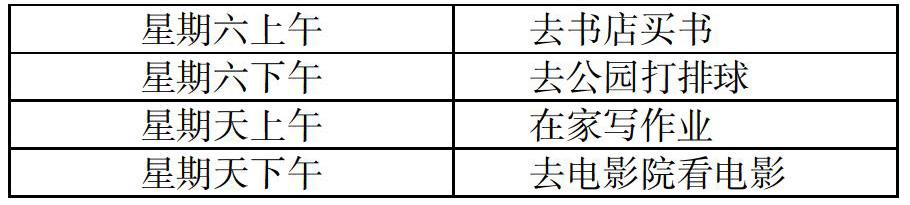
假如你是王娟,請根據表格提示,寫一篇 60 詞左右的英語短文,向同學介紹你上周末的活動,可適當發揮。